
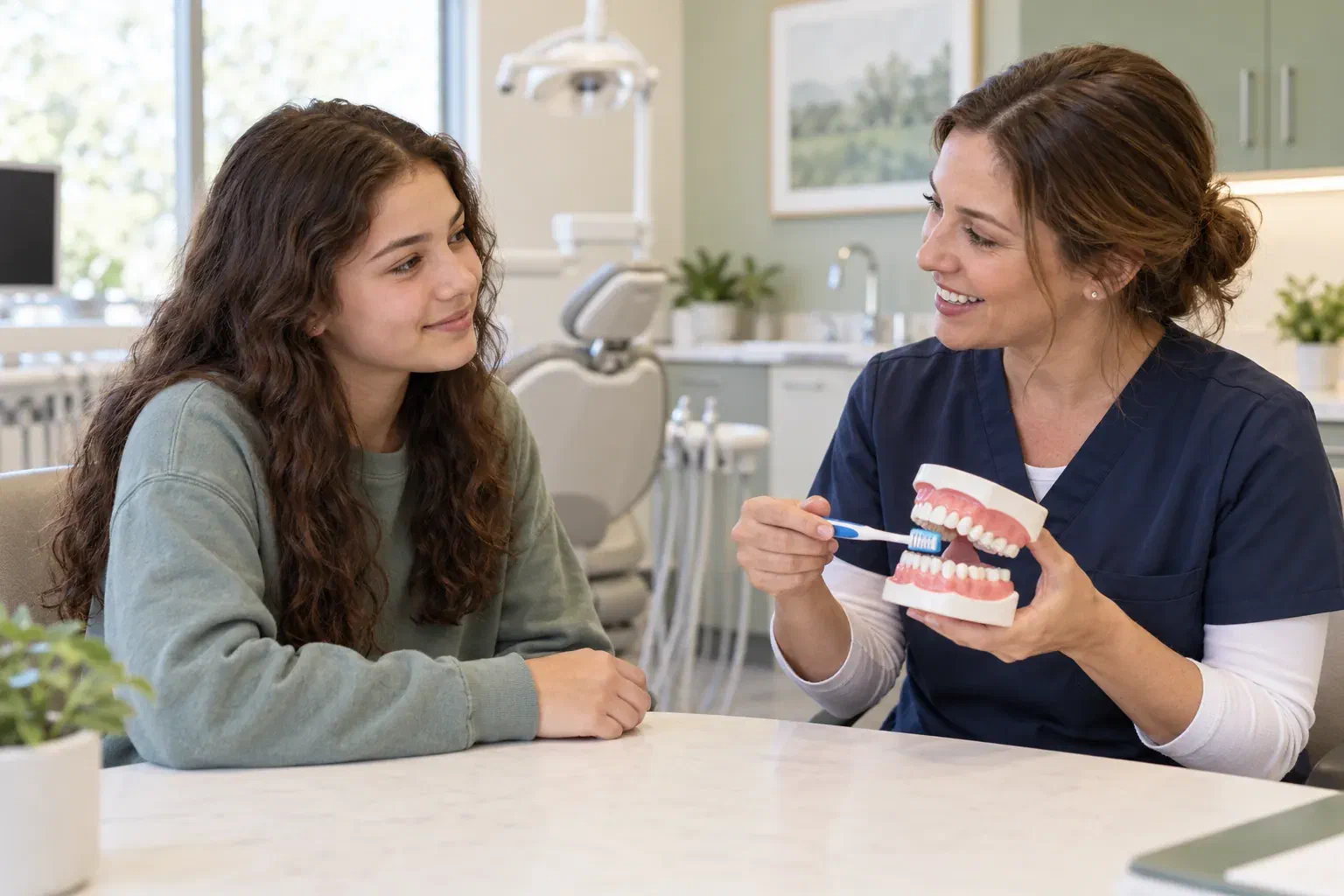
The teenage years often change who manages dental care. A parent may still book appointments, but the teenager is increasingly responsible for brushing, choosing drinks, remembering an appliance, and speaking up when something hurts. That shift works best when responsibility grows alongside practical knowledge, rather than arriving as a sudden expectation to manage everything alone.
Dental care for teenagers in Milton should fit school, work, sport, friendships, and changing independence. It also needs room for questions about appearance, braces, wisdom teeth, and habits a young person may find awkward to discuss. A useful appointment gives the teenager a voice and leaves them understanding what to do next, with support available where it is still needed.
Start by asking what the teenager wants help with
Before an appointment, invite the teenager to name one or two concerns in their own words. They might be worried about breath, a tooth that looks different in photographs, a mouthguard that feels bulky, or bleeding around a bracket. The concern that motivates them may differ from the one a parent would raise first.
Write those questions down or save them in a phone note. During the visit, give the teenager time to describe the issue directly. A parent can add helpful history afterward without turning the whole conversation into a report about the teenager while they sit beside it.
If a topic feels private, ask the practice how a separate conversation can be arranged and how confidentiality and consent are handled. Do not assume that the patient understands these arrangements automatically. Clear explanations make it easier to ask honest questions and understand who will receive information about the visit.
Build a routine around the busiest ordinary day
The Canadian Dental Association recommends brushing twice daily with fluoride toothpaste, cleaning between teeth each day, and attending dental reviews. These basics remain relevant during adolescence, even when the timetable becomes less predictable. CDA guidance on teen oral health.
Ask which part of the routine is most likely to disappear. It may be the morning after a late night, the evening after practice, or time spent at another household. Solve that specific problem: put supplies where they are used, keep a second kit where needed, or link brushing with a reliable part of the evening before tiredness takes over.
Let the teenager help choose workable tools. A brush that is comfortable to hold and a toothpaste they can tolerate are more useful than products selected only because an adult likes them. If taste, texture, sensory discomfort, or hand movement makes care difficult, discuss that with the dental team instead of interpreting every missed session as lack of effort.
Make technique visible rather than assuming it is understood
Knowing that brushing matters is different from knowing how to reach every surface. Ask the hygienist or dentist to demonstrate around the teenager’s own problem areas and then let the teenager try. A short, specific correction can be easier to remember than a long lecture about brushing better.
The same applies to cleaning between teeth. Ask which method suits the available spaces and any appliances. If the suggested tool is awkward, say so during the demonstration. It is better to discover that difficulty while someone can help than to take the product home and leave it unused.
Agree on a small number of priorities after the visit. For example, the plan may focus on one area that is regularly missed and one point in the day when care is being skipped. Avoid changing several products and habits at once unless the clinical situation requires it; the teenager should be able to explain the plan back in straightforward terms.
Coordinate braces, aligners, and general dental care
Braces can make cleaning more demanding because plaque and food collect around the appliance. The CDA recommends learning appropriate techniques and tools from the dental or orthodontic team. CDA advice on caring for teeth with braces.
Ask which appointments belong to the orthodontist and which belong to the general dental practice. An adjustment visit does not automatically replace other dental care. Keep both teams informed if a bracket breaks, an aligner no longer fits, or soreness makes cleaning difficult.
For removable appliances, make the case part of the daily kit. Decide where it goes during lunch or sport rather than wrapping an appliance in a napkin and hoping it will be remembered. Follow the treating team’s wear and cleaning instructions, and ask before changing the schedule to accommodate an event. If an appliance is lost, contact the team for the next step instead of improvising a replacement.
Talk about drinks without turning every meal into a dispute
Frequent sugary drinks and snacks can contribute to tooth decay because oral bacteria use sugars to produce acids. Fluoride and regular plaque removal support prevention, while repeated sugar exposures can make the balance harder to maintain. NIDCR explanation of the tooth decay process.
Discuss the pattern rather than labelling a teenager’s diet as good or bad. Does a sweet drink last through several classes? Is a snack replacing lunch? Are food choices limited by work hours, braces discomfort, or what is available nearby? These details give the dental team a more useful starting point than a vague instruction to stop eating sugar.
Choose realistic changes together, such as keeping water available and reducing prolonged sipping of sweet drinks. Ask for individualized advice if sports nutrition, a medical condition, or difficulty eating complicates the situation. Dental advice should fit adequate nutrition and overall health, not encourage skipped meals or restrictive eating.
Check sports protection as the mouth changes
A mouthguard can help protect the teeth and mouth during activities involving collisions or falls. Fit matters, and teenagers with braces should ask the dentist or orthodontist about an appropriate option. CDA information on sports and teen oral health.
Check the guard before the season begins rather than on the way to the first game. Ask the teenager whether it stays in place, causes discomfort, or interferes with communication. A guard that sits unused in a bag provides no practical benefit, so discomfort is a problem to solve rather than a reason to abandon protection.
Keep the guard clean and stored according to its instructions, and arrange a review if teeth are moving or its fit changes. Do not trim it casually to make room for brackets. If an injury occurs, explain the symptoms to a dental professional even when the guard was being worn; protective equipment does not rule out an injury.
Give appearance questions a proper assessment
Social media can make whitening, tooth gems, and rapid smile changes look simple. Ask the teenager what result they want and what they have already tried. A concern about one darker tooth, uneven edges, or a gap deserves an assessment before choosing a cosmetic product or treatment.
Bring the product name or a screenshot of the proposed method to the appointment. Ask what it contains, what evidence supports it, whether it is appropriate for the teenager’s mouth, and what could go wrong. Avoid home experiments involving filing teeth, household chemicals, or improvised tooth movement.
If the concern is mainly how teeth appear in photographs, leave space for that conversation without immediately promising treatment. The dentist can explain the difference between a health issue, normal variation, and an optional cosmetic change. Understanding those distinctions helps the teenager make a more informed decision rather than treating an online trend as a clinical need.
Discuss vaping, piercings, and other habits honestly
The CDA advises telling the dental team about smoking, vaping, or cannabis use so oral changes can be assessed and appropriate support offered. It also identifies tooth and gum injury and infection as concerns with oral piercings. CDA teen oral-health guidance.
A useful discussion is specific and free of guessing. Explain what is used, how often, and whether symptoms have changed. If the teenager wants help stopping a habit, ask which professional or service can provide support and how to make contact. Do not expect a dental examination alone to solve every aspect of dependence or behaviour.
Parents can make help-seeking easier by responding calmly when a concern is disclosed. The immediate priority is understanding any symptoms and arranging suitable care. Questions about rules or consequences can be addressed without making the teenager afraid to report pain, swelling, or another change in the future.
Take persistent symptoms seriously
Ask for an assessment if bleeding, sensitivity, pain, a sore area, or difficulty chewing persists. Do not assume that discomfort is simply part of growing up or wearing braces. Tell the practice whether it affects sleep, meals, school attendance, or appliance use so the concern is communicated clearly.
Wisdom teeth may become part of the conversation as the teenager gets older. Ask what the examination shows, whether monitoring or further assessment is needed, and what symptoms should prompt contact. A friend’s extraction experience does not establish what will be recommended for another teenager.
If anxiety makes the appointment difficult, discuss it before treatment begins. The teenager can ask how to request a pause and how findings will be explained. Being able to participate in the appointment is part of learning to manage healthcare, not a skill that should be assumed to appear automatically with age.
Prepare for the transition to adult responsibility
Gradually involve the teenager in booking, remembering appointment dates, updating medical information, and understanding estimates. A parent may still provide practical support, but explaining these tasks prepares the young person for times when they will manage care independently.
Before a move for school or work, ask what records and follow-up information should go with them. Keep the current appliance instructions and the date of the next recommended review available. If plans change, help them arrange continuity rather than letting uncertainty about a new location become a long break in care.
For teenage dental care in Milton, call Milton Dental Clinic at (905) 876-4488 or contact the team. Bring the teenager’s own questions alongside the relevant health history. A practical, respectful visit can support both healthier habits now and greater confidence managing dental care in the years ahead.
