
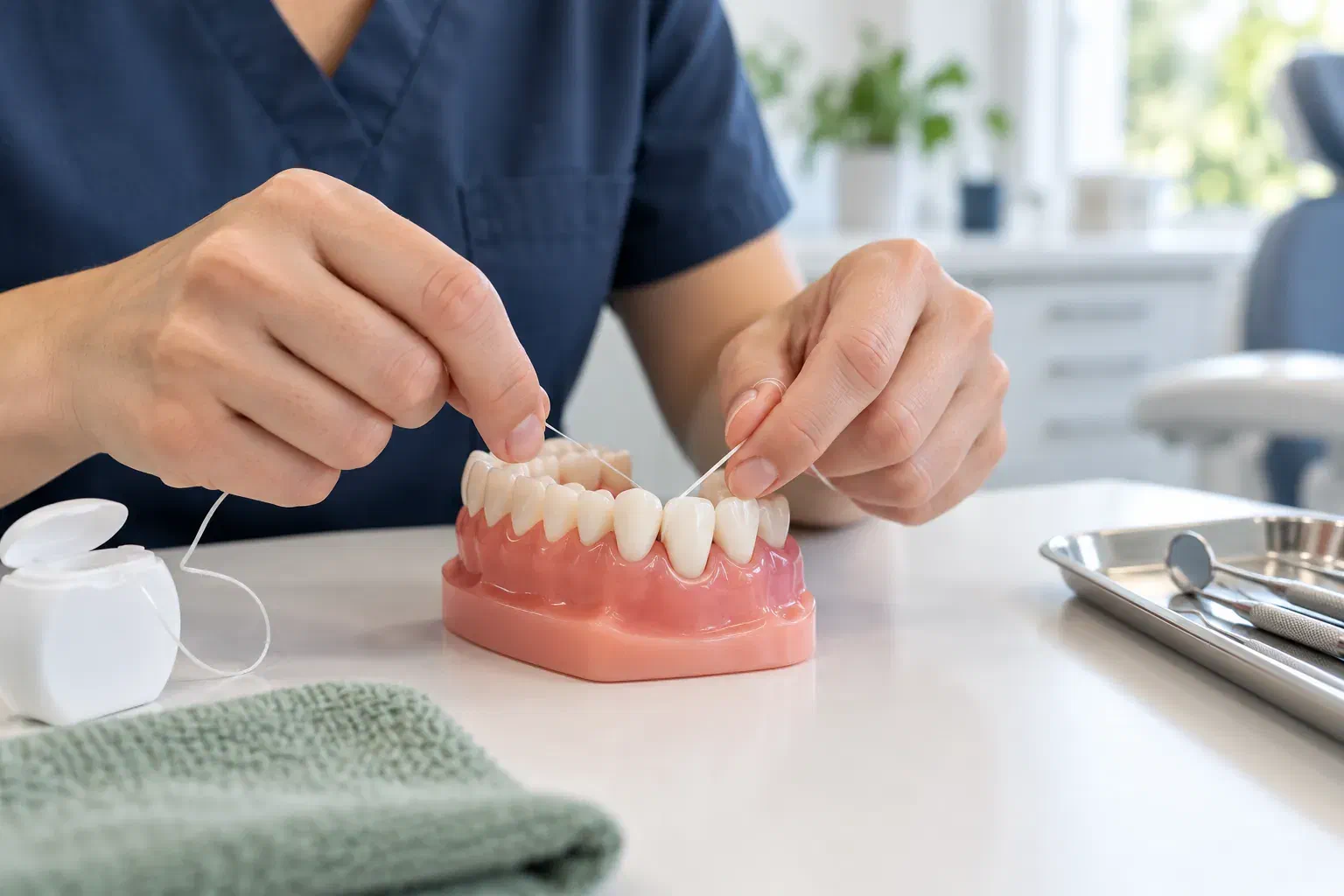
Many people understand that cleaning between their teeth matters but still find flossing awkward. The thread slips, a back tooth is difficult to reach, or the routine is forgotten until the next dental appointment. These are practical problems that can be addressed without turning oral care into a daily source of frustration.
Good flossing advice in Milton should begin with what is difficult for you. The goal is to clean the sides of the teeth comfortably and consistently, using a method that suits your mouth and hands. Learning one useful adjustment can do more than repeatedly trying the same uncomfortable technique with greater determination.
Know what floss is trying to reach
A toothbrush does not fully clean the surfaces where neighbouring teeth meet. Floss is one way to reach those areas and disrupt plaque before it hardens. The NIDCR explanation of flossing describes this as the central purpose of cleaning between teeth, while noting that hardened calculus requires professional removal.
This makes flossing more than a way to remove a piece of food after lunch. An area can benefit from cleaning even when nothing obvious is stuck there. Think about contacting the side of each tooth rather than simply passing a thread through a gap and pulling it out again.
If you are unsure which surfaces need attention, ask the hygienist to demonstrate on a model and then show you in your own mouth. Seeing the difference between cleaning a space and cleaning both tooth surfaces can make the movement easier to understand.
Choose a time you can actually keep
The American Dental Association’s patient guide recommends cleaning between teeth once daily and emphasizes a thorough, regular habit rather than a particular time of day. If you are consistently too tired before bed, a different time may be easier to maintain.
Link the task to something predictable, such as the evening bathroom routine or a quiet part of the morning. Keep the floss where it is easy to find. If it lives in a drawer behind several rarely used products, move it to a place that reminds you of the routine without cluttering the sink.
If you miss a day, return to the normal routine rather than trying to compensate by flossing aggressively. The useful question is what made the step difficult to remember. Adjust the cue or timing so that the next day is easier, instead of treating one missed occasion as a reason to abandon the habit.
Learn the movement slowly
Begin with enough floss to hold a short section securely between your fingers. Guide it gently through the contact between two teeth, avoiding a sudden snap into the gum. Once through, curve it around the side of one tooth and move it along that surface, then repeat against the neighbouring tooth. The Canadian Dental Association’s flossing guidance describes this curved, controlled approach.
Use a fresh section as you move along and work through the mouth in a consistent order. Include the back surface of the last tooth where accessible. The aim is controlled contact with the tooth, not sawing deeply into soft tissue or testing how far the thread can be forced.
Practise on an easier-to-reach area while learning. Once the hand position feels familiar, ask for help adapting it to the back teeth. A demonstration is most useful when the clinician watches you try the movement and can identify exactly where control is being lost.
Let tight contacts guide the choice of tool
If floss is difficult to pass between particular teeth, tell the dental team which contacts are involved. Ask whether a different type of floss or another method is suitable. The answer may differ from one part of the mouth to another, so a single product does not have to solve every space equally well.
Avoid pulling so hard that the floss suddenly cuts into the gum. If it repeatedly shreds, catches, or becomes stuck at the same location, have that area assessed. Do not use a sharp household object to free trapped material or assume the difficulty is something you must simply tolerate.
Bring the product you currently use to the appointment if you can. A recommendation is easier to tailor when the clinician sees the thickness, texture, and way you hold it. You can then test a suggested alternative before buying a collection of products that may not address the problem.
Make the back teeth less of a guessing game
Many people spend most of their effort on the front teeth because they are easier to see. Ask for a demonstration of hand positions for the back areas and discuss whether a holder would help. A different approach may reduce the need to stretch the cheek or open wider than is comfortable.
Use a consistent route through the mouth so you do not repeatedly return to an easy area while missing a difficult one. You might complete one arch before moving to the other. Choose a sequence that is easy to remember rather than changing direction whenever the next space feels awkward.
If jaw discomfort or a strong gag reflex limits access, explain that. The technique can be reviewed alongside the reason for discomfort. You should not need to hold the mouth open until it hurts simply to prove that you have completed a routine correctly.
Understand bleeding without dismissing it
Bleeding during cleaning deserves attention to both technique and gum health. Ask whether you are applying too much force and whether the gums show inflammation that needs care. Do not assume that every episode is caused by the floss, or that bleeding means you should permanently avoid the area.
The NIDCR gum-disease guide includes bleeding, swelling, tenderness, and persistent bad breath among signs that should be assessed. An examination can identify whether home-care changes, professional treatment, or another response is appropriate.
If bleeding persists, is substantial, occurs spontaneously, or comes with pain, swelling, or a loose tooth, contact the practice. Tell the clinician about relevant medicines and health changes. Do not stop prescribed medicines on your own to make flossing easier; any medication decision needs the appropriate professional advice.
Work around restorations deliberately
A crown, bridge, implant, or fixed retainer can change the route a cleaning tool needs to take. Ask the dentist or hygienist to demonstrate the method for each type of work you have. Ordinary floss passed straight down may not reach every area beneath a connected restoration or wire.
If a threader, special floss, or another tool is recommended, ask where it enters, which surfaces it should contact, and how it is removed. Practise before leaving. A small diagram or written note can help when you try the routine later without someone beside you.
Do not force a tool under a restoration or repeatedly tug at a point where it catches. Report new difficulty after dental work or a change in how an appliance feels. The aim is to clean safely around what is present, not to adapt an unsuitable technique by using more pressure.
Use a holder or another aid when it helps
String floss is not the only way to clean between teeth. NIDCR describes alternatives such as floss holders, interdental brushes, and water flossers when the usual technique is difficult. The right choice depends on the spaces, dental work, and what you can use effectively.
If hand movement or grip is the main barrier, test how a holder feels rather than judging it only by appearance. Ask whether it can reach the areas you need and how to keep it clean or replace it. A tool that is easier to hold still needs a technique that contacts the intended surfaces.
If you are comparing several options, ask the dental team to identify the simplest workable routine. You do not need to use every available device. A clear reason for each tool makes daily care easier to understand and reduces the chance that the routine becomes too time-consuming to keep.
Help children learn without rushing independence
The ADA advises starting between-tooth cleaning when a child has teeth that touch, with adult help until the child can manage the task effectively. Ask the dentist to demonstrate a comfortable position and an age-appropriate approach. The child should know what is about to happen and have a way to ask for a pause.
Keep the experience calm and predictable. A short explanation and a consistent sequence can be more helpful than repeated warnings about cavities. If the child is distressed or a particular area hurts, pause and seek advice rather than forcing the tool through.
As the child becomes more capable, let them practise with supervision and ask the dental team to review the result. Independence is about being able to clean safely and thoroughly, not reaching a birthday. Continue helping where needed and keep the conversation focused on learning a skill.
Keep expectations realistic
Cleaning between teeth supports oral health, but no single habit guarantees that cavities or gum disease will never occur. NIDCR discusses limitations in long-term flossing research while supporting interdental cleaning as a practical way to reach surfaces a brush misses. Avoid judging the entire routine by whether one appointment finds a problem.
Ask what the examination shows about the areas you are cleaning. If plaque remains in a particular location, request a targeted adjustment. If the technique is effective, keep it simple rather than changing products every time you see a new advertisement.
Professional reviews still matter because home care cannot remove established calculus or diagnose every problem. Your dentist can help decide the right interval for visits and whether a symptom needs earlier attention. The routine and the examination serve related but different purposes.
Bring one concrete question to your next visit
Choose the part you most want help with: floss that slips, a difficult back contact, bleeding, a fixed retainer, or a routine you cannot sustain. Ask for a demonstration that addresses that exact issue. A small, specific improvement is easier to practise than a long set of general instructions.
To discuss flossing advice in Milton, contact Milton Dental Clinic or call (905) 876-4488. Bring your current cleaning tool and explain what happens when you use it. The aim is a comfortable daily method that reaches the right surfaces and fits naturally into the rest of your oral care.
