
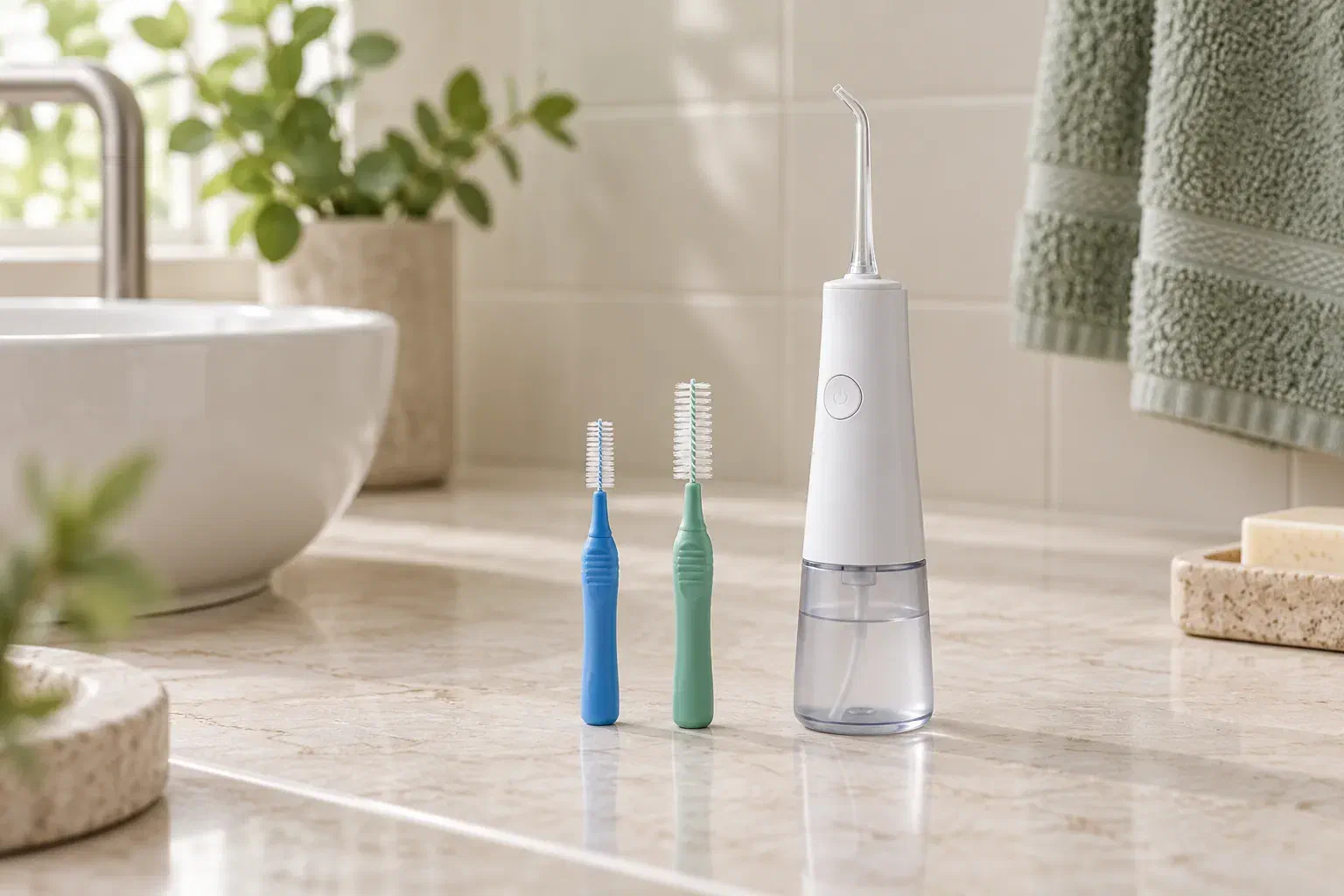
The oral-care aisle can turn a straightforward goal into a complicated shopping decision. Small brushes come in several colours and shapes. Water flossers have different pressure settings, reservoirs, and tips. Packaging may suggest that one purchase will transform your routine, but the useful question is more personal: which tool helps you clean the spaces you currently miss?
For someone comparing interdental brushes and water flossers in Milton, a demonstration can be more valuable than a long list of product features. Your tooth spacing, dental work, hand movements, and daily schedule all affect what is practical. A device that suits another family member might be awkward for you. This guide explains how to approach that choice without assembling an expensive collection of tools you rarely use.
Begin with the places that need attention
Before discussing a product, ask your dental professional to show you where your current cleaning leaves plaque. A vague instruction to improve hygiene is difficult to act on. Knowing that you consistently miss a particular back-tooth space gives you a specific problem to solve.
It helps to describe what happens at home. Perhaps string floss reaches your front teeth easily, but your hands cannot comfortably reach the back. Perhaps an open space catches food, or you are unsure how to clean under a bridge. Bring the tool you already own, or a photograph of its packaging, so the conversation starts with your actual routine.
You do not need to choose one method for every space. Ask whether your mouth needs a combination, and have the clinician identify where each item belongs. A simple drawing or brief written note can be easier to remember than several instructions delivered while you are lying in the dental chair.
What an interdental brush does
An interdental brush has a small bristled head intended to clean suitable spaces between teeth. It differs from the full-sized toothbrush you use on the outer, inner, and chewing surfaces. The NHS notes that these brushes can be useful where there are gaps and that the brush should fit snugly. A dental professional can help determine an appropriate fit. NHS guidance on cleaning between teeth.
Size is therefore a functional choice, not simply a preference for one handle colour. Ask to try the recommended size during a demonstration rather than guessing from a display shelf. If several sizes are suggested, record the product name and size information for each location. Colours can vary between manufacturers, so a colour alone may not be enough when buying replacements.
Do not force a brush into a space that will not accept it comfortably. Stop if the wire repeatedly bends or the movement hurts, and ask for the fit and direction to be reviewed. A smaller brush is not automatically effective everywhere either; the purpose of professional sizing is to find suitable contact without excessive pressure.
Make the handle work for your hands
Some people find a longer handle easier to hold, while others prefer a shorter one. An angled design may feel different when approaching a back tooth. These are reasons to compare how a tool behaves in your hand rather than judging only the brush head in a photograph.
Try the movement in front of a mirror while someone checks your technique. Ask where to rest your hand and how much mouth opening is helpful. If arthritis, tremor, or limited finger movement makes gripping difficult, say so directly. Advice should account for that limitation instead of assuming that more effort will solve it.
Once the fit is established, follow the product’s care and replacement instructions. Keep the packaging until the routine feels familiar. A brush with damaged bristles or a distorted wire should not become a permanent fixture simply because it is the last one in the drawer. Add replacements to a regular shopping list before you run out.
What a water flosser can offer
A water flosser directs a pulsing stream of water between and around teeth. The American Dental Association describes it as an option for people who find hand flossing difficult, including some people with braces or fixed bridges. Devices with the ADA Seal have been evaluated for safety and effectiveness for their accepted claims, including plaque removal and reducing gingivitis. That does not mean every device on sale has the same evidence. ADA information about water flossers.
Before purchasing, consider whether you can comfortably fill, hold, and empty the device. A countertop reservoir and a cordless unit create different practical demands. Storage space, charging arrangements, and replacement-tip availability may matter more to daily use than the number of advertised modes.
A useful demonstration includes the ordinary details: positioning yourself over the sink, placing the tip before turning the unit on, controlling splashing, and turning it off before removing it. Follow the manufacturer’s instructions for your particular model and ask your dental team which settings and tips suit your mouth.
Start with control rather than maximum pressure
The strongest setting is not a target that everyone needs to reach. Learn how to direct the water comfortably and consistently using the starting settings recommended for your device and your dental situation. Pain is a reason to reassess, not a sign that cleaning is becoming more effective.
If you recently had surgery, have a healing extraction site, or are receiving treatment around an implant, check with the treating clinician before directing a jet into the area. Ordinary daily-care instructions may not apply during healing. Keep any temporary instructions separate from your long-term routine so you know when to ask for an update.
Use only liquids and additives approved for the device and recommended for your circumstances. Do not assume that adding a strong mouthwash makes it better. The reservoir and tip also need care; consult the manufacturer’s cleaning instructions rather than improvising with household chemicals or leaving water standing indefinitely.
Understand what the tool is replacing
A new cleaning device should have a defined job. Ask whether it is being recommended instead of a method you cannot manage, alongside another method for certain spaces, or as temporary help while you learn a technique. Otherwise, it is easy to buy something and remain uncertain about what the full routine should include.
Water flossing does not replace brushing. The ADA continues to recommend brushing twice daily and cleaning between teeth daily. Professional examinations and any necessary treatment also remain part of care. A pleasant clean feeling after using a device does not establish that every surface has been adequately cleaned. ADA daily-care advice.
Ask the dental team how they will assess whether the new approach is helping. For example, they may review the sites that were difficult to clean at your next appointment. That gives you a meaningful reason to practise and report problems, rather than relying only on online product reviews or the amount of debris visible in the sink.
Bridges, implants, and braces need individual instructions
Dental work changes the route a cleaning tool must take. The space beneath a bridge is different from the contact between two natural teeth. An implant restoration may require a particular approach, and an orthodontic wire adds another obstacle. The appearance of these areas in a mirror does not tell you everything about their design.
Ask the clinician who knows the restoration to demonstrate the recommended method. Have them explain what the tool should pass around, what it should not catch, and which tip or brush is appropriate. Avoid choosing solely because a package says it is suitable for dental work generally.
If an appliance or restoration feels loose, cleaning around it more aggressively is not the answer. Contact the relevant dental provider for advice. Keep track of when you first noticed the change and whether it occurs during eating, brushing, or using the new tool. Those observations are more helpful than trying to adjust the dental work yourself.
Notice discomfort without abandoning the plan
A change in routine may reveal an area you have not cleaned effectively before. Tell your dental team about bleeding, persistent tenderness, or a site that repeatedly catches the tool. Describe exactly where it happens and how long it has been occurring. Do not assume that the device itself explains every symptom.
If a specific movement hurts, stop that movement and seek advice about the area. You can still ask how to maintain the rest of your routine while the problem is assessed. The practical goal is to replace a painful or uncertain technique with a workable one, rather than choosing between forcing it and giving up altogether.
It can help to bring the device to an appointment with its tip or brush attached. A description such as “the small blue one” may not identify the product or size. Seeing the actual equipment lets the clinician correct misunderstandings about assembly, orientation, and pressure much more easily.
Compare the ongoing cost, not just the purchase price
Replacement brushes and tips, batteries or charging requirements, and product availability all affect whether a routine lasts. Before buying a water flosser, check whether replacement parts are readily available and what the warranty covers. Before committing to an interdental brush, confirm that you can identify and obtain the recommended size again.
An expensive device is not automatically the most suitable choice. Explain your budget during the consultation. Ask which part of the routine matters most for your particular problem and whether a simpler tool could accomplish it. A manageable plan that you can maintain deserves more attention than a premium feature you do not expect to use.
For shared households, discuss storage and personal components as well. Follow the manufacturer’s rules about individual tips and cleaning the unit. Clear labels and separate storage can prevent the everyday confusion of several people leaving similar-looking items beside the same sink.
Leave with a routine you can describe
Before ending the discussion, try explaining the plan back in your own words: which tool, which spaces, how often, and what should prompt a call. If that explanation becomes complicated, ask for the instructions to be simplified or written down. There is no benefit in leaving with several products but no clear sequence.
For help choosing interdental brushes or a water flosser in Milton, contact Milton Dental Clinic or call (905) 876-4488. Bring your current cleaning supplies and one or two specific difficulties. The aim is a comfortable, repeatable method suited to your mouth, with enough guidance that you know what to do when you are back at your own bathroom sink.
