
Daily dental care can become more complicated when a familiar movement is harder to coordinate or energy changes through the day. With Parkinson’s disease, the difficulty might be gripping a toothbrush, reaching the back teeth, managing a denture, or communicating discomfort during an appointment. Different people face different combinations of challenges, and the routine should reflect that variation.
Parkinson’s disease and daily dental care in Milton are best discussed as a practical partnership. The dental team needs to understand the person’s symptoms, medication schedule, swallowing needs, and preferred level of assistance. Small adjustments can then be tested in the actual routine rather than prescribed as a one-size-fits-all collection of products.
Begin with the task that has become difficult
Instead of reporting only that brushing is harder, identify where the difficulty occurs. Is it opening the toothpaste, holding the brush, turning the wrist, keeping the mouth open, or remembering which surfaces have been cleaned? The answer helps distinguish a tool problem from a timing, fatigue, or support problem.
Parkinson Canada describes motor symptoms, changes in communication, dry mouth, and chewing difficulties among factors that can affect oral care. Its guidance encourages discussing the individual’s symptoms and medication details with the dental team. Parkinson Canada dental care fact sheet.
Bring the actual brush and interdental tools to a visit. A demonstration often reveals more than a description. If the routine works well at one time of day but becomes difficult later, explain that pattern. The purpose is to adapt the process before frustration turns into repeatedly missing the same area.
Tool selection should preserve control
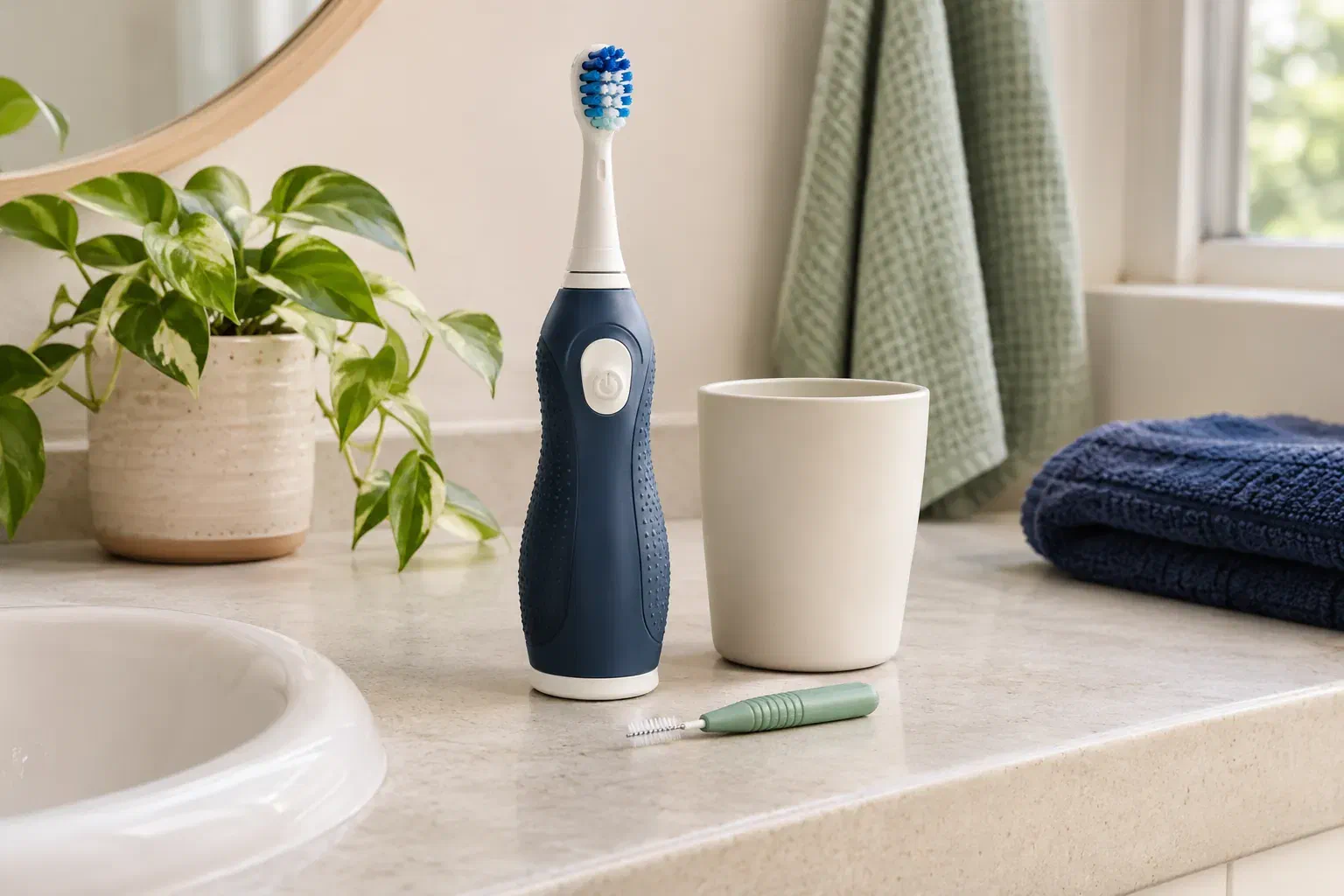
A powered brush or larger handle may be useful for some people, but convenience is individual. Consider weight, grip, vibration, the location of the switch, and the ability to change the brush head. An expensive device is not automatically easier to use when hand movement varies.
Ask the hygienist to observe how you hold and guide the brush. If an adapted grip is suggested, discuss whether it remains easy to clean and whether it interferes with the switch or charging. An occupational therapist may contribute practical advice when hand function or positioning affects several daily activities.
Choose a manageable setup at the sink. Frequently used supplies should be within comfortable reach, with enough light to identify them. If standing is tiring or balance is uncertain, discuss a safe seated arrangement with the relevant care professional. Avoid balancing on an unstable stool or leaning awkwardly simply to follow a bathroom layout that no longer works.
Cleaning between teeth needs its own demonstration
Traditional string floss may be difficult when two hands must work together in a small space. There may be other suitable aids, but the choice depends on the spaces, restorations, and ability to control the tool. Ask for a demonstration that includes the back teeth rather than only the easiest front area.
Try the recommended method while the hygienist can see what happens. A handle that seems comfortable in the hand may still be difficult to angle in the mouth. Let the team know if a tool catches, slips, or requires more force than you can comfortably manage.
Keep a note of the sizes or products that were fitted to your mouth. This reduces uncertainty when replacing them later. If someone shops for your supplies, a photograph of the packaging can be useful. The goal is a repeatable routine, not a drawer full of devices whose intended use is unclear.
Swallowing instructions come before generic mouth-care tips
If you have dysphagia or a history of choking, tell the dental team before treatment and before changing your home routine. Ordinary advice to rinse vigorously, sip extra water, or use gum or lozenges may be unsuitable. Follow the individualized plan from your swallowing or medical team and ask how dental care should fit it.
The Parkinson’s Foundation explains that impaired swallowing can affect dental treatment and that speech-language professionals may assess swallowing problems. Parkinson’s Foundation dental health information and speech and swallowing guidance.
Describe coughing during mouth care, difficulty clearing toothpaste, changes in voice after drinking, or food remaining in the mouth. These observations deserve professional attention rather than an improvised technique. If a care partner assists, have them learn the same instructions. Do not change fluid texture, positioning, or swallowing exercises based solely on a general dental article.
Dry mouth and drooling need distinct conversations
Both symptoms can be frustrating, but they do not mean the same thing. The College of Dental Hygienists of Ontario notes that drooling in Parkinson’s can relate to less efficient or less frequent swallowing rather than simply excessive saliva production. Its advisory also addresses medication history and precautions relevant to dental care. CDHO Parkinson’s disease advisory.
Tell the clinician what you experience and when: dryness on waking, difficulty wearing a denture, saliva escaping during particular activities, or soreness at the corners of the mouth. Avoid deciding that a product marketed for one symptom must be suitable for the other.
Ask the dentist and medical team to coordinate when medication effects or swallowing are involved. Do not stop or reduce a prescribed medicine to see whether the mouth feels better. If a saliva product or preventive treatment is recommended, confirm how it will be used safely and when its usefulness will be reviewed.
Plan appointments around the medication routine
Bring an accurate list of medications, doses, usual times, supplements, and allergies. Include the clinician who manages your Parkinson’s care. Explain whether you have predictable periods when movement is easier and how long a comfortable appointment usually feels possible.
Parkinson Canada recommends considering medication “on” times when scheduling and making the dental team aware of medicines that may interact with drugs used during treatment. It also advises discussing how the team can help if an “off” period occurs. Parkinson Canada appointment preparation guidance.
Use that information to plan the visit, not to change the prescription yourself. If sedation, fasting, or a long procedure is proposed, the treating professionals should resolve how medication and food instructions fit together. Request written directions when several schedules are involved, and clarify any conflict before the treatment day.
Give communication enough time
A softer voice, reduced facial expression, or slower response should not be mistaken for lack of interest or understanding. Tell the team how you prefer to communicate and whether a written note, communication device, or trusted companion would help. The dentist should continue speaking directly with you.
Agree on a pause signal that you can reliably use while the mouth is open. A hand signal may be useful for one person but difficult for another with tremor or rigidity. Test the arrangement before treatment begins and make sure everyone in the room recognizes it.
If a companion helps with history, decide which information you want them to add. Assistance should support your participation, not replace it. You can request a written summary afterward so you do not need to remember a long explanation while tired or concentrating on leaving the chair safely.
Discuss chair position and transfers in advance
Tell the office about stiffness, involuntary movement, difficulty reclining, dizziness when standing, or help needed with transfers. The team can then discuss appropriate arrangements and whether the proposed setting is suitable. Do not assume that all treatment must happen in one position or that every practice has the same equipment.
Ask how breaks will work during a longer procedure. If keeping the mouth open becomes difficult, say so before discomfort builds. The clinician can assess ways to support the procedure and explain any limits. A shorter sequence of visits may be worth discussing when fatigue is a major concern.
At the end of treatment, allow time for the transition out of the chair. Tell the team if you feel dizzy or unsteady, and follow their assistance plan. Planning transport and a realistic return home is part of arranging the appointment, particularly when symptoms or the procedure make independent travel more difficult.
Denture care includes handling and fit
If you wear a removable denture, explain whether inserting, removing, or cleaning it has become difficult. A denture that once worked well may now be challenging because of hand function, dryness, movement, or a change in fit. The dentist needs to assess the appliance and your experience together.
Bring the denture and any cleaning aids to the appointment. Ask for a handling method that is comfortable and safe, including how to reduce the chance of dropping it. Do not adjust clasps, grind the surface, or use household adhesive when the appliance becomes awkward.
If someone else provides assistance, clarify which parts of the routine you want help with. Store the denture consistently and keep the care instructions available. A well-defined arrangement can preserve independence in the steps you can manage while providing support where it is actually needed.
Update the plan as symptoms or support change
A routine that was manageable last year may need revision. Tell the dental team about changes in movement, swallowing, cognition, vision, medication, or caregiver availability. If you have a deep brain stimulation device or another implanted medical device, provide its details so the treating professionals can assess procedure-specific considerations.
The dental care for patients with limited mobility page offers related appointment-planning context. Discuss your actual requirements before booking rather than assuming that a broad service description guarantees a particular accommodation.
Continue reviews at an interval recommended for your mouth. Report pain, swelling, a broken tooth, a loose restoration, or a change in eating promptly. Breathing difficulty, severe choking, or rapidly spreading facial or neck swelling requires emergency medical attention. Parkinson’s may change how care is organized, but new oral symptoms still deserve their own assessment and explanation.
For daily dental care in Milton, the useful endpoint is a routine that fits your hands, your schedule, and your health instructions. Bring the awkward parts to the team and revisit them when necessary. Sustainable care is built through specific adjustments and clear communication, with the person receiving care directing the support as much as possible.
