
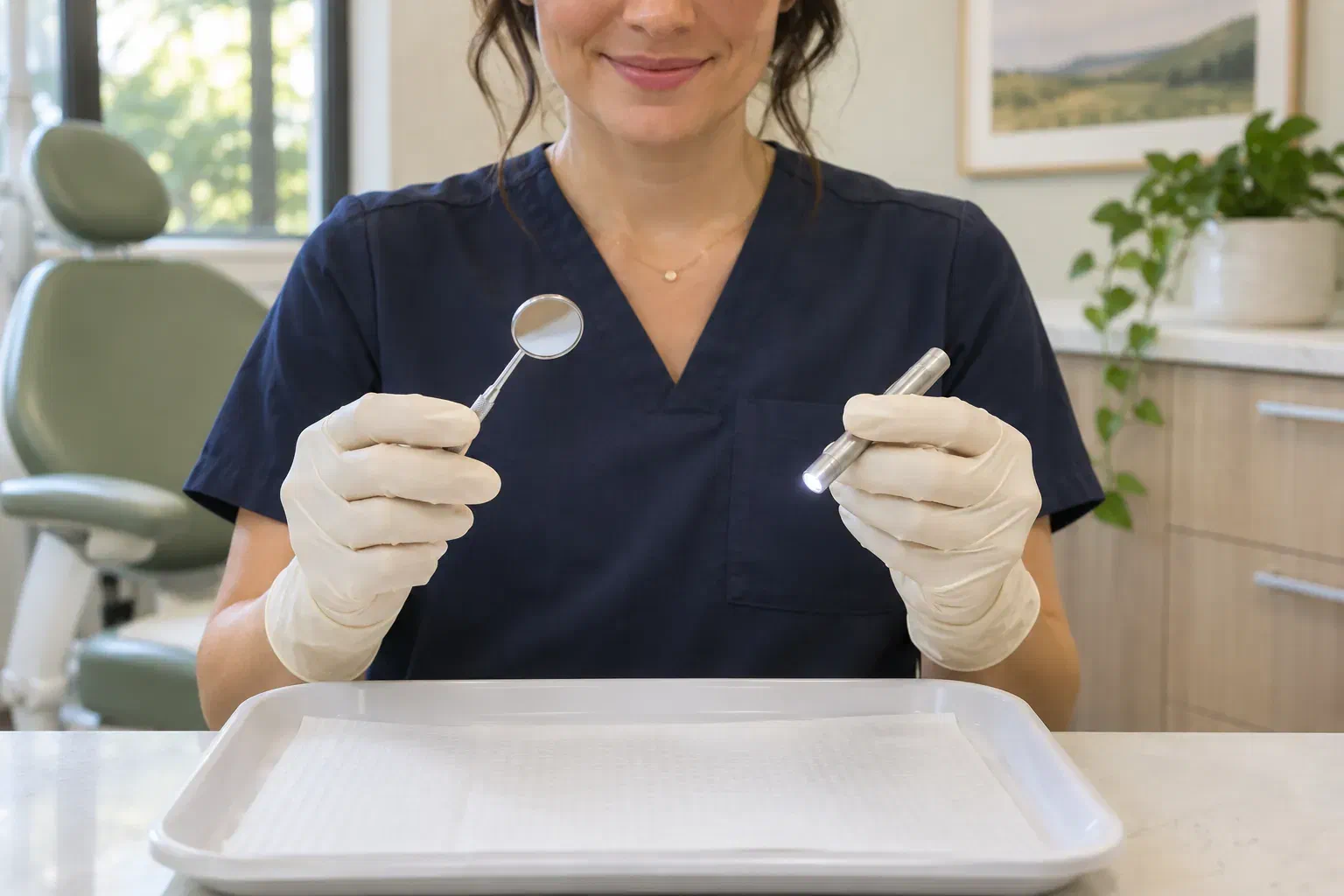
A patch inside the mouth is easy to notice and difficult to interpret. It may appear while you are brushing, feel different against the tongue, or be pointed out during an examination. The absence of pain can make it tempting to forget about it. Online images can have the opposite effect, suggesting frightening diagnoses without enough context to distinguish them.
Persistent red or white mouth patches in Milton should be examined rather than diagnosed from colour alone. Several conditions can produce a similar appearance, and some need timely investigation. The useful response is to document what you have noticed, arrange an assessment, and follow through on the recommended review. A clear process can reduce uncertainty without making promises before the cause is known.
Persistence matters even when a patch is painless
The Canadian Cancer Society lists persistent red or white patches among possible oral-cancer symptoms, while noting that other conditions can cause similar changes. A patch is therefore a reason for assessment, not a diagnosis by itself. Pain is not a reliable way to decide whether examination is needed.
The National Institute of Dental and Craniofacial Research advises seeing a dentist or physician for mouth changes that last more than two weeks. Seek advice sooner for concerning changes, unexplained bleeding, a lump, or difficulty swallowing. Do not use a time threshold as a reason to postpone a problem that is worsening.
When calling, explain that the same area has remained present and give the best estimate of its duration. If you only noticed it recently, say that too. A clinician can work with uncertainty; an invented start date may make the history less useful.
Describe the change before naming it
Useful details include where the patch is, whether it is red, white, or mixed, whether its surface feels different, and whether the size appears to have changed. Mention soreness, numbness, bleeding, a neck lump, or changes in swallowing or speech. You do not need to use a technical term.
If the area is difficult to locate, describe it in relation to a tooth, the side of the tongue, or the inside of the cheek. A dated photograph may help show what you mean, especially if the appearance changes. Avoid repeated manipulation or stretching that makes the area sore merely to get a better picture.
Do not scrape the patch as a home test. Whether an area can be removed, how it feels, and what surrounds it are clinical observations to be interpreted together. Attempts to remove or chemically treat the patch can injure the tissue and complicate the assessment.
Similar appearances can have different explanations
Irritation, infection, inflammatory conditions, and other tissue changes may enter the clinician’s assessment. The NHS information on leukoplakia explains that a persistent white patch requires evaluation and that other causes, such as thrush or cheek biting, need consideration. The word leukoplakia is not a synonym for every white area inside the mouth.
Ask the dentist which possibilities fit the examination and which features guide the next step. You should understand whether the clinician has reached a diagnosis, is considering several explanations, or is recommending a referral because further assessment is necessary.
An uncertain initial answer can be appropriate when it comes with a plan. The problem is not uncertainty itself; it is leaving without knowing how that uncertainty will be resolved. Ask what will happen next, when it should happen, and whom to contact if the process stalls.
Bring the history that may otherwise be forgotten
Prepare a short timeline of the patch and any related events. Mention a recent burn, dental work, a rough edge, a new appliance, or a product change. These details may be relevant, but do not assume that a plausible irritant fully explains a persistent lesion.
Bring an up-to-date list of medicines and medical conditions. Tell the clinician about tobacco use and alcohol use honestly, along with any previous mouth lesions or biopsies. The purpose is to inform assessment, not to assign blame. A person without common risk factors can still need investigation of an unexplained change.
If another professional has already examined the area, bring their name, approximate appointment date, and any report you have. Ask whether records should be transferred. Continuity is useful when a patch has been seen at more than one place and each clinician otherwise has only a fragment of the history.
Understand what happens during an examination
The clinician will ask about the history and examine the area and surrounding structures as appropriate. You may be asked to move your tongue or describe what you feel. If you have difficulty opening your mouth, a strong gag reflex, or discomfort with the examination, tell the team at the start.
Ask the dentist to show you the area with a mirror or image if that would help. Knowing exactly which patch is being discussed prevents confusion when you later check whether it has changed. If there are several findings, ask which one is the concern and whether they share an explanation.
You can also ask what has been recorded for comparison. A documented location, size, and description can support later review. This is particularly useful when the plan includes reassessing a suspected local irritant after it has been addressed.
If an irritant is addressed, keep the review appointment
Sometimes the clinician identifies a possible source of repeated trauma, such as an appliance or rough dental surface. If an adjustment is recommended, ask what improvement is expected and by when. Do not assume that addressing the suspected cause ends the need to reassess the tissue.
A follow-up appointment helps determine whether the explanation fits what happens next. Put that date in the calendar before leaving if possible. If the area worsens, develops new symptoms, or does not improve as expected, contact the practice rather than waiting silently for a distant routine visit.
Avoid making further adjustments yourself during the interval. Trimming a denture, filing a tooth, or trying several mouth treatments can introduce new irritation and make the course harder to interpret. Follow the agreed plan and report any practical difficulty with it.
A referral is a request for focused expertise
A dentist may recommend assessment by an oral medicine specialist, oral surgeon, or another appropriate clinician. Ask why the referral is being made and what question the specialist is expected to answer. The referral itself does not establish a diagnosis.
Clarify the logistics: who sends the referral, how you will hear about an appointment, what records accompany it, and what to do if you have not been contacted. If there is a recommended timeframe, write it down. A process that is clear in the clinician’s mind can still be unclear to the person waiting at home.
Tell the referring team about barriers such as transportation, language needs, or scheduling limitations. These do not change the clinical concern, but they may affect whether the referral is completed. Raising them early gives the team a chance to help you navigate the next step.
Know what a biopsy can clarify
A biopsy involves obtaining tissue for examination by a laboratory. The NHS notes that a specialist may recommend biopsy when investigating leukoplakia. Whether it is needed, what type is appropriate, and how it is performed depend on the lesion and the clinician’s assessment.
If biopsy is proposed, ask what part of the patch will be sampled, what anaesthesia is planned, and what aftercare is required. Discuss medicines and health conditions before the procedure, and do not stop prescribed medication unless the responsible clinician gives specific instructions.
Also ask how and when the result will be communicated. A biopsy appointment is not complete care if the family does not know how to obtain the report and explanation. Confirm who will discuss the result and who is responsible for arranging any further investigation or treatment.
Waiting for information can be the hardest part
Uncertainty can make people inspect the patch repeatedly or search photographs late into the night. Consider limiting checks to the instructions given by the clinician. Repeated checking rarely answers the question that an examination or pathology report is intended to resolve.
Keep your questions in one place as they arise. At the next conversation, ask the questions that would change your understanding or actions first. It may help to bring a trusted person, with your permission, to listen and take notes. You can request a plain-language explanation of any unfamiliar term.
Avoid interpreting the absence of a phone call as a result. If the expected communication date passes, contact the office. Following up is a normal part of navigating care, especially when a referral and laboratory report involve several organizations.
Understand the result and the next interval
When results are available, ask what they mean for the specific patch and whether any uncertainty remains. Does the result explain the clinical appearance? Is additional treatment or observation recommended? What changes should prompt an earlier review? The written report may contain technical language that needs interpretation.
If ongoing monitoring is recommended, understand its purpose and schedule. A reassuring result does not mean every future mouth change should be ignored, just as a recommendation for follow-up does not necessarily mean a serious outcome is expected. The plan should reflect the actual findings.
Keep copies of relevant reports where you can find them if you move or change practices. Accurate records reduce the need to reconstruct a complex history from memory. Tell future clinicians where the patch was and what follow-up was recommended, rather than only saying that a biopsy was fine.
Arrange assessment rather than relying on appearance alone
The clinic’s oral-cancer screening page explains one aspect of routine oral examinations. A persistent patch, however, deserves its own description when you book. Do not assume that an appointment months away is the right timing simply because the area does not hurt.
For a red or white mouth patch in Milton, contact the clinic and explain how long it has been present and any associated symptoms. Seek urgent medical help for breathing difficulty, severe swallowing difficulty, or another acute emergency. The aim is an appropriate examination followed by a clear, completed plan, so that an unexplained finding does not remain an unanswered question.
