
A missing tooth can raise several questions at once. You may be concerned about chewing, a visible space, the health of neighbouring teeth, or the cost of treatment. Friends and online advertisements may each recommend a different solution, often without knowing anything about your mouth. A useful comparison begins with your examination and priorities rather than a ranking of treatments from best to worst.
When discussing replacing missing teeth in Milton, ask the dentist to explain which options are clinically reasonable for you and why. Bridges, removable dentures, and implant-supported restorations work in different ways. The right discussion includes how the replacement will be supported, how you will clean it, what treatment stages are involved, and what maintenance may be needed later.
First establish what needs replacing
The number and position of missing teeth shape the conversation, but they are only the starting point. Explain when the teeth were lost, whether the area is still healing, and whether you currently use a temporary or older replacement. Bring that appliance to the consultation if you have one.
Describe the effect on your day. You may avoid certain foods, notice speech changes, feel self-conscious at work, or be comfortable with the appearance but concerned about function. These details help distinguish your main goal from assumptions that others might make about it.
If a tooth has not yet been removed, clarify the decision about keeping it before discussing replacement as a certainty. Ask what the examination shows, which treatments might preserve it, and what the likely limitations are. A replacement plan should follow an informed decision about the existing tooth, except when urgent care requires immediate action.
Understand the difference between support and appearance
The visible replacement tooth is only part of the design. Something must support it: neighbouring teeth, the gum tissues, implants, or a combination. Asking what provides that support can make otherwise confusing treatment names easier to understand.
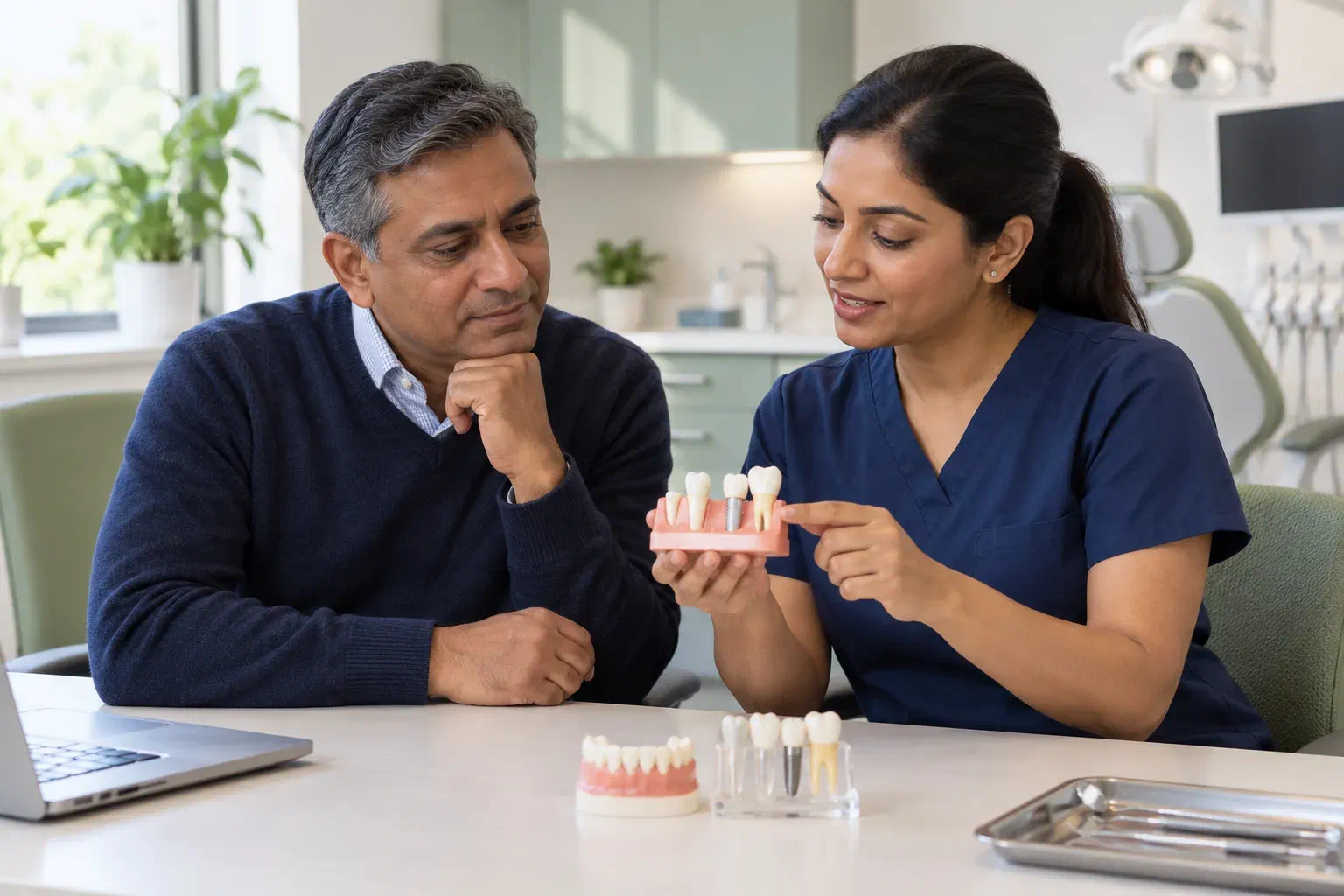
For each proposed option, ask the dentist to show you where the support comes from and which existing structures would be involved. Then ask what needs to be healthy before treatment proceeds. A diagram or model may help you compare the options more clearly than a photograph of the finished appearance.
Also clarify whether the replacement is removable by you. The word permanent is sometimes used to mean fixed in place, but it should not be interpreted as lasting forever without maintenance. Ask the clinician to use the words fixed or removable and explain what those terms mean in daily life.
How a tooth-supported bridge differs
A traditional bridge spans a missing-tooth space and is supported by adjacent teeth that are prepared for crowns. It stays in place rather than being removed for cleaning. The Canadian Dental Association explains that other bridge designs exist and that the choice depends on the location and condition of the surrounding teeth and tissues. CDA information on bridges.
Ask how healthy the proposed supporting teeth are and what preparation they would require. A plan involving teeth that already need restoration raises different questions from one involving largely untouched teeth. The dentist should explain the trade-off rather than assuming that every gap calls for the same bridge.
Discuss what would happen if a supporting tooth developed a problem later. You do not need a prediction of every possible event, but you should understand how the parts of the restoration depend on each other. Also ask how the design would be cleaned beneath the replacement tooth and whether you can manage the recommended tools.
Where a removable partial denture may fit
A removable partial denture replaces some missing teeth while natural teeth remain. The CDA describes designs with artificial teeth held by clasps around suitable natural teeth. Complete dentures replace an entire set of missing teeth in a jaw. Both require fitting and ongoing care, and a new denture can take time to become familiar. CDA overview of dentures.
Ask to see how the proposed appliance would sit in your mouth and how it would be inserted and removed. Discuss the parts you might notice with your tongue, what may be visible when you smile, and how the design relates to the remaining teeth. These questions make the comparison more concrete than simply asking whether a denture looks natural.
If you have used a denture before, describe what worked and what did not. Was the difficulty looseness, soreness, cleaning, appearance, or remembering to wear it? An assessment of those problems can help distinguish a correctable fit issue from a preference for a different type of replacement.
What implant-supported replacement involves
A dental implant is placed in the jawbone to support a replacement tooth or other restoration. The CDA notes that assessment includes general health, gum health, and available bone; some people may need additional procedures. Treatment can involve several visits and a healing period before the final restoration is completed. CDA explanation of dental implants.
Ask whether an implant is appropriate for your situation before focusing on a brand, a quoted success rate, or a rapid-treatment advertisement. Have the dentist explain what records or imaging are needed and whether a specialist consultation would add useful information. The reasons for recommending or ruling out an option should be clear.
Clarify what the proposed implant will support. A single crown, a bridge, and a removable overdenture are different restorations with different practical implications. Ask who will carry out each stage and who will be responsible for reviewing the completed work.
Compare everyday care before making a choice
Maintenance is part of the decision, especially if your hands, eyesight, or mobility make cleaning difficult. Ask for a demonstration of the daily routine associated with each realistic option. Explain what you can comfortably do yourself and whether a caregiver helps with oral care.
Bridges need cleaning around the supporting teeth and beneath the replacement area. Removable dentures need cleaning outside the mouth as well as care for the remaining tissues and teeth. Implant-supported restorations also require regular cleaning and professional review. CDA bridge-care guidance, denture-care guidance, and implant-care guidance.
Try to picture the routine at your own sink. Where would the supplies be stored? Can you reach the back of the mouth? Would you be able to remove and replace an appliance without assistance? These questions are relevant to the design of care, not evidence that you are unsuitable for treatment simply because you need support.
Ask about temporary arrangements and timing
Some treatment plans have a period between the initial procedure and the final replacement. Ask what you will have during that interval, whether a temporary appliance is proposed, and what limitations it may have. Confirm whether its cost is included in the overall estimate.
Tell the dental team about work, travel, caregiving, and other commitments that affect attendance. Ask which stages are flexible and which depend on healing or another clinical milestone. A written sequence can help you plan without interpreting a rough estimate as a fixed completion date.
If you need to delay elective treatment, ask what should happen in the meantime. The answer may involve monitoring, adjusting an existing appliance, or addressing another concern first. Do not assume that waiting is either harmless or disastrous in every case; ask what it means for your particular findings.
Compare costs on the same basis
Two estimates can look very different because they include different stages. Request an itemized plan showing assessment, any extraction or preparatory care, laboratory work, temporary replacement, the final restoration, and follow-up. Ask which items could change if new findings arise.
For implants, distinguish the surgical implant from the connecting components and the visible restoration. For a denture, ask about fitting visits and later adjustments. For a bridge, clarify the number of teeth or units involved. The purpose is to compare complete care rather than isolated price labels.
Discuss your budget directly. Ask which alternatives are clinically reasonable, whether treatment can be staged, and what the consequences of each approach would be. Verify coverage with your benefits provider when relevant. A treatment recommendation and an insurer’s reimbursement rules answer different questions and should not be confused.
Be cautious with universal promises
No option can be selected responsibly from a promise that it is always the most natural, fastest, or longest-lasting. Ask what the clinician expects in your situation and what uncertainty remains. The condition of supporting teeth and tissues, the design of the restoration, and the ability to maintain it all deserve consideration.
If you are given a lifespan estimate, ask what it refers to. Does it concern a component, the visible restoration, or the whole treatment? What repairs might be possible along the way? Understanding the maintenance pathway is more useful than treating a single number as an expiry date or guarantee.
A second opinion can be helpful when the options are complex or you remain uncertain. Bring the available examination findings and proposed plan so that the discussion addresses the same clinical situation. Different recommendations should be explained through their assumptions and trade-offs, not judged only by which sounds simpler.
Leave with a short comparison you understand
At the end of the consultation, try summarizing the realistic choices in your own words. For each, identify what supports the replacement, whether you remove it, the main treatment stages, the cleaning routine, and the costs still to confirm. If one of those points remains unclear, ask before making a decision.
You can also rank your priorities: preserving adjacent teeth, avoiding a removable appliance, minimizing surgery, managing cost, or making cleaning easier. Priorities may conflict, and the dentist can help explain where a compromise is needed. There is no requirement to value every feature equally.
For an assessment of missing-tooth replacement options in Milton, contact Milton Dental Clinic or call (905) 876-4488. Bring any existing appliance and explain what you most want to improve. A clear comparison should help you choose a plan that fits your mouth, your daily routine, and your expectations for ongoing care.
