
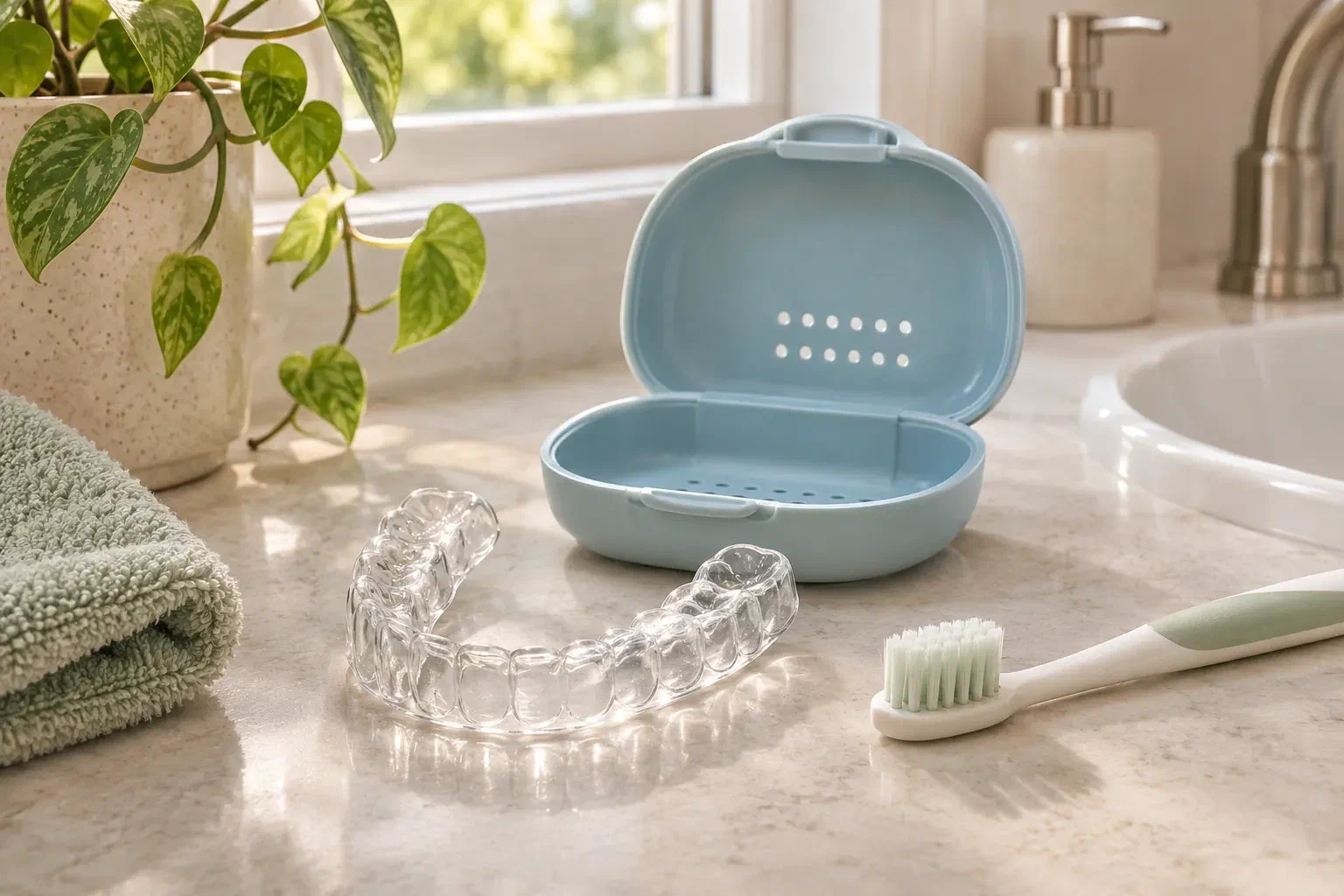
Having braces removed changes the rhythm of daily life. There are fewer appointments on the calendar, brushing feels different, and the careful habits built during treatment can start to fade. Retainers arrive at exactly this transition. They are small enough to lose and familiar enough to stop thinking about, yet they remain part of looking after the result of orthodontic treatment.
Retainer care after braces in Milton works best when the instructions fit an ordinary week. That means knowing what to do at breakfast, where the appliance goes during lunch, how to handle an overnight trip, and whom to call when something feels different. A realistic routine is easier to maintain than a set of instructions remembered vaguely from the day treatment finished.
Start with the retention plan you were actually given
The British Orthodontic Society explains that retainers help limit movement after treatment and age-related changes in tooth position. Retention is generally a long-term commitment. Removable and bonded retainers have different care needs, and some people use both. Your clinician should specify the appliance, wearing schedule, cleaning method, and review arrangements appropriate to your teeth.
Write those instructions down before leaving the final treatment appointment. A teenager and a parent may hear different parts of the same conversation; an adult rushing back to work may remember the wearing schedule but forget the review date. Ask for clarification while the appliance is available for a demonstration.
Keep the plan somewhere useful, such as a note with the clinic’s contact details. If instructions change later, update that note rather than keeping several conflicting versions. Your friend’s wearing schedule, an older sibling’s appliance, and advice attached to an online product cannot establish what is appropriate for you.
Learn the appliance’s everyday limits
Look at your retainer with the person who fitted it. Ask how it should seat, where to place your fingers when removing it, and which areas are vulnerable to damage. A demonstration is especially useful if you have long nails, reduced hand strength, or difficulty seeing the appliance clearly.
Ask specifically about eating, drinking, sports, and cleaning. Different devices are made from different materials, so avoid assuming that a method suitable for one appliance is suitable for another. Obtain instructions for temperature, brushing tools, cleaning solutions, and storage. Keep the packaging of any recommended cleaner so you can check its directions later.
A retainer is also a personal appliance. If family members have similar cases, mark the outside clearly. A simple label is more useful than relying on remembering which clear appliance belongs to whom. Keep it away from pets and young children, and choose a storage location that does not get rearranged every morning.
Give the case a permanent place
Much of successful retention is organization. Choose one place for the case beside your usual toothbrushing supplies and another predictable place in the bag you carry outside the home. The case needs to travel with the appliance, rather than remaining safely at home while the retainer is wrapped in a napkin at lunch.
Think through the moments when your routine changes. At a restaurant, put the case in the same pocket before you sit down. During a school trip, make sure the student can reach it without unpacking an entire backpack. At a friend’s house, use a closed case instead of an unfamiliar bathroom counter.
If you repeatedly lose the case, address that problem directly. A bright colour, a label, or a small pouch with your oral-care supplies may help. Buying several identical cases can be useful, provided you still know where the actual retainer is. The goal is to remove unnecessary decisions from the day.
Make cleaning specific enough to repeat
Ask the dental team to show the complete cleaning process from removal through storage. Which brush should you use? Is the suggested product suitable for this material? Does the appliance need rinsing before it goes back in your mouth? What should happen if there is visible buildup that ordinary cleaning does not remove?
Write the answers as a short sequence. A teenager might prefer a note on a phone; someone supporting an older adult may need instructions beside the sink. Keep the supplies together so that cleaning does not require searching through several cupboards. Replace missing supplies before the routine becomes difficult to follow.
Do not experiment with household disinfectants, improvised bleaching mixtures, or heat to make an appliance look new. Ask about persistent staining or odour instead. Appearance alone cannot tell you whether a retainer remains suitable, and an aggressive cleaning method can create a separate problem. The cleaning plan should come from the appliance’s instructions and your treating team.
A bonded wire still needs attention
A fixed retainer can be easy to forget because it stays behind the teeth. The British Orthodontic Society notes that bonded retainers require careful cleaning and professional advice if they become loose. Include the wire in your normal dental discussions rather than assuming it will always look after itself.
Ask the hygienist to demonstrate how to clean around your particular wire and attachment points. If a tool seems impossible to use at home, bring it back and ask for another demonstration. Difficulty with the technique is useful information. It is better to adapt the method than to nod through instructions that do not work in your hands.
Know who is monitoring the retainer. A general dentist may notice a concern during routine care, while the orthodontic team may remain responsible for the retention plan. Confirm the arrangement explicitly, especially after moving or changing practices. Do not assume that one clinic knows what the other has checked.
Treat a change in fit as information
Notice what is different before trying to solve it yourself. Does the removable appliance no longer seat fully? Is one area sharp? Has a bonded wire lifted away from a tooth? Has there been a missed period of wear, a recent filling, or an accident involving the appliance?
Contact the team responsible for your retainer and describe the change. Do not force an appliance into place, trim it, bend its wire, or use adhesive at home. Keep the retainer and any broken pieces available so the clinician can inspect them. Ask whether to continue wearing it while you wait; that decision depends on the problem.
If you have been away from your prescribed schedule, be straightforward about it. An accurate history helps distinguish a problem with the appliance from a possible change in the teeth. The appointment should focus on what is safe and useful now, rather than on embarrassment about the gap.
Make a replacement conversation concrete
When a retainer is missing or damaged, call promptly rather than waiting for the next routine visit. Ask what information the clinic needs, whether an assessment or new scan is required, and what happens during the interval. An old spare should be used only if the treating team confirms that it remains appropriate.
Request a clear estimate for the proposed solution. Ask whether it covers assessment, records, fabrication, fitting, and any follow-up. If repair is being considered, ask what can reasonably be repaired and what would make replacement preferable. These questions help you compare the actual care involved rather than comparing two prices with different inclusions.
If you no longer live near your original orthodontist, ask about transferring relevant records. Keep the original clinic’s name and approximate treatment dates. A new clinician needs to understand the present situation; a photograph of the smile immediately after braces may be interesting, but it does not substitute for examination or usable records.
Plan for travel before the last evening
A retainer belongs on the same packing list as medication and glasses. Pack the case, the approved cleaning supplies, and the contact details of the treating clinic. Keep the appliance where you can access it during the journey instead of placing everything in luggage you may not see until late at night.
Think about the routine at the destination. Shared bathrooms, camping trips, and crowded hotel counters can make a familiar task awkward. Decide where the case will be kept and how cleaning will happen. A small, washable pouch can make it easier to keep supplies together without placing them directly on unfamiliar surfaces.
Before a long trip, mention any fit concerns that you have been postponing. Ask what to do if the appliance is lost abroad and whether your records would be available to another clinician. This is particularly useful when a student leaves Milton for a semester or an adult spends extended periods away for work.
Help teenagers take ownership without daily arguments
The person wearing the retainer needs to understand the reason for it and the practical responsibilities involved. Discuss where the case lives, how supplies are replaced, and when help is needed. Avoid making the whole conversation about whether the teenager has been obedient; that framing can make a lost or broken appliance harder to admit.
Agree on a simple reminder system together. It might be a phone notification, a case beside the toothbrush, or a brief check before bed. Choose the least intrusive method that works. If a schedule is repeatedly missed, look for the obstacle: discomfort, embarrassment at school, forgotten supplies, or unclear instructions may require different solutions.
Give the teenager a role in appointments, too. Let them explain what feels awkward and practise asking questions. A parent can support the discussion without answering every question. Retainer care becomes more sustainable when it is a skill the young person can manage independently.
Keep ordinary dental care in the picture
Finishing orthodontic treatment does not finish dental care. Continue your usual examinations and hygiene visits, and bring the removable retainer when the clinic asks. Mention planned restorative work because changes to tooth shape may matter to an appliance’s fit. Tell both teams when you are uncertain who should review a particular concern.
If you are arranging orthodontic retainer care or asking about replacement retainers, bring the appliance, its case, and any previous instructions. That gives the conversation something concrete to work from. You can contact Milton Dental Clinic to ask which appointment is appropriate for your situation.
A good retention routine should become ordinary: the right appliance, used as prescribed, stored predictably, and checked when something changes. Those small habits help make the months after braces feel less like another complicated stage of treatment and more like a manageable part of looking after your teeth.
