
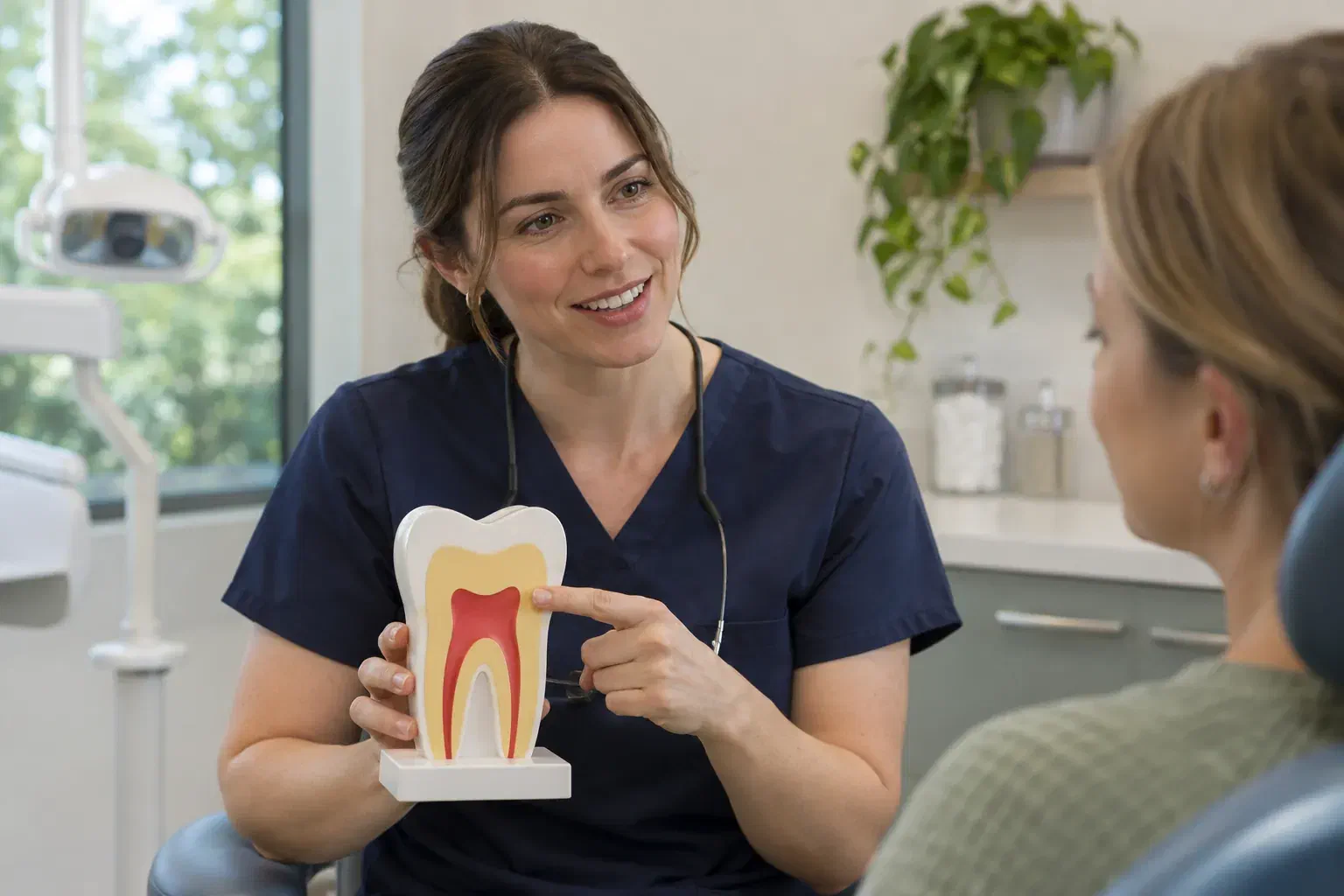
A deep cavity can lead to a conversation that is more nuanced than “a filling or a root canal.” In some circumstances, the dentist may discuss treatment intended to preserve living tissue inside the tooth. Terms such as pulp capping and pulpotomy can sound similar, but they describe different approaches and are not interchangeable promises.
When discussing vital pulp therapy and pulp capping in Milton, start by asking what the dentist believes is happening inside your particular tooth. The aim is to understand why a pulp-preserving approach may be reasonable, what findings could change that plan, and what will be required after the appointment. This is a treatment decision supported by diagnosis and follow-up, not a technique to request regardless of the tooth’s condition.
What “vital pulp” means
The pulp is the tissue inside a tooth containing blood vessels, nerves, and connective tissue. Vital pulp therapy seeks to maintain the health and function of some or all of that living tissue after damage associated with decay, injury, or dental procedures. The American Association of Endodontists’ position statement describes several approaches within that category, including pulp capping and pulpotomy.
The word vital does not mean that every part of a painful tooth is healthy. Nor does the absence of pain establish that the pulp is suitable for a preserving procedure. The clinician combines the history, examination, and relevant tests with what is found during treatment.
Ask for a simple explanation of the diagnosis before focusing on a material or procedure name. It helps to know both the intended benefit and why the clinician thinks the remaining tissue has a reasonable opportunity to be maintained.
Pulp capping and pulpotomy describe different interventions
Broadly, direct pulp capping involves placing a protective material over a suitable exposed pulp. A pulpotomy removes a portion of pulp tissue while aiming to preserve remaining vital tissue. Management of a deep cavity without exposing the pulp may also involve a conservative approach intended to protect it.
These descriptions provide vocabulary for a discussion; they are not instructions for selecting treatment yourself. Ask exactly which procedure is proposed and whether the final choice may depend on findings after decay is addressed. A broad phrase such as “saving the nerve” can be reassuring while leaving important details unclear.
If you are comparing estimates or seeking another opinion, use the written procedure name and tooth number. Two offices may be discussing different treatment stages or different clinical assumptions. Clear terminology makes a comparison more meaningful than relying on a short description remembered from a conversation.
It also helps to distinguish a pulpotomy from a pulpectomy. The former aims to retain some vital pulp, while the latter involves removing pulp tissue from the tooth’s internal spaces. If similar words appear on an estimate, have the clinician explain the intended procedure before you sign. Small differences in terminology can represent substantially different treatment goals and follow-up needs for the tooth involved.
Deep decay does not always mean removing every affected area in the same way
The American Dental Association’s restorative caries guideline supports conservative approaches to carious tissue removal in appropriate teeth. The purpose is to manage decay while preserving tooth structure and reducing avoidable complications, including pulp exposure. The recommended approach depends on the clinical situation.
If your dentist describes selective removal, ask what that means for your tooth and how the final restoration will be sealed. Do not interpret it as leaving a cavity untreated. Equally, do not assume the same approach is appropriate for every deep lesion or every painful tooth.
Patients sometimes worry that a conservative plan is less thorough. A useful question is what outcome the technique is designed to improve. Understanding the biological goal can make the plan clearer than equating more drilling with better care.
Baby teeth and permanent teeth need different conversations
Pulp therapy may be discussed for children as well as adults, but the decisions differ. The American Academy of Pediatric Dentistry’s guidance for primary teeth specifically addresses vital primary teeth with deep caries. Its recommendations should not simply be transferred to nonvital teeth or adult teeth.
For a child, ask which tooth is involved, how long it is expected to remain, and what role it has in eating and the developing dentition. Also discuss the restoration needed afterwards and how the child can manage the appointment. A treatment name alone does not explain the entire plan.
For a young permanent tooth, ask how the stage of root development affects the discussion. For an adult tooth, ask what findings support a pulp-preserving option in a mature tooth. Age matters in context, but it should not replace an explanation tied to the examination.
Describe symptoms in a way the dentist can use
Before the visit, note what starts the discomfort, whether it continues after the trigger ends, and whether it occurs without an obvious trigger. Include pain on biting, symptoms that interrupt sleep, swelling, and any recent injury. Mention previous fillings or treatment on that tooth if you know about them.
You do not need to classify your pain using dental terms. “Cold water caused a brief feeling yesterday” and “the tooth woke me twice last night” are clearer descriptions than guessing a diagnosis from an online checklist. If you cannot identify one tooth, say that too.
Do not repeatedly test the tooth with extremes of temperature. The clinician has methods for investigating symptoms and will interpret them alongside other findings. Your main contribution is an accurate history, including changes over time and the effect on everyday activities.
Agree on the contingency plan before treatment starts
Some decisions can only be finalized once the dentist sees the condition of the tooth more directly. Ask what findings might lead them to change from the initial plan, and how they will discuss that with you during the visit.
For example, you may want to understand whether a different pulp treatment, root canal treatment, referral, or another option could become necessary. The point is not to predict a complication; it is to avoid being surprised by a decision you have not had time to consider.
Ask how a change would affect the appointment, cost, and next steps. If you have limits around time or finances, explain them before the procedure. The clinician can tell you which aspects can be planned flexibly and which depend on the tooth’s condition.
The final restoration is part of the treatment
A pulp procedure should be discussed together with the filling or other restoration that follows. Ask what will cover and protect the treated area, whether it will be completed that day, and what care is needed if there is an interim stage.
This question is especially useful when the tooth already has a large filling or substantial damage. Preserving pulp tissue does not answer every structural question. The dentist should explain how the tooth will be restored for chewing and how that recommendation relates to the remaining tooth structure.
If more than one appointment is required, book the next stage and obtain written advice about the temporary period. Tell the office promptly if the restoration loosens, part of it comes away, or the bite feels different. Do not quietly extend a temporary plan because the tooth happens to feel comfortable.
What success will be judged by
Ask the clinician how they will assess the tooth over time. Comfort matters, but the follow-up may also involve examination and imaging when appropriate. Make sure you know when review is recommended and whether it is included in your ordinary dental visits or requires a separate appointment.
A good follow-up plan also explains which symptoms should prompt an earlier call. New spontaneous pain, swelling, discomfort that worsens, or a broken restoration should be reported. Avoid waiting for the scheduled review simply because it is already in the calendar.
It may help to write down the tooth number and the date of treatment. If another clinician sees you later, that record provides useful context. A tooth can be comfortable at a routine visit while still needing its specific treatment history considered.
Discuss uncertainty without treating it as a failure
No procedure offers a guarantee that living tissue will respond exactly as hoped. Ask what factors make the outlook favourable or less favourable for your tooth, and what further treatment might be needed if the response is not satisfactory.
The possibility of later root canal treatment does not by itself make a pulp-preserving attempt unreasonable. Conversely, wanting to avoid root canal treatment does not make vital pulp therapy suitable for every case. A balanced decision considers the evidence, the condition of the tooth, and the consequences of each pathway.
If you feel uncertain, ask the dentist to summarize the strongest reason for the recommendation and the most important limitation. That focused explanation can be more useful than a long list of general advantages. A specialist opinion may be appropriate when the diagnosis or treatment options are complex.
Practical questions for the appointment
Find out whether the visit is an assessment or treatment appointment, how long it is likely to take, and whether you should expect another visit for restoration. Mention anxiety, difficulty keeping your mouth open, or previous problems with anaesthetic. These details help the team plan the experience as well as the procedure.
For parents, ask how the treatment will be explained to the child and how comfort will be monitored. Avoid promising that the visit will involve no sensations at all. A calm, accurate explanation builds more trust than a promise that may not match the child’s experience.
If symptoms are urgent, lead with them when calling rather than requesting a specific technique. You can contact Milton Dental Clinic to arrange an assessment and discuss the findings. The useful endpoint is a clear plan for the pulp, the restoration, and the follow-up, with alternatives understood before treatment begins.
