

Illustrative child and parent learning about molar chewing surfaces
Children’s Dentistry

Children’s Dental Sealants in Acton

Second molars tend to arrive around the preteen years, when kids brush on their own. Families from Acton can ask whether those new grooves suit a sealant, what the visit involves, and how it is checked.

Preteens, second molars and Acton families

The twelve-year molars come in just as you stop checking.

By the time the second permanent molars push through, often somewhere around age twelve, most children have taken over their own brushing. Parents no longer see the back of the mouth every night. These teeth sit furthest back of all, and a quick brush before the bus can miss them entirely.

That is why sealants come up again at this age. A sealant is a coating that flows into the pits and fissures on top of a molar and hardens, leaving a surface that traps less plaque. It is not automatic. The dentist checks how far each second molar has erupted, what its grooves look like, any early change, and your preteen’s cavity risk.

Bring your child into the conversation. They are the one who will feel the coating with their tongue and keep the routine going. Make sure they understand that a sealant covers only selected chewing surfaces, that brushing, flossing and fluoride still matter, and that no coating promises a tooth will never decay.

Ask about sealing second molars
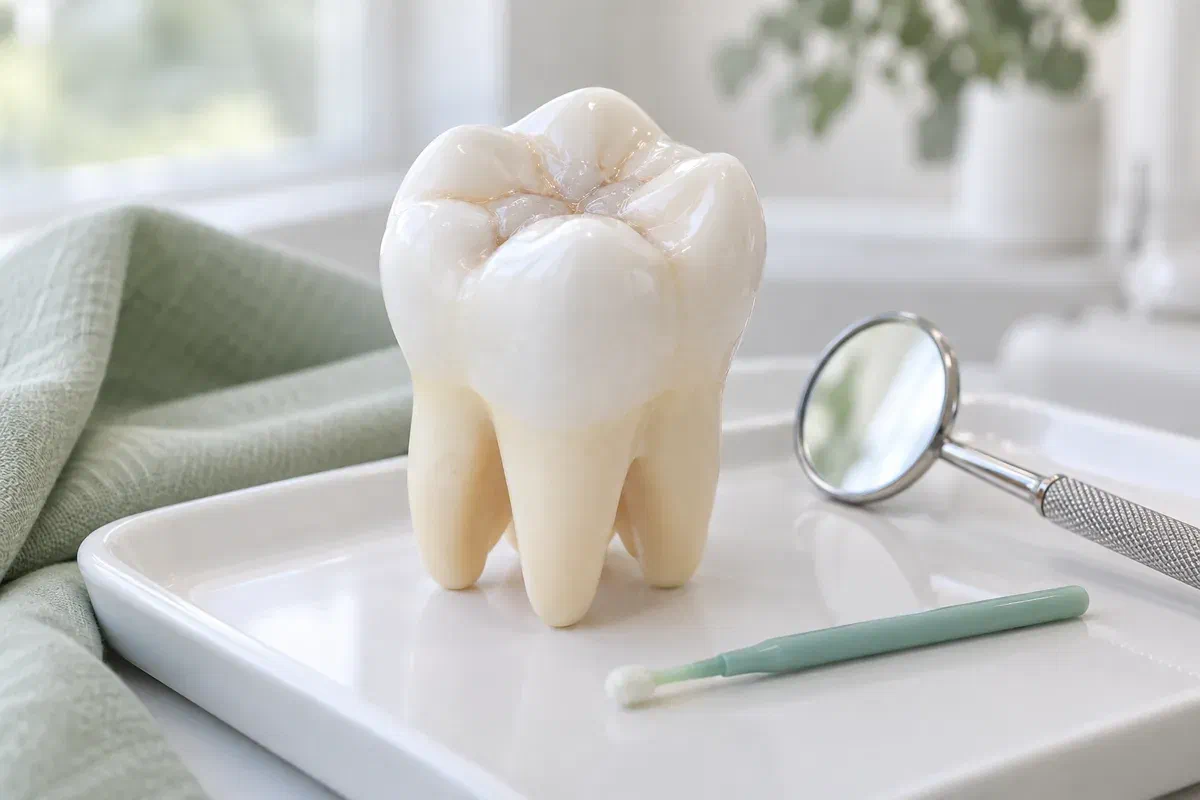
Illustrative molar teaching model, dental mirror, and sealant applicator
What to mention for an older child

Signs that the furthest teeth need a look.

Neither you nor your preteen needs to decide whether a groove is deep or a spot is early decay. Share what either of you has noticed, and the dentist will do the assessing.

Gum swelling or a tooth breaking through at the very back

A new molar behind the first set often shows up with a little gum tenderness. Let us know when it appears. We can confirm it and suggest how to brush around gum that still partly covers it, and we’ll time any sealant talk to how far the tooth has come through.

Independent brushing that skips the back

Many preteens brush on their own now, and the furthest teeth are often shortchanged. Tell us about past cavities, braces plans, snacking habits or areas they say are hard to reach. That helps the dentist match any advice to real risk.

Older sealants from the first molars

Sealants placed years ago on the six-year molars deserve a check too. Mention roughness, a changed bite, or coatings from another office. Ask your child to resist picking at a loose edge and not to try fixing it themselves.

Ongoing pain, a visible hole, or food jamming in a groove needs an examination before anyone talks about sealing. The dentist has to separate a healthy surface from one with damage needing different treatment.

Why it can be worth it at this age

Covering grooves your preteen can barely reach.

On a suitable groove, a sealant helps keep decay from starting where bristles struggle to get in. In selected cases, an early lesion that hasn’t broken the surface may be sealed after the dentist has diagnosed it and set a monitoring plan. Sealing is never a substitute for checking a suspected cavity.

A coating helps only as long as it stays bonded. During reviews, the dentist checks the material and the enamel around it. Ask your preteen to listen in when this is explained, since they are the one most likely to notice a rough patch first.

Patient information: AAPD and ADA — pit-and-fissure sealant guideline

Part of a routine they own

The sealant takes care of particular grooves while brushing, cleaning between teeth and fluoride protect the other surfaces. Talk through how this fits a routine your child now manages. Independence works best when they know which habits still count.

Locating the second molars

Many preteens don’t realize these teeth have arrived. The visit can show them, in a mirror, where the brush has to go. Encourage them to practise angling it there, and check in now and then at home.

Reasons they can understand

Older children can follow the reasoning: why one surface is sealed, what will be watched, and why another molar is left alone. Invite them to ask questions. Findings, not age alone, should guide each recommendation.

How sealing a second molar works

Short, steady and explained along the way.

Materials differ, and second molars sit further back, which can take a little more patience. We explain each step and agree on how your child can ask for a pause.

  1. Decide if the tooth is ready

    The dentist checks eruption, cavity risk and any early lesion. A second molar that is only partly through may need to wait. Ask whether sealing would prevent decay on sound enamel or manage a selected early change, and whether images are advised.

  2. Clean and keep the area dry

    The groove is cleaned and prepared for the selected material. Because the tooth is so far back, keeping it dry can take extra care. Your child may notice air, water, suction or cotton; we explain each beforehand.

  3. Apply the material

    The sealant is placed in the chosen pits and fissures and set as required, sometimes with a curing light. Older children often like knowing exactly what is happening, so we describe each part, while noting the sequence can vary.

  4. Check the bite

    Your child bites together so we can see how the new surface meets the opposing tooth. Speak up if it feels high or sore. We confirm any instructions for that material and when the coating will next be examined.

Afterward, at home and at school

Their routine, their responsibility, your backup.

Follow the guidance for the material used and any other care done that day. There isn’t one eating rule that applies to all sealants.

Brush right to the back

Your child should keep using fluoride toothpaste as advised and cleaning between teeth. The sides of each molar aren’t sealed. A parent spot-check now and then can help, even when brushing is mostly independent.

Speak up about a bite that feels wrong

If a high spot lingers, the tooth aches, or the coating looks chipped, contact the clinic. Tell your preteen not to grind it down or test it with a pen cap or other hard object. A dentist can check it.

Keep regular reviews

Sealants can wear and may need patching or replacing. Share any history of coatings from other offices and ask which surfaces are being followed. A check matters even when nothing hurts, since early wear is rarely noticeable.

Options for the furthest-back teeth

Sealant, fluoride, or treatment: it depends on the groove.

Ask what the examination found and which approach answers it. More than one can be helpful if each has a clear purpose.

For a surface that would benefit from a barrier

A sealant on suitable grooves

Covers selected chewing areas and relies on good placement and checks over time. The dentist will say which second molar is a candidate and why, and how its condition will be reviewed.

For overall prevention

Fluoride and self-managed habits

These can accompany a sealant or come first if sealing should wait. Ask about suitable products and how much supervision still makes sense for your preteen. Fluoride and sealants serve separate purposes and do not replace each other.

When the tooth needs another approach

Further tests or a filling

A lesion that has broken down, or another finding, may need care beyond sealing. A molar only partway through might need a later appointment. Ask what prevents sealing now and when to come back.

Acton parents of preteens ask

Second molars, braces and independence.

Ask about which teeth, which material and how follow-up will work. Answers should reflect your child’s findings.

(905) 876-4488
When do second permanent molars usually come in?
Often around the preteen years, though timing varies from child to child. The dentist can check whether they have started to erupt and talk about sealing once enough of the tooth is visible.
Can sealants be placed if my child is getting braces soon?
Mention any orthodontic plans to the dentist. Sealants and braces address different things, and the timing can be discussed with your child’s dental and orthodontic providers.
My child had sealants at age six. Do the new molars need them too?
Not automatically. Each tooth is assessed on its own surface and your child’s current risk. The dentist will also check whether the earlier sealants are still intact.
Is my preteen too old for sealants?
Age alone doesn’t decide it. What matters is whether the groove is suitable and how likely decay is. Teens and even adults sometimes have sealants when the surface and risk support it.
Should my child stop flossing once the back teeth are sealed?
No. A sealant sits on the chewing surface and doesn’t reach between teeth. Keep flossing or using whatever cleaning aid was recommended.
What should my child do if part of a sealant feels loose?
Let a parent know and contact the clinic, especially if it feels sharp or uncomfortable. The dentist can look at the remaining material and decide on repair, replacement or another option. Don’t pull at it.
Sealant visits for families in Acton

Check the newest molars before habits slip.

Contact our Bronte Street practice to discuss sealants for your preteen. We can assess second molars as they erupt, review older coatings, and explain the preventive care that fits the findings.

Sealants are suggested only when an examination supports them. They need ongoing review and sit alongside brushing, flossing and other preventive care.

Visit Milton Dental Clinic
Unit 1, 342 Bronte St. S, Milton, ON L9T 5B7
Get directions Clinic hours
Monday–Thursday
11am–7pm
Friday–Sunday
By appointment only

Areas we serve

  • Milton
  • Oakville
  • Mississauga
  • Georgetown
  • Halton Hills
  • Acton
  • Campbellville
  • Brampton
  • Burlington
  • Puslinch
  • Rockwood
  • Erin
  • Caledon
  • Etobicoke
  • Old Milton
  • Bronte Meadows
  • Timberlea
  • Dorset Park
  • Dempsey
  • Clarke
  • Beaty
  • Coates
  • Harrison
  • Scott
  • Willmott
  • Ford
  • Bowes
  • Cobden
  • Walker
  • Mountain View
  • Milton Heights
  • Hawthorne Village
  • Valley View
  • Fallingbrook
  • Nassagaweya
  • Trafalgar
  • Esquesing
  • Nelson
  • Brookville
  • Moffat
  • Glen Williams
  • Norval
  • Limehouse
  • Stewarttown
  • Ashgrove
  • Hornby
  • Silver Creek
  • Speyside
  • Scotch Block
  • North Oakville
  • River Oaks
  • Glen Abbey
  • West Oak Trails
  • Palermo
  • Bronte Creek
  • College Park
  • Joshua Creek
  • Uptown Core
  • Preserve
  • Iroquois Ridge
  • Lisgar
  • Meadowvale
  • Meadowvale Village
  • Churchill Meadows
  • Erin Mills
  • Central Erin Mills
  • Streetsville
  • East Credit
  • Creditview
  • Heartland
  • Sheridan
  • Mount Pleasant
  • Credit Valley
  • Huttonville
  • Churchville
  • Springbrook
  • Northwest Brampton
  • Bram West
  • Fletcher's Meadow
  • Fletcher's Creek South
  • Alton Village
  • Orchard
  • Millcroft
  • Headon Forest
  • Tansley
  • Brant Hills
  • Tyandaga
  • Kilbride
  • Lowville
  • Aberfoyle
  • Morriston
  • Arkell
  • Hillsburgh
  • Freelton
  • Carlisle
  • Waterdown
  • Flamborough
  • Mountsberg

How can we help?

Milton Dental Clinic

Have a question about your smile? Choose the option that works best for you.

For urgent dental concerns, please call.
Messages are reviewed during clinic hours.