

Illustrative child and parent learning about molar chewing surfaces
Children’s Dentistry

Children’s Dental Sealants in Milton

Spotted a new back tooth during bedtime brushing? Talk with our Milton team about whether its chewing grooves could use a sealant, how placement works, and why later checks still count.

Sealants for growing smiles in Milton

A new molar arrives quietly. Its grooves deserve attention.

Many parents first notice it while holding the toothbrush at night: a larger tooth sitting behind the last baby tooth, with no baby tooth lost to make room for it. That is often a first permanent molar. Its biting surface has narrow pits and fissures where plaque can settle and bristles struggle to reach.

A sealant is a thin coating that flows into suitable grooves and sets into a protective layer. Whether one makes sense for that tooth is a clinical question. The dentist looks at how far the molar has come in, what the surface shows, and how likely your child is to develop decay before suggesting anything.

Think of a sealant as one tool among several rather than a shield for the whole mouth. Brushing, cleaning between teeth and the fluoride advice given for your child keep doing their own jobs. A good plan names the surface being protected, describes how it will be checked, and tells you what to watch for afterward.

Ask about sealants for your child
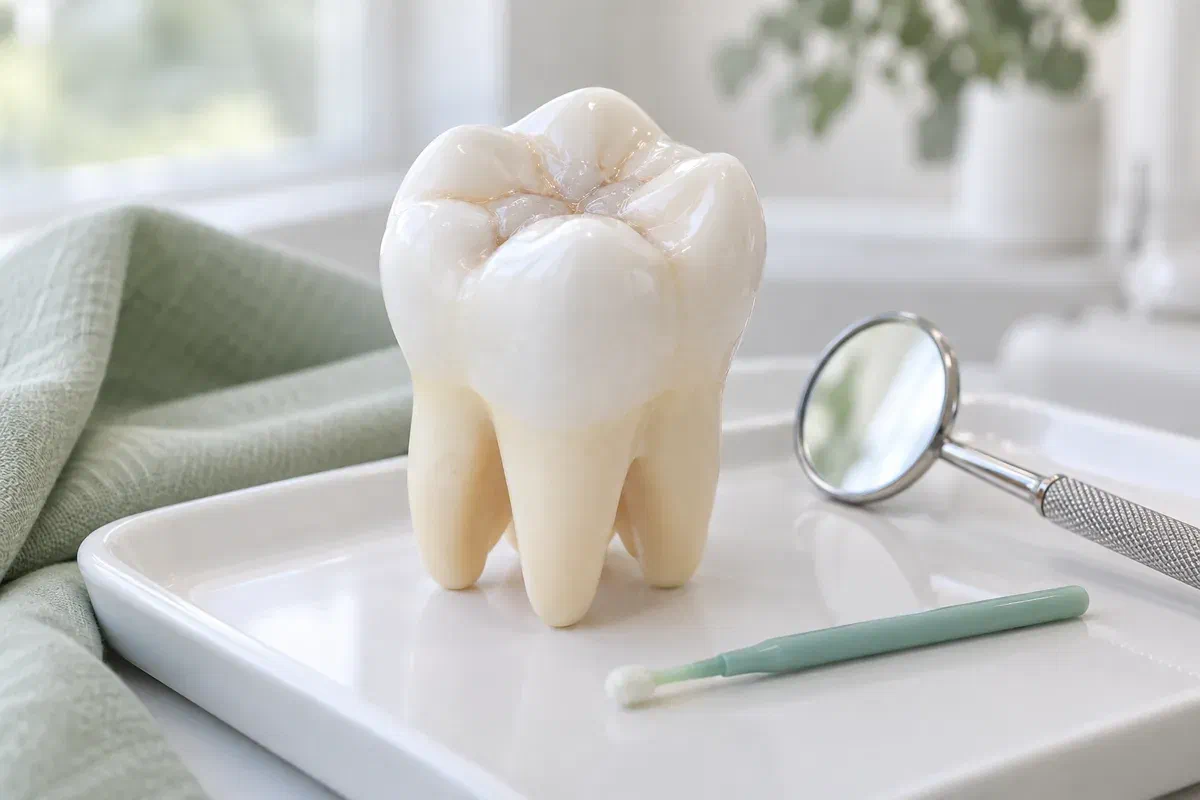
Illustrative molar teaching model, dental mirror, and sealant applicator
Moments that prompt the question

What did you notice, and what does the dentist see?

Your observations at home are helpful, but nobody expects you to judge groove depth or spot an early lesion yourself. Bring what you have seen and let the examination sort out the rest.

A big tooth appearing at the back

Tell us when a molar has surfaced behind the baby teeth, even if only part of it shows. We can confirm whether it is permanent and show you how to angle the brush while gum still covers some of it. Any sealing conversation follows the tooth’s progress.

Past fillings or hard-to-brush spots

Earlier cavities and corners your child resists brushing are worth sharing. Let the team know how much hands-on help you give at the sink. That context shapes whether a sealant is suggested, so the advice fits your child instead of following a blanket rule.

A sealant that seems different now

Point out a coating that feels rough to the tongue, a bite that seems off, or a sealant placed at another office. We can check whether it is still sound. Please don’t let your child scratch at it or try filing it down with anything from the kitchen drawer.

A toothache, a visible hole, or food packing into a groove calls for an examination first. Sealants are meant for suitable surfaces, and the dentist needs to tell those apart from damage that requires a different kind of treatment.

Why some grooves get sealed

Put the protection exactly where it is needed.

On a suitable chewing surface, a sealant can help keep decay from starting in the pits and fissures. Some early, unbroken lesions may also be managed with a sealant once they have been properly assessed and a monitoring plan is in place. That option is a professional judgment, not a way to cover over a cavity nobody has examined.

The benefit lasts as long as the coating stays in good condition. Both the material and the enamel around it are looked at during later appointments. Ask what the team will be checking and what happens if the sealant wears down or a section comes away.

Patient information: AAPD and ADA — pit-and-fissure sealant guideline

One piece of a bigger routine

A sealant covers particular grooves, while brushing, flossing and fluoride look after the rest. Ask how they fit together for your child. Once the coating is in place, you should feel more certain about which habits to keep, not less.

A good time to meet the new molars

Children often don’t realize an adult tooth has arrived at the very back. During the visit we can point it out and show how to reach it. Have your child practise guiding the brush there while you help as much as their age calls for.

A choice you can revisit

The dentist can tell you why one surface is being sealed and what will be watched over time. If another tooth gets a different suggestion, ask about the difference. Each recommendation should rest on what that tooth shows, not on one approach for every molar.

Inside the sealant visit

From checking the groove to checking the bite.

Steps vary with the material and the tooth. We explain each stage in words your child understands and agree on a signal they can use if they need a short break.

  1. Decide whether the tooth qualifies

    The examination looks at the surface, decay risk and any early change already present. Ask whether the goal is preventing decay on healthy enamel or managing a specific early lesion. Talk through alternatives and whether any images are needed before going ahead.

  2. Clean the surface and keep it dry

    The groove is cleaned and prepared to suit the chosen material. A dry working area matters for the result. Your child may feel water spray, hear suction, or have cotton or a small holder placed nearby, and we can explain each item before it goes in.

  3. Apply the coating

    The sealant is painted into the targeted pits and fissures, then set in the way that material requires. Some types harden under a small blue light. The clinician can describe what your child might notice, though not every visit follows an identical order.

  4. Test the finish and plan ahead

    We check the finished surface and how the teeth meet. Mention it if your child feels the tooth sits too high or seems sore. Before you leave, confirm any instructions for that material and when the sealant will be reviewed with the rest of the mouth.

Once you are home

The routine stays the same. New changes get a call.

Follow whatever guidance applies to the material and to any other care done that day. There is no single eating rule that applies to every sealant.

Keep up daily brushing and flossing

Use the fluoride toothpaste amount recommended for your child’s age and clean between teeth as advised. Sealants leave the sides of teeth uncovered. Carry on with the brushing help your child still needs, even if the sealed surface now feels smooth.

Speak up about a high spot or roughness

If a bite feels high for more than a short while, the tooth is uncomfortable, or the coating looks different, contact the clinic. Avoid encouraging your child to chew through it or poke at it with something hard. A quick look can sort out what is happening.

Come back for the scheduled check

Sealants sometimes need touching up or replacing as the mouth changes. Let the dentist know about any placed at another office, and ask which surfaces are being tracked. A review still helps when nothing feels wrong, because children rarely notice early wear.

Matching care to the surface

Three tools, three different jobs.

Ask what the examination found and which measure answers it. A child may benefit from more than one, as long as each has a stated reason.

When a surface could use a barrier

Sealing suitable pits and grooves

This targets chosen chewing areas and depends on careful placement and later review. The dentist can tell you which tooth qualifies and why. Any sealant suggestion should include how the coating will be assessed as your child grows.

For wider preventive support

Fluoride with a workable home routine

These may sit alongside a sealant or come first when sealing is not the right step yet. Ask about the product, the amount and how much adult help fits your child’s age. Fluoride and sealants work differently and are not substitutes for each other.

When the tooth needs something else

Further assessment or a filling

If the surface has started to break down, sealing may not be enough. A molar that is still coming in may also call for different timing or a temporary plan. Ask what is holding back the current option and when the tooth will be looked at again.

Sealant questions from Milton parents

Straight answers about grooves, coatings and checkups.

Ask about the specific teeth, the material and the follow-up. Answers should come back to what was found in your child’s mouth.

(905) 876-4488
How can I tell whether the new back tooth is a permanent molar?
A tooth that appears behind the last baby tooth, without a baby tooth falling out first, is often a first permanent molar. The dentist can confirm it at an examination. Ask to be shown where it sits so you can guide the brush there at home.
Is the sealant visible when my child smiles?
Sealants go on the chewing surfaces of back teeth, which are not usually seen in a smile. Some materials are clear or tooth-coloured, and others are slightly tinted so they are easier to check. Ask which type is planned if you are curious.
Can a baby molar be sealed too?
In some cases, yes. Suitable primary molars may be considered depending on the surface, decay risk and overall situation. Ask why a particular baby tooth is a candidate and how long that tooth is expected to stay before its replacement arrives.
Will my child need a needle for a sealant?
Sealing a sound chewing surface usually does not involve drilling or freezing, though the dentist will explain what the specific plan involves. If other treatment is happening the same day, ask how that changes the visit so you can prepare your child.
Do sealants mean we can skip flossing?
No. Sealants cover chewing grooves, not the contact points between teeth where food and plaque also collect. Keep cleaning between teeth as advised. Ask the team to point out which areas the sealant protects and which ones still rely on your routine.
What should we do if a piece of the sealant chips off?
Contact the clinic for advice, especially if the edge feels sharp or the tooth is uncomfortable. The dentist can look at what remains and decide whether to repair, replace or monitor it. Please don’t try to pull off the rest at home.
Book a sealant visit in Milton

Bring your questions about the back teeth.

Reach our Bronte Street practice to talk about sealants for your child. We can look at molars that are just arriving, check any existing sealants, and explain the prevention steps that suit what we find.

Whether a sealant is suitable depends on the examination. Sealants need regular review and work alongside, not instead of, daily cleaning and other preventive care.

Visit Milton Dental Clinic
Unit 1, 342 Bronte St. S, Milton, ON L9T 5B7
Get directions Clinic hours
Monday–Thursday
11am–7pm
Friday–Sunday
By appointment only

Areas we serve

  • Milton
  • Oakville
  • Mississauga
  • Georgetown
  • Halton Hills
  • Acton
  • Campbellville
  • Brampton
  • Burlington
  • Puslinch
  • Rockwood
  • Erin
  • Caledon
  • Etobicoke
  • Old Milton
  • Bronte Meadows
  • Timberlea
  • Dorset Park
  • Dempsey
  • Clarke
  • Beaty
  • Coates
  • Harrison
  • Scott
  • Willmott
  • Ford
  • Bowes
  • Cobden
  • Walker
  • Mountain View
  • Milton Heights
  • Hawthorne Village
  • Valley View
  • Fallingbrook
  • Nassagaweya
  • Trafalgar
  • Esquesing
  • Nelson
  • Brookville
  • Moffat
  • Glen Williams
  • Norval
  • Limehouse
  • Stewarttown
  • Ashgrove
  • Hornby
  • Silver Creek
  • Speyside
  • Scotch Block
  • North Oakville
  • River Oaks
  • Glen Abbey
  • West Oak Trails
  • Palermo
  • Bronte Creek
  • College Park
  • Joshua Creek
  • Uptown Core
  • Preserve
  • Iroquois Ridge
  • Lisgar
  • Meadowvale
  • Meadowvale Village
  • Churchill Meadows
  • Erin Mills
  • Central Erin Mills
  • Streetsville
  • East Credit
  • Creditview
  • Heartland
  • Sheridan
  • Mount Pleasant
  • Credit Valley
  • Huttonville
  • Churchville
  • Springbrook
  • Northwest Brampton
  • Bram West
  • Fletcher's Meadow
  • Fletcher's Creek South
  • Alton Village
  • Orchard
  • Millcroft
  • Headon Forest
  • Tansley
  • Brant Hills
  • Tyandaga
  • Kilbride
  • Lowville
  • Aberfoyle
  • Morriston
  • Arkell
  • Hillsburgh
  • Freelton
  • Carlisle
  • Waterdown
  • Flamborough
  • Mountsberg

How can we help?

Milton Dental Clinic

Have a question about your smile? Choose the option that works best for you.

For urgent dental concerns, please call.
Messages are reviewed during clinic hours.