

Illustrative child and parent learning about molar chewing surfaces
Children’s Dentistry

Children’s Dental Sealants in Mississauga

One child was offered sealants and the other was not? Families from Mississauga can learn how we judge each tooth separately, what a coating protects, and how it is followed up.

Sealant decisions for Mississauga siblings

Two children, two mouths, two different answers.

It happens often in families who book siblings back to back. The older child leaves with sealants on two molars, and the younger one is told to wait, or is not offered any at all. That is not inconsistency. Each recommendation follows what the dentist sees on that particular tooth.

Here is what goes into that judgment. A sealant is a liquid coating that hardens inside the narrow grooves on top of a molar, leaving a smoother, easier-to-clean surface. Before suggesting one, the dentist asks how much of the tooth is through the gum, how the groove looks, whether enamel has started to change, and how prone that child is to decay.

So ask about each child separately. Which teeth were looked at, what the coating is meant to protect, and when it will be checked are fair questions for every sibling. No sealant covers the whole tooth or replaces brushing and fluoride, and none can promise a cavity will never form.

Ask about sealants for each child
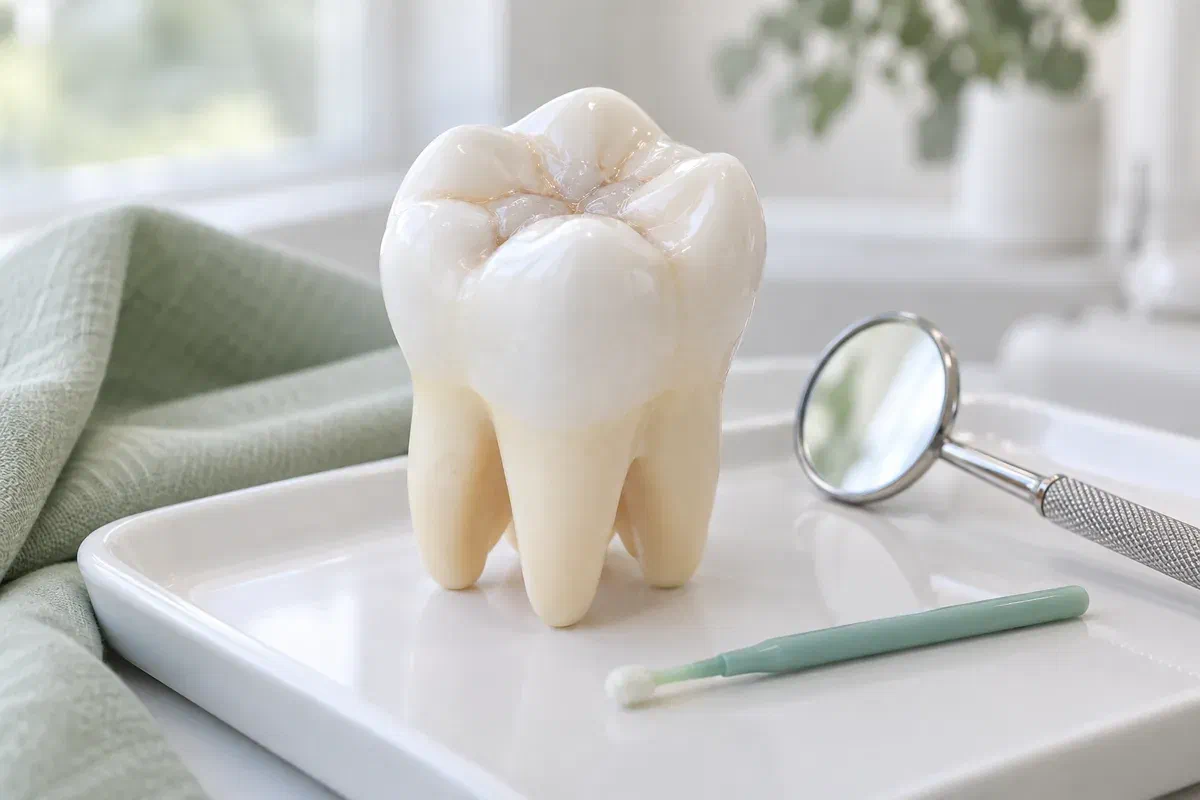
Illustrative molar teaching model, dental mirror, and sealant applicator
Clues worth sharing

Tell us what is different about each child.

You don’t need to judge how deep a groove is or whether a spot is early decay. Describe what you notice and how each child brushes, and the examination takes it from there.

One child’s molars arrived first

Siblings rarely get permanent molars at the same pace. Mention any tooth that has appeared behind the baby teeth, even partway. We can confirm what it is and show how to clean it while the gum is still around it, then time the sealant conversation to the tooth.

Different cavity histories

If one child has had fillings and the other has not, that matters. Let us know which areas each one finds awkward and how much help they get at the sink. The dentist uses that information to fit advice to each child’s risk rather than the family as a whole.

A sealant one child already has

Point out a coating that feels rough, a bite that seems changed, or a sealant from another office. We can see whether it is intact. Remind your child not to pick at it, and leave any smoothing to the dental team rather than trying it at home.

Pain, a visible hole, or food getting stuck in a groove should be examined first. A sealant suits some healthy surfaces, and the dentist must separate those from teeth with damage that needs other care.

What a sealant can offer

Prevention sized to the tooth in front of us.

On a suitable surface, a sealant helps stop decay from starting in pits and fissures. In particular cases it may also be used on an early lesion that has not yet broken through the enamel, once that lesion has been assessed and a monitoring plan agreed. It is never meant to hide an unexamined cavity.

The coating protects only as long as it stays in good shape. At future appointments, the dentist checks the material and the enamel surrounding it. Ask how this will be done for each child and what would lead to a repair or replacement.

Patient information: AAPD and ADA — pit-and-fissure sealant guideline

A partner to everyday brushing

Sealants handle chosen grooves, while brushing, cleaning between teeth and fluoride protect everything else. Ask how these combine for each child. With siblings on different plans, it helps to know exactly which habits stay the same for both.

Showing each child their new molar

Children are often surprised to learn a grown-up tooth has come in at the back. The appointment can point it out and show how the brush reaches it. Let each child demonstrate, with the help their age calls for.

A recommendation you can compare

You are entitled to hear the reasoning: this groove gets a coating because of what was seen, and this is what we will keep an eye on. When siblings, or two molars in one mouth, receive different advice, ask what tipped the balance. Matching treatment across the family is not the goal.

How placement usually unfolds

Examine first. Seal only what qualifies.

No two materials are handled identically. Before starting, we walk your child through what is coming and settle on a hand signal for when they want a rest.

  1. Decide what the coating is for

    First comes a look at the groove, the child’s overall cavity risk, and any spot that has begun to change. You can ask directly: is this prevention on sound enamel, or treatment of a chosen early lesion? Other options, and whether images would help, belong in this conversation too.

  2. Get the tooth clean and dry

    The groove is scrubbed and readied in the way the chosen product needs. Saliva can interfere, so the team works to keep the spot dry. Expect a little spray, a straw-like suction tip and perhaps cotton rolls; children cope better when each one is named first.

  3. Paint and harden the sealant

    A small brush or tip carries the material into the targeted fissures. Depending on the product, it sets by itself or under a bright blue lamp. We tell your child what to expect in general terms, since the order of small steps can shift between visits.

  4. Feel the bite and plan the next look

    Your child bites down gently so we can see how the teeth meet over the new surface. A tooth that feels tall or tender is worth mentioning right away. Before leaving, ask about any material-specific advice and the date the sealant will be reviewed.

After the appointment

Keep both children on the same good habits.

Follow the instructions given for the material and any other care done that day. Sealants do not come with one rule about eating that fits all of them.

Daily care for every child

Brush with the fluoride amount advised for each child’s age and clean between teeth as recommended. Sides and contact points are not covered by a sealant. Keep providing hands-on help where it is needed, sealed teeth or not.

Report a bite that feels off

If a high spot lasts, the tooth aches, or the coating looks different, contact the clinic. Don’t encourage your child to chew through it or test it with something hard. The tooth and sealant can be checked at a visit.

Keep each child’s review

Coatings wear, and some eventually need a top-up or a fresh layer. If any were placed at another office, say so, and ask which surfaces are on each child’s watch list. Children seldom feel early wear, so the check earns its place even in a quiet year.

Preventive paths compared

Why one child gets a sealant and another gets fluoride advice.

Ask what each examination showed and which measure answers it. More than one can be appropriate, as long as each has a stated purpose.

For a surface that may need a barrier

A sealant on suitable grooves

A coating aimed at specific fissures, which only works when it is placed well and inspected over time. Ask which molar is the candidate and what makes it one. The recommendation should arrive with a plan for future checks.

For broader prevention

Fluoride and a routine that works

These may sit alongside a sealant or come first when sealing is not the right step. Ask about products, amounts and the adult help suited to each child. Fluoride and sealants protect in different ways and are not swapped for one another.

If the tooth needs other care

More assessment or a restoration

Once enamel has broken down, a coating is usually not enough, and another finding may point elsewhere too. A molar that is only half through might simply need to wait, with a stopgap in place. Ask what stands in the way today and when the tooth will be seen again.

Mississauga families ask

Sibling questions, answered tooth by tooth.

Every child gets their own answers. Ask which teeth, which material and what follow-up applies to each one.

(905) 876-4488
Why did my older child get sealants but my younger one did not?
The dentist decides based on each tooth’s surface, eruption and the child’s decay risk. Molars may not have come in yet for a younger child, or the grooves may not need sealing. Ask what was seen and when it will be looked at again.
Can we book both children for sealants on the same day?
Often families arrange back-to-back visits. Contact the clinic to discuss timing. Each child is still examined individually, so one may leave with sealants and the other with a plan to review later.
My youngest only has baby teeth. Is sealing ever done on those?
It can be. A primary molar with suitable grooves and a higher decay risk is sometimes sealed. The dentist weighs how many years that tooth still has to serve before its adult replacement comes in, so ask how that timeline factors into the advice.
Is a sealant something my child will feel on the tooth?
Some children notice a slightly different texture at first. If the bite feels high or uncomfortable for more than a short while, contact the clinic so the dentist can check it. Don’t let your child grind or pick at it to adjust it.
Do sealants mean less brushing is needed?
No. A sealant covers selected chewing grooves only. The sides and spaces between teeth still depend on brushing, cleaning between teeth and fluoride. Ask the team to show which surfaces the sealant protects.
What should happen if a sealant comes loose?
Contact the clinic for advice, particularly if the tooth feels sharp or sore. The dentist can check the remaining material and the tooth, then decide whether repair, replacement or other care is needed. Don’t remove the rest yourself.
Planning a visit from Mississauga

One visit can cover the whole family’s molars.

Get in touch with our Bronte Street practice and mention how many children you would like seen. We can check arriving molars, look over existing coatings, and set out the prevention that fits each child’s findings.

Sealants are recommended only when an examination supports them. They need review over time and work alongside daily cleaning and other preventive care.

Visit Milton Dental Clinic
Unit 1, 342 Bronte St. S, Milton, ON L9T 5B7
Get directions Clinic hours
Monday–Thursday
11am–7pm
Friday–Sunday
By appointment only

Areas we serve

  • Milton
  • Oakville
  • Mississauga
  • Georgetown
  • Halton Hills
  • Acton
  • Campbellville
  • Brampton
  • Burlington
  • Puslinch
  • Rockwood
  • Erin
  • Caledon
  • Etobicoke
  • Old Milton
  • Bronte Meadows
  • Timberlea
  • Dorset Park
  • Dempsey
  • Clarke
  • Beaty
  • Coates
  • Harrison
  • Scott
  • Willmott
  • Ford
  • Bowes
  • Cobden
  • Walker
  • Mountain View
  • Milton Heights
  • Hawthorne Village
  • Valley View
  • Fallingbrook
  • Nassagaweya
  • Trafalgar
  • Esquesing
  • Nelson
  • Brookville
  • Moffat
  • Glen Williams
  • Norval
  • Limehouse
  • Stewarttown
  • Ashgrove
  • Hornby
  • Silver Creek
  • Speyside
  • Scotch Block
  • North Oakville
  • River Oaks
  • Glen Abbey
  • West Oak Trails
  • Palermo
  • Bronte Creek
  • College Park
  • Joshua Creek
  • Uptown Core
  • Preserve
  • Iroquois Ridge
  • Lisgar
  • Meadowvale
  • Meadowvale Village
  • Churchill Meadows
  • Erin Mills
  • Central Erin Mills
  • Streetsville
  • East Credit
  • Creditview
  • Heartland
  • Sheridan
  • Mount Pleasant
  • Credit Valley
  • Huttonville
  • Churchville
  • Springbrook
  • Northwest Brampton
  • Bram West
  • Fletcher's Meadow
  • Fletcher's Creek South
  • Alton Village
  • Orchard
  • Millcroft
  • Headon Forest
  • Tansley
  • Brant Hills
  • Tyandaga
  • Kilbride
  • Lowville
  • Aberfoyle
  • Morriston
  • Arkell
  • Hillsburgh
  • Freelton
  • Carlisle
  • Waterdown
  • Flamborough
  • Mountsberg

How can we help?

Milton Dental Clinic

Have a question about your smile? Choose the option that works best for you.

For urgent dental concerns, please call.
Messages are reviewed during clinic hours.