

Illustrative child and parent discussing a sports-related dental concern
Children’s Dentistry

Children’s Dental Trauma Treatment

After a fall or impact, call for advice about your child’s injured teeth. Dental trauma care in Milton starts with the injury assessment and continues with a plan for repair, monitoring, and the developing smile.

A closer look at children’s dental trauma

Assess the impact today. Keep watching how the tooth responds.

A dental injury may involve a chipped edge, a loose or displaced tooth, or damage that is not obvious from the outside. After a fall or collision, check the child's overall condition first. Serious head or facial injury, breathing or swallowing difficulty, or uncontrolled heavy bleeding requires emergency medical care.

For an injured tooth, contact a dental professional promptly and describe when and how the impact happened. A knocked-out permanent tooth needs immediate attention; never replant a knocked-out baby tooth. Call Milton Dental Clinic to discuss availability, and seek another available emergency dental provider if urgent care cannot be arranged here.

Trauma care often extends beyond making a tooth look better. The dentist assesses the tooth, surrounding tissues, and stage of development, then explains immediate treatment and follow-up. Some effects become clearer over time. Ask what needs to be monitored even if your child becomes comfortable and the visible damage has been repaired.

Arrange non-urgent injury follow-up
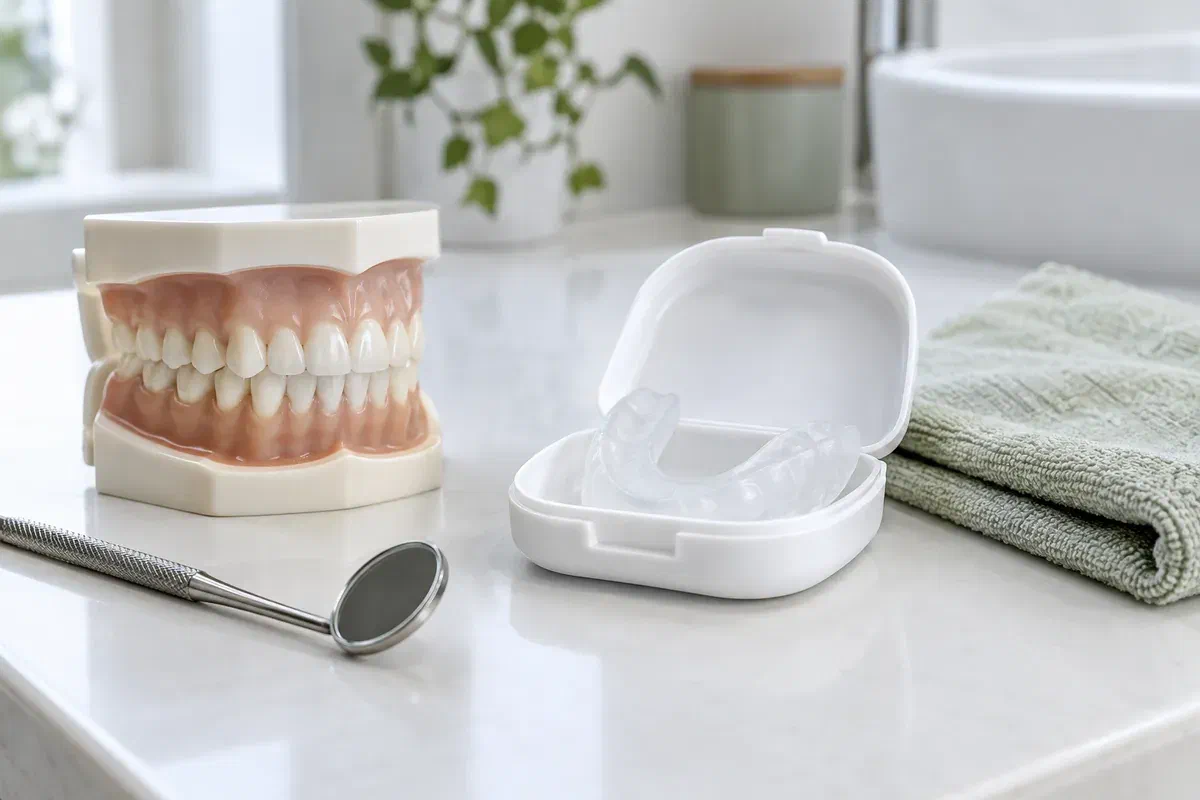
Illustrative dental model, mirror, and protective mouthguard in a case
What to report after an impact

Describe the event as well as the tooth.

The mechanism, timing, and symptoms help guide assessment. Do not repeatedly wiggle a tooth or ask your child to bite hard to see whether it is still injured.

A chip, fracture, or missing fragment

Mention how much appears missing and whether the tooth is sensitive or painful. If you find a broken fragment safely, keep it moist in milk or water and bring it to the dentist. Do not glue it back or file a sharp edge at home.

A tooth that feels loose or looks displaced

Report a tooth that appears longer, shorter, tilted, or out of line, or a bite that no longer fits normally. These changes need prompt professional assessment. Do not push a displaced or intruded tooth into position yourself or assume it is merely a naturally loose baby tooth.

Soft-tissue injuries or a missing tooth

Describe cuts, swelling, bleeding, and any tooth or fragment that cannot be found. Explain other symptoms after the accident, including possible head injury. The clinician needs the wider picture to decide what should be assessed and whether medical care is also required.

For a knocked-out permanent tooth, obtain immediate first-aid advice and dental care. Hold the crown rather than the root and keep the tooth moist in milk if it cannot be safely replanted. Never put a loose tooth inside a young child's cheek.

Why injury-specific care matters

Look beyond the visible chip to the whole injury.

A tooth can have more than one type of injury after the same impact. The examination may need to consider the crown, root, supporting tissues, and pulp inside the tooth. A cosmetic repair alone does not establish that those other structures have recovered.

The stage of development also affects treatment planning. A young permanent tooth and a baby tooth are not managed as interchangeable versions of the same problem. Ask which tooth is involved, what is known about the injury, and what remains uncertain at the first visit.

Patient information: IADT and AAPD — fractures and luxations of permanent teeth

Treatment linked to the actual damage

The options may include monitoring, repair, stabilization, or another form of care depending on the findings. Ask what each measure is intended to achieve. A splint or a restoration, for example, may address one part of the injury without completing the entire treatment plan.

A record for later comparison

Initial findings and appropriate records provide context for future review. Tell the clinician about any earlier injury to the same area. Ask what information will be compared at follow-up and which changes would lead to further assessment or treatment.

A clear explanation of uncertainty

Some outcomes cannot be predicted at the first appointment. Ask what signs are encouraging and what complications are being watched for. Honest follow-up advice is more useful than a promise that a repaired tooth will never need attention again.

From injury assessment to review

Identify the damage, address immediate needs, and plan monitoring.

The sequence and urgency depend on the injury. Contact the clinic by phone about a recent impact rather than relying on a routine online booking request.

  1. Establish the injury history

    Explain the time, place, and type of impact, any first aid, and whether medical care has already been provided. Mention lost teeth or fragments and changes in the bite. Bring relevant health information and details of medicines already given to your child.

  2. Examine the affected and neighbouring areas

    The dentist assesses the teeth and tissues and discusses appropriate imaging or tests. More than the visibly damaged tooth may need review. Ask what can be established now and whether a test result may need reassessment as the tooth responds to the injury.

  3. Discuss and provide indicated treatment

    The plan may involve a repair, stabilization, pulp-related care, observation, or another appropriate option. Explain your child's comfort and communication needs. If a referral or a different care setting is recommended, clarify the reason and the urgency of that next step.

  4. Set the review schedule and home instructions

    Confirm what was completed and which restrictions or cleaning methods apply. Ask when to return and what symptoms should prompt an earlier call. Follow-up after trauma may continue beyond the point at which the tooth looks or feels normal.

Supporting care after a dental injury

Protect the area and keep the planned reviews.

Follow instructions tailored to the injury and treatment. Advice for a small repair may differ from advice for a displaced tooth, splint, or replanted permanent tooth.

Use the eating and cleaning guidance provided

Ask which foods or biting activities to avoid and for how long in your child's situation. Keep the area clean using the demonstrated method. If pain or a splint makes cleaning difficult, contact the team for help rather than abandoning the routine.

Report changes in comfort, colour, or position

Tell the clinic about worsening pain, swelling, a gum bump, an altered bite, or a noticeable colour change. Do not diagnose the outcome from colour alone. The significance depends on the tooth, symptoms, examination, and the type of injury.

Discuss return to sport and protection

Ask when the injured area can tolerate the planned activity and whether a mouthguard is appropriate. If your child already has one, check whether it still fits after treatment or tooth movement. Protection can reduce risk but cannot guarantee that another injury will not occur.

Patient information: IADT — broken teeth and preserving a fragment

Choosing care for the injured tooth

Repair, monitoring, and further treatment answer different needs.

The appropriate option depends on tooth type, injury, development, and the examination. Ask how the immediate plan connects with any later care.

When damaged structure can be restored

A suitable repair with review

A fragment may sometimes be reattached or the surface rebuilt with a suitable material. The dentist can explain the limitations and care required. Repairing the appearance does not remove the need to assess the pulp or supporting tissues when the injury involves them.

When healing and position need monitoring

Observation or stabilization

Some injuries need a defined observation plan; others may require professional repositioning or a splint. The choice and review interval depend on the diagnosis. Monitoring is an active plan with instructions, not a suggestion to ignore the tooth until pain appears.

When the injury involves deeper structures

Additional treatment or specialist assessment

Pulp treatment, extraction, or another intervention may be discussed where indicated. The developing permanent teeth are relevant when baby teeth are injured. Ask why further care is recommended and whether a clinician with particular expertise should be involved.

Patient information: IADT and AAPD — injuries to primary teeth

Questions about children’s dental trauma

Understand why follow-up remains part of the treatment.

Bring questions about the injury, repair, and the changing tooth. A first appointment may establish the starting point without answering every long-term question.

(905) 876-4488
Why does a small visible chip sometimes need a wider dental examination?
The same impact may affect the root, pulp, supporting tissues, or neighbouring teeth. The visible chip does not show the full extent of injury. The dentist can explain which areas need assessment and whether further records or monitoring are appropriate.
Should I bring a broken tooth fragment even if it looks too small to use?
Yes, if you can find it safely. Keep the fragment moist in milk or water and bring it to the assessment. The dentist can decide whether it is useful. Do not delay urgent care searching extensively, and do not attempt to attach it yourself.
Does a tooth turning darker after an injury always need immediate root canal treatment?
Colour alone does not determine the treatment. Report the change so the tooth can be assessed alongside symptoms and other findings. The interpretation differs with the tooth and injury. Do not assume either that treatment is inevitable or that the change can be ignored.
Why are tests on an injured young permanent tooth sometimes repeated?
The response can change after trauma, and an early result may not provide a complete answer. The dentist considers it with the history, examination, and other records. Repeated assessment helps identify the pattern over time rather than relying on a single finding.
Can an injury to a baby tooth affect the permanent tooth developing nearby?
It can, depending on the injury and stage of development. This is one reason primary-tooth trauma needs appropriate assessment and follow-up. Ask what should be watched and when to return. Never replant an avulsed baby tooth in an attempt to protect the space.
Can we skip trauma follow-up once the repair looks normal and my child has no pain?
Keep the recommended reviews unless the treating clinician changes the plan. Some complications may develop later without immediate pain. The follow-up checks more than appearance and gives an opportunity to assess healing, development, and whether any additional care is needed.
Children’s dental trauma treatment in Milton

Let’s assess the injury and plan the follow-up.

Call our Bronte Street practice after a dental injury to discuss availability and the appropriate next step. For a recent urgent injury, use an available emergency dental provider if care cannot be arranged here.

A knocked-out permanent tooth needs immediate care. Serious head injury, breathing or swallowing difficulty, or uncontrolled heavy bleeding requires emergency medical attention.

Visit Milton Dental Clinic
Unit 1, 342 Bronte St. S, Milton, ON L9T 5B7
Get directions Clinic hours
Monday–Thursday
11am–7pm
Friday–Sunday
By appointment only

How can we help?

Milton Dental Clinic

Have a question about your smile? Choose the option that works best for you.

For urgent dental concerns, please call.
Messages are reviewed during clinic hours.