

Illustrative child and parent discussing a sports-related dental concern
Children’s Dentistry

Children’s Dental Trauma Treatment in Erin

A child who has just hurt a tooth may be scared of anyone touching their mouth. For households in Erin and Hillsburgh, we explain how to prepare your child, what the injury assessment involves and how follow-up is planned.

Calming a frightened child

When your child won’t let anyone near the sore tooth

After a fall, many children clamp their mouth shut and refuse to let anyone look. Stay calm and focus first on how they are overall. Emergency medical care takes precedence after a severe hit to the head or face, if your child struggles to breathe or swallow, or if bleeding is heavy and continuing.

When things are quieter, call a dental office and explain what happened and when; you don’t need a perfect view of the tooth to do that. An adult tooth knocked out of the mouth must be seen urgently, and a baby tooth that falls out is never put back. Families coming from Erin can phone us to ask about availability, and if urgent care can’t be arranged here, please go to another emergency dental provider.

At the visit, the team works at your child’s pace while the dentist examines the tooth, the surrounding tissues and its stage of development. You’ll hear what is needed now and what will be reviewed later. Because some changes show up afterwards, ask about follow-up even once your child is happy again.

Book a non-urgent injury visit
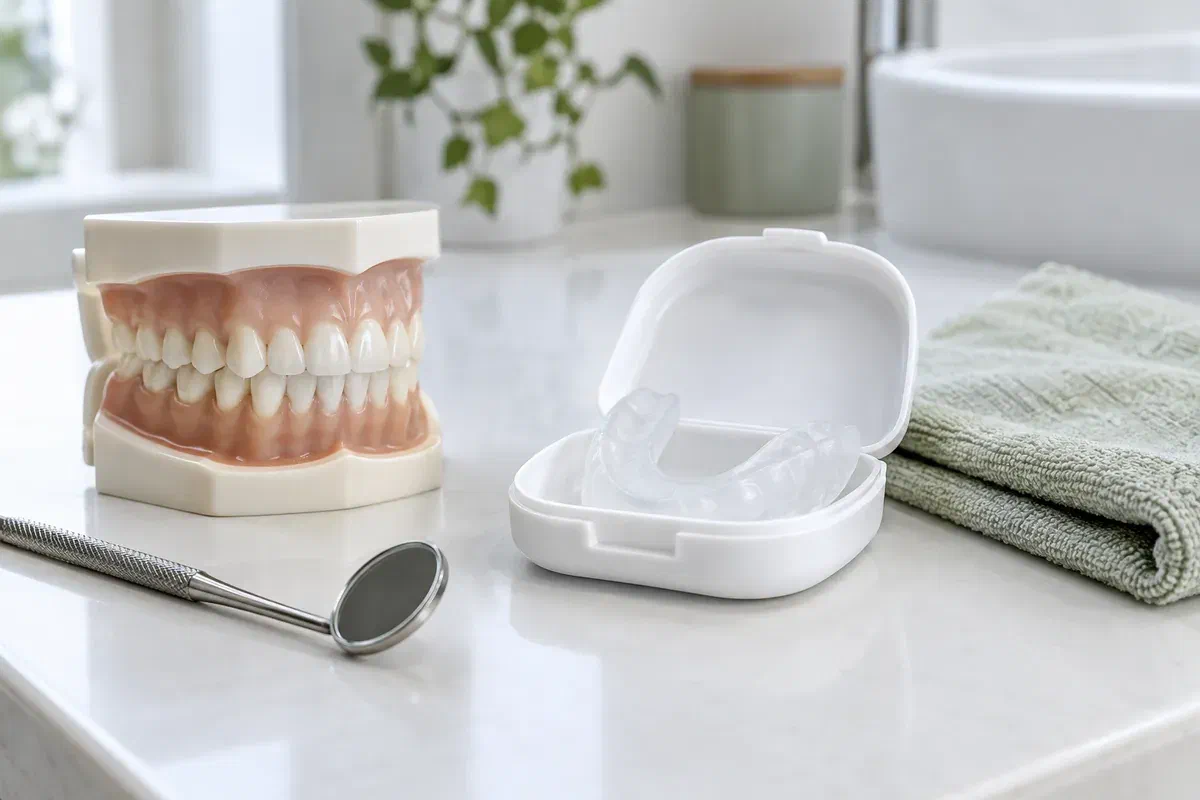
Illustrative dental model, mirror, and protective mouthguard in a case
What you can tell us without a close look

Describe what you saw, even from a distance.

The way it happened, the timing and your child’s behaviour since all help. Don’t force the mouth open, wiggle the tooth or ask your child to bite down to test it.

A broken or chipped tooth

Tell us whether you noticed a missing corner or a bigger gap and whether your child flinches with drinks or air. If the piece turns up and can be picked up safely, keep it moist in milk or water. Don’t attempt to fix or smooth it.

A tooth that looks different in position

Mention a tooth that seems pushed in, sticking out, crooked or out of line, or a child who says their teeth feel wrong when they close. These need prompt assessment. Never push it back, and don’t assume a baby tooth was just loose.

Mouth injuries and other symptoms

Share any cuts, swelling or bleeding, and whether a tooth or piece is missing. Mention unusual sleepiness, vomiting or anything else that might suggest a head injury. That helps the clinician decide what needs examining and whether a physician should be involved.

If a permanent tooth is knocked out, get first-aid advice and dental care immediately. Handle the crown rather than the root, keep the tooth in milk if replanting safely isn’t possible, and don’t let a young child hold it in their mouth.

Why a gentle, thorough look is worth it

The tooth may have more than one injury.

Besides the visible tooth, an impact can affect the root, the pulp inside and the fibres and bone around it. The dentist considers each where relevant. A repair that restores appearance doesn’t confirm that those deeper parts are recovering.

Children’s teeth are at different stages, so the plan for a baby tooth isn’t the same as for a young permanent one. Ask which tooth was injured, what the dentist can tell so far and what will need another visit to answer.

Patient information: IADT and AAPD — fractures and luxations of permanent teeth

Treatment fitted to the findings

Care may involve watching the tooth, a repair, a splint or another option. Ask what each part is intended to do. Sometimes a short first visit handles what is urgent, with more care planned when your child is calmer.

Records for later

First-visit findings give later reviews a point of comparison. Mention any previous injury to the same teeth. Ask what will be compared and what changes would lead to more treatment.

Honesty about what isn’t known yet

Some outcomes can’t be predicted at the outset. Ask which signs are encouraging and what complications are being looked for. A clear plan helps more than a promise that the tooth will never need care again.

A visit built around your child

Talk first, look gently, treat what’s needed.

The sequence and urgency depend on the injury. After a recent one, please phone us rather than requesting a routine appointment online.

  1. A conversation before the exam

    We’ll ask when and where the injury happened, what first aid was given and whether your child has seen a doctor. Mention lost teeth or pieces and bite changes. Bring health information, a note of medicines given and anything that helps your child feel secure.

  2. A careful, step-by-step examination

    The dentist examines the teeth and soft tissue, explaining each step to your child, and discusses imaging or tests. Ask what can be determined today and whether some checks may need repeating as the tooth recovers.

  3. Treatment at a manageable pace

    The dentist may suggest a repair, a splint, pulp treatment, observation or another option. Tell us about your child’s fears, sensory needs and how they show discomfort. If a referral or another setting is suggested, ask why and how urgent it is.

  4. Home guidance and the next visit

    Confirm what was done, which foods and activities to avoid and how to clean the area. Ask when to return and what symptoms mean calling earlier. Follow-up can continue after the tooth looks and feels fine.

Supporting your child at home

Patience with brushing, and a watchful eye

Home instructions follow the injury and treatment. A minor repair may need different care from a splinted, displaced or replanted adult tooth.

Make eating and cleaning manageable

Ask which foods to avoid and for how long. Clean the area as shown, perhaps letting your child hold the brush first or using a mirror. If soreness or a splint makes cleaning a battle, call us for ideas rather than abandoning it.

Notice changes and let us know

Phone about growing pain, swelling, a bump on the gum, a bite that feels different or a change in colour. Colour on its own isn’t a diagnosis; the dentist reads it alongside the symptoms and the examination.

Return to play when the dentist agrees

Ask when your child can go back to sports and boisterous play, and whether a mouthguard is worth considering. An existing guard should be checked for fit. Protection reduces risk but can’t prevent every injury.

Patient information: IADT — broken teeth and preserving a fragment

Treatment choices

What might be recommended, and why

The choice depends on the type of tooth, the injury, development and what the dentist finds. Ask how the immediate plan fits with later care.

When damaged structure can be restored

A repair, then review

A fragment may be reattached, or the tooth rebuilt with a tooth-coloured material. The dentist will explain its limits and how to look after it. A good-looking repair doesn’t replace assessment of the pulp or supporting tissue if they were involved.

When position and healing need tracking

Watching or steadying the tooth

Some injuries are best managed with planned observation; others need the tooth repositioned or splinted. The diagnosis shapes the approach and review timing. Observation follows a plan rather than waiting for symptoms.

When deeper structures are affected

Further care or a referral

Pulp care, extraction or another procedure may be discussed if indicated. With baby teeth, the adult tooth growing beneath them is considered. Ask why further care is needed and whether a dentist with specialist training should see your child, especially if anxiety makes treatment hard.

Patient information: IADT and AAPD — injuries to primary teeth

Questions about nervous children

Helping an upset child through injury care

Bring questions about your child’s comfort as well as the tooth. Some answers about the tooth’s future only come with time.

(905) 876-4488
How can I prepare my child for a dental visit after an injury?
Use simple, honest words about what will happen, such as the dentist counting and looking at teeth. Bring a comfort item if it helps, and tell the team in advance about your child’s worries or sensory needs.
What if my child won’t open their mouth for the dentist?
The team will go gently and explain each step. Let us know what usually helps your child. If an examination isn’t possible, the dentist can discuss other options, including whether a different setting may be appropriate.
Can I stay with my child during the injury assessment?
Parents can usually stay close for support. Ask the team when you call so you know what to expect. Your calm presence often helps a frightened child cope better.
Does a small chip mean the dentist won’t need to look at other teeth?
The same force can affect the root, pulp or neighbouring teeth even when the chip is tiny. The dentist may check more than the obvious tooth and explain why.
Will my child remember the injury and be afraid of the dentist afterwards?
Some children are wary after an injury. A calm first visit, plain explanations and keeping later reviews predictable can help. Tell the team if worry is growing so they can adjust their approach.
Is there any way to keep visits from Erin short for an anxious child?
Ask what each appointment will involve so you can prepare your child and plan the trip. Some visits are brief checks. The dentist decides what’s needed, but we can talk about timing that suits your child.
Gentle tooth injury care for Erin families

We’ll go at your child’s pace.

Call our Bronte Street practice to describe the injury, share your child’s needs and discuss availability. For a recent urgent injury that can’t be seen here, please use an available emergency dental provider.

Get immediate care for a knocked-out adult tooth. Emergency medical attention is needed for a serious head injury, trouble breathing or swallowing, or bleeding that won’t ease.

Visit Milton Dental Clinic
Unit 1, 342 Bronte St. S, Milton, ON L9T 5B7
Get directions Clinic hours
Monday–Thursday
11am–7pm
Friday–Sunday
By appointment only

Areas we serve

  • Milton
  • Oakville
  • Mississauga
  • Georgetown
  • Halton Hills
  • Acton
  • Campbellville
  • Brampton
  • Burlington
  • Puslinch
  • Rockwood
  • Erin
  • Caledon
  • Etobicoke
  • Old Milton
  • Bronte Meadows
  • Timberlea
  • Dorset Park
  • Dempsey
  • Clarke
  • Beaty
  • Coates
  • Harrison
  • Scott
  • Willmott
  • Ford
  • Bowes
  • Cobden
  • Walker
  • Mountain View
  • Milton Heights
  • Hawthorne Village
  • Valley View
  • Fallingbrook
  • Nassagaweya
  • Trafalgar
  • Esquesing
  • Nelson
  • Brookville
  • Moffat
  • Glen Williams
  • Norval
  • Limehouse
  • Stewarttown
  • Ashgrove
  • Hornby
  • Silver Creek
  • Speyside
  • Scotch Block
  • North Oakville
  • River Oaks
  • Glen Abbey
  • West Oak Trails
  • Palermo
  • Bronte Creek
  • College Park
  • Joshua Creek
  • Uptown Core
  • Preserve
  • Iroquois Ridge
  • Lisgar
  • Meadowvale
  • Meadowvale Village
  • Churchill Meadows
  • Erin Mills
  • Central Erin Mills
  • Streetsville
  • East Credit
  • Creditview
  • Heartland
  • Sheridan
  • Mount Pleasant
  • Credit Valley
  • Huttonville
  • Churchville
  • Springbrook
  • Northwest Brampton
  • Bram West
  • Fletcher's Meadow
  • Fletcher's Creek South
  • Alton Village
  • Orchard
  • Millcroft
  • Headon Forest
  • Tansley
  • Brant Hills
  • Tyandaga
  • Kilbride
  • Lowville
  • Aberfoyle
  • Morriston
  • Arkell
  • Hillsburgh
  • Freelton
  • Carlisle
  • Waterdown
  • Flamborough
  • Mountsberg

How can we help?

Milton Dental Clinic

Have a question about your smile? Choose the option that works best for you.

For urgent dental concerns, please call.
Messages are reviewed during clinic hours.