

Illustrative child and parent discussing a sports-related dental concern
Children’s Dentistry

Children’s Dental Trauma Treatment in Halton Hills

Trampolines, bikes and backyard games bring their share of bumped teeth. When a child in Halton Hills hurts a tooth, a quick call helps you judge how soon to come in, and we plan the treatment and the check-ups that follow.

How soon does it need to be seen?

Today, tomorrow, or this week?

Most parents’ first question after a backyard spill is about timing. The answer starts with your child rather than the tooth. Get emergency medical help straight away for a hard hit to the head or face, breathing or swallowing that seems laboured, or bleeding you can’t bring under control.

After that, phone a dental office and describe the accident and its timing so someone can help you judge urgency. A permanent tooth knocked fully out sits at the top of the list and needs care immediately. Baby teeth that come out are left out; they are never put back. From anywhere in Halton Hills, call us about availability, and if urgent care isn’t possible here, reach another emergency dental provider.

Even a visit that can wait a day is about more than appearance. The dentist checks the tooth, the gum and bone holding it and its stage of growth, then lays out what is needed now and what gets rechecked. Problems sometimes develop slowly, so ask what the review plan covers once the soreness is gone.

Set up a non-urgent injury visit
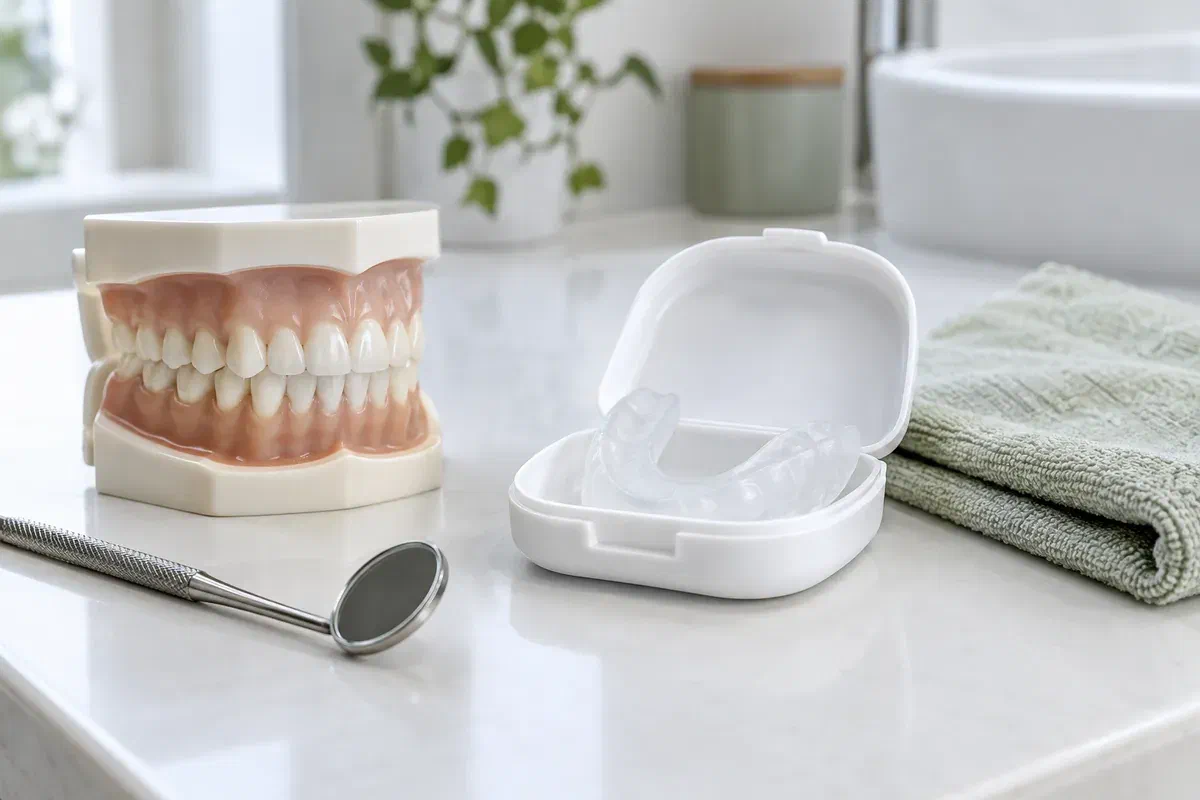
Illustrative dental model, mirror, and protective mouthguard in a case
Signs that shape the timing

Three things that tell us how quickly to act

The force, the hour it happened and what your child is feeling now all affect how soon to come in. It helps not to rock the tooth or ask for a hard bite to test it.

A fractured tooth

Say whether it is a small corner or a bigger section and whether there is pain or sensitivity. If the missing piece turns up and is safe to collect, drop it into milk or water. Leave the sharp edge for the dentist rather than smoothing it.

A tooth knocked out of place

A tooth that now looks lower, higher, angled or out of step with the others, or a bite that no longer feels right, should be examined promptly. Don’t push it back yourself, and don’t put it down to a baby tooth that was about to drop out anyway.

Soft tissue and anything unaccounted for

Mention a cut lip or gum, swelling, bleeding and any tooth or fragment still missing after a search. Other symptoms count too, particularly anything suggesting a head injury. The clinician weighs all of it to decide on the examination and whether a physician is also needed.

An adult tooth knocked out completely is the most urgent case: get first-aid instructions and dental care at once. Touch the crown only, store it in milk if replanting it safely isn’t possible, and keep it out of a young child’s mouth.

Why the dentist looks deeper

Surface repair, deeper questions

Behind a visible chip there may be a bruised root, an affected pulp or strained supporting fibres. The examination takes these into account where they apply. Smoothing and rebuilding the front of the tooth cannot confirm that what lies underneath is recovering.

Your child’s age points the plan in a particular direction. Baby teeth and newly arrived permanent teeth are handled on their own terms. You can ask which tooth is involved, what the dentist is sure of and what will only become clear later.

Patient information: IADT and AAPD — fractures and luxations of permanent teeth

Treatment that answers the findings

Depending on what the examination shows, the dentist may suggest watching, rebuilding or steadying the tooth, or something else. It is worth asking the purpose of each step, since a single repair may address only one part of what happened.

A first snapshot to measure against

Notes and records from day one make later reviews meaningful. Let us know about any old injury in the same spot. Ask what the dentist will compare next time and what would trigger further investigation.

Plain answers about uncertainty

Early on, nobody can promise how an injured tooth will do. Ask which signs would be positive and which complications are on the dentist’s radar. A follow-up plan you understand beats a vague assurance.

The visit, in order

We start with questions and finish with a calendar.

How fast this moves depends on the injury. Please ring the clinic after a recent injury rather than using the routine online booking form.

  1. Questions about the accident

    We’ll ask the time and place, what your child struck, the first aid given and whether a doctor has already been involved. Tell us about any missing teeth or pieces and bite changes, and bring your child’s health details and medicines taken.

  2. A careful look in and around the mouth

    The injured tooth, its neighbours and the soft tissues are examined, and the dentist talks about any imaging or tests that would help. Ask what today’s findings show and whether some checks will be repeated while the tooth settles.

  3. Care for the immediate problem

    This might be a bonded repair, a splint, treatment involving the pulp, a period of watching or another approach. Tell us what helps your child cope in the chair. Should a referral be needed, ask the reason and the timeframe.

  4. Instructions and review dates

    Before leaving, confirm what was done, any limits on food, activity and brushing, and the date of the next check. Ask which symptoms mean calling early. Reviews may run on after the tooth seems completely normal.

At home after treatment

The next few weeks matter.

Advice varies with the injury and the treatment. A minor repair often comes with simpler instructions than a tooth that was moved, splinted or replanted.

Softer food and careful cleaning

Ask which foods and biting habits to steer clear of, and for how long. Brush and clean the area with the technique shown. When a splint or soreness gets in the way, a quick call for advice is better than skipping the routine.

A watch for anything new

Phone if pain builds, swelling appears, a small bump forms on the gum, the bite shifts or the tooth starts to change colour. Colour alone isn’t a verdict; what it means depends on the tooth, the symptoms and the original injury.

Trampoline, bike and sport timing

Check when your child can go back to active play and organised sport, and whether a mouthguard would help. A guard they already own should be refitted or checked after treatment. It lowers risk without removing it.

Patient information: IADT — broken teeth and preserving a fragment

Possible routes after the examination

Not every injured tooth needs the same fix.

Tooth type, injury pattern, stage of growth and the examination all steer the decision. Ask how the first step leads into anything planned later.

When the broken part can be replaced

Restoring the shape, then checking

Occasionally the original fragment can be bonded on again; otherwise the dentist may build the tooth back up with a tooth-coloured material and explain how to protect it. Looking whole again isn’t proof that the pulp and supporting tissue are fine.

When the tooth’s position is in question

Holding steady or watching closely

Some injuries are managed with a set observation schedule; others need the tooth guided back into position or held with a splint. Which one, and how often to return, follows from the diagnosis. Watching is planned care, not waiting for trouble.

When the injury reaches the root or pulp

Going further, sometimes with a specialist

Where it’s indicated, care for the pulp, removing the tooth or another procedure may come up. For a baby tooth, the adult tooth growing beneath it is part of that conversation. Ask the reason for added care and whether a clinician with specific expertise should be consulted.

Patient information: IADT and AAPD — injuries to primary teeth

Timing and treatment questions

How urgent is it, and what comes after?

Questions about urgency, repair or the months ahead are all welcome. A first visit gives a baseline; some answers take longer.

(905) 876-4488
Which tooth injuries in children need same-day dental care?
A knocked-out adult tooth needs immediate care, and a tooth that has clearly moved, a large break or significant pain should be discussed with a dental office right away. Call and describe the injury so the team can advise how quickly your child should be seen.
My child fell off the trampoline last night but seems okay. Can it wait until Monday?
Call to describe the injury rather than guessing. Some injuries can safely be seen in a day or two, while others shouldn’t wait. A tooth that looks out of place, a broken tooth or increasing pain are reasons to speak to someone sooner.
Is ice helpful for a swollen lip after a tooth injury?
A cold compress on the outside of the lip may help with comfort. Follow the first-aid advice you get when you call, and mention the swelling so the dentist can check the soft tissue along with the teeth.
Why might the dentist look at my child’s bottom teeth when the top one was hit?
An impact can drive the jaws together, so the opposite teeth and those next to the injured one may be affected without an obvious chip. Checking them helps make sure part of the injury isn’t missed.
Does a tooth that changes colour after a fall always need a root canal?
No single sign decides that. A colour change should be reported and assessed with symptoms and other findings. It doesn’t automatically lead to a particular treatment, and it shouldn’t be ignored.
How do families across Halton Hills keep track of trauma reviews?
Ask for the expected schedule at the first visit and add each date to your calendar straight away. Reviews can stretch over months. If something new appears between visits, call to decide whether to come in sooner.
Tooth injury care for children in Halton Hills

Not sure how urgent it is? Let’s talk it through.

Call our Bronte Street practice to describe what happened so we can discuss availability and timing. For a recent injury that is urgent and can’t be seen here, please contact an available emergency dental provider.

Immediate care is needed for a knocked-out adult tooth. For a serious head injury, laboured breathing or swallowing, or heavy bleeding that won’t ease, seek emergency medical attention.

Visit Milton Dental Clinic
Unit 1, 342 Bronte St. S, Milton, ON L9T 5B7
Get directions Clinic hours
Monday–Thursday
11am–7pm
Friday–Sunday
By appointment only

Areas we serve

  • Milton
  • Oakville
  • Mississauga
  • Georgetown
  • Halton Hills
  • Acton
  • Campbellville
  • Brampton
  • Burlington
  • Puslinch
  • Rockwood
  • Erin
  • Caledon
  • Etobicoke
  • Old Milton
  • Bronte Meadows
  • Timberlea
  • Dorset Park
  • Dempsey
  • Clarke
  • Beaty
  • Coates
  • Harrison
  • Scott
  • Willmott
  • Ford
  • Bowes
  • Cobden
  • Walker
  • Mountain View
  • Milton Heights
  • Hawthorne Village
  • Valley View
  • Fallingbrook
  • Nassagaweya
  • Trafalgar
  • Esquesing
  • Nelson
  • Brookville
  • Moffat
  • Glen Williams
  • Norval
  • Limehouse
  • Stewarttown
  • Ashgrove
  • Hornby
  • Silver Creek
  • Speyside
  • Scotch Block
  • North Oakville
  • River Oaks
  • Glen Abbey
  • West Oak Trails
  • Palermo
  • Bronte Creek
  • College Park
  • Joshua Creek
  • Uptown Core
  • Preserve
  • Iroquois Ridge
  • Lisgar
  • Meadowvale
  • Meadowvale Village
  • Churchill Meadows
  • Erin Mills
  • Central Erin Mills
  • Streetsville
  • East Credit
  • Creditview
  • Heartland
  • Sheridan
  • Mount Pleasant
  • Credit Valley
  • Huttonville
  • Churchville
  • Springbrook
  • Northwest Brampton
  • Bram West
  • Fletcher's Meadow
  • Fletcher's Creek South
  • Alton Village
  • Orchard
  • Millcroft
  • Headon Forest
  • Tansley
  • Brant Hills
  • Tyandaga
  • Kilbride
  • Lowville
  • Aberfoyle
  • Morriston
  • Arkell
  • Hillsburgh
  • Freelton
  • Carlisle
  • Waterdown
  • Flamborough
  • Mountsberg

How can we help?

Milton Dental Clinic

Have a question about your smile? Choose the option that works best for you.

For urgent dental concerns, please call.
Messages are reviewed during clinic hours.