

Illustrative child and parent discussing a sports-related dental concern
Children’s Dentistry

Children’s Dental Trauma Treatment in Puslinch

Treating a child’s injured tooth usually means several visits spread over time, not one. For households in Puslinch, we explain what happens at the first appointment, what each review checks and how to plan around them.

The long view of a tooth injury

Why one injury can mean several visits

Families who live further out often ask early on how many trips an injured tooth will need. That depends on the injury, and on the day itself your child’s safety is the first concern. Seek emergency medical care for any serious knock to the head or face, trouble breathing, difficulty swallowing or bleeding that pressure isn’t controlling.

For the tooth, ring a dental office promptly with the details of how and when it was hurt. An adult tooth knocked out of its socket needs dental care without delay. A baby tooth that comes out is never to be replanted. From Puslinch, call us to ask what availability we have, and if urgent care can’t be arranged here, find another emergency dental provider.

The first visit usually handles the immediate problem and sets up what comes after. The dentist examines the tooth, the gum and bone, and your child’s stage of development, then explains today’s treatment and the review schedule. Because some changes show up later, ask what each future visit will be looking for.

Schedule a non-urgent injury review
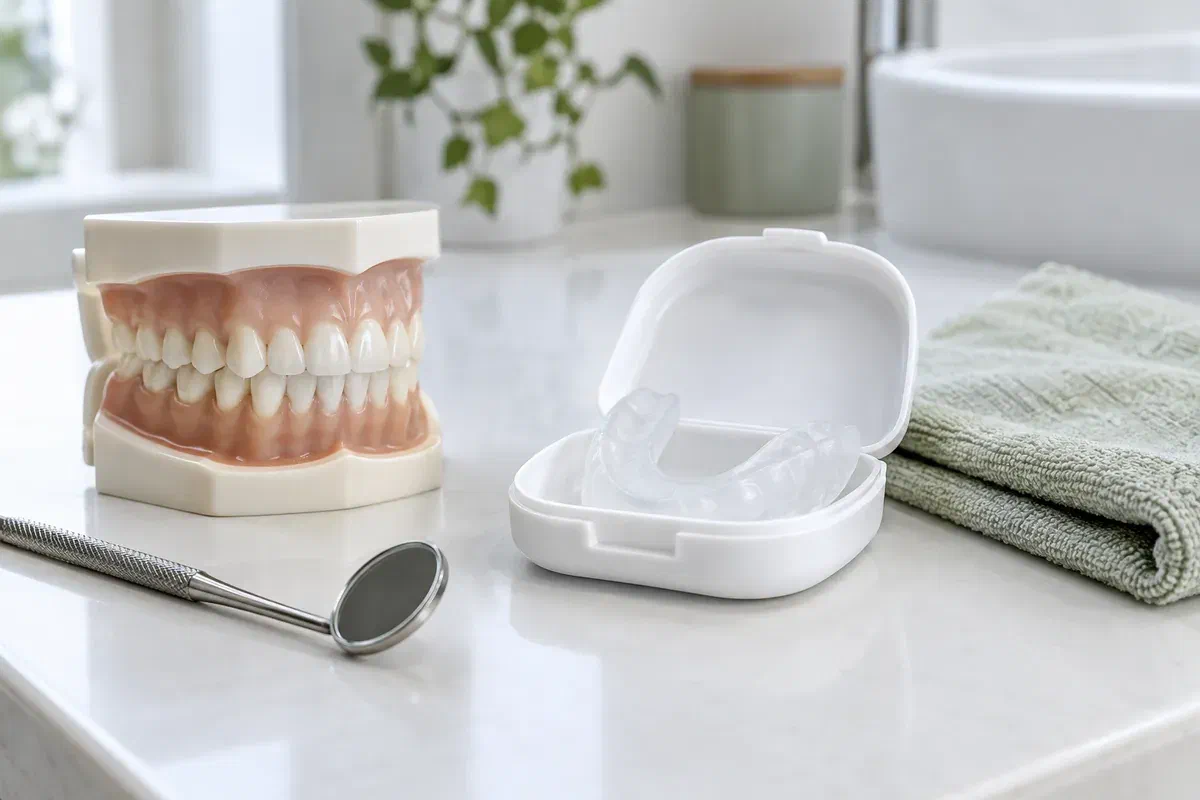
Illustrative dental model, mirror, and protective mouthguard in a case
Details that shape the follow-up plan

The more we know now, the better each review compares.

Describing the impact, its timing and your child’s symptoms helps the dentist decide what to examine and track. Try not to test the tooth by wiggling it or getting your child to bite firmly.

Damage to the tooth itself

Tell us how much of the tooth appears to be gone and whether it hurts or reacts to cold. If the fragment can be found and picked up safely, keep it moist in milk or water and bring it. Please don’t glue it or smooth the edge.

Changes in where the tooth sits

Let us know if a tooth now looks longer or shorter, angled or out of line, or the bite has changed. This needs prompt assessment. Resist pushing the tooth back, and don’t assume a baby tooth was simply loosening on its own.

Injuries to the soft tissue

Mention a cut lip or gum, swelling, bleeding and anything that went missing, whether a whole tooth or a piece. Share any symptoms that might suggest a head injury. With this, the clinician can plan the examination and decide whether medical input is needed too.

A knocked-out permanent tooth calls for first-aid guidance and dental care immediately. Hold it only by the crown, store it in milk if replanting safely isn’t possible, and never let a young child hold it in their cheek.

What reviews are really for

Each visit compares today with the day of the injury.

An impact can affect the crown, the root, the pulp and the supporting tissues, and not all of those changes are visible at once. Reviews give the dentist a chance to look again. A repair that looks right at the first visit doesn’t confirm what is happening inside.

Your child’s teeth are still developing, so the dentist may also be watching how a young root continues to form or how an adult tooth comes in beneath an injured baby tooth. Ask which tooth is affected, what is known and what the reviews are meant to answer.

Patient information: IADT and AAPD — fractures and luxations of permanent teeth

Care tied to the findings

Treatment may be monitoring, a repair, a splint or another approach. Ask what each step accomplishes. A restoration may address the visible damage while the review visits track the pulp and root.

A baseline for every comparison

Records from the first visit are what later reviews are measured against. Tell the dentist about any past injury to the same area. Ask what will be compared at each visit and what change would lead to more care.

A clear sense of what’s uncertain

Some outcomes can only be judged over time. Ask which findings would be reassuring and which complications are being watched. Honest guidance about the review plan is more useful than a promise that nothing else will be needed.

How the first visit sets up the rest

Four stages, one plan

Urgency and order depend on the injury. Please phone the clinic about a recent injury rather than relying on the routine online booking request.

  1. Record the injury history

    Explain when and where it happened, what your child hit, what first aid was done and whether they were seen by a doctor. Mention lost teeth or pieces and bite changes. Bring your child’s health information and any medicines given.

  2. Examine and document

    The dentist checks the injured tooth, nearby teeth and soft tissue, and discusses imaging or tests. These first findings become the reference point. Ask which results may change and need repeating as the tooth recovers.

  3. Treat what needs treating now

    Care may include a repair, a splint, pulp treatment, observation or another option. Tell us what helps your child feel at ease. If a referral is advised, ask what it’s for and how urgent it is.

  4. Book the review sequence

    Confirm what was done, any limits on food, activity or cleaning, and the full set of review dates as far as they are known. Ask which symptoms mean calling early. Reviews often continue after the tooth seems back to normal.

Between review visits

What you notice at home helps at the next check.

Your aftercare will suit the injury and treatment. Instructions for a minor repair may differ from those for a displaced, splinted or replanted tooth.

Follow the eating and hygiene guidance

Ask which foods and activities to avoid and for how long. Clean the area as you were shown. If discomfort or a splint makes brushing difficult, call us instead of skipping it.

Report anything that changes

Phone the clinic if pain increases, swelling appears, a gum bump develops, the bite shifts or the tooth darkens. Mention these at your review too. Colour alone doesn’t settle anything; the dentist looks at it with symptoms and the examination.

Plan the return to activity

Ask when your child can go back to sports and whether a mouthguard is sensible. If they have one, have it checked after treatment. A guard reduces the chance of another injury without ruling it out.

Patient information: IADT — broken teeth and preserving a fragment

Treatment and what follows it

Every option comes with its own review plan.

Which approach suits depends on the tooth, the injury, growth and examination findings. Ask how today’s care shapes the reviews that follow.

When the damaged part can be restored

A repair, checked over time

A fragment may be bonded back on, or the shape rebuilt with an appropriate material. The dentist explains its limits and care. Reviews then check the pulp and supporting tissues, which a good-looking repair can’t vouch for.

When position and healing need tracking

Observation or splinting

Some injuries are managed with a structured observation plan; others need repositioning or a splint. The diagnosis decides the approach and spacing of visits. Observation means returning on schedule, not waiting for pain.

When deeper parts of the tooth are affected

More care if the reviews show a need

If indicated, pulp treatment, extraction or another option may be discussed, sometimes only after a review reveals a change. For a baby tooth, the developing adult tooth matters too. Ask why further care is suggested and whether specialist input would help.

Patient information: IADT and AAPD — injuries to primary teeth

Questions about review visits

What happens at a trauma review?

Bring questions about the review schedule, the treatment and what’s being watched. Some answers depend on how the tooth responds.

(905) 876-4488
What does the dentist actually check at a trauma review appointment?
Usually the tooth’s comfort, position, colour and response, the gum around it and, where appropriate, imaging compared with earlier records. The dentist will explain what is being checked in your child’s case.
Why can’t the dentist tell us at the first visit whether the tooth will be fine?
Some effects of an injury take time to show, and early test results may change as the tooth recovers. Reviews let the dentist build a fuller picture rather than relying on one visit.
Do review visits involve X-rays every time?
Not necessarily. Whether imaging is used depends on the injury and what the dentist needs to compare. Ask what each review will include and why.
My child’s injured tooth seems fine now. What would we be missing if we skipped a review?
Some complications develop without pain and are only picked up on examination or imaging. Keep the scheduled reviews unless the dentist changes the plan.
Do we need to keep an eye on the adult tooth after a baby tooth was injured?
Yes, depending on the injury. The dentist may watch how the adult tooth develops and comes in. Ask what to look for at home and when the next check is due.
Can reviews be spaced to make the drive from Puslinch easier?
The dentist sets the schedule around the injury, so ask early what it looks like and which visits are most important. We can try to fit dates to your routine, but please don’t postpone a review without talking to us.
Child dental trauma care for Puslinch

Start the plan with a phone call.

Call our Bronte Street practice after your child injures a tooth so we can discuss availability, the first visit and what follows. For a recent urgent injury that can’t be seen here, please go to an available emergency dental provider.

Immediate care is needed if a permanent tooth is knocked out. A serious head injury, breathing or swallowing difficulty, or heavy bleeding that won’t stop requires emergency medical attention.

Visit Milton Dental Clinic
Unit 1, 342 Bronte St. S, Milton, ON L9T 5B7
Get directions Clinic hours
Monday–Thursday
11am–7pm
Friday–Sunday
By appointment only

Areas we serve

  • Milton
  • Oakville
  • Mississauga
  • Georgetown
  • Halton Hills
  • Acton
  • Campbellville
  • Brampton
  • Burlington
  • Puslinch
  • Rockwood
  • Erin
  • Caledon
  • Etobicoke
  • Old Milton
  • Bronte Meadows
  • Timberlea
  • Dorset Park
  • Dempsey
  • Clarke
  • Beaty
  • Coates
  • Harrison
  • Scott
  • Willmott
  • Ford
  • Bowes
  • Cobden
  • Walker
  • Mountain View
  • Milton Heights
  • Hawthorne Village
  • Valley View
  • Fallingbrook
  • Nassagaweya
  • Trafalgar
  • Esquesing
  • Nelson
  • Brookville
  • Moffat
  • Glen Williams
  • Norval
  • Limehouse
  • Stewarttown
  • Ashgrove
  • Hornby
  • Silver Creek
  • Speyside
  • Scotch Block
  • North Oakville
  • River Oaks
  • Glen Abbey
  • West Oak Trails
  • Palermo
  • Bronte Creek
  • College Park
  • Joshua Creek
  • Uptown Core
  • Preserve
  • Iroquois Ridge
  • Lisgar
  • Meadowvale
  • Meadowvale Village
  • Churchill Meadows
  • Erin Mills
  • Central Erin Mills
  • Streetsville
  • East Credit
  • Creditview
  • Heartland
  • Sheridan
  • Mount Pleasant
  • Credit Valley
  • Huttonville
  • Churchville
  • Springbrook
  • Northwest Brampton
  • Bram West
  • Fletcher's Meadow
  • Fletcher's Creek South
  • Alton Village
  • Orchard
  • Millcroft
  • Headon Forest
  • Tansley
  • Brant Hills
  • Tyandaga
  • Kilbride
  • Lowville
  • Aberfoyle
  • Morriston
  • Arkell
  • Hillsburgh
  • Freelton
  • Carlisle
  • Waterdown
  • Flamborough
  • Mountsberg

How can we help?

Milton Dental Clinic

Have a question about your smile? Choose the option that works best for you.

For urgent dental concerns, please call.
Messages are reviewed during clinic hours.