

Illustrative parent and child discussing a molar model during a dental consultation
Children’s Dentistry

Pediatric Pulpectomy in Milton

Hearing the word “pulpectomy” at your child’s appointment raises a lot of questions at once. Our Milton team can explain why a baby tooth’s inner tissue may need treatment, whether the tooth is worth keeping, and what restoration and review would follow.

What the recommendation means

A baby tooth with a damaged centre still deserves a careful decision.

Inside every primary tooth sits the pulp, a soft core of nerves and blood vessels. When that tissue is inflamed beyond recovery, or has died, the tooth may still have enough sound structure to keep. A pulpectomy then removes the affected pulp from the crown and root canals, cleans those spaces, and fills them with a material suited to a baby tooth.

A pulpotomy is a different procedure: it tries to keep healthy living tissue in the roots, while a pulpectomy treats the whole canal system. Nor is it an adult root canal in miniature, because a primary tooth’s roots and the permanent tooth forming beneath them change how the dentist diagnoses, chooses materials and plans checks.

For Milton families, our first conversation is about whether keeping the tooth makes sense in the first place. Symptoms, root condition, how much tooth remains, your child’s health and any other treatment needs all shape that answer. We will tell you plainly what we recommend next, and when a pediatric dental referral or a different approach would serve your child better.

Talk through your child’s pulpectomy plan
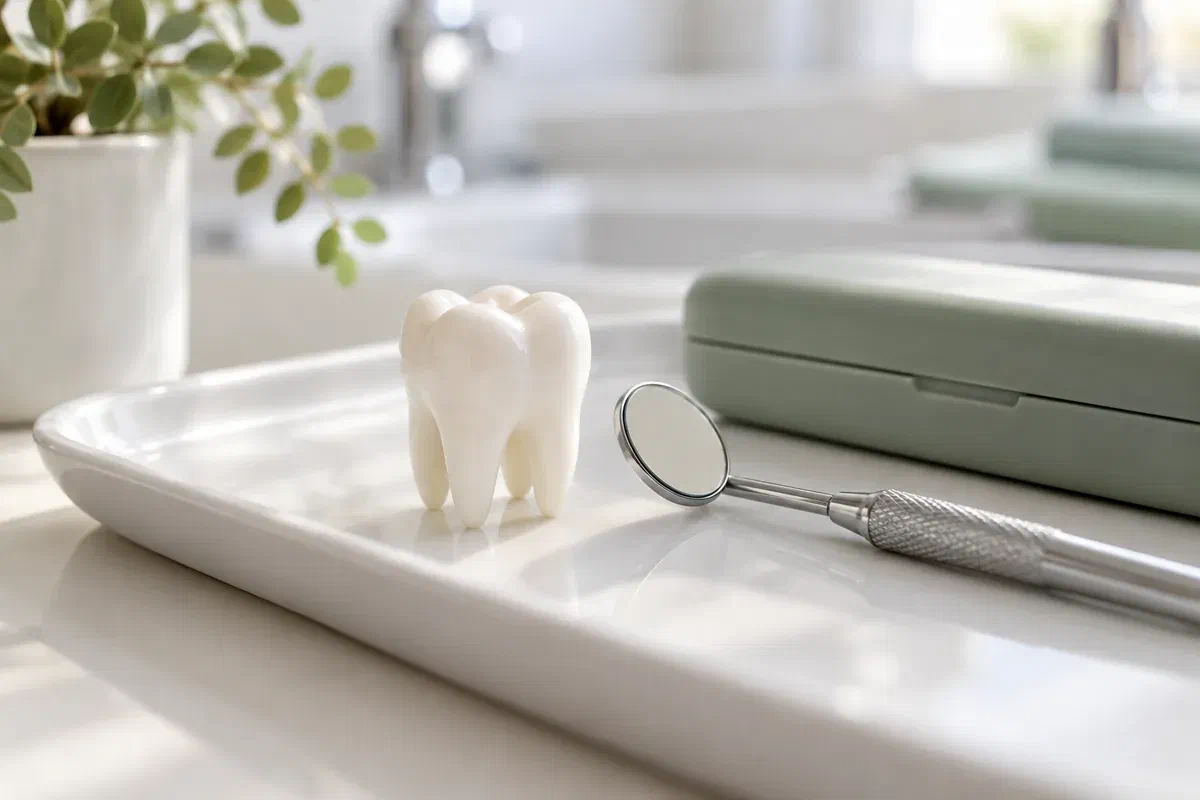
Illustrative opaque molar model and mirror on a clean dental tray
Details worth telling us

What happened at home matters as much as what we see in the chair.

Assessment combines your account, a clinical examination and suitable imaging. A child who seems fine on the day of the visit may still have a tooth with a serious history.

Toothache that comes on its own or at night

Note roughly when the pain started, whether it appears without chewing, and whether it has woken your child. Tell us what medicine you have given and whether it helped. That timeline lets the clinician judge the tooth without depending only on how your child behaves in the chair.

A bump, bad taste or puffiness by the tooth

Mention any gum pimple, odd taste, discharge or facial swelling, even if it seemed to go away by itself. Each of these needs to be looked at. Please do not press on a gum bump, and do not take drainage as a sign that the cause has cleared.

Not much tooth left to work with

How much crown remains and what the roots look like both influence whether a pulpectomy is a reasonable choice. Ask how near the tooth may be to falling out naturally and how that changes the advice. A picture of the cavity on its own cannot answer that.

Call for prompt dental advice if you suspect an infection. Trouble breathing or swallowing, facial swelling that spreads quickly, or a child who is very unwell needs emergency medical care.

What treatment is trying to achieve

Clearing infection from inside the tooth, then asking if it can keep doing its job.

In a well-chosen primary tooth, a pulpectomy aims to deal with diseased pulp so the tooth can stay and keep working. The state of the roots weighs heavily in deciding which teeth are suitable. Removal should be discussed honestly alongside it, because keeping the tooth is not always the right call.

No dentist can promise a good result. You should hear about the outlook for this particular tooth, what the treatment cannot do, and what would happen if pain or swelling continued or came back. Knowing those possibilities lets you decide calmly, without assuming that saving a baby tooth is always worth any effort.

Patient information: AAPD — non-vital pulp therapies in primary teeth

A choice tied to how your child is growing

Ask what this tooth would offer during the time it has left. The answer may involve chewing and the way the developing teeth come in. It should also weigh how demanding the treatment is and whether the restoration and reviews can realistically be completed.

Inner treatment and an outer repair

Cleaning the canals does not rebuild a broken biting surface. A proper final restoration belongs in the plan from the start. Ask how the tooth will be sealed and protected, and whether the booked visits cover every stage.

Records that make later checks meaningful

Clinical notes and appropriate X-rays allow the dentist to compare the tooth over time. Find out when the first review is due and how later checks will be booked. What you notice about eating, comfort and any returning swelling still counts alongside those records.

From assessment to final seal

Four stages, planned around your child.

How many visits are needed, and how long each takes, depends on the tooth and on your child. Ask how comfort will be handled and whether a different setting would suit the treatment better.

  1. Confirm the diagnosis and talk through the plan

    The clinician weighs symptoms, examination findings, root changes and whether the tooth can be restored. You will hear about reasonable alternatives and the likely outlook. Ask whether a specialist should be involved and what would happen if something unexpected turned up.

  2. Plan comfort and keep the tooth isolated

    Local anaesthetic and good isolation are arranged to suit the case. Your child should know a simple way to signal discomfort. Tell us about past difficult visits, medical conditions or support needs ahead of time rather than partway through.

  3. Remove the affected pulp and fill the canals

    The dentist takes out the diseased tissue and cleans the inner spaces with suitable techniques. The canals of a primary tooth are then filled with a resorbable material. Methods vary from tooth to tooth, and this is clinical work only, never something to attempt at home.

  4. Rebuild the tooth and book the next check

    A sound seal and restoration are needed, and a crown is sometimes the right choice. An X-ray may record the finished canal treatment where indicated. Confirm any remaining visit, the aftercare instructions and when symptoms, the restoration and the surrounding tissues will be reassessed.

Home after treatment

Know what is normal, and say so early when something is not.

Ask what your child may feel after the exact treatment they had. Everyone who looks after your child should know about food limits, medicine advice and the next appointment.

Guard the lips and cheeks while numb

After local anaesthetic, keep an eye on your child so they do not chew their lip, cheek or tongue. Follow the advice you were given about eating and drinking. Use only pain medicine that suits your child’s age, weight and health, with clear directions from the treating professional.

Look after the temporary and final repairs

When treatment happens in stages, check how to protect the temporary filling and when to come back. Let us know quickly about a lost filling, a loose crown or a new spot where food catches. Never use household glue, and do not delay the final step just because the tooth feels better.

Keep review visits on the calendar

A pain-free tooth is a good sign, but it does not prove the treatment worked. Attend the clinical and X-ray reviews you were advised to keep. Keep helping with brushing and ask about prevention for the whole mouth, not just this tooth.

Patient information: AAPD — local anaesthesia and pediatric aftercare

Comparing the paths

Saving the tooth is one option. It is not automatically the best one.

Ask how the diagnosis, the roots, the remaining tooth and the number of visits each feed into the advice. Every alternative should be explained clearly enough for you to compare.

For a primary tooth that qualifies

Pulpectomy followed by a suitable restoration

Canal treatment may make sense when the pulp needs it and the tooth can be kept and properly rebuilt. The dentist should outline the outlook and review schedule. It is not chosen simply because a parent would rather avoid an extraction.

When findings suggest a different route

Another way of managing the pulp

Some teeth still have healthy living pulp and call for a different procedure, while other cases need a more specialised conversation. Ask why the suggested treatment fits what was found. Pulpotomy and pulpectomy are not swapped based on which appointment is shorter.

When keeping it is unlikely to succeed

Removing the tooth and watching the space

Extraction may be wiser if the tooth cannot be rebuilt, the roots have changed significantly, or other findings rule out keeping it. Ask whether the gap should be assessed afterward. A space maintainer is decided case by case and is not needed after every baby-tooth extraction.

Parents often ask

Straight answers about treating the inside of a baby tooth.

If another office has given you a written plan or X-rays, bring them along. They help us explain what was proposed and what still needs to be checked.

(905) 876-4488
What is the difference between removing part of the pulp and all of it?
Removing only the crown portion is a pulpotomy, which aims to keep healthy tissue in the roots. Treating the full canal system is a pulpectomy. Each suits different findings, so the choice comes from diagnosis rather than preference or convenience.
Why not simply wait for the baby tooth to fall out on its own?
A tooth with diseased pulp can cause pain or infection long before it would naturally loosen. How much time the tooth has left is part of the decision, and sometimes removal or monitoring is discussed. The dentist should explain why waiting is or is not reasonable for this tooth.
Can antibiotics clear up the problem instead of treatment?
Antibiotics may be prescribed in some situations, but they do not remove the diseased tissue inside the tooth. The source still needs to be addressed through treatment or removal. Ask the dentist how any medicine fits into the overall plan.
Will my child be awake during the procedure?
Many pulpectomies are done with local anaesthetic while the child is awake. Some children need a different level of support, which may mean referral to a setting that offers it. Tell us about your child’s past experiences so we can talk through what suits them.
Is it worth booking the assessment soon if the pain has stopped?
Yes. Pain can fade when the pulp dies, which does not mean the problem has resolved. Mention the earlier pain or swelling when you call, and keep the appointment so the tooth can be examined.
We live in Milton. How quickly can we come back if something changes?
Phone and describe what you are seeing, and the team will advise whether your child should be seen and how soon. Being nearby makes reviews easier to fit in, but spreading swelling still calls for immediate medical care.
Book in Milton

Understand every option before the tooth is treated.

Reach our Bronte Street practice to talk about your child’s symptoms or a pulpectomy that has been recommended. We can go over the assessment, why a baby tooth might be kept or removed, and when a referral would make sense.

Every plan depends on an examination and appropriate X-rays. Please phone us if swelling is present or pain is increasing.

Visit Milton Dental Clinic
Unit 1, 342 Bronte St. S, Milton, ON L9T 5B7
Get directions Clinic hours
Monday–Thursday
11am–7pm
Friday–Sunday
By appointment only

Areas we serve

  • Milton
  • Oakville
  • Mississauga
  • Georgetown
  • Halton Hills
  • Acton
  • Campbellville
  • Brampton
  • Burlington
  • Puslinch
  • Rockwood
  • Erin
  • Caledon
  • Etobicoke
  • Old Milton
  • Bronte Meadows
  • Timberlea
  • Dorset Park
  • Dempsey
  • Clarke
  • Beaty
  • Coates
  • Harrison
  • Scott
  • Willmott
  • Ford
  • Bowes
  • Cobden
  • Walker
  • Mountain View
  • Milton Heights
  • Hawthorne Village
  • Valley View
  • Fallingbrook
  • Nassagaweya
  • Trafalgar
  • Esquesing
  • Nelson
  • Brookville
  • Moffat
  • Glen Williams
  • Norval
  • Limehouse
  • Stewarttown
  • Ashgrove
  • Hornby
  • Silver Creek
  • Speyside
  • Scotch Block
  • North Oakville
  • River Oaks
  • Glen Abbey
  • West Oak Trails
  • Palermo
  • Bronte Creek
  • College Park
  • Joshua Creek
  • Uptown Core
  • Preserve
  • Iroquois Ridge
  • Lisgar
  • Meadowvale
  • Meadowvale Village
  • Churchill Meadows
  • Erin Mills
  • Central Erin Mills
  • Streetsville
  • East Credit
  • Creditview
  • Heartland
  • Sheridan
  • Mount Pleasant
  • Credit Valley
  • Huttonville
  • Churchville
  • Springbrook
  • Northwest Brampton
  • Bram West
  • Fletcher's Meadow
  • Fletcher's Creek South
  • Alton Village
  • Orchard
  • Millcroft
  • Headon Forest
  • Tansley
  • Brant Hills
  • Tyandaga
  • Kilbride
  • Lowville
  • Aberfoyle
  • Morriston
  • Arkell
  • Hillsburgh
  • Freelton
  • Carlisle
  • Waterdown
  • Flamborough
  • Mountsberg

How can we help?

Milton Dental Clinic

Have a question about your smile? Choose the option that works best for you.

For urgent dental concerns, please call.
Messages are reviewed during clinic hours.