
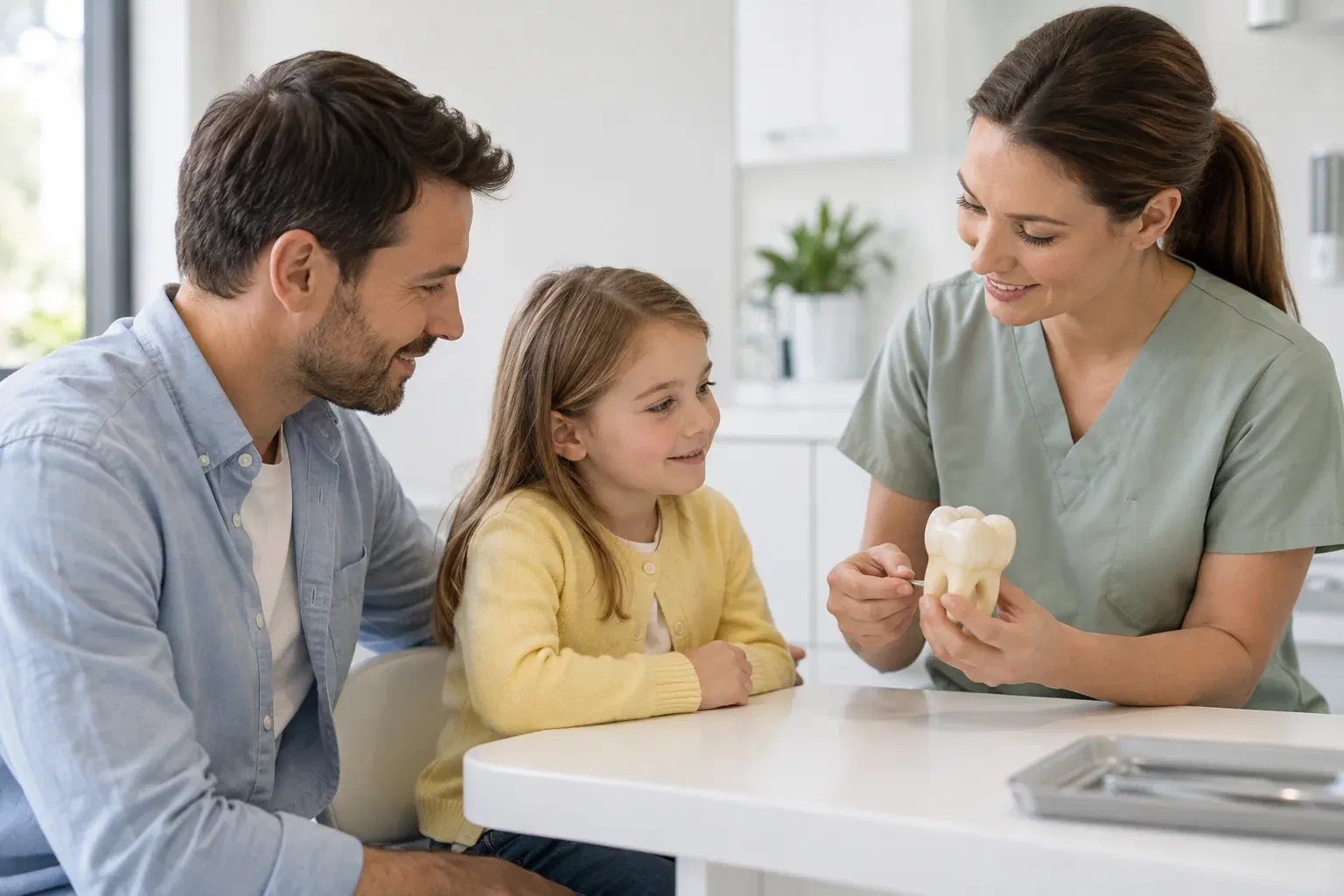
Illustrative child and father discussing a tooth model with a dental clinician
Children’s Dentistry

Pediatric Pulpotomy in Campbellville

Out in rural Milton, a dental trip usually means planning the whole afternoon. This Campbellville page walks through what a pulpotomy does for a baby tooth, how to tell whether it fits, and how to handle the numb ride home and the evening that follows.

Rural Milton, one treatment visit at a time

Small procedure, careful planning

A pulpotomy is narrower than many parents expect. When a cavity in a baby tooth has gone deep enough to reach the pulp, the soft living core, the dentist removes the pulp from the crown only. The goal is to keep the healthy pulp in the roots alive. A protective material goes over it, and then the tooth is rebuilt and sealed.

Whether this suits your child is worked out case by case. A deep hole in a molar does not decide it. The dentist weighs any pain or swelling you have noticed, the examination, X-ray findings, the amount of tooth still sound enough to restore, and, once treatment begins, the actual look of the pulp. A different plan can come out of any of those steps.

Households around Campbellville and the rest of Nassagaweya tend to group errands and appointments, and dental care is no exception. We can lay out every visit that is likely, explain why keeping this particular baby tooth makes sense for your child, and talk you through the restoration and the checks that come later.

Map out your child’s visits
Illustrative solid primary molar model beside a dental mirror and gauze
Worth mentioning when you call

Tell us what the tooth has been up to.

Describe your child’s symptoms, even if today is a good day. Neither a single complaint nor a phone photo can show that a pulpotomy is the right fit.

An ache that starts on its own

Pain that arrives without food or cold, that wakes your child, or that hangs on after a meal is a meaningful clue. Mention how long it tends to last and what settles it. The dentist uses this to judge whether the root pulp can reasonably be kept.

A gum bump, swollen cheek or loose tooth

Watch for a small blister near the tooth, discharge, puffiness in the face, or a tooth getting loose earlier than expected. Each needs examining and may lead to a different treatment. A blister that drains and disappears may still have a cause underneath.

The job this tooth still does

Some baby molars have years of chewing and space-keeping ahead; others are close to their natural exit. The dentist also asks whether there is enough tooth to restore reliably. A treatment plan should only go ahead with a clear clinical basis.

When pain or swelling is getting worse, call us promptly. If your child has difficulty breathing or swallowing, swelling travelling across the face, or seems seriously ill, get emergency medical care first.

The point of treatment

Keep the roots alive and the tooth in use

In a baby tooth that suits the procedure, removing the inflamed crown pulp gives the root pulp a chance to stay healthy, so the tooth can carry on until it sheds. Dentists call this vital-pulp therapy. It is not a remedy for a tooth whose roots are infected throughout.

A good result relies on accurate diagnosis, clean working conditions, a suitable material, a well-sealed restoration and follow-up over time. Ask which findings point toward this treatment and which would steer the dentist elsewhere. Feeling fine afterward is encouraging, but checks still matter.

Patient information: AAPD — vital pulp therapies in primary teeth

A specific case for this tooth

The dentist can describe what this tooth does for your child at their current stage and weigh treatment against extraction. If removal would bring a spacing assessment or appliance, that can mean extra trips too. Ask that the advice be about this tooth.

A seal that protects the pulp

The restoration placed over the treated pulp keeps out bacteria and strengthens what remains. Badly broken-down molars may do best with a crown. Ask how the pieces fit together and whether everything can be completed in one visit.

Reviews booked alongside routine care

Planned examinations and X-rays show how the tooth and surrounding bone respond. Where possible, they can line up with regular cleanings to save a drive. Ask which warning signs mean calling before the next one.

During the appointment

Four steps from the first look to a sealed tooth

The details shift with your child and the tooth. Ask how much time to set aside and how the dentist would raise any unexpected finding with you before continuing.

  1. Review the evidence and the choices

    History, examination and X-rays are gone over together. The dentist explains why a pulpotomy is being proposed, what restoration is planned, and what other options are reasonable. You also settle on comfort support and whether a pediatric specialist or different setting would be better.

  2. Numb the area and keep it clean

    Local anaesthetic is given, and the tooth is isolated from saliva. The team explains what your child may notice and agrees on a way to ask for a pause. Your child is encouraged to speak up if anything hurts.

  3. Take out the crown pulp and inspect

    The pulp in the crown is removed and the remaining root tissue is checked. If it does not look right, the dentist may change to another treatment. If it does, a material that supports the living pulp is placed.

  4. Rebuild the tooth before you leave

    A restoration closes the tooth. Confirm whether it is final or temporary. The team then covers food, numbness, pain relief and the first review date, so you are prepared for the trip home.

Heading home to Campbellville

A numb lip in the car seat needs watching

Use the instructions for the care your child received and any anaesthetic support. Bring a soft snack for later, and ask for written notes if someone else will look after your child this evening.

No snacks until the freezing fades

Children often chew a numb lip, cheek or tongue during the drive without noticing the damage. Keep an eye on them and wait to offer food until feeling returns, as advised. Give pain medicine only as the clinician recommends for your child.

A comfort check at supper

When your child eats normally again, ask how the tooth feels. Call if the bite seems off, pain lingers or builds, or the restoration chips. Significant discomfort should be reported, not waited out.

Brushing help and the review calendar

Keep helping with brushing around the restored tooth. A treated tooth can still run into problems, and other teeth still need prevention. Keep the planned reviews and X-rays, even if your child has no complaints.

Patient information: AAPD — local anaesthesia in pediatric dental care

When a pulpotomy is not the fit

Other answers for a deep cavity

For each option, ask what it would accomplish and why it is a good or poor match for this tooth. The least involved option is not always adequate, and the most involved is not always better.

When living tissue can stay

Other ways to keep the pulp alive

Indirect pulp treatment, which leaves a thin protective layer over the pulp, is sometimes chosen instead of a pulpotomy. The two suit different findings. Ask which matches this tooth and why.

When the root pulp cannot be kept

Treating the root canals

A pulpectomy may be considered for a restorable baby tooth whose pulp disease reaches further into the roots. It answers a different diagnosis. The state of the roots and other findings decide whether it is sensible.

When keeping it is not advisable

Taking the tooth out

Extraction may be recommended if the tooth cannot be rebuilt properly or its outlook is poor. Ask how the gap would be managed and whether spacing or the adult tooth should be monitored. Referral may help for complex needs.

Practical questions

From the first call to the follow-up

Treatments with similar names are easy to mix up. The dentist can explain the advice using your child’s own tooth and X-rays.

(905) 876-4488
Should I call before driving in if my child’s tooth suddenly hurts?
Yes. Describing the pain or swelling by phone helps the team advise how soon to come in. If there is spreading swelling, trouble breathing or swallowing, or your child seems very ill, seek emergency care instead.
Is it safe for my child to sleep in the car on the way home?
Ask the team, especially if any sedation or calming support was used. With local anaesthetic alone, the main concern is a numb lip being chewed. Follow the specific advice given for your child’s appointment.
How soon after a pulpotomy can my child eat?
Usually once the numbness has worn off, but follow the clinician’s instructions. Soft foods are often easier at first. Ask whether to avoid sticky or hard foods while a temporary or new restoration settles.
What restoration usually goes on a treated baby molar?
It depends on how much tooth remains. Extensive damage often calls for a crown, while a smaller repair may suit a filling. Ask which is planned and why, and whether it will be placed at the same visit.
Can a pulpotomy fail later on?
A treated tooth can still develop problems, which is why follow-up examinations and X-rays are recommended. Watch for new pain, swelling or a gum bump, and call if you notice any of them.
Does a pulpotomy take out all of the pulp?
No. It removes the crown portion and aims to keep healthy pulp in the roots. Clearing pulp from the canals is a separate procedure called a pulpectomy, used for a different diagnosis.
From Campbellville to our practice

One phone call can save a wasted trip

Call our Bronte Street practice to arrange an assessment or to discuss a pulpotomy that was suggested for your child. Describe the symptoms and bring any earlier advice, and we will explain the next step and how visits could be grouped.

Treatment depends on diagnosis and on whether the tooth can be rebuilt. If your child has pain or swelling now, please phone rather than relying on an online request.

Visit Milton Dental Clinic
Unit 1, 342 Bronte St. S, Milton, ON L9T 5B7
Get directions Clinic hours
Monday–Thursday
11am–7pm
Friday–Sunday
By appointment only

Areas we serve

  • Milton
  • Oakville
  • Mississauga
  • Georgetown
  • Halton Hills
  • Acton
  • Campbellville
  • Brampton
  • Burlington
  • Puslinch
  • Rockwood
  • Erin
  • Caledon
  • Etobicoke
  • Old Milton
  • Bronte Meadows
  • Timberlea
  • Dorset Park
  • Dempsey
  • Clarke
  • Beaty
  • Coates
  • Harrison
  • Scott
  • Willmott
  • Ford
  • Bowes
  • Cobden
  • Walker
  • Mountain View
  • Milton Heights
  • Hawthorne Village
  • Valley View
  • Fallingbrook
  • Nassagaweya
  • Trafalgar
  • Esquesing
  • Nelson
  • Brookville
  • Moffat
  • Glen Williams
  • Norval
  • Limehouse
  • Stewarttown
  • Ashgrove
  • Hornby
  • Silver Creek
  • Speyside
  • Scotch Block
  • North Oakville
  • River Oaks
  • Glen Abbey
  • West Oak Trails
  • Palermo
  • Bronte Creek
  • College Park
  • Joshua Creek
  • Uptown Core
  • Preserve
  • Iroquois Ridge
  • Lisgar
  • Meadowvale
  • Meadowvale Village
  • Churchill Meadows
  • Erin Mills
  • Central Erin Mills
  • Streetsville
  • East Credit
  • Creditview
  • Heartland
  • Sheridan
  • Mount Pleasant
  • Credit Valley
  • Huttonville
  • Churchville
  • Springbrook
  • Northwest Brampton
  • Bram West
  • Fletcher's Meadow
  • Fletcher's Creek South
  • Alton Village
  • Orchard
  • Millcroft
  • Headon Forest
  • Tansley
  • Brant Hills
  • Tyandaga
  • Kilbride
  • Lowville
  • Aberfoyle
  • Morriston
  • Arkell
  • Hillsburgh
  • Freelton
  • Carlisle
  • Waterdown
  • Flamborough
  • Mountsberg

How can we help?

Milton Dental Clinic

Have a question about your smile? Choose the option that works best for you.

For urgent dental concerns, please call.
Messages are reviewed during clinic hours.