
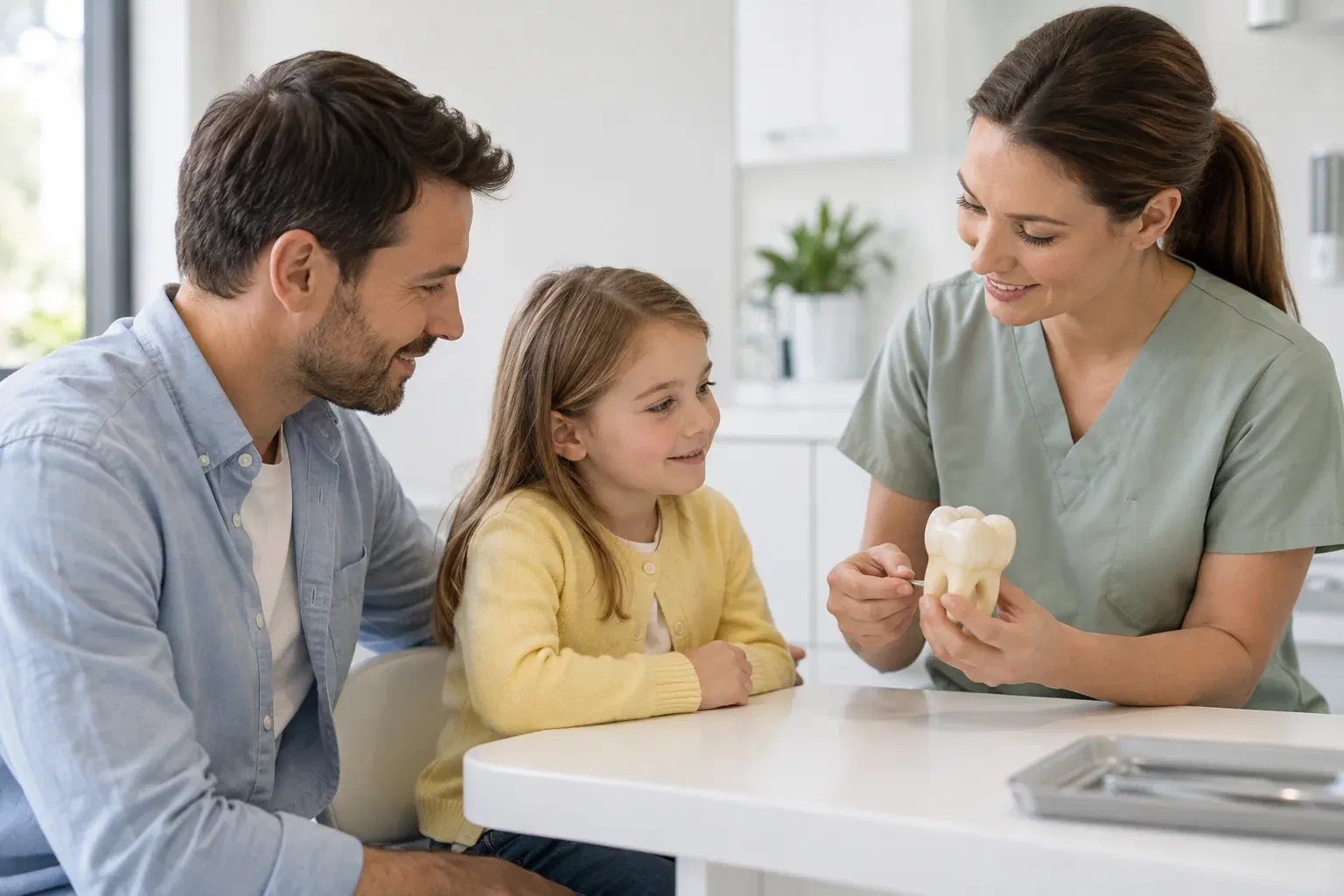
Illustrative child and father discussing a tooth model with a dental clinician
Children’s Dentistry

Pediatric Pulpotomy in Erin

Most of what keeps a treated baby tooth healthy happens at the kitchen table and the bathroom sink. For households in Erin and Hillsburgh, this page explains how a pulpotomy works, how it is chosen, and how home routines protect the repair and the rest of the mouth.

Treatment in the chair, care at home

The repair is ours; the routine is yours.

Think of a pulpotomy as a partnership. In the clinic, the dentist treats a baby tooth whose decay has reached the pulp, the living tissue at its centre. Pulp in the crown is removed, healthy pulp in the roots is kept, and the tooth is sealed with a restoration. At home, brushing help, snack habits and keeping review dates do much of the rest.

First, though, the treatment has to be right for the tooth. A deep cavity raises the possibility without confirming it. The dentist draws on symptoms you report, the examination, X-rays, how much tooth can be rebuilt, and the condition of the pulp during treatment. Those findings can steer things another way.

For a rural household in Erin, where dental trips are planned in advance, it helps to leave the first visit with a clear picture. Ask us why keeping this baby tooth is worthwhile, how treatment would be set up for your child, and what you can do day to day to protect the restored tooth.

Ask about care at home
Illustrative solid primary molar model beside a dental mirror and gauze
What you see at home matters

Brushing time is a good time to notice changes

Mention what your child has felt and what you have spotted, even on a symptom-free day. One complaint or one photo cannot show that a pulpotomy is suitable.

Sore without a reason

Pain that starts on its own, wakes your child, or lingers well after meals is worth describing in detail. Note duration and what helps. The dentist uses this to judge how inflamed the pulp may be and whether the roots can be kept.

Something new on the gum

While brushing, look for a small bump near the tooth, discharge, swelling, or a tooth loosening earlier than expected. These signs need examining and may point to another treatment. A bump that fades can still leave a problem behind.

How useful the tooth still is

A baby molar may still have years of chewing and space-holding ahead. The dentist considers whether it can be rebuilt soundly and how long it should stay. Keeping it is worthwhile only when the plan has good clinical grounds.

Phone promptly if your child’s pain or swelling is building. Difficulty breathing or swallowing, facial swelling that keeps spreading, or a child who seems gravely ill needs emergency medical help.

Why the dentist may suggest it

A baby tooth that keeps working until it is ready to go

When a primary tooth suits the procedure, the aim is to keep the root pulp healthy so the tooth can stay in use until it sheds naturally. That is what vital-pulp treatment means. It is not suitable for a tooth with infection through the roots.

Several things affect how it turns out: diagnosis, treatment conditions, the material, the restoration and follow-up, along with what happens at home. Ask which findings point to this treatment and what would change the plan. Even a smooth visit needs later checks.

Patient information: AAPD — vital pulp therapies in primary teeth

A reason grounded in your child’s mouth

Ask what this tooth contributes now and how keeping it compares with removal. If losing it early would call for a space assessment, ask about that as well. Advice should rest on this tooth, not a general rule.

A seal that home care helps protect

The restoration keeps bacteria away from the treated pulp. Daily brushing along its edges and limiting sticky, sugary snacks help it last. A crown may be advised for extensive decay; ask whether it can be placed at the same visit.

Reviews that become routine

Planned examinations and X-rays show how the tooth and surrounding bone are doing. Pairing them with regular cleanings keeps trips down. Ask which signs mean calling sooner.

What happens in the clinic

The professional part of the partnership

The plan adapts to your child and to the tooth. Ask what to expect and how you would be consulted if something unexpected came up.

  1. Explain the reasoning and alternatives

    Your child’s dentist goes over history, findings and images, explains why a pulpotomy is being proposed and what restoration would follow, and outlines other reasonable choices. You also discuss comfort support and whether a specialist would be more suitable.

  2. Freeze the tooth and keep it dry

    Local anaesthetic numbs the area and isolation keeps saliva out. Your child is told what they may feel and how to signal for a break. Speaking up about pain is always welcome.

  3. Treat the crown pulp after checking

    Pulp in the crown is removed and the remaining tissue examined. If it is not suitable, another approach may be recommended. If it is, a material that supports the living root pulp is placed.

  4. Restore and hand over the home plan

    A restoration seals the tooth. Ask whether it is final or temporary. You will leave with advice on eating, numbness, pain relief, brushing and the first review.

The home routine

Supper, snacks, brushing and bedtime

Follow the instructions for your child’s treatment and any anaesthetic support. If another caregiver will help at home, ask the team to note what they should know.

Hold off on food while numb

A numb lip, cheek or tongue is easy to bite without noticing, and the sore often shows up the next morning. Wait to offer lunch or a snack as advised, keep an eye on your child during quiet play or screen time, and give pain medicine only as the clinician recommends.

Notice how chewing feels

When normal meals return, ask about the tooth. Call if the bite seems wrong, pain persists or increases, or the restoration breaks. Discomfort should not be something your child simply tolerates.

Brushing help and fewer sticky treats

Help brush twice a day, paying attention to the restoration edges. Treated teeth can still develop problems, and other teeth are at risk from the same habits. Keep the planned reviews and X-rays even when all seems well.

Patient information: AAPD — local anaesthesia in pediatric dental care

Other routes

What else the dentist might recommend

Ask what each option would do and why it is or is not right for this tooth. A lighter procedure is not always enough, and a heavier one is not always better.

If healthy tissue can stay

Keeping the pulp alive

Two procedures fall under this heading. In indirect pulp treatment the pulp is left unopened beneath a protective layer; in a pulpotomy the crown pulp is removed. Each fits a different set of findings, so ask the dentist what made one the better choice for your child’s tooth.

If the root pulp cannot be kept

Cleaning out the root canals

For a restorable baby tooth with deeper pulp disease, a pulpectomy may be considered. It addresses a different diagnosis, and the roots’ condition helps decide whether it is reasonable.

If keeping the tooth is unwise

Extraction

Removal may be advised when the tooth cannot be rebuilt or has a poor outlook. Ask how the space would be managed and whether spacing or the adult tooth should be watched. Referral may help in complex cases.

Everyday questions

Living with a treated baby tooth

Ask the dentist to explain the recommendation using your child’s own tooth and X-rays, and to tailor home advice to your child.

(905) 876-4488
How should I help my child brush around a crown on a baby molar?
Use a soft brush and gentle circles along the gumline and the edges of the crown. Young children usually need an adult to help or check. Ask the team to show you the best angle for your child’s tooth.
Can my child still have sweets after a pulpotomy?
Occasional treats are usually fine, but frequent sugary or sticky snacks raise the risk of new decay in other teeth and around restorations. Keeping sweets to mealtimes and rinsing with water afterward can help.
Should my child use fluoride toothpaste?
Fluoride toothpaste is widely recommended for children, in an amount suited to their age. Ask the dentist how much to use and whether a fluoride treatment at the clinic would help prevent further cavities.
Can sealants or other prevention protect my child’s other teeth?
Depending on your child’s teeth and risk, the dentist may suggest sealants, fluoride or changes to brushing and diet. Ask which preventive steps make sense now that one tooth has needed pulp treatment.
Is a pulpotomy different from a filling?
Yes. A filling repairs decay that has not reached the pulp. A pulpotomy treats a baby tooth where decay has reached the pulp in the crown, removing that portion and keeping healthy root pulp, then the tooth is restored.
How can we keep trips from Erin to a minimum?
Ask the team to outline all visits, including reviews, and whether the restoration can be completed at the treatment appointment. Reviews can often be booked with routine cleanings. Call first about sudden pain or swelling.
From Erin to our practice

Leave with a plan for the chair and the sink

Get in touch with our Bronte Street practice to book an assessment or talk about a pulpotomy suggested for your child. Share earlier advice and any symptoms, and we can explain the next step along with practical home care.

Treatment depends on diagnosis and restorability. If your child has pain or swelling now, please call us rather than waiting for an online reply.

Visit Milton Dental Clinic
Unit 1, 342 Bronte St. S, Milton, ON L9T 5B7
Get directions Clinic hours
Monday–Thursday
11am–7pm
Friday–Sunday
By appointment only

Areas we serve

  • Milton
  • Oakville
  • Mississauga
  • Georgetown
  • Halton Hills
  • Acton
  • Campbellville
  • Brampton
  • Burlington
  • Puslinch
  • Rockwood
  • Erin
  • Caledon
  • Etobicoke
  • Old Milton
  • Bronte Meadows
  • Timberlea
  • Dorset Park
  • Dempsey
  • Clarke
  • Beaty
  • Coates
  • Harrison
  • Scott
  • Willmott
  • Ford
  • Bowes
  • Cobden
  • Walker
  • Mountain View
  • Milton Heights
  • Hawthorne Village
  • Valley View
  • Fallingbrook
  • Nassagaweya
  • Trafalgar
  • Esquesing
  • Nelson
  • Brookville
  • Moffat
  • Glen Williams
  • Norval
  • Limehouse
  • Stewarttown
  • Ashgrove
  • Hornby
  • Silver Creek
  • Speyside
  • Scotch Block
  • North Oakville
  • River Oaks
  • Glen Abbey
  • West Oak Trails
  • Palermo
  • Bronte Creek
  • College Park
  • Joshua Creek
  • Uptown Core
  • Preserve
  • Iroquois Ridge
  • Lisgar
  • Meadowvale
  • Meadowvale Village
  • Churchill Meadows
  • Erin Mills
  • Central Erin Mills
  • Streetsville
  • East Credit
  • Creditview
  • Heartland
  • Sheridan
  • Mount Pleasant
  • Credit Valley
  • Huttonville
  • Churchville
  • Springbrook
  • Northwest Brampton
  • Bram West
  • Fletcher's Meadow
  • Fletcher's Creek South
  • Alton Village
  • Orchard
  • Millcroft
  • Headon Forest
  • Tansley
  • Brant Hills
  • Tyandaga
  • Kilbride
  • Lowville
  • Aberfoyle
  • Morriston
  • Arkell
  • Hillsburgh
  • Freelton
  • Carlisle
  • Waterdown
  • Flamborough
  • Mountsberg

How can we help?

Milton Dental Clinic

Have a question about your smile? Choose the option that works best for you.

For urgent dental concerns, please call.
Messages are reviewed during clinic hours.