

Illustrative child and father discussing a tooth model with a dental clinician
Children’s Dentistry

Pediatric Pulpotomy in Georgetown

A nervous child can make even a short procedure feel big. For Georgetown parents, this page explains how a pulpotomy treats a baby tooth, how comfort is planned and how your child can signal during care, and what restoration and follow-up come afterward.

For the worried child, and the worried parent

Knowing what will happen makes the chair less scary

Children cope better when they know what is coming, and so do parents. A pulpotomy is a treatment for a baby tooth whose decay has reached the pulp, the soft living centre of the tooth. The dentist removes the affected pulp from the crown, aims to keep the healthy tissue in the roots, and then places a restoration to seal it.

Before any of that, there has to be a sound reason. Deep decay prompts the question but does not settle it. The dentist looks at how the tooth has been behaving, what the examination and X-rays show, whether the tooth can be properly rebuilt, and how the pulp appears once it is reached. Any of these may suggest a different route.

When you bring a child in from Georgetown who is uneasy about dental work, tell us early. We can explain in simple words why keeping this baby tooth is worthwhile, talk about what will help your child feel safe, and describe how the tooth will be repaired and checked later. If a different setting would suit your child better, we will say so.

Talk about your child’s comfort
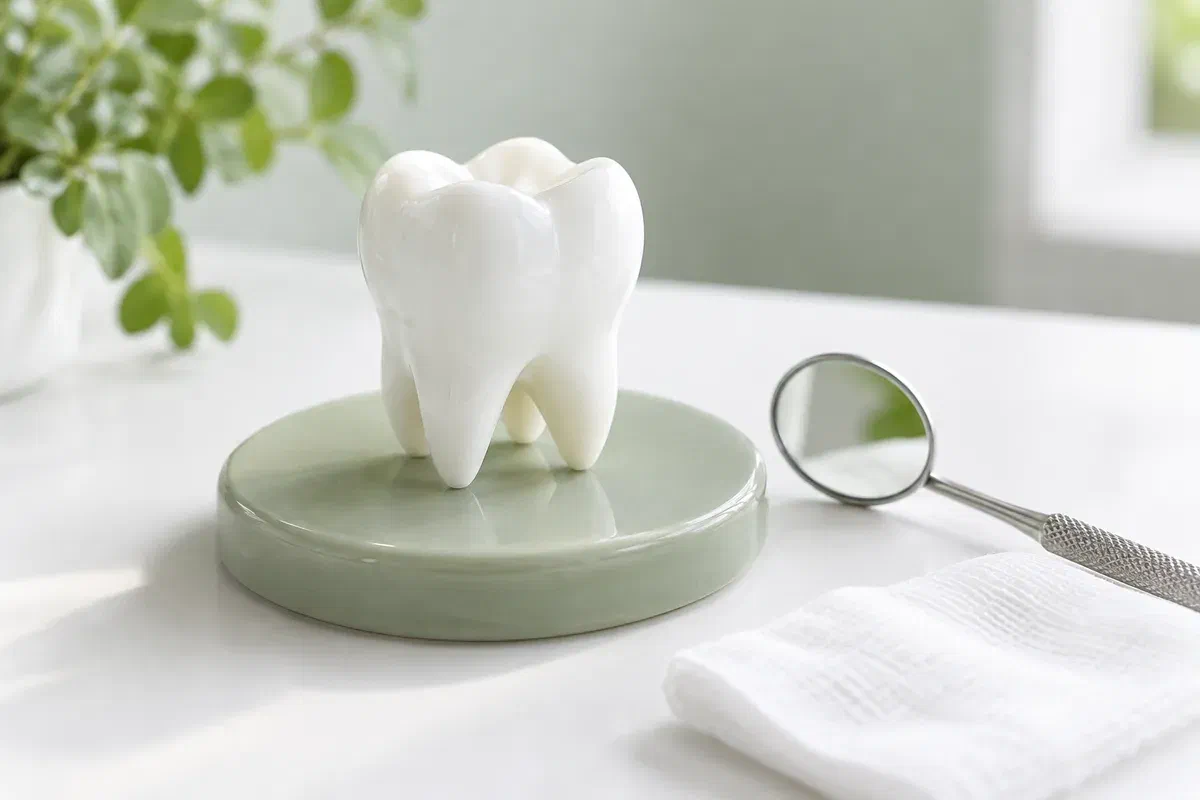
Illustrative solid primary molar model beside a dental mirror and gauze
Helping the dentist understand

Small clues from home, big help in the chair

Let us know what your child has felt, even if the tooth is calm today, and how they usually react to dental visits. A pulpotomy cannot be confirmed from a single symptom or picture.

Pain that shows up uninvited

Has the tooth hurt while your child was resting, woken them, or ached for a long time after food? Note how long it lasts and what soothes it. Patterns like these help the dentist decide whether the root pulp is likely healthy enough to keep.

Swelling or a pimple on the gum

Mention a small bump near the tooth, any fluid from it, a puffy cheek, or looseness that seems too early. These signs call for an examination and may point to another treatment. A bump that fades has not necessarily resolved.

Whether this tooth is worth the effort

For an anxious child, any treatment should clearly earn its place. The dentist weighs whether the tooth can be restored well, what it does for chewing and spacing, and how long it should last. Treating it needs real clinical grounds.

Call without waiting if pain or swelling is getting worse. Breathing or swallowing problems, swelling that keeps spreading over the face, or a child who looks very unwell require emergency medical care.

What the treatment aims for

One focused procedure, a tooth that stays useful

In a suitable baby tooth, removing the inflamed crown pulp can let the root pulp stay healthy so the tooth keeps working until it falls out naturally. That is why it is considered vital-pulp therapy. It is not meant for a tooth with infection extending through the roots.

The outcome depends on accurate diagnosis, good working conditions, the chosen material, the seal on top and follow-up visits. Ask what supports the recommendation and what might change it. A calm, successful visit is a good start, but the tooth still needs checking.

Patient information: AAPD — vital pulp therapies in primary teeth

A reason you can explain to your child

Ask the dentist what this tooth does for your child now and how treatment compares with taking it out. Removal can be its own experience for an anxious child, and may need a spacing assessment. The advice should fit this tooth.

A protective restoration

The restoration seals the treated pulp against bacteria and supports the tooth. A crown may be suggested when decay is extensive. Ask whether the pulp treatment and restoration can be done in one visit, which may mean fewer appointments to prepare for.

Check-ins planned ahead

Scheduled examinations and X-rays show how the treated tooth and nearby bone are doing. Knowing about these in advance helps your child see them as routine. Ask which symptoms should prompt a call sooner.

What your child will experience

Tell, show, numb, treat, seal

The visit is shaped by your child’s needs and the tooth. Ask what will happen, how breaks will work, and how the dentist would talk with you if the findings changed.

  1. Explain the plan and the comfort options

    The dentist reviews history, examination and X-rays, explains why a pulpotomy is suggested, which restoration will follow and what alternatives exist. Together you decide how to support your child’s comfort, and whether a pediatric specialist or different treatment setting would serve them better.

  2. Freezing, with a signal for breaks

    Local anaesthetic numbs the tooth, and isolation keeps it clean and dry. Before starting, the team agrees on a signal, such as raising a hand, so your child can ask for a pause. Children should feel free to say when something hurts.

  3. Treat the crown pulp if it still suits

    The pulp in the crown is removed and the remaining tissue checked. If it is not suitable, the dentist may recommend a different approach. If it is, a material that supports the living root pulp is placed.

  4. Restore the tooth and praise the effort

    The tooth is sealed with a restoration. Ask whether it is final or whether another visit is needed. You will go over eating, numbness, pain relief and the plan for reviews before heading home.

Back home in Georgetown

Comfort, supervision and a few simple rules

Use the aftercare instructions you were given, including advice tied to any anaesthetic or calming support. If someone else will care for your child later, ask the team what they should know.

Explain the numb feeling

A numb lip can feel strange, and children sometimes chew or suck on it, causing sores. Tell your child the feeling will pass, supervise them, and follow food advice until it does. Give pain medicine only as advised for your child.

Check in gently about the tooth

Once eating returns to normal, ask how the tooth feels. Call if biting seems uncomfortable, pain persists or increases, or the restoration breaks. Do not expect your child to put up with real discomfort.

Keep brushing and come back for checks

Help your child brush carefully around the restored tooth. Treated teeth can still develop problems, and other teeth still need prevention. Keep the review appointments and X-rays even if everything seems fine.

Patient information: AAPD — local anaesthesia in pediatric dental care

Other treatments the dentist may raise

Finding the right fit for this pulp

Ask what each choice would achieve and why it is right or wrong for this tooth. The lightest treatment is not always enough, and the most extensive is not always best.

If healthy pulp can be preserved

Keeping living tissue

A pulpotomy is one vital-pulp option; indirect pulp treatment is another, used in different circumstances. Ask why the one being suggested matches what the dentist sees in this tooth.

If the root pulp is too affected

Pulpectomy

A restorable baby tooth with more widespread pulp disease may need treatment inside its root canals. That is a different diagnosis from a pulpotomy, and the roots’ condition helps decide whether it is reasonable.

If keeping the tooth is not advisable

Removal and planning for the gap

When a tooth cannot be restored well or has a poor outlook, extraction may be recommended. Ask how the space will be managed and whether the adult tooth should be monitored. Complex needs may call for referral.

Comfort questions

What parents of nervous kids ask us

Every child is different. Ask the dentist to explain the recommendation using your child’s own tooth and images, and to talk through comfort options in plain language.

(905) 876-4488
How can I prepare my anxious child for a pulpotomy?
Use simple, calm words and avoid frightening terms. You might explain that the dentist will make the tooth sleepy and clean out the sore part. Ask the team for age-appropriate explanations and whether a short visit beforehand would help.
Will my child feel the treatment?
Local anaesthetic is used to numb the area, and the team will check on your child during care. Some pressure or unusual sensations may be noticed. Your child should signal if anything hurts so the team can respond.
Can I stay with my child during the procedure?
Ask the clinic about its approach. Many parents can stay, depending on the child and the situation. The team can suggest how to help your child feel supported while letting the clinician guide the visit.
What if my child cannot cope with treatment in the chair?
Some children need a different setting or more support than a regular office can provide. The dentist may discuss referral to a pediatric specialist. Ask what options exist and how they would affect timing.
Is a pulpotomy the same as pulling the tooth?
No. A pulpotomy keeps the tooth. The pulp in the crown is removed and healthy root pulp is preserved where possible, then the tooth is sealed. Extraction removes the tooth and is considered when keeping it is not appropriate.
How do I describe the follow-up visits to my child?
You might call them check-ups for the tooth that was fixed. Reviews usually involve an examination and sometimes X-rays to make sure the tooth is staying healthy. Ask the team what each visit will involve.
Georgetown children welcome

A calm first conversation

Get in touch with our Bronte Street practice to arrange an assessment or to talk about a pulpotomy someone has suggested for your child. Tell us about symptoms and how your child feels about dental visits, and we will explain the next step and treatment planning.

Treatment depends on diagnosis and whether the tooth can be restored. If your child has pain or swelling now, please call us instead of sending an online request.

Visit Milton Dental Clinic
Unit 1, 342 Bronte St. S, Milton, ON L9T 5B7
Get directions Clinic hours
Monday–Thursday
11am–7pm
Friday–Sunday
By appointment only

Areas we serve

  • Milton
  • Oakville
  • Mississauga
  • Georgetown
  • Halton Hills
  • Acton
  • Campbellville
  • Brampton
  • Burlington
  • Puslinch
  • Rockwood
  • Erin
  • Caledon
  • Etobicoke
  • Old Milton
  • Bronte Meadows
  • Timberlea
  • Dorset Park
  • Dempsey
  • Clarke
  • Beaty
  • Coates
  • Harrison
  • Scott
  • Willmott
  • Ford
  • Bowes
  • Cobden
  • Walker
  • Mountain View
  • Milton Heights
  • Hawthorne Village
  • Valley View
  • Fallingbrook
  • Nassagaweya
  • Trafalgar
  • Esquesing
  • Nelson
  • Brookville
  • Moffat
  • Glen Williams
  • Norval
  • Limehouse
  • Stewarttown
  • Ashgrove
  • Hornby
  • Silver Creek
  • Speyside
  • Scotch Block
  • North Oakville
  • River Oaks
  • Glen Abbey
  • West Oak Trails
  • Palermo
  • Bronte Creek
  • College Park
  • Joshua Creek
  • Uptown Core
  • Preserve
  • Iroquois Ridge
  • Lisgar
  • Meadowvale
  • Meadowvale Village
  • Churchill Meadows
  • Erin Mills
  • Central Erin Mills
  • Streetsville
  • East Credit
  • Creditview
  • Heartland
  • Sheridan
  • Mount Pleasant
  • Credit Valley
  • Huttonville
  • Churchville
  • Springbrook
  • Northwest Brampton
  • Bram West
  • Fletcher's Meadow
  • Fletcher's Creek South
  • Alton Village
  • Orchard
  • Millcroft
  • Headon Forest
  • Tansley
  • Brant Hills
  • Tyandaga
  • Kilbride
  • Lowville
  • Aberfoyle
  • Morriston
  • Arkell
  • Hillsburgh
  • Freelton
  • Carlisle
  • Waterdown
  • Flamborough
  • Mountsberg

How can we help?

Milton Dental Clinic

Have a question about your smile? Choose the option that works best for you.

For urgent dental concerns, please call.
Messages are reviewed during clinic hours.