
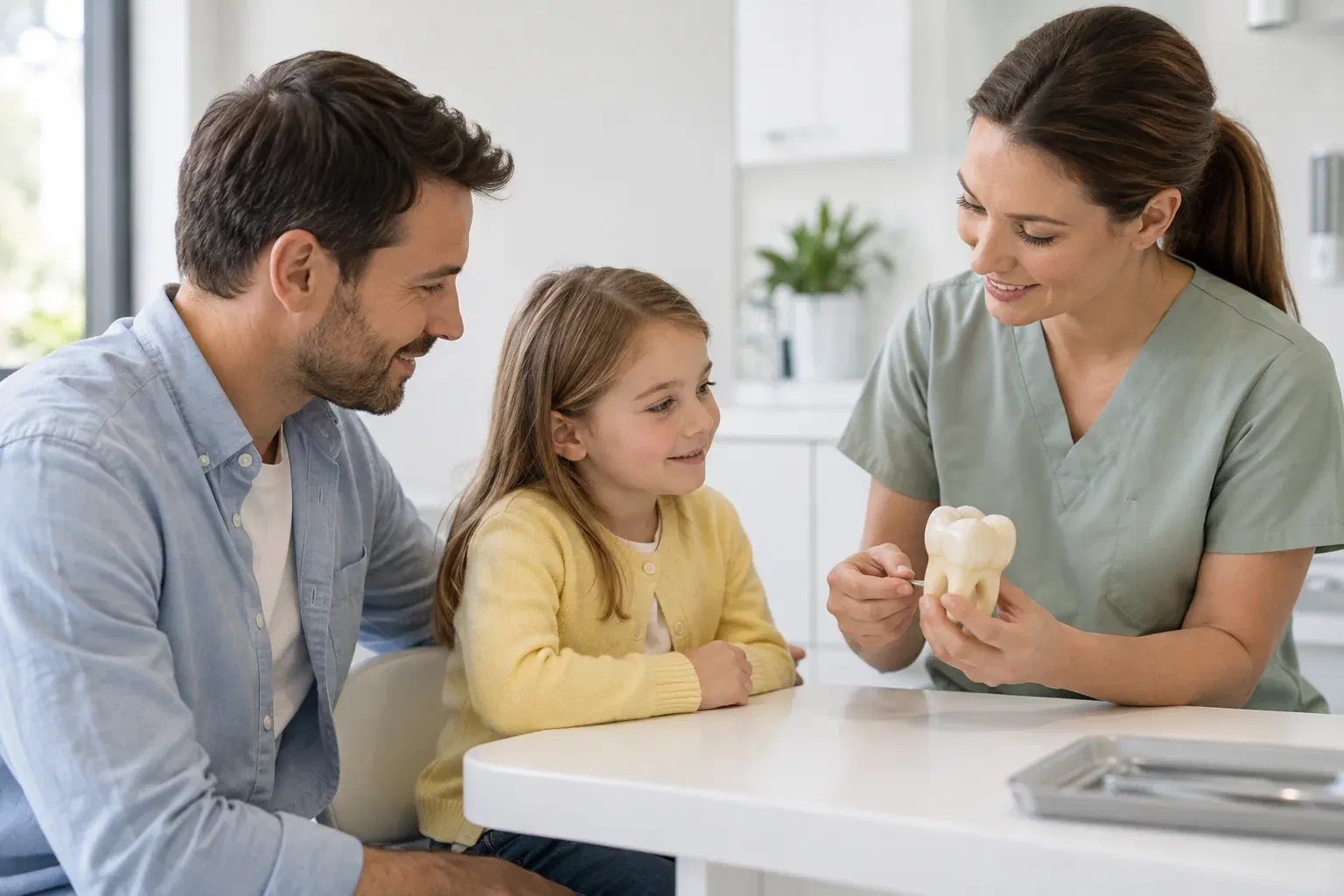
Illustrative child and father discussing a tooth model with a dental clinician
Children’s Dentistry

Pediatric Pulpotomy in Old Milton

Sometimes called a “baby root canal,” a pulpotomy is really a more limited treatment. For children in Old Milton, here is what the procedure removes, what it tries to keep, and how parents, grandparents and other caregivers can follow the plan afterward.

Not quite a “baby root canal”

Why the name matters less than the diagnosis

Friends and relatives often use the phrase “baby root canal,” but that blurs an important distinction. In a pulpotomy, only the pulp in the upper chamber of a primary tooth is taken out. The living tissue down in the roots is left in place when it is healthy enough. A full root-canal-style treatment, by contrast, clears the canals themselves.

So the real question is not what the procedure is called, but whether it fits. Decay that has gone deep is a starting point for that conversation, never the answer. Your child’s dentist considers reported symptoms, what can be seen and felt, X-ray findings, how much sound tooth is left to rebuild, and the condition of the pulp once it is visible.

In Old Milton, it is common for a grandparent or neighbour to handle dental runs while parents work. Whoever comes in, ask us to explain why this baby tooth is worth keeping, how the appointment will be paced for your child, and what repair and checkups will follow, so the whole household hears the same plan.

Talk through the treatment plan
Illustrative solid primary molar model beside a dental mirror and gauze
Before the appointment

Small details from home can change the plan

Jot down what your child has mentioned, even if the tooth seems quiet today. Nobody can confirm that a pulpotomy is suitable from one complaint or one picture of the tooth.

Toothache with no obvious cause

Has the ache started while your child was resting, kept them awake, or hung around long after a snack? Write down roughly how long it lasted and whether anything settled it. Spontaneous or lingering pain can tell the dentist a lot about the pulp’s condition.

A spot on the gum, a puffy cheek, or a tooth that moves

Point out any small blister near the tooth, fluid coming from it, facial puffiness, or movement that seems early for a baby tooth. These can suggest a problem that calls for treatment other than a pulpotomy. If a gum spot shrinks, that does not prove the cause is gone.

What this tooth still has to do

Some baby molars stay in place for years and help with chewing and the spacing of incoming teeth. The dentist asks whether this one can be rebuilt well and how long it is likely to remain. Keeping it is worthwhile only if the treatment is well supported.

If pain or swelling keeps building, call the clinic without delay. A child struggling to breathe or swallow, with facial swelling that spreads, or who looks very unwell needs emergency medical help immediately.

What a well-chosen pulpotomy aims for

Living roots, a working tooth

When the tooth is a good candidate, removing the inflamed crown pulp can let the healthier root tissue carry on, and the tooth can stay in use until its natural time to go. That is why dentists call it a vital-pulp treatment. It is not intended for a tooth whose infection has already reached through the roots.

Several things shape the outcome: an accurate diagnosis, a clean working field, the medicament chosen, how well the tooth is sealed, and steady follow-up. Ask what supports the recommendation and what might make the dentist reconsider. A tooth that came through treatment well still needs watching.

Patient information: AAPD — vital pulp therapies in primary teeth

A reason grounded in this tooth

Ask the dentist what role this particular baby tooth plays for your child at their current age. Compare keeping it with having it removed, and ask whether removal would mean assessing the space separately. A blanket rule about baby teeth is not a good enough reason either way.

A seal that keeps bacteria out

Whatever goes on top of the treated pulp has to protect it from leakage and further breakdown. With wide decay, a crown is sometimes the better choice than a filling. Ask how the restoration and pulp care work together and whether one visit covers both.

Checkups that are already scheduled

Planned examinations and periodic X-rays let the dentist see how the tooth and surrounding bone are faring. Caregivers should know which warning signs mean phoning before the next review. These visits belong to the treatment itself, not only to teeth that start hurting.

For Old Milton children, in the treatment room

Four stages, each with a chance to pause

How the visit unfolds depends on your child and on the tooth. Ask what is planned and how the dentist would check in with the adult present if something unexpected came up.

  1. Agree on the diagnosis and the alternatives

    The clinician reviews history, examination findings and images, then explains why this treatment is on the table, how the tooth will be rebuilt, and what else might reasonably be done. Together you settle on comfort measures and whether a specialist or different setting would serve your child better.

  2. Freezing and a dry, protected tooth

    Local anaesthetic numbs the area, and isolation keeps the tooth clean and dry while it is treated. Your child is told what sensations to expect and how to signal, perhaps by raising a hand. Speaking up about pain is encouraged, never discouraged.

  3. Removing the upper pulp and checking what remains

    Once the crown pulp is out, the remaining tissue is examined. Should it not look suitable, the dentist may switch to a different treatment. If it is suitable, a material chosen to support the living root pulp is placed over it.

  4. Sealing the tooth and going over home care

    The tooth is restored after the pulp step. Find out whether this is the final repair or a temporary one with another appointment to come. The team then reviews food, numbness, pain relief and the date of the first check.

Back home on a familiar street

The repair needs care, and the reviews need keeping

Use the instructions you were given for this treatment and for any anaesthetic or calming support. If a different caregiver will be with your child that evening, ask us to write down the key points so nothing is lost in the handover.

No chewing on a frozen lip

Young children often nibble a numb lip, cheek or tongue without knowing they are hurting themselves. Stay close and stick to the food guidance until sensation is back. Pain relievers should be given only as advised for your child’s age, weight and health.

A quick comfort check at mealtimes

As your child returns to the recommended diet, ask how the tooth feels. Call if biting seems sore, if pain hangs on or gets worse, or if part of the restoration breaks. Significant discomfort should be reported, not endured because treatment is over.

Brushing help and the next visit

Keep assisting with brushing and flossing around the restored tooth. A treated tooth can still have problems later, and the neighbouring teeth need the same prevention as before. Attend the review appointments and X-rays even if everything feels and looks fine.

Patient information: AAPD — local anaesthesia in pediatric dental care

When deep decay reaches the pulp

Three paths, chosen by what the pulp shows

For each approach, ask what it is meant to achieve and why it does or does not suit this tooth. Less treatment is not automatically adequate, and more treatment is not automatically safer.

Where healthy tissue can reasonably stay

Keeping the pulp alive

Depending on the findings, the dentist may talk about indirect pulp treatment or a pulpotomy. They are distinct procedures with their own uses. Ask why the one being suggested matches the state of this tooth, rather than relying on what the treatment is called.

Where the root pulp is too affected to keep

Pulpectomy or other root treatment

A baby tooth that can still be restored but has more widespread pulp disease may need treatment inside the root canals. That reflects a different diagnosis from a pulpotomy. The roots’ condition and other findings decide whether it is reasonable.

Where keeping it would not be wise

Taking the tooth out

If the tooth cannot be rebuilt properly or its outlook is poor, removal may be the advice. Ask how the space will be managed and whether the adult tooth’s arrival should be monitored. A referral may be suggested for more complicated needs.

Caregiver questions

What people ask before and after a pulpotomy

Dental terms can blur together. Ask the dentist to explain using your child’s own tooth, X-rays and findings, especially if you will be relaying the plan to someone else.

(905) 876-4488
Why do people call a pulpotomy a baby root canal?
Both involve the pulp, so the nickname stuck. A pulpotomy, though, removes only the crown portion and tries to keep healthy pulp in the roots. Clearing the canals themselves is a separate procedure. The diagnosis decides which, if either, is right.
Can a grandparent or babysitter bring my child for the appointment?
Ask the clinic ahead of time about consent and who needs to be present for treatment decisions. Whoever comes should be able to share symptoms, medical history and any medications, and should leave with written aftercare so the plan reaches everyone at home.
Does the dentist ever change plans partway through?
Yes, it can happen. Once the pulp is visible, the dentist may see things the X-rays could not show. If the remaining tissue is not suitable, another treatment may be needed. Ask beforehand how that decision would be explained to you.
Is a crown always needed after a pulpotomy?
Not always. The tooth needs a restoration that seals and supports it, and a heavily damaged molar may be better served by a crown than a filling. Ask which type is proposed, why, and whether it goes on at the same visit.
What should my child eat for the rest of the day?
Follow the specific food advice you are given. In general, soft foods and waiting until numbness has worn off help protect the lips, cheeks and tongue. Ask whether any foods should be avoided while the restoration settles or a temporary filling is in place.
How will I know if the treated tooth is having trouble later?
Watch for new pain, a bump or drainage on the gum, swelling, or a broken restoration, and call if you notice any. Some changes cause no symptoms, which is why the planned X-rays and examinations matter even when your child feels well.
From Old Milton to our practice

Have a recommendation explained before you decide

Call or message our Bronte Street practice, just a short way from Milton’s historic downtown, to arrange an assessment or discuss a pulpotomy that was suggested for your child. Bring earlier notes and describe the symptoms, and we will help you understand the next step.

Whether treatment is suitable depends on diagnosis and restorability. If your child has pain or swelling right now, please phone rather than sending an online request.

Visit Milton Dental Clinic
Unit 1, 342 Bronte St. S, Milton, ON L9T 5B7
Get directions Clinic hours
Monday–Thursday
11am–7pm
Friday–Sunday
By appointment only

Areas we serve

  • Milton
  • Oakville
  • Mississauga
  • Georgetown
  • Halton Hills
  • Acton
  • Campbellville
  • Brampton
  • Burlington
  • Puslinch
  • Rockwood
  • Erin
  • Caledon
  • Etobicoke
  • Old Milton
  • Bronte Meadows
  • Timberlea
  • Dorset Park
  • Dempsey
  • Clarke
  • Beaty
  • Coates
  • Harrison
  • Scott
  • Willmott
  • Ford
  • Bowes
  • Cobden
  • Walker
  • Mountain View
  • Milton Heights
  • Hawthorne Village
  • Valley View
  • Fallingbrook
  • Nassagaweya
  • Trafalgar
  • Esquesing
  • Nelson
  • Brookville
  • Moffat
  • Glen Williams
  • Norval
  • Limehouse
  • Stewarttown
  • Ashgrove
  • Hornby
  • Silver Creek
  • Speyside
  • Scotch Block
  • North Oakville
  • River Oaks
  • Glen Abbey
  • West Oak Trails
  • Palermo
  • Bronte Creek
  • College Park
  • Joshua Creek
  • Uptown Core
  • Preserve
  • Iroquois Ridge
  • Lisgar
  • Meadowvale
  • Meadowvale Village
  • Churchill Meadows
  • Erin Mills
  • Central Erin Mills
  • Streetsville
  • East Credit
  • Creditview
  • Heartland
  • Sheridan
  • Mount Pleasant
  • Credit Valley
  • Huttonville
  • Churchville
  • Springbrook
  • Northwest Brampton
  • Bram West
  • Fletcher's Meadow
  • Fletcher's Creek South
  • Alton Village
  • Orchard
  • Millcroft
  • Headon Forest
  • Tansley
  • Brant Hills
  • Tyandaga
  • Kilbride
  • Lowville
  • Aberfoyle
  • Morriston
  • Arkell
  • Hillsburgh
  • Freelton
  • Carlisle
  • Waterdown
  • Flamborough
  • Mountsberg

How can we help?

Milton Dental Clinic

Have a question about your smile? Choose the option that works best for you.

For urgent dental concerns, please call.
Messages are reviewed during clinic hours.