

Illustrative child and parent discussing a silver-crowned tooth teaching model
Children’s Dentistry

Pediatric Stainless Steel Crowns in Brampton

A rash from a belt buckle or an earring can make a parent stop and ask about a metal crown. For children from Brampton, this page covers how stainless steel crowns are chosen for baby molars, and why allergies and health history come first.

Brampton · metal crowns and health history

Start the crown conversation with your child’s medical file.

Some parents arrive with a specific worry. Their child broke out in a rash from a watch strap or a snap on a jacket, and now a dentist has mentioned a metal crown. That is exactly the kind of detail to share early, because stainless steel crown materials can contain nickel.

A pediatric stainless steel crown is a pre-shaped metal covering, chosen in a size that suits the tooth and fitted over everything above the gum line of a back baby tooth. It is silver, not white. Dentists consider it when a primary molar has decay or breakage too extensive for a filling to hold reliably, or when nerve treatment has left the tooth needing full protection.

Before any material is chosen, the dentist should know about allergies, medications, medical conditions and how your child handles dental visits. With that information, they can explain whether a metal crown suits this tooth, what the alternatives are and whether advice from your child’s doctor would help. Ask questions until the plan is clear.

Discuss a crown with your child’s health in mind
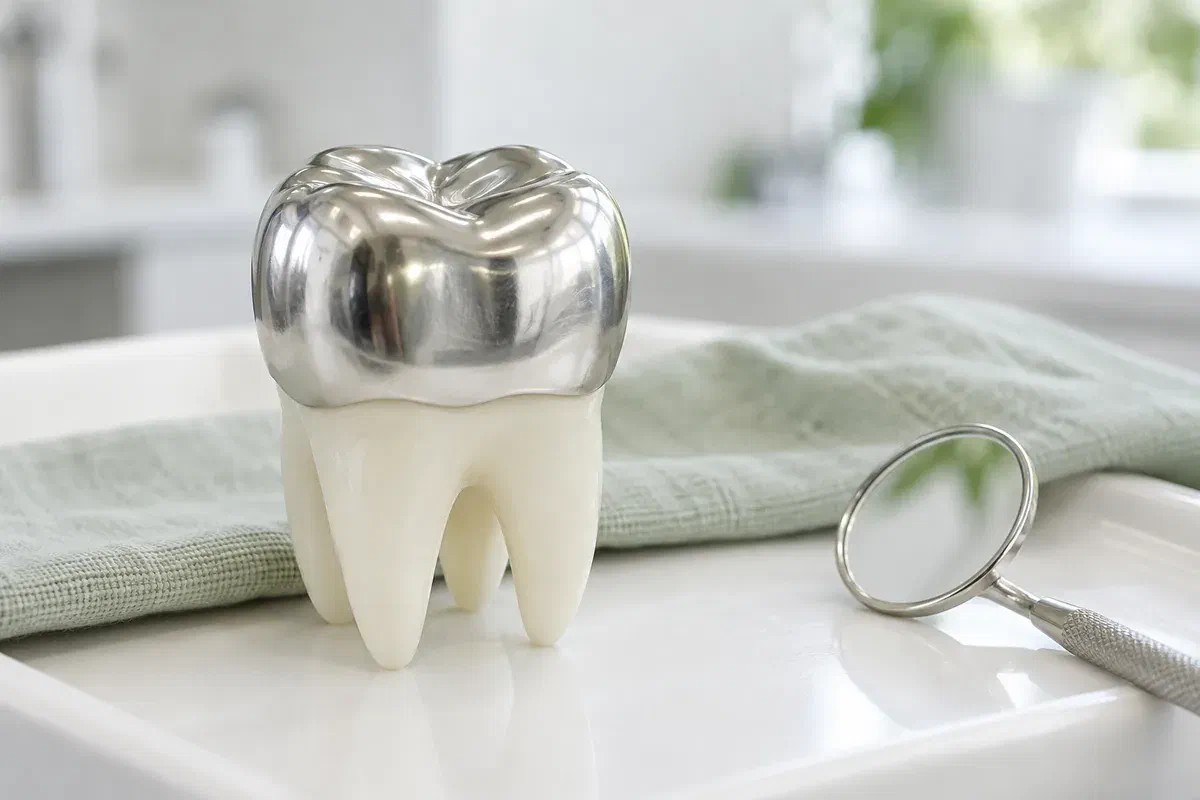
Illustrative molar teaching model with a smooth stainless steel crown
Why the dentist might bring up a crown

When a filling has too little to hold on to

How deep decay runs, how many surfaces it touches and whether the nerve is involved all shape the options. Mention symptoms, health history and previous dental work during the assessment.

Decay across several surfaces

If a baby molar is damaged on more than one side, there may not be enough sound tooth to anchor a filling. Mention fillings that have broken or been replaced. The dentist can explain whether covering the tooth is a better fit for what remains.

A tooth that has had nerve treatment

A pulpotomy or pulpectomy addresses tissue at the centre of the tooth, while restoring the outside is a separate step. Ask whether a crown is needed to finish the work. Feeling comfortable again does not mean the restoration can be left undone.

Nickel sensitivity and other health factors

Share any known allergy or reaction, including to nickel or other metals, as well as medical conditions and current medications. Mention sensory or communication needs and feelings about appearance too. These shape both the material and the way treatment is provided.

Swelling, a pimple on the gum or toothache that keeps returning may point to a problem a crown will not fix by itself. Describe these when booking so the visit can address them.

What full coverage can do

A covering that protects every side of the molar

Unlike a filling, which replaces one missing area, a stainless steel crown encloses the whole visible tooth. For selected baby molars with heavy decay, weak walls or a need for protection after pulp treatment, that complete coverage is the reason it is considered. The diagnosis, and your child’s health history, come first.

It is intended to last for as long as the baby tooth is needed. That said, a crown may loosen or wear, and the tooth beneath it can still develop a problem. Daily cleaning, prevention and regular reviews remain part of the routine after placement.

Patient information: AAPD — restorative dentistry for children

Strength where much of the tooth is damaged

Ask the dentist to explain which surfaces are weakened and why that matters for the choice. Stretching a large filling over thin, fragile walls is not always wise. The recommendation should follow from the tooth’s structure and the chewing it does.

Keeping the baby tooth until its natural time

A restored primary molar can go on holding space and helping with chewing while the adult tooth develops. When this tooth is likely to fall out is part of the picture. Ask whether the developing permanent tooth alters the plan.

Fitting into a coordinated plan

If your child has other dental or medical needs, a crown may be one part of a broader approach. Ask which teeth need treatment and how appointments will be spaced. Prevention advice should be included so the whole mouth stays in view.

Planning and placement

Review the history, then the tooth

There is more than one way to place a preformed metal crown. The dentist should explain the proposed approach and why it suits both the tooth and your child.

  1. Go over health history and findings

    The dentist asks about allergies, medications and conditions, reviews symptoms, examines the tooth and takes images when clinically needed. Together you discuss whether nerve treatment is needed and whether the tooth can be restored. Ask about alternatives, appearance and comfort or referral.

  2. Prepare using the selected method

    Conventional placement often involves local anaesthetic, decay removal and reshaping the tooth. For selected primary molars, the Hall technique may be considered. That method has its own criteria and is not suitable for every decayed or painful tooth.

  3. Choose, fit and secure the crown

    A preformed crown is selected, tried for fit and fixed with dental cement. Exactly how it is done depends on the tooth and technique. Your child should have an agreed way to signal discomfort, and the team can explain unfamiliar sensations along the way.

  4. Check the bite and explain next steps

    Find out how the bite may feel for the first while and which symptoms would justify phoning us. Numbness precautions and the date of the next review should be clear before you head back to Brampton, along with timing for any treatment still planned.

Caring for the crown afterward

Watch the gums, the skin and the bite.

Follow the guidance for the technique and any anaesthetic. If another caregiver or school staff will look after your child afterward, ask for instructions you can share with them.

Supervise eating while numbness fades

Go by the clinician’s advice on timing and food choices. While part of the mouth is numb, help your child avoid biting their lip, cheek or tongue. Ask which pain relief suits their health needs; pain that is severe or rising should be reported.

Brush around the crown every day

Plaque still collects where the crown meets the gum and on neighbouring teeth. Keep helping with brushing as your child’s age requires and clean between teeth as advised. Let the team know about any area that repeatedly traps food.

Report looseness, damage or unusual reactions

Contact the clinic if the crown moves, comes off or looks worn, or if you notice irritation in the mouth that concerns you. Store a dislodged crown in a container; do not glue it back or leave it loose in your child’s mouth. Keep up regular reviews.

Patient information: Guy’s and St Thomas’ — stainless steel crowns for children

Material and restoration choices

If metal is not right, what else could work?

Allergies, the amount of tooth left and placement needs all narrow the field. Within what remains, compare how each choice is prepared, how it will look, the follow-up it needs and where it falls short.

When full metal coverage is clinically suitable

Stainless steel crown

May be proposed for a damaged primary molar or after pulp treatment, once allergies and health history have been reviewed. The dentist should explain the placement method and material considerations. It is a fixed restoration, not something removed at mealtimes.

When another restoration meets the need

A filling or a different crown material

A smaller defect may be suitable for a direct filling, and other crown materials may be considered in selected cases. Appearance, remaining structure, placement requirements and your child’s health and comfort all play a role. Ask which alternatives truly fit this tooth.

When a covering cannot solve the problem

Additional treatment or extraction

If the pulp is affected, treatment inside the tooth may come first, and a tooth that cannot be restored may need removal. The findings decide which of these remain on the table. If extraction is advised, space for the adult tooth can be assessed separately.

Allergy and health questions

Before a metal crown: what parents want to know

Questions about allergies and health conditions are some of the most important ones to raise. The dentist can explain how they affect the plan.

(905) 876-4488
My child reacts to some jewellery. Could a metal crown cause a problem?
Tell the dentist before treatment is planned. Stainless steel crown materials can contain nickel, a common cause of skin reactions. The dentist will review the history and discuss whether another material or further medical advice is appropriate.
Should my child’s doctor be involved before a crown is placed?
For some medical conditions or medications, the dentist may suggest checking with your child’s doctor first. Share the full health history and ask whether any coordination is needed before the appointment.
What signs of irritation should I watch for after a metal crown?
Mention anything unusual, such as persistent redness or soreness around the gum or a rash, to the clinic. These can have various causes, so the dentist should look rather than you guessing at the reason.
Can a child with autism or sensory sensitivities have a stainless steel crown?
Often, yes, with planning. Tell the team about your child’s needs, triggers and what helps them cope. The dentist can discuss the method, the setting and whether referral for a different care setting would be more suitable.
Will my child’s crowned baby tooth fall out like the others?
Usually. The crown stays with the tooth and both come out together when it sheds. Reviews continue meanwhile, because some crowns or teeth need attention earlier.
If a crown is placed, does my child still need fluoride and checkups?
Yes. The crown protects only the tooth it covers. Prevention steps such as brushing help, fluoride as advised and regular reviews are still needed for the rest of the mouth.
Crown planning for children from Brampton

Share the health details, then plan the tooth.

Contact our Bronte Street practice to talk about a crown recommendation or a damaged baby molar, especially if allergies or health conditions are part of the picture. We will explain the findings, suitable options and how the care fits your child’s overall plan.

Material and technique are chosen after assessment. Please mention pain, swelling, allergies or medical conditions when you book.

Visit Milton Dental Clinic
Unit 1, 342 Bronte St. S, Milton, ON L9T 5B7
Get directions Clinic hours
Monday–Thursday
11am–7pm
Friday–Sunday
By appointment only

Areas we serve

  • Milton
  • Oakville
  • Mississauga
  • Georgetown
  • Halton Hills
  • Acton
  • Campbellville
  • Brampton
  • Burlington
  • Puslinch
  • Rockwood
  • Erin
  • Caledon
  • Etobicoke
  • Old Milton
  • Bronte Meadows
  • Timberlea
  • Dorset Park
  • Dempsey
  • Clarke
  • Beaty
  • Coates
  • Harrison
  • Scott
  • Willmott
  • Ford
  • Bowes
  • Cobden
  • Walker
  • Mountain View
  • Milton Heights
  • Hawthorne Village
  • Valley View
  • Fallingbrook
  • Nassagaweya
  • Trafalgar
  • Esquesing
  • Nelson
  • Brookville
  • Moffat
  • Glen Williams
  • Norval
  • Limehouse
  • Stewarttown
  • Ashgrove
  • Hornby
  • Silver Creek
  • Speyside
  • Scotch Block
  • North Oakville
  • River Oaks
  • Glen Abbey
  • West Oak Trails
  • Palermo
  • Bronte Creek
  • College Park
  • Joshua Creek
  • Uptown Core
  • Preserve
  • Iroquois Ridge
  • Lisgar
  • Meadowvale
  • Meadowvale Village
  • Churchill Meadows
  • Erin Mills
  • Central Erin Mills
  • Streetsville
  • East Credit
  • Creditview
  • Heartland
  • Sheridan
  • Mount Pleasant
  • Credit Valley
  • Huttonville
  • Churchville
  • Springbrook
  • Northwest Brampton
  • Bram West
  • Fletcher's Meadow
  • Fletcher's Creek South
  • Alton Village
  • Orchard
  • Millcroft
  • Headon Forest
  • Tansley
  • Brant Hills
  • Tyandaga
  • Kilbride
  • Lowville
  • Aberfoyle
  • Morriston
  • Arkell
  • Hillsburgh
  • Freelton
  • Carlisle
  • Waterdown
  • Flamborough
  • Mountsberg

How can we help?

Milton Dental Clinic

Have a question about your smile? Choose the option that works best for you.

For urgent dental concerns, please call.
Messages are reviewed during clinic hours.