

Illustrative child and parent discussing a silver-crowned tooth teaching model
Children’s Dentistry

Pediatric Stainless Steel Crowns in Campbellville

A routine checkup turns up a baby molar that needs a crown, and there are siblings to book as well. For rural households in Campbellville, here is what a stainless steel crown involves and how to plan the visits around family life.

From Campbellville and the Nassagaweya countryside

Found at a checkup, planned around the household

Nothing hurt. Nobody complained. Then the routine exam showed a back baby tooth with a deep cavity underneath a small dark spot, and the dentist mentioned a crown. For a family juggling school buses, chores and more than one child, the next question is usually about logistics.

Start with the treatment itself. A stainless steel crown for a child is a premade silver cap that comes in graded sizes. The best match is fitted over the exposed part of a primary molar, enclosing its biting surface and sides. It may be advised when decay or a fracture has left too little tooth for a filling to hold, or after the pulp has been treated.

Then the planning. Ask the dentist how urgent this tooth is, what alternatives exist, whether other teeth need work and how follow-up will be arranged. Your child should have room to ask their own questions, and you should leave knowing how the visits fit together.

Plan a crown visit for your child
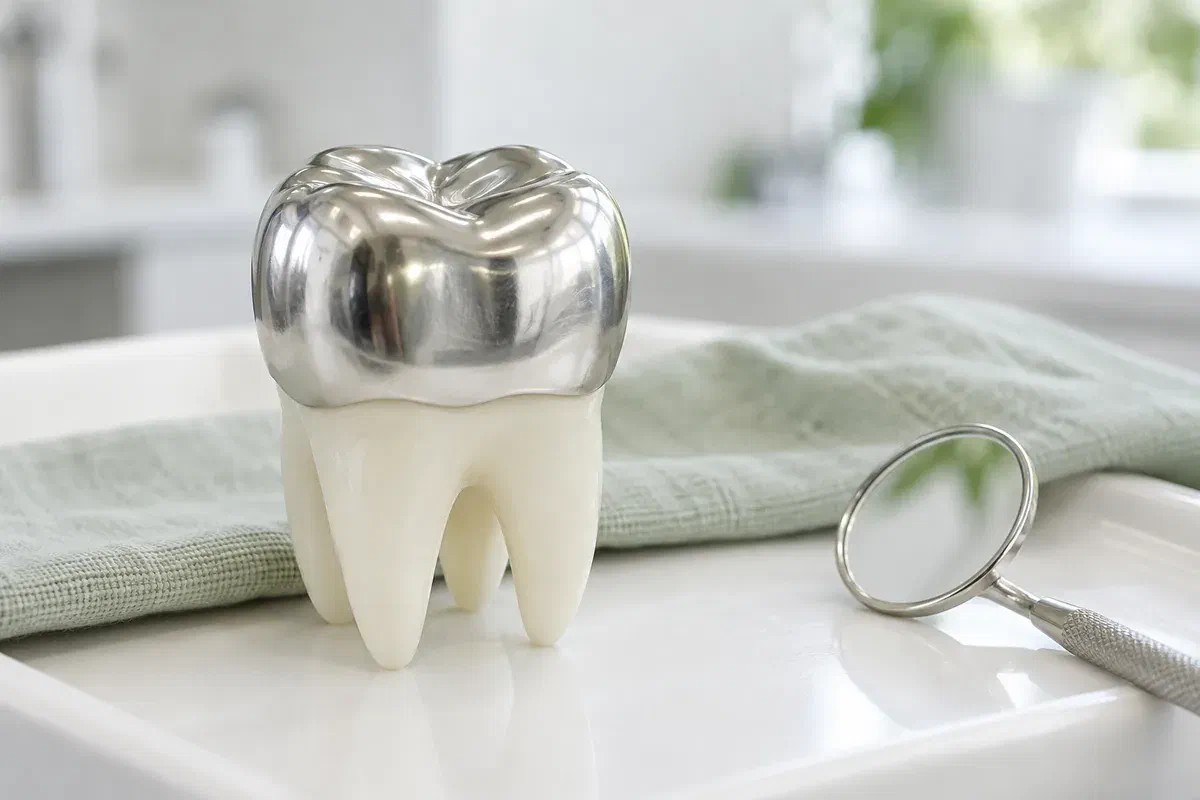
Illustrative molar teaching model with a smooth stainless steel crown
Why the dentist raised a crown

A quiet tooth can still be badly damaged.

Cavities in baby molars do not always cause pain. The extent of decay, the surfaces involved and the condition inside the tooth shape the repair, so mention any symptoms you have noticed.

Decay that has spread wider than it looks

A small opening on the surface can sit over a much larger cavity. When several sides are affected, a filling may not have enough healthy tooth to anchor to. Share details of earlier repairs, and ask whether a crown is the sturdier choice.

A molar that has had its nerve treated

Pulpotomy and pulpectomy address the tissue inside a baby tooth, and protecting what is left on the outside comes next. Ask whether a crown completes the plan. Comfort after nerve treatment does not mean the job is finished.

Allergies, needs and preferences

Tell the team about nickel or other metal allergies and any past reactions. Mention sensory sensitivities, communication needs and your child’s feelings about a silver tooth. Those details matter when choosing the material and planning how treatment will go.

If your child develops pain, gum swelling or a bump near the tooth before treatment, call. These can signal a change that needs earlier assessment.

Why full coverage can make sense

A repair built to last as long as the baby tooth

By covering the whole crown of the tooth, a stainless steel cap supports a molar that has been weakened in more than one place. That is why it is often considered for baby teeth with deep decay, thin walls or recent pulp therapy. The tooth’s condition decides, not the convenience of the material.

The aim is for the restoration to last until natural tooth loss. Along the way, a crown can loosen or wear, and new problems can arise in the tooth underneath. Regular cleaning and reviews continue, which also gives siblings a chance to be checked at the same time.

Patient information: AAPD — restorative dentistry for children

Strength when many surfaces are involved

Ask which parts of the tooth are compromised and why a large filling may not be the better fit. Thin, weakened walls do not always support a big repair well. The decision should reflect the tooth’s build and the chewing it handles.

Room for the adult tooth

Primary molars help keep space for the teeth developing below. A tooth with several years left to serve is weighed differently from one that is already loose. Find out where the adult tooth is in its development and whether that shifts what the dentist suggests.

One plan for the whole mouth

If more than one tooth needs work, or more than one child needs care, ask how treatment can be organised. Clinical needs come first, but thoughtful sequencing helps. Leave with prevention advice that the whole household can use.

What the crown visit looks like

Decide, prepare, place and review

Preformed metal crowns can be placed using more than one approach. The dentist will explain which is planned for your child’s molar and why it fits.

  1. Settle the diagnosis

    The dentist goes over any symptoms, examines the molar and arranges radiographs when there is a clinical need. You hear whether the pulp needs attention and whether the tooth is worth restoring. Ask about other routes, appearance, allergies and comfort or referral.

  2. Prepare according to method

    In conventional placement, the area is usually frozen, decay is managed and the tooth is shaped to receive the crown. Selected primary molars may instead be done with the Hall technique. That approach has firm criteria and does not suit every tooth.

  3. Fit and fix

    A preformed crown in a suitable size is tried, checked and then fixed with dental cement. The steps depend on the tooth and the technique. Your child should know how to signal for a pause, and the team will explain unfamiliar sensations.

  4. Bite check and the plan from here

    Ask how your child’s bite might feel and what should prompt a phone call. Note any numbness advice for the drive home and the next review date. If other teeth or siblings are waiting, agree on when they will be seen.

Home again

Simple care that fits a busy household

Use the instructions given for the method and any freezing. If a neighbour, grandparent or older sibling helps with your child afterward, make sure they know the main points.

Wait before eating, then go gently

Follow the advice about when your child can eat. Until feeling returns, help them avoid nibbling their lip, cheek or tongue. Ask what pain relief is suitable; pain that is significant or getting worse is worth a call.

Brush the crown like any other tooth

The crown’s edge at the gum and the teeth beside it need daily cleaning. Help your child brush as their age calls for, and floss as you were shown. If food keeps catching in one spot, mention it at the next visit or sooner.

Phone about any change in the crown

Let us know if the crown feels loose, comes off or looks worn through. Keep a crown that has come out in a lidded container; do not try to refit or glue it, and keep it away from your child’s mouth. Keep reviews on the calendar.

Patient information: Guy’s and St Thomas’ — stainless steel crowns for children

Looking at the alternatives

What could this tooth have instead?

Each suitable choice differs in preparation, appearance, follow-up and limitations. When a lot of tooth has been lost, a white repair and a minimal one may not both be possible.

When full coverage suits the findings

Stainless steel crown

Often suggested for a significantly damaged primary molar or after nerve treatment. You should hear which placement method is planned and whether material concerns apply. It is fixed in place for the life of the baby tooth, not taken off at meals.

When a different repair is enough

A filling or another crown material

Smaller damage may be manageable with a filling placed straight into the tooth, and a crown made of something other than steel is occasionally possible. The look you want, the tooth left to work with, the demands of placing each option and how your child copes in the chair all play a part. Ask which alternatives are realistic.

When a cap would not solve it

Treatment inside, or extraction

Where the nerve is involved, care inside the tooth may need to come first. A molar too damaged to restore may be better removed. Ask how the findings affect the options, and if extraction is suggested, whether the space needs managing.

Questions rural families ask

Timing, siblings and what happens next

When a crown is found at a routine visit, the questions are often about timing and coordination as much as the tooth itself.

(905) 876-4488
If the tooth does not hurt, how soon does it need a crown?
A painless tooth can still have deep decay, and baby teeth do not always warn you before an infection develops. Ask the dentist how urgent this one is and what could happen if treatment is delayed, so you can plan sensibly rather than wait for a toothache to force the timing.
Can my child’s crown and a sibling’s checkup happen on the same day?
Ask when booking. Coordinating visits can save trips for households in Campbellville, as long as each child’s treatment is timed according to their needs.
Can the crown be placed at the same visit the problem is found?
Sometimes, depending on the tooth, the method and the time available. Often a separate appointment is planned so the visit can be prepared properly. Ask what is possible.
Will my child need X-rays before a crown?
Images are taken when clinically indicated, for example to see how deep decay goes or whether the nerve is affected. The dentist can explain why they are recommended, and recent images from another office may be useful to bring along.
Does the crown come out with the baby tooth?
Usually, yes. The crown stays on the tooth until it is naturally lost, and both come out together. Reviews continue in case anything needs attention earlier.
Does having a crown mean the other teeth are safe from decay?
No. A crown protects only the tooth it covers. Brushing help, fluoride as advised, limiting sugary snacks and regular checkups still matter for every other tooth.
Children’s crowns for Campbellville households

A crown plan that works for your family

If a recent checkup flagged a crown, or a back baby tooth seems to be breaking down, ring our Bronte Street practice. We can explain the findings and options, and help you plan appointments around school, work and the other children in the house.

Treatment is planned after assessment. Mention pain, swelling, allergies or siblings who also need visits when you call.

Visit Milton Dental Clinic
Unit 1, 342 Bronte St. S, Milton, ON L9T 5B7
Get directions Clinic hours
Monday–Thursday
11am–7pm
Friday–Sunday
By appointment only

Areas we serve

  • Milton
  • Oakville
  • Mississauga
  • Georgetown
  • Halton Hills
  • Acton
  • Campbellville
  • Brampton
  • Burlington
  • Puslinch
  • Rockwood
  • Erin
  • Caledon
  • Etobicoke
  • Old Milton
  • Bronte Meadows
  • Timberlea
  • Dorset Park
  • Dempsey
  • Clarke
  • Beaty
  • Coates
  • Harrison
  • Scott
  • Willmott
  • Ford
  • Bowes
  • Cobden
  • Walker
  • Mountain View
  • Milton Heights
  • Hawthorne Village
  • Valley View
  • Fallingbrook
  • Nassagaweya
  • Trafalgar
  • Esquesing
  • Nelson
  • Brookville
  • Moffat
  • Glen Williams
  • Norval
  • Limehouse
  • Stewarttown
  • Ashgrove
  • Hornby
  • Silver Creek
  • Speyside
  • Scotch Block
  • North Oakville
  • River Oaks
  • Glen Abbey
  • West Oak Trails
  • Palermo
  • Bronte Creek
  • College Park
  • Joshua Creek
  • Uptown Core
  • Preserve
  • Iroquois Ridge
  • Lisgar
  • Meadowvale
  • Meadowvale Village
  • Churchill Meadows
  • Erin Mills
  • Central Erin Mills
  • Streetsville
  • East Credit
  • Creditview
  • Heartland
  • Sheridan
  • Mount Pleasant
  • Credit Valley
  • Huttonville
  • Churchville
  • Springbrook
  • Northwest Brampton
  • Bram West
  • Fletcher's Meadow
  • Fletcher's Creek South
  • Alton Village
  • Orchard
  • Millcroft
  • Headon Forest
  • Tansley
  • Brant Hills
  • Tyandaga
  • Kilbride
  • Lowville
  • Aberfoyle
  • Morriston
  • Arkell
  • Hillsburgh
  • Freelton
  • Carlisle
  • Waterdown
  • Flamborough
  • Mountsberg

How can we help?

Milton Dental Clinic

Have a question about your smile? Choose the option that works best for you.

For urgent dental concerns, please call.
Messages are reviewed during clinic hours.