
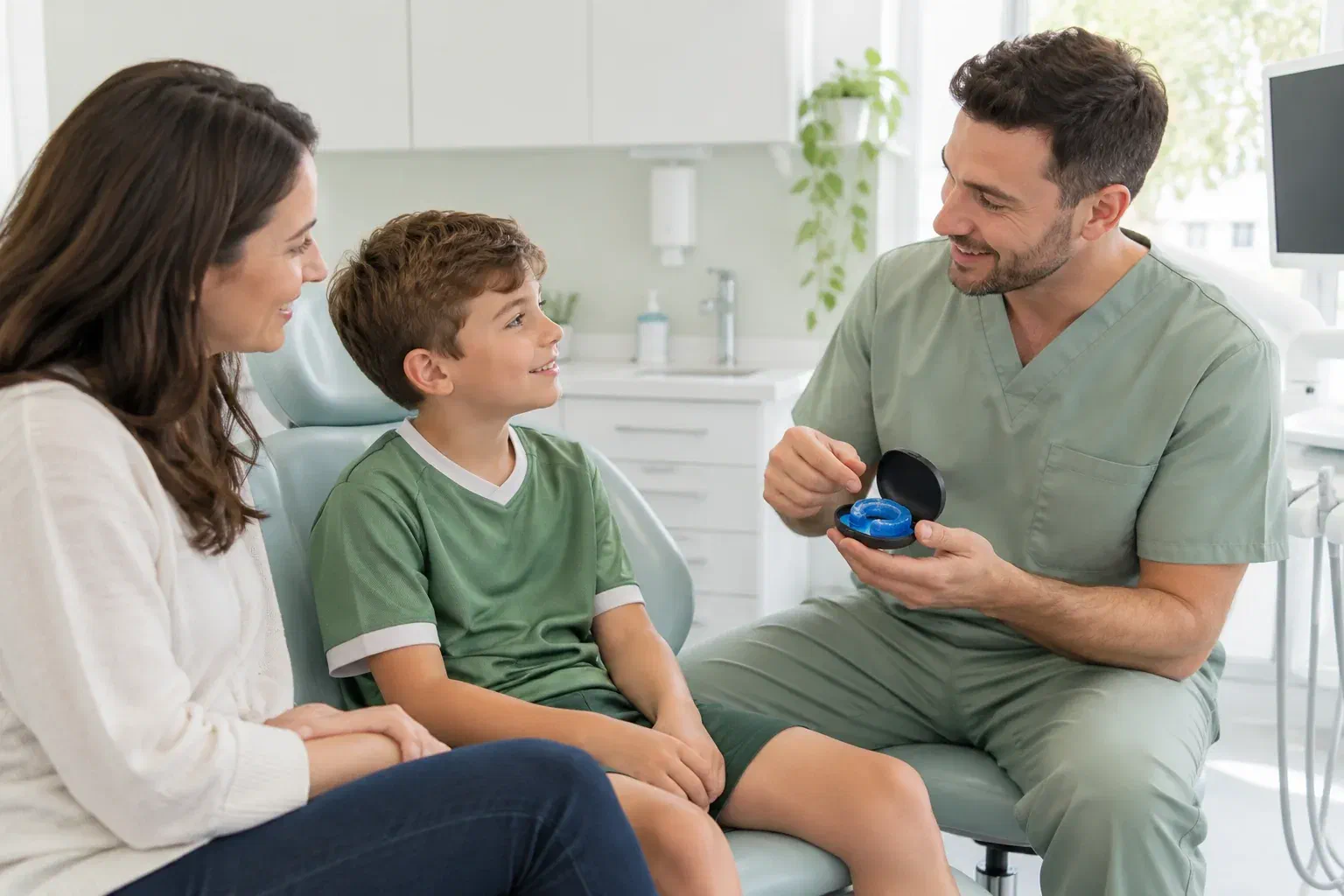
Illustrative young athlete and parent discussing a sports mouthguard with a clinician
Children’s Dentistry

Sports Mouthguards for Children in Brampton

One child plays rep hockey, another does taekwondo, and the youngest has just joined soccer. Each needs a mouthguard that suits their own teeth and sport. We can review the whole family’s guards, sort out who needs what, and plan rechecks as each smile changes.

Brampton families with more than one athlete

Three kids, three sports, three different mouths

In a busy household, mouthguards have a way of multiplying and getting mixed up. One lives in the hockey bag, one in a backpack, one in the car door. Sooner or later someone grabs the wrong one. Each child’s guard needs to match that child’s teeth and activity, and those change at different speeds.

It can help to plan a single conversation about everyone. Bring each child’s current guard, labelled, and a quick list: who plays what, whose teeth are loose, who has new adult molars, and who is starting braces. If you are coming from Brampton, booking siblings back to back may make the trip easier.

Each child still gets their own say. An older sibling may happily wear a guard a younger one finds bulky or hard to talk through. We listen to each of them, because the guard that works is the one they agree to keep in.

Plan mouthguard checks for your children
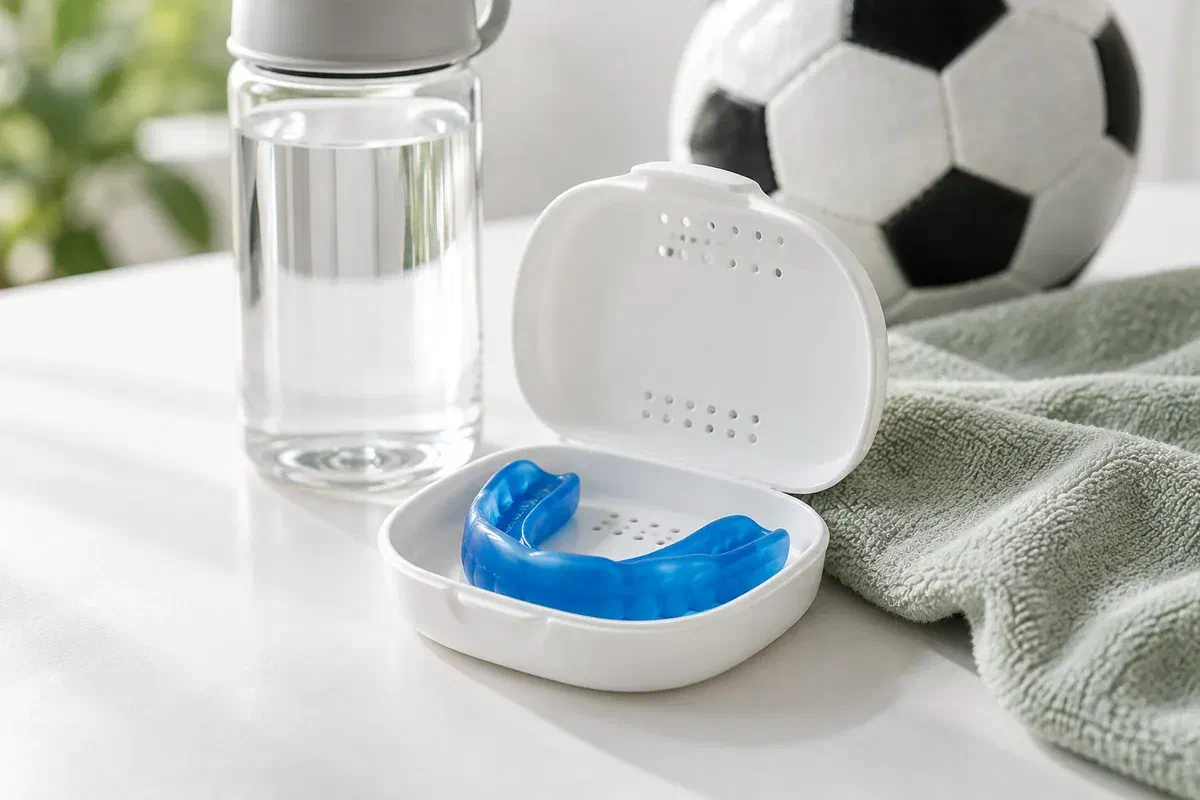
Illustrative blue sports mouthguard in a ventilated case beside sports equipment
Sorting out the household

Different ages, different needs

Guards that fit in the spring may not fit in the fall. Look at each child’s guard before their season and whenever one of them mentions a problem.

Sports with different risks

Martial arts, hockey, basketball and soccer each bring their own mix of contact, falls and equipment. List every activity for every child, organised or casual. Ask the dentist how a guard works with the helmets, face protection and rules each sport uses.

Complaints from one child, not the others

If one child says their guard slides around, rubs or makes breathing hard, take it seriously even when a sibling has no trouble. Bring the guard for a fit review instead of cutting it at home, and let that child know speaking up was right.

Teeth changing at different stages

A seven-year-old losing front teeth and a twelve-year-old with new braces have very different fit questions. Let the clinician know where each child is in tooth development and orthodontic care, and ask when each guard should be looked at again.

Any blow to the mouth may need checking, whichever child it is and whether or not their guard was in. A guard reduces the chance of injury; it does not confirm there was none.

Getting each guard right

Individual fit, for every child in the family

Sports mouthguards that fit well help lower the risk of injury to teeth and nearby soft tissue. Custom-fitted guards are something the Canadian Dental Association suggests families think about. For any child, the guard needs to stay in position through play to be useful, which is why fit is individual.

Keep expectations realistic. A guard sits alongside helmets, face cages, safe-play rules and medical assessment after a suspected head injury; it replaces none of them. It is not a concussion shield, and it cannot guarantee that teeth won’t be injured.

Patient information: Canadian Dental Association — preventing sports-related oral injuries

Each child assessed on their own

The clinician considers each child’s teeth, bite and any appliances rather than assuming an age group or a sibling’s guard is a good guide. Ask how fit will be confirmed and what a suitable guard should feel like, and encourage each child to describe theirs.

Practice time for each child

Trying a new guard calmly, before practice, lets a child learn to put it in, remove it and store it in their own case. Ask questions at that point. Ongoing discomfort is worth mentioning, never something a child has to endure.

A rolling plan as the kids grow

With more than one child, someone’s teeth are almost always changing. Ask which signs should prompt a visit and bring guards to everyone’s dental appointments. The goal is that each child has suitable protection at the stage they are at.

Planning for the whole family

One plan, a guard for each child

Raise this before the busiest part of the season. How long it takes depends on the guards chosen, and assessment visits do not produce guards on the spot.

  1. Map out who plays what

    Share each child’s sports, levels, existing equipment, past injuries and any orthodontic plans, and bring their current guards. If one child struggles with things in their mouth, mention it so their visit can be handled accordingly.

  2. Examine each child and discuss options

    The clinician checks each child’s teeth, bite, eruption and appliances, then compares custom and retail guards for that child. Ask about the number of visits, cost and expected replacement for each before deciding.

  3. Take records where custom is chosen

    For a custom guard, records of the child’s teeth are taken by whatever method the clinician arranges. A strong gag reflex or sensory issue is useful to know in advance. Ask when each guard will be ready and whether fittings are included.

  4. Fit, practise and label

    At the fitting we check that the guard stays in and that your child can breathe and speak with it. They practise handling it, and we go over cleaning and storage. Labelled cases help. Ask about follow-up and what to do if a guard tears or stops fitting.

Keeping guards sorted at home

Separate cases, shared routine

Follow the care instructions for each guard. Younger children usually need a parent to keep the cleaning and storage routine on track.

Wash, dry and case each guard

Rinse and clean each guard as directed with products suited to its material. Let it dry, then store it in that child’s own vented case. Keep all of them away from heat, including a hot car, since high temperatures can distort the shape.

Check them and curb the chewing

Look for tears, worn or chewed areas, warping and rough edges. Encourage children to wear their guards rather than chew them between plays. Siblings and teammates should never swap, and damaged guards should not be glued.

Recheck as each child grows

Bring guards to dental visits and call sooner if one no longer seats comfortably. New teeth, lost teeth, restorations and braces each affect fit. How long ago a guard was made won’t tell you whether it still fits.

Patient information: Fraser Health — choosing and caring for sports mouthguards

Options by child

The right type may differ between siblings.

Budget, timing and convenience matter, especially when buying for several children. Ask which options each child can wear properly.

For a child who needs an individual fit

Custom-fitted guard

Made from records of one child’s teeth, it is planned around that mouth as assessed. It still needs fitting, care and review as teeth change. Ask what the process includes and whether a child’s current stage of growth affects how soon it may be outgrown.

For comparing more accessible options

Retail guard, checked first

Stock and mouldable guards vary in how they fit and how they are prepared. Ask the dentist to look at suitability for each child, especially those with erupting teeth or braces. Follow the package directions; a children’s label does not mean every child will be comfortable in it.

When one of the kids has braces or an appliance

Guard matched to orthodontic treatment

Ask the clinician managing that child’s braces about a sports guard that allows for the appliance and ongoing tooth movement. A retainer, aligner or night guard is built for something else. Agree on a plan before combining devices.

Questions from busy households

Mouthguards when there’s more than one athlete at home

Parents with several children ask about sharing, scheduling, cleaning and replacing lost guards. Each child’s fit needs its own review.

(905) 876-4488
Can siblings swap mouthguards if they are close in age?
No. Even children close in age have different teeth and bites, and sharing raises hygiene concerns. Each child needs a guard chosen and checked for their own mouth, kept in their own case.
Can we book mouthguard checks for several children on the same day?
Ask when you call. Back-to-back appointments may be possible, which can make planning easier. Custom guards still need records and fittings for each child, so ask how those visits are likely to be arranged.
How do we keep track of whose guard is whose?
Use a separate, clearly labelled case for each child, and consider different colours where the guard type allows. Store each guard in its own case after cleaning, and bring all of them to dental visits for a fit check.
Does my child need a mouthguard for martial arts as well as hockey?
Discuss each activity with the dentist and follow the rules of each sport. Mouth injuries can happen in many activities, not only those with a formal mouthguard rule. A guard is one part of protection, with appropriate head and face equipment.
Will wearing a guard keep my child safe from concussion?
It should not be relied on for that. A mouthguard helps protect the teeth and soft tissue, while helmets, safe play and assessment after impacts remain essential. Follow the concussion protocol and get medical advice when a head injury is suspected.
One child keeps losing their guard. What should we do?
Contact the dentist or the original provider about a suitable replacement, and ask what to use until it is ready. A tethered case clipped to the bag may help. Please do not lend a sibling’s guard in the meantime.
Sports mouthguards for Brampton children

Bring the whole team from home.

Contact our Bronte Street practice to plan mouthguard visits for your children. Bring each child’s current guard, a list of who plays what, and any notes on braces, appliances or recent dental changes.

Each sibling gets their own discussion of guard style, fit, timeline and replacement. Any child hurt during play should be checked, whether their guard was in or not.

Visit Milton Dental Clinic
Unit 1, 342 Bronte St. S, Milton, ON L9T 5B7
Get directions Clinic hours
Monday–Thursday
11am–7pm
Friday–Sunday
By appointment only

Areas we serve

  • Milton
  • Oakville
  • Mississauga
  • Georgetown
  • Halton Hills
  • Acton
  • Campbellville
  • Brampton
  • Burlington
  • Puslinch
  • Rockwood
  • Erin
  • Caledon
  • Etobicoke
  • Old Milton
  • Bronte Meadows
  • Timberlea
  • Dorset Park
  • Dempsey
  • Clarke
  • Beaty
  • Coates
  • Harrison
  • Scott
  • Willmott
  • Ford
  • Bowes
  • Cobden
  • Walker
  • Mountain View
  • Milton Heights
  • Hawthorne Village
  • Valley View
  • Fallingbrook
  • Nassagaweya
  • Trafalgar
  • Esquesing
  • Nelson
  • Brookville
  • Moffat
  • Glen Williams
  • Norval
  • Limehouse
  • Stewarttown
  • Ashgrove
  • Hornby
  • Silver Creek
  • Speyside
  • Scotch Block
  • North Oakville
  • River Oaks
  • Glen Abbey
  • West Oak Trails
  • Palermo
  • Bronte Creek
  • College Park
  • Joshua Creek
  • Uptown Core
  • Preserve
  • Iroquois Ridge
  • Lisgar
  • Meadowvale
  • Meadowvale Village
  • Churchill Meadows
  • Erin Mills
  • Central Erin Mills
  • Streetsville
  • East Credit
  • Creditview
  • Heartland
  • Sheridan
  • Mount Pleasant
  • Credit Valley
  • Huttonville
  • Churchville
  • Springbrook
  • Northwest Brampton
  • Bram West
  • Fletcher's Meadow
  • Fletcher's Creek South
  • Alton Village
  • Orchard
  • Millcroft
  • Headon Forest
  • Tansley
  • Brant Hills
  • Tyandaga
  • Kilbride
  • Lowville
  • Aberfoyle
  • Morriston
  • Arkell
  • Hillsburgh
  • Freelton
  • Carlisle
  • Waterdown
  • Flamborough
  • Mountsberg

How can we help?

Milton Dental Clinic

Have a question about your smile? Choose the option that works best for you.

For urgent dental concerns, please call.
Messages are reviewed during clinic hours.