
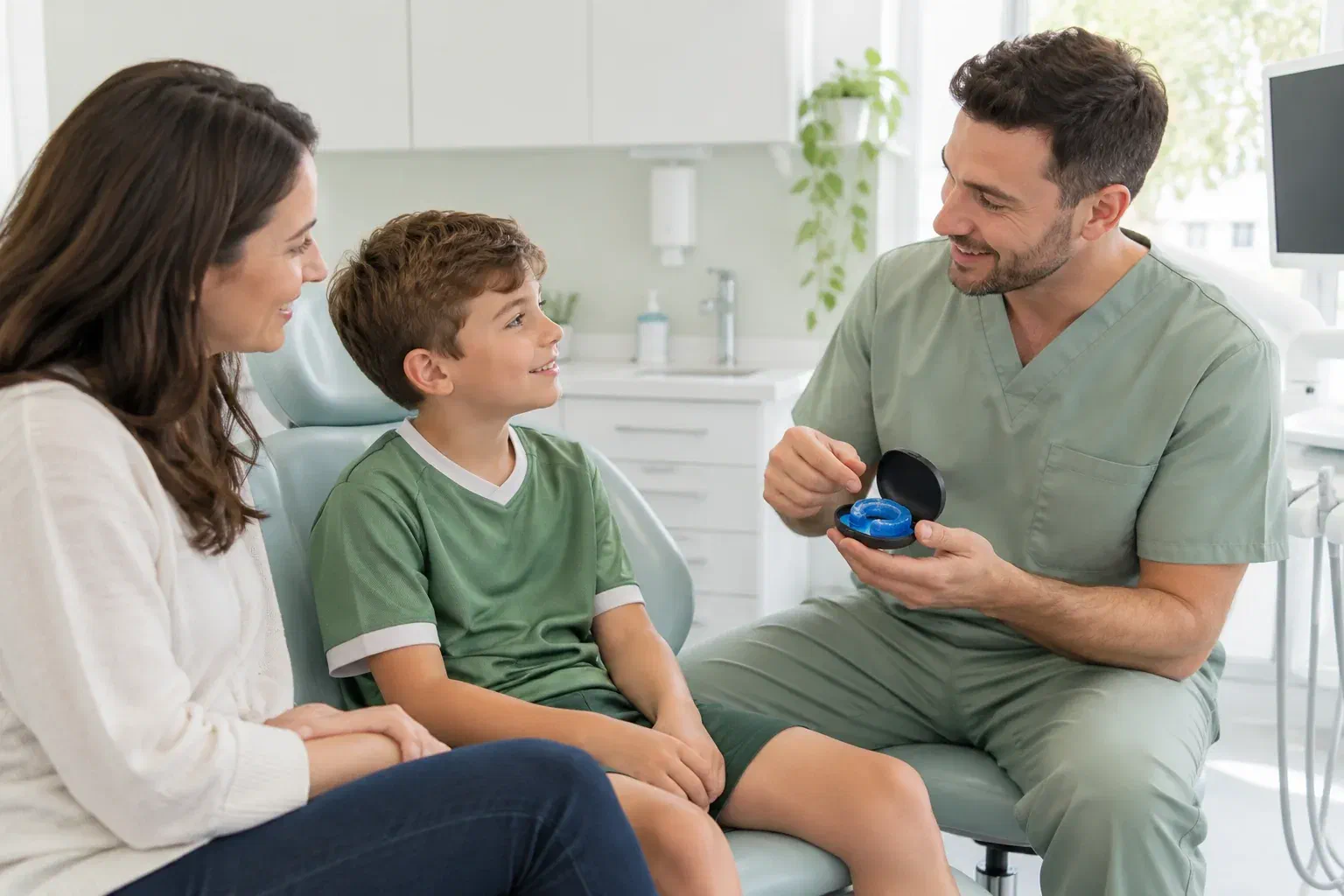
Illustrative young athlete and parent discussing a sports mouthguard with a clinician
Children’s Dentistry

Sports Mouthguards for Children in Milton

Registration is done and the equipment list is growing. Add a mouthguard conversation to it, so your child’s guard suits their sport, their changing teeth and the way they breathe and talk while they play, with fit checks planned as the season goes on.

Mouthguards for young athletes in Milton

Put the mouthguard on the registration checklist.

Sign-up week tends to bring a list: cleats, shin pads, a helmet that still fits. A mouthguard deserves a line of its own on that list whenever the activity involves contact, falls or a fast-moving ball, stick or puck. Choosing one well means thinking about the sport and about the particular teeth your child has this year.

For a Milton household already close to our Bronte Street practice, a guard check can slot in after school rather than becoming a special trip. Bring the current guard if there is one, and tell us about loose baby teeth, newly arrived adult teeth, past knocks to the mouth, or braces that are planned or already on.

A guard that sits in the bag protects nothing. We ask children directly how theirs feels: whether it slips, feels too thick, or makes it hard to call for the ball. Their answers shape the advice, and they are never treated as complaining.

Book a mouthguard visit for your child
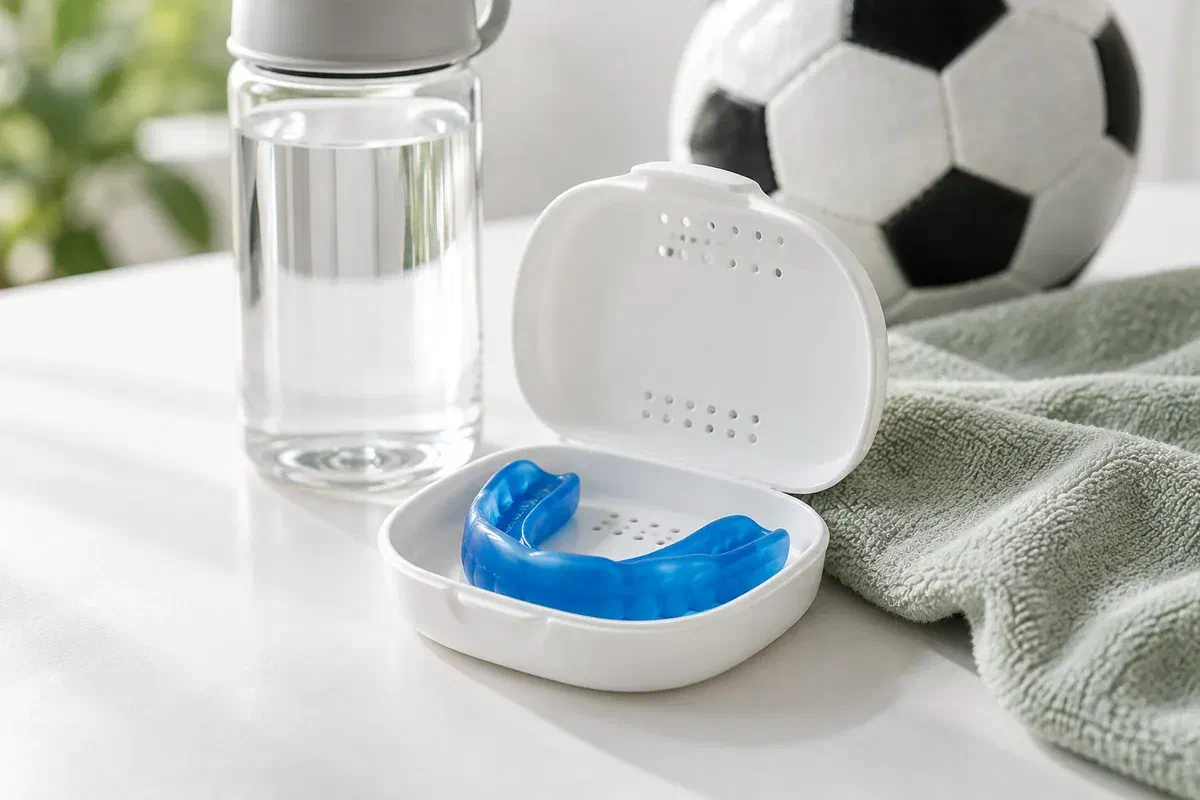
Illustrative blue sports mouthguard in a ventilated case beside sports equipment
Worth raising before the season

Three things that change which guard makes sense

Teeth and activities both shift from one season to the next. A quick review before play starts, and a call when something changes, keeps the plan current.

More than one sport, or play outside a league

List everything your child does around Milton, including pickup games, skating, biking or gymnastics, not only the team that hands out a rule sheet. The dentist can talk through where mouth protection adds value and how it works alongside a helmet, a face shield and the sport’s own safety rules.

Slipping, rubbing, or biting down to hold it in

If your child clenches to keep the guard in place or comes home with a sore spot, that is a fit question for the clinician. Please avoid cutting it down at home. Let your child know that saying it feels wrong is helpful, not a fuss.

New teeth coming in, or braces on the way

Losing a primary tooth, a permanent tooth erupting, or teeth shifting with orthodontics can all alter how a guard seats. Mention upcoming appliance changes so the plan can allow for them, and ask when the fit should be looked at again.

After a hit to the mouth, arrange an injury assessment where it is warranted, even with a guard in. A mouthguard lowers the risk; it does not prove nothing was damaged.

Why the fit matters

Protection your child will actually keep in.

A sports mouthguard that fits properly helps lower the chance of injury to the teeth, lips, cheeks and gums. The Canadian Dental Association encourages families to consider custom-fitted guards. The reason is practical: a guard can only do its job if it stays where it should through the whole game.

It is still one piece of equipment, not a force field. A guard does not stand in for a helmet, a visor, fair-play rules or a medical check after a possible head injury, and no one should promise your family that it prevents concussion or every kind of dental injury.

Patient information: Canadian Dental Association — preventing sports-related oral injuries

Advice built around your child’s mouth

Rather than going by the age range printed on a package, the clinician looks at the teeth, the bite and any appliance. Ask how the fit will be judged and what a good guard should feel like. What your child tells us counts in that judgement.

Time to get used to it off the field

Trying a new guard at the clinic, without a coach waiting, lets your child learn how to put it in, take it out and pack it away. Raise questions then. Discomfort is worth reporting; it is not simply the price of being protected.

A plan that follows growth

Children’s mouths keep changing, so fit needs revisiting. Ask which signs should bring you back, and pack the guard for regular dental visits. The goal is suitable protection at each stage, not stretching one guard well past the point it fits.

From first chat to finished guard

How a mouthguard visit usually unfolds

Start the conversation well ahead of opening day. The timeline depends on the type of guard chosen, and a first assessment does not mean the guard leaves with you that day.

  1. Tell us about the sport and the teeth

    Share the activity, your child’s level, the gear they already use, any earlier injuries and any orthodontic plans. An old guard is useful for comparison. If your child finds things in the mouth hard to tolerate, say so early so we can plan around it.

  2. Look at the mouth and weigh the choices

    The clinician checks teeth, bite, eruption and appliances, then explains how a custom guard compares with retail options for your child. This is the time to ask about appointments, cost and how often replacement might be needed before you decide.

  3. Take impressions or scans if going custom

    A custom guard is made from records of the teeth, taken in whatever way the clinician arranges. Mention a strong gag reflex or sensory sensitivity ahead of time. Ask when it should be ready and whether a fitting appointment is part of the plan.

  4. Try it in and learn the routine

    When the guard is ready, we check how well it stays put and how breathing and talking feel with it in. Your child practises handling it, and you go over cleaning and storage. Ask when to come back, and what to do if a tooth erupts, the guard splits or braces change the fit.

Looking after it at home

Rinse, dry, case, and watch for changes.

Use the care instructions that come with the specific guard. Younger children usually need a parent to run the routine until it becomes habit.

Clean and dry after each use

Rinse and clean the guard the way you were shown, using products that suit its material. Let it air-dry, then keep it in a vented case. Keep it out of high heat, including a parked car on a warm day, which can warp the shape.

Look it over and discourage chewing

Every so often, check for tears, thin spots, warping or rough edges. Encourage your child to wear it properly rather than gnaw on it on the bench. Teammates should not borrow it, and glue is not a fix for a damaged guard.

Recheck after growth or dental work

Bring the guard to checkups, and call before then if it stops seating comfortably. New teeth, lost teeth, fillings and braces can all change the fit. The date it was made says less about suitability than how it fits now.

Patient information: Fraser Health — choosing and caring for sports mouthguards

Types of guard

Each option asks something different of your family.

Cost and availability belong in the conversation alongside your child’s teeth. Ask which options your child can wear properly in their situation.

When you want a guard made for this mouth

Custom-fitted sports guard

Made from records of your child’s teeth, a custom guard is designed for the mouth that was assessed. It still needs a fitting, regular care and review as teeth change. Ask what the process includes and how your child’s stage of growth may affect replacement.

When weighing a store-bought option

Retail guard, reviewed by the dentist

Stock guards and mouldable guards differ in how they fit and how they are prepared. Ask the dentist whether one suits your child, especially with teeth erupting or braces on. Follow the package directions, and keep in mind that a children’s label does not guarantee a safe, comfortable fit.

When braces or an appliance are involved

Guard planned around orthodontics

Speak with the treating dental or orthodontic clinician about a guard that allows for the appliance and expected tooth movement. Aligners, retainers and night guards are not sports guards by default. Settle the plan before using devices together.

Mouthguard questions from parents

Answers to sort out before opening day

Parents ask about timing, growth, cleaning and lost guards. Knowing when a fit needs another look is part of being ready.

(905) 876-4488
How far ahead of the season should we book a custom guard?
Allow enough time for an assessment, records and a fitting, because the timeline depends on the guard chosen. Ask at the first visit when the guard is likely to be ready, and plan the fitting before your child’s first game, not on the morning of it.
Is there a minimum age for wearing a sports mouthguard?
Age alone does not decide it. The activity, your child’s ability to keep a guard in and follow instructions, and the teeth present all matter. Talk with the dentist about whether protection makes sense now and what kind your child can manage.
Our team doesn’t require mouthguards. Should my child wear one anyway?
It is worth discussing. Contact, falls and stray equipment can injure the mouth whether or not a league has a rule. Follow the sport’s safety requirements, and ask the dentist where a guard fits alongside the head and face protection your child already uses.
Does a mouthguard protect against concussion?
Do not count on it for that. A guard helps protect the teeth and soft tissues, while head protection, safe play and assessment after a hit remain essential. Follow your sport’s concussion protocol and get medical advice if a head injury is suspected.
What should we do if the guard goes missing mid-season?
Contact the dentist, or whoever supplied the guard, about a suitable replacement, and ask what your child should use in the meantime. Please do not borrow a sibling’s or teammate’s guard, since fit is individual and sharing raises hygiene concerns.
My child can’t call plays clearly with the guard in. Is that normal?
Some adjustment is expected at first, but ongoing trouble talking or breathing should be reviewed. Bring the guard in and describe what happens during play. Please avoid trimming it yourself, and ask what protection to use until the fit is sorted out.
Children’s mouthguards in Milton

Book the fit check before the first whistle.

Get in touch with our Bronte Street practice in Milton to plan your child’s sports protection. Bring the guard they use now, a list of their activities, and any news about braces or recent dental changes.

The type of guard, fit, timing and replacement are discussed for each child. Any injury still needs assessment, even if a guard was worn.

Visit Milton Dental Clinic
Unit 1, 342 Bronte St. S, Milton, ON L9T 5B7
Get directions Clinic hours
Monday–Thursday
11am–7pm
Friday–Sunday
By appointment only

Areas we serve

  • Milton
  • Oakville
  • Mississauga
  • Georgetown
  • Halton Hills
  • Acton
  • Campbellville
  • Brampton
  • Burlington
  • Puslinch
  • Rockwood
  • Erin
  • Caledon
  • Etobicoke
  • Old Milton
  • Bronte Meadows
  • Timberlea
  • Dorset Park
  • Dempsey
  • Clarke
  • Beaty
  • Coates
  • Harrison
  • Scott
  • Willmott
  • Ford
  • Bowes
  • Cobden
  • Walker
  • Mountain View
  • Milton Heights
  • Hawthorne Village
  • Valley View
  • Fallingbrook
  • Nassagaweya
  • Trafalgar
  • Esquesing
  • Nelson
  • Brookville
  • Moffat
  • Glen Williams
  • Norval
  • Limehouse
  • Stewarttown
  • Ashgrove
  • Hornby
  • Silver Creek
  • Speyside
  • Scotch Block
  • North Oakville
  • River Oaks
  • Glen Abbey
  • West Oak Trails
  • Palermo
  • Bronte Creek
  • College Park
  • Joshua Creek
  • Uptown Core
  • Preserve
  • Iroquois Ridge
  • Lisgar
  • Meadowvale
  • Meadowvale Village
  • Churchill Meadows
  • Erin Mills
  • Central Erin Mills
  • Streetsville
  • East Credit
  • Creditview
  • Heartland
  • Sheridan
  • Mount Pleasant
  • Credit Valley
  • Huttonville
  • Churchville
  • Springbrook
  • Northwest Brampton
  • Bram West
  • Fletcher's Meadow
  • Fletcher's Creek South
  • Alton Village
  • Orchard
  • Millcroft
  • Headon Forest
  • Tansley
  • Brant Hills
  • Tyandaga
  • Kilbride
  • Lowville
  • Aberfoyle
  • Morriston
  • Arkell
  • Hillsburgh
  • Freelton
  • Carlisle
  • Waterdown
  • Flamborough
  • Mountsberg

How can we help?

Milton Dental Clinic

Have a question about your smile? Choose the option that works best for you.

For urgent dental concerns, please call.
Messages are reviewed during clinic hours.