
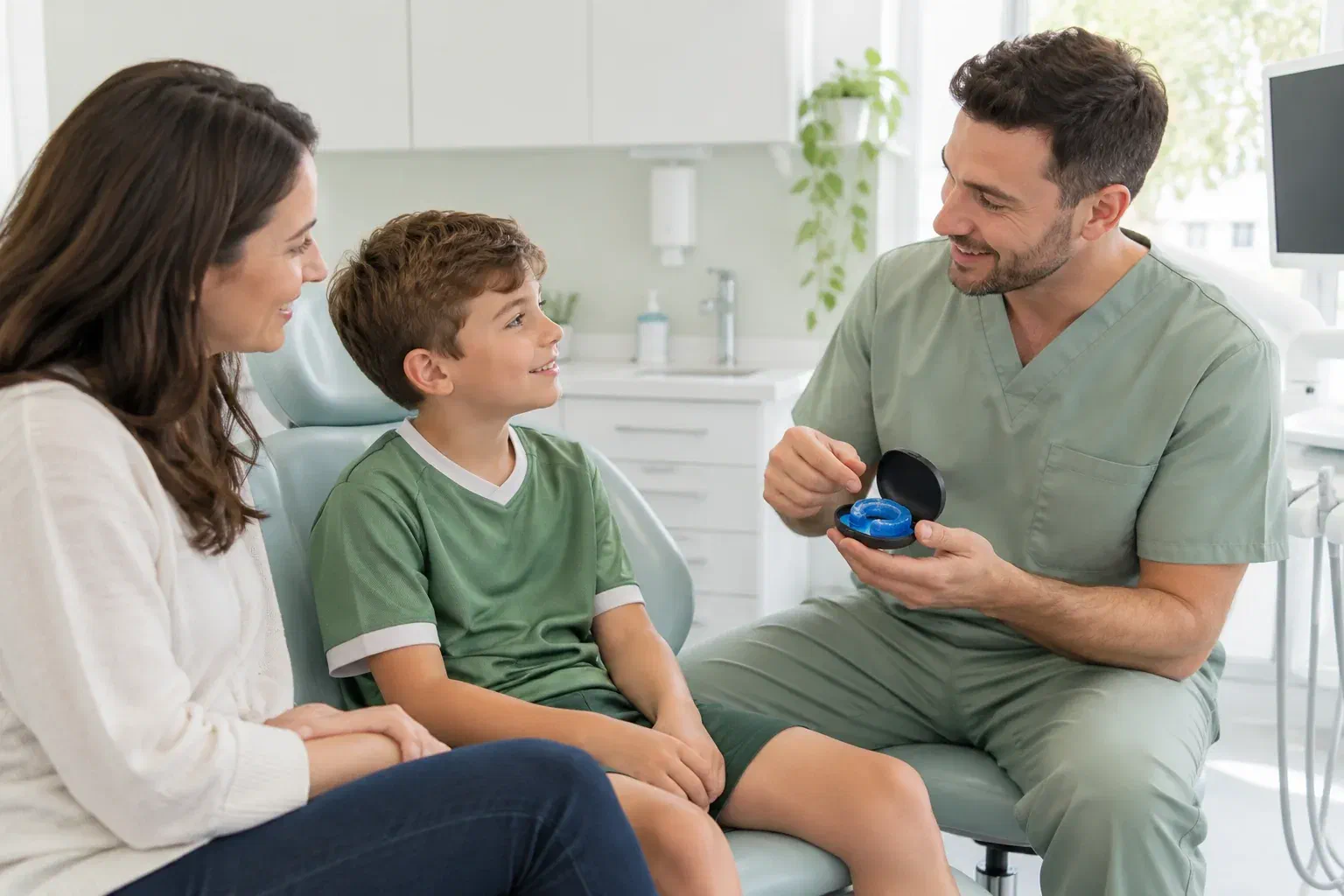
Illustrative young athlete and parent discussing a sports mouthguard with a clinician
Children’s Dentistry

Sports Mouthguards for Children in Oakville

Some children take their mouthguard out the moment the coach looks away. If that sounds familiar, the issue is often fit or comfort, not attitude. We look at your child’s teeth, sport and feedback, and plan a guard they can breathe, talk and play in.

For young players from Oakville

The guard tucked in a sock between shifts

Plenty of parents have watched it happen: the guard goes in for warm-up and is out again by the second drill, stuffed into a glove or a sock. Children rarely ditch a mouthguard for no reason. Often it feels too bulky, makes them gag, or stops them from being heard on the field.

That is where a visit helps. Bring the guard your child has been avoiding and let them explain, in their own words, what bothers them. Tell us about recent tooth changes, earlier injuries, and any braces or appliances, because each of these can affect what will feel right.

For families travelling from Oakville, one well-prepared appointment can cover a lot: the sport, the current guard, and whether a new or custom-fitted option is worth considering. The point is a guard your child will actually leave in.

Arrange a comfort and fit review
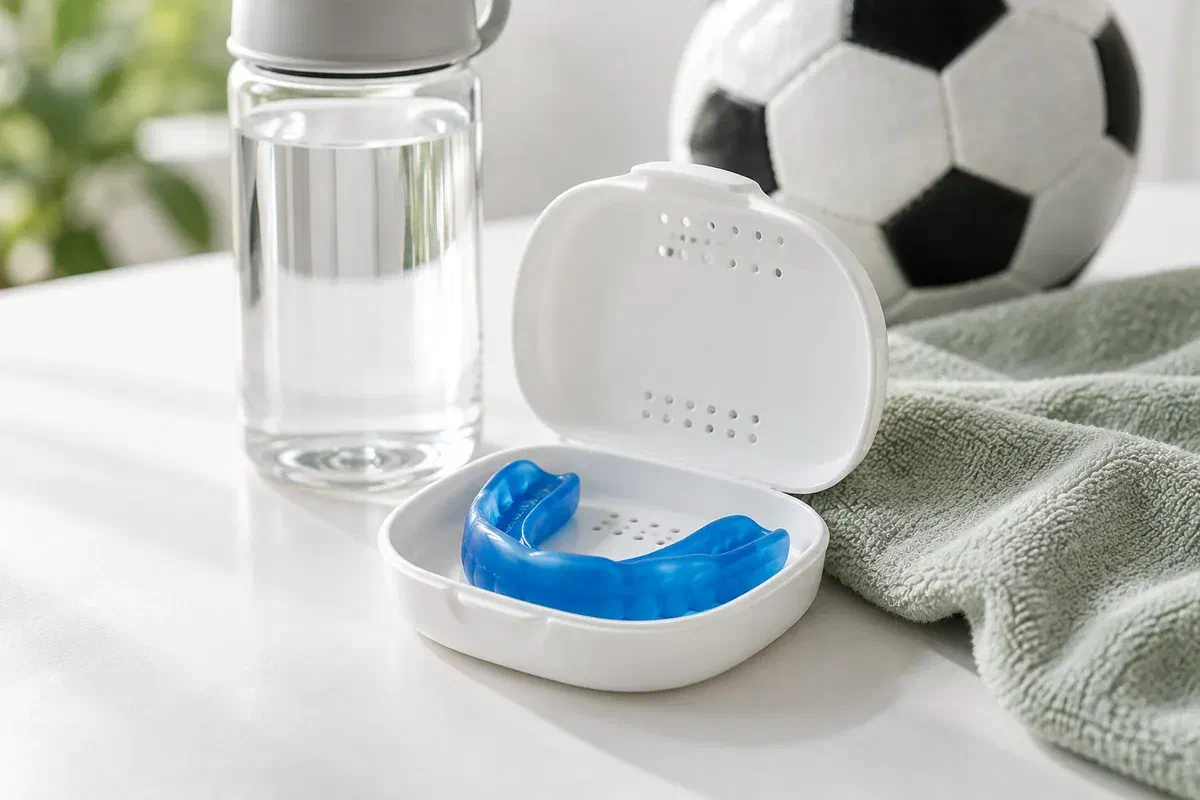
Illustrative blue sports mouthguard in a ventilated case beside sports equipment
Why children stop wearing it

Usually there is a reason, and it can be fixed.

Resistance is useful information. Pair it with a look at the activity and the teeth, and revisit the plan whenever something changes.

It doesn’t seem worth it for this sport

Children sometimes assume a guard is only for tackle sports. Mention every activity, from basketball and soccer to skating and trampoline parks, and ask the dentist how protection fits with the helmet, face gear and rules involved. A clear reason helps a child cooperate.

It gags, rubs or falls out

Gagging, chafed gums, or a guard that drops whenever your child opens wide all deserve a professional look. Bring it in instead of trimming it yourself. Telling a child to put up with it usually means it ends up back in the bag.

The teeth have moved on

Lost baby teeth, new adult teeth and orthodontic movement can turn a comfortable guard into an uncomfortable one. Let the clinician know about upcoming braces or adjustments, and ask whether the guard can allow for those changes and when to recheck.

Even when a guard was in, a blow to the mouth may need an injury assessment. Protection lowers the risk but cannot confirm that nothing was hurt.

Comfort and protection go together

A guard that stays in is a guard that helps.

Well-fitted sports mouthguards help reduce injuries to the teeth and the tissues around them. The Canadian Dental Association encourages families to look at custom-fitted options. Comfort is not a luxury here; a guard that is easy to wear is more likely to be in place when an impact happens.

It also has limits. A mouthguard does not replace a helmet, a face cage, fair play or medical attention after a suspected head injury. Nobody should describe it to you as a way to prevent concussion or every possible dental injury.

Patient information: Canadian Dental Association — preventing sports-related oral injuries

Fit judged on your child, not a size chart

The clinician considers the teeth, how they meet and any appliance, rather than going by the age on a package. Ask how comfort and fit will be checked, and encourage your child to describe exactly what they feel.

Practice before pressure

A calm try-on lets your child learn to insert and remove the guard and store it properly, without teammates watching. It is a good moment to ask about gagging, speech and breathing. Ongoing discomfort should be reported, not accepted.

Checks that keep up with growth

As your child grows, a guard that felt fine can start to pinch or loosen. Ask what signs to watch for and bring the guard to routine visits. Keeping protection comfortable over time is what keeps it in use.

What happens at the appointment

Listen, examine, decide, then fit.

Start early enough that the guard is ready before the season. Timing depends on the type of guard, and the assessment itself does not mean same-day delivery.

  1. Hear what has not been working

    We talk about the sport, the level of play, existing equipment, past injuries and orthodontic plans. Your child can show us what they dislike about the current guard. Mention any sensory difficulties so the visit can be paced accordingly.

  2. Examine and lay out the choices

    Once the teeth, bite, erupting teeth and any appliance have been checked, the clinician sets out where a custom guard and a store-bought one differ for your child. Ask about the number of visits, the cost and how often a replacement might be needed.

  3. Record the teeth for a custom guard

    If you choose custom, records of the teeth are taken in the way the clinician arranges. Let us know beforehand about a strong gag reflex. Ask when the guard should be ready and whether a fitting visit is included.

  4. Try it, adjust expectations, and learn care

    At the fitting, we check retention and ask your child to talk and breathe with the guard in. They practise putting it in and taking it out, and we review cleaning and storage. Confirm when to return and what to do if a tooth erupts, the guard tears, or braces change things.

Keeping it wearable

Care habits that keep the guard comfortable

Use the instructions for your child’s particular guard. A parent may need to oversee the routine at first, especially for younger players.

Clean, dry and case it

Rinse and clean the guard as directed with products suited to its material, then let it dry. Store it in a protective case with vents. Never leave it somewhere hot, such as a closed car, where it can lose its shape.

Watch for damage and chewing

Check now and then for tears, thinning, distortion or edges that have become uncomfortable. A chewed guard is less likely to fit, so encourage your child to wear it rather than gnaw on it. Don’t share it or patch it with glue.

Book a recheck when things change

Bring the guard to dental visits and call sooner if your child says it no longer feels right. Erupting or lost teeth, fillings and braces can all affect comfort. The calendar alone won’t tell you whether it still fits.

Patient information: Fraser Health — choosing and caring for sports mouthguards

Finding the right type

Three routes to a guard your child will wear

Price, timing and convenience are part of the decision, just as much as the teeth are. The best choice is one your child finds comfortable enough to use properly.

When comfort and fit have been a struggle

Custom-made guard

Because it is made on a model of your child’s own teeth, a custom guard can be shaped with comfort in mind. That does not make it permanent: a fitting, daily care and periodic review are still part of the deal. Ask how growth is likely to shorten or extend its useful life.

When considering a store option

Retail guard, checked for suitability

Ready-made and mouldable guards are not all alike; some need preparing at home, and fit varies widely. Bring the one you are considering so the dentist can judge it against your child’s teeth, braces or erupting molars. Follow the package steps exactly, since a youth label alone says little about comfort.

When an appliance is part of the picture

Braces-friendly protection

Brackets and wires change what feels tolerable, so whoever is managing the orthodontic treatment should be part of the conversation. Keep in mind that a retainer, an aligner or a night guard was never designed to take a hit. Settle on one plan before your child wears anything together.

Questions about wearing a guard

When the guard keeps coming out

Parents ask about comfort, speech, growth and replacing lost guards. A fit check is often the answer to more than one of them.

(905) 876-4488
How can I tell whether my child is actually wearing the mouthguard during games?
Ask your child and the coach, and look at the guard itself. A guard that looks barely used may be a sign of a comfort problem. Bring it in for a review so the reason can be sorted out rather than argued about.
My child gags whenever the guard goes in. What can help?
Tell the dentist. Gagging can relate to the guard’s size or shape, or to how sensitive your child is. A fit review can look at both. Do not cut the guard down at home, and ask what protection to use in the meantime.
Will a better-fitting guard make it easier for my child to talk on the field?
Often, yes. One that fits properly is usually easier to speak around than one that slips or is too bulky, though some adjustment period is normal. If speech or breathing stays difficult, bring the guard back and describe the problem.
Is a custom guard a concussion safeguard?
No. A mouthguard helps protect the mouth, but it should not be relied on for concussion prevention. Head protection, safe play and assessment after an impact remain essential. Follow the sport’s concussion protocol and seek medical care when a head injury is suspected.
Should my child wear the guard at practice as well as in games?
Ask the dentist and follow the sport’s rules, but injuries can happen in practice as well as games. Wearing the guard consistently also helps your child get used to it, which tends to make game days easier.
Can we plan a single visit if we are coming from Oakville?
Tell us when you book that you would like to make the most of the trip. We can discuss the sport, review the current guard and talk through options. A custom guard still needs records and a fitting, so ask how those appointments are likely to be arranged.
Children’s sports mouthguards · Oakville

Make the next guard one your child keeps in.

Reach out to our Bronte Street practice to plan a mouthguard visit. Bring the guard your child has been using, a list of their sports, and any notes on braces, appliances or recent dental changes.

Guard type, fit, fabrication time and replacement are discussed for each child. An injury still needs assessment even if the guard was worn.

Visit Milton Dental Clinic
Unit 1, 342 Bronte St. S, Milton, ON L9T 5B7
Get directions Clinic hours
Monday–Thursday
11am–7pm
Friday–Sunday
By appointment only

Areas we serve

  • Milton
  • Oakville
  • Mississauga
  • Georgetown
  • Halton Hills
  • Acton
  • Campbellville
  • Brampton
  • Burlington
  • Puslinch
  • Rockwood
  • Erin
  • Caledon
  • Etobicoke
  • Old Milton
  • Bronte Meadows
  • Timberlea
  • Dorset Park
  • Dempsey
  • Clarke
  • Beaty
  • Coates
  • Harrison
  • Scott
  • Willmott
  • Ford
  • Bowes
  • Cobden
  • Walker
  • Mountain View
  • Milton Heights
  • Hawthorne Village
  • Valley View
  • Fallingbrook
  • Nassagaweya
  • Trafalgar
  • Esquesing
  • Nelson
  • Brookville
  • Moffat
  • Glen Williams
  • Norval
  • Limehouse
  • Stewarttown
  • Ashgrove
  • Hornby
  • Silver Creek
  • Speyside
  • Scotch Block
  • North Oakville
  • River Oaks
  • Glen Abbey
  • West Oak Trails
  • Palermo
  • Bronte Creek
  • College Park
  • Joshua Creek
  • Uptown Core
  • Preserve
  • Iroquois Ridge
  • Lisgar
  • Meadowvale
  • Meadowvale Village
  • Churchill Meadows
  • Erin Mills
  • Central Erin Mills
  • Streetsville
  • East Credit
  • Creditview
  • Heartland
  • Sheridan
  • Mount Pleasant
  • Credit Valley
  • Huttonville
  • Churchville
  • Springbrook
  • Northwest Brampton
  • Bram West
  • Fletcher's Meadow
  • Fletcher's Creek South
  • Alton Village
  • Orchard
  • Millcroft
  • Headon Forest
  • Tansley
  • Brant Hills
  • Tyandaga
  • Kilbride
  • Lowville
  • Aberfoyle
  • Morriston
  • Arkell
  • Hillsburgh
  • Freelton
  • Carlisle
  • Waterdown
  • Flamborough
  • Mountsberg

How can we help?

Milton Dental Clinic

Have a question about your smile? Choose the option that works best for you.

For urgent dental concerns, please call.
Messages are reviewed during clinic hours.