
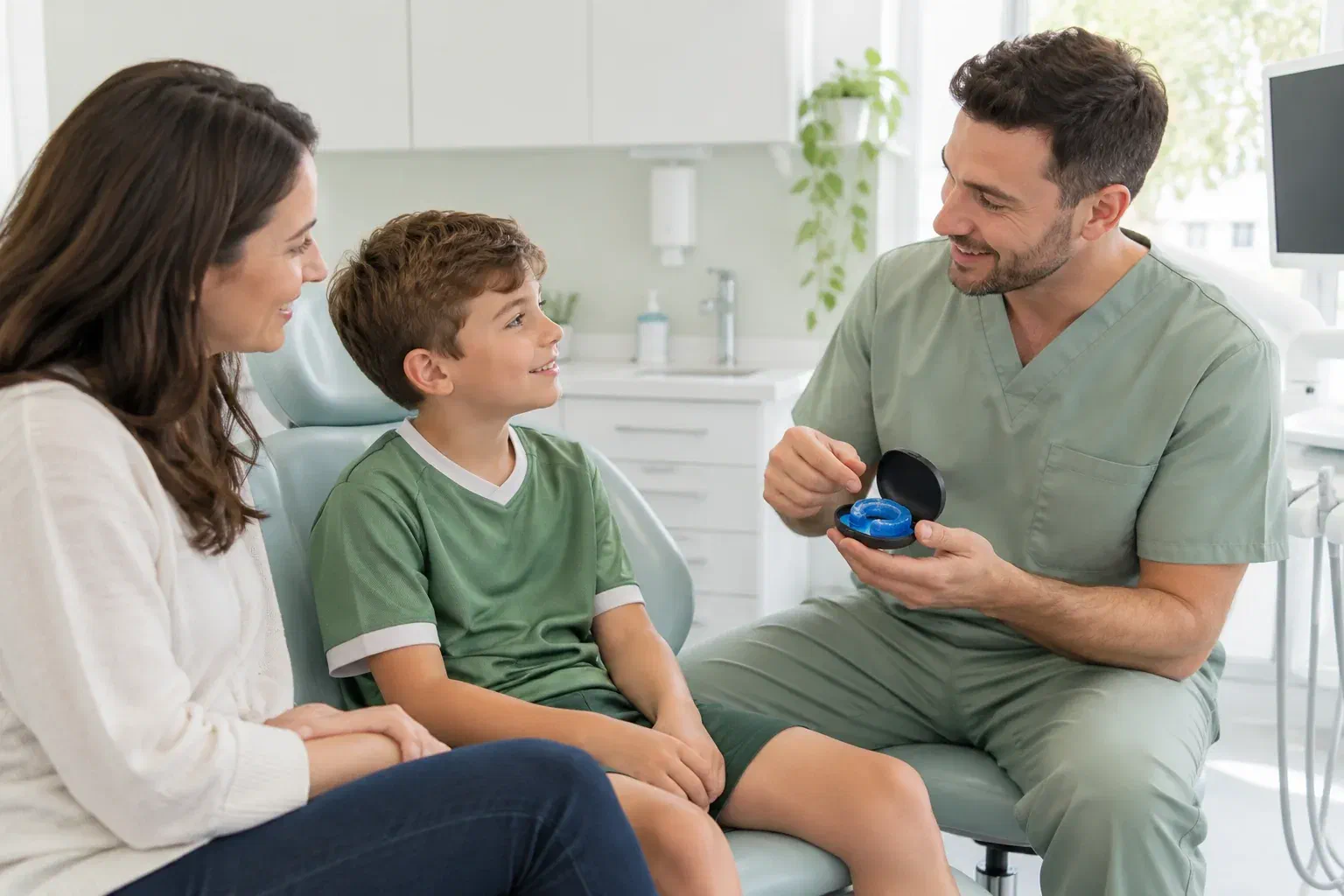
Illustrative young athlete and parent discussing a sports mouthguard with a clinician
Children’s Dentistry

Sports Mouthguards for Children in Puslinch

A mouthguard spends most of its life in a gear bag, a car or a coat pocket, and that is where many fit problems begin. We help you choose a guard suited to your child’s sport and growing teeth, then show you how to clean, store and check it so it keeps doing its job.

Mouthguard care for Puslinch households

Where does the guard live between games?

Ask most kids and the honest answer is somewhere damp: a glove, a cleat, the floor of the car. Summer sun through a windshield, a sweaty bag zipped shut for days and a habit of chewing on the bench can all change a guard’s shape well before the season ends.

Choosing the right guard is the first half of the job, and keeping it in good shape is the second. At a visit, we look at your child’s current guard and teeth together. Tell us about the activities they do, recent tooth changes, any previous injury to the mouth, and orthodontic plans.

Your child’s description of how it feels is often the earliest warning that something has shifted. A guard that suddenly seems loose or tight after a hot weekend is worth a look before the next game, especially when you are planning a trip in from Puslinch.

Have your child’s guard checked
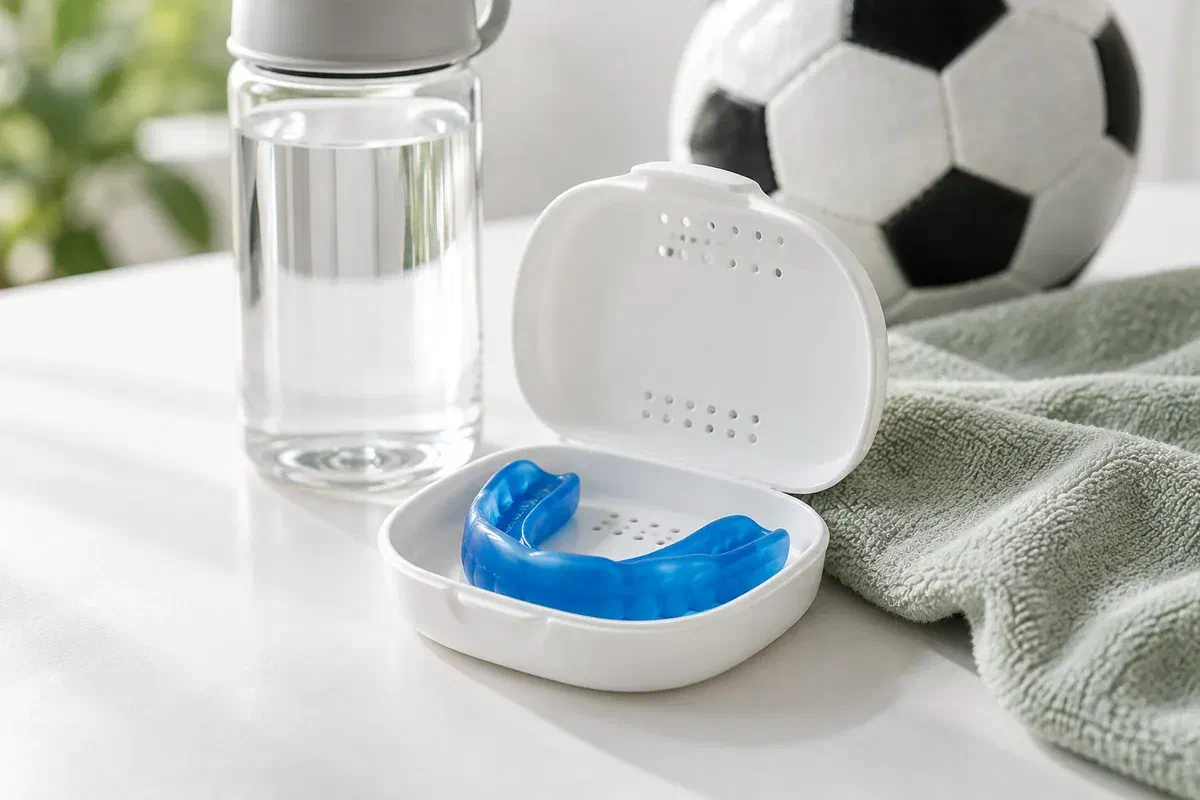
Illustrative blue sports mouthguard in a ventilated case beside sports equipment
When a guard has seen better days

Common ways a good guard stops fitting

Teeth change, and so does the guard itself. A quick review before the season, and after any obvious damage, helps catch problems early.

Activities that put the guard to work

Contact sports, falls and fast-moving equipment are where a guard earns its place, organised league or not. Talk through all your child’s activities, and ask how a guard fits with the helmet, face shield and rules for each.

Warping, rubbing or slipping

Heat or chewing can distort a guard so that it slips, presses on the gums or needs clenching to stay in. Bring it in rather than trimming it, and encourage your child to tell you the moment it starts to feel different.

Teeth that have shifted underneath

Even a guard in perfect condition can stop fitting when primary teeth are lost, permanent ones erupt or braces move teeth. Let the clinician know about orthodontic plans, and ask how often the fit should be reviewed.

After an impact to the mouth, an assessment may be needed even if the guard was in. It reduces risk but cannot confirm that no injury occurred.

Why condition and fit matter

A well-kept guard does its job better.

A sports mouthguard that fits and is in good condition helps lower the risk of injury to teeth and the surrounding tissues. The Canadian Dental Association recommends families consider custom-fitted guards. A warped or chewed guard is less likely to stay in position, which limits what it can do.

It is worth being clear about the rest. A guard doesn’t replace a helmet, face protection, safe rules or medical assessment after a suspected head injury. It isn’t a concussion preventer, and nobody can promise it will stop every dental injury.

Patient information: Canadian Dental Association — preventing sports-related oral injuries

Fit assessed against the real mouth

Packaging can only guess at age. In the chair, the clinician can see the teeth, the bite and any appliance, and judge the guard against them. Ask how fit is being assessed and what a good guard should feel like once it is in. Your child’s feedback helps settle it.

Learning the routine early

Practising in a calm setting lets your child learn to insert, remove, clean and store the guard properly. Ask questions there, when there is time. Discomfort is worth reporting rather than accepting.

Checks through the growing years

Growth and everyday wear both affect fit. Ask which signs mean a recheck and bring the guard to routine visits. The aim is a guard in good condition that suits each stage, not one kept going long past its time.

The appointment

Inspect the guard, examine the mouth, then decide.

Start before the season begins if you can. The timeline depends on the guard chosen, and an assessment does not mean a guard goes home with you that day.

  1. Show us the guard, case and all

    We look at your child’s current guard and case, and ask about the sport, level, equipment, past injuries and orthodontic plans. If your child has trouble with things in the mouth, tell us so the visit can be adapted.

  2. Assess and compare

    The clinician checks the teeth, bite, eruption and appliances, and explains how a custom guard compares with retail ones for your child. Ask about visits, cost and how often replacement may be needed before you choose.

  3. Take records for a custom option

    If you go with custom, records of the teeth are taken by the method the clinician arranges. Mention gagging or sensory difficulties ahead of time. Ask when the guard will be ready and if a fitting is included.

  4. Fit it and practise the care routine

    At the fitting we check that it stays in and that your child can breathe and talk comfortably. They practise handling it, and we show you how to clean, dry and store it. Ask when the next review is due and what kinds of damage or tooth change should bring you in sooner.

Daily care

Small habits, longer-lasting fit

Follow the care directions that come with your child’s guard. A parent may need to check the routine regularly until it sticks.

Clean and dry before it goes in the case

Rinse and clean the guard after use with products suitable for its material. Let it dry completely, then store it in a vented protective case rather than loose in the bag. Damp, closed spaces are not ideal.

Keep it away from heat and teeth

Never leave it on the dashboard or in a parked car on a warm day, since heat can warp it. Discourage chewing between plays. Check for tears, thinning and sharp edges, and don’t share it or patch it with glue.

Recheck as the mouth changes

Pack it for every dental visit, and phone before then if it stops seating comfortably. A tooth arriving or leaving, a new filling, or an orthodontic adjustment can each alter the fit, no matter how new the guard is. Your child will often notice first.

Patient information: Fraser Health — choosing and caring for sports mouthguards

Comparing guards

Options, and what each needs from you

Cost and replacement are part of the decision, along with your child’s teeth. Ask which options your child can wear and care for properly.

For a fit planned around your child’s teeth

Custom-fitted

Made from records of your child’s teeth, a custom guard is planned for the mouth assessed. It still needs fitting, good care and review as teeth change. Ask what is included and how growth may affect how long it lasts.

For a more accessible option

Retail, with a suitability check

Stock and mouldable guards differ in fit and preparation, and some are more easily distorted by heat. Ask the dentist whether a particular guard suits your child, particularly with braces or new teeth. Follow the product instructions.

For children with braces or an appliance

Planned with orthodontic care

Your child’s orthodontic clinician can advise on a sports guard compatible with the appliance and with tooth movement still to come. A retainer or aligner is not a substitute for sports protection. Confirm the plan before combining them.

Guard care questions

Keeping the guard in working order

Parents ask about cleaning, storage, damage and when a guard needs replacing. A fit check is often the quickest way to an answer.

(905) 876-4488
What should I use to clean my child’s mouthguard?
Follow the instructions for the guard’s material, and use the products recommended by the dentist or manufacturer. Rinse it after use, clean it as directed, and let it dry fully before storing it in a ventilated case.
Can heat really change the shape of a mouthguard?
Yes. High temperatures, such as a hot car or a heater, can distort a guard. If it has been left somewhere hot and now feels different, have the fit checked before your child wears it for play.
Is it a problem if my child chews their guard?
Chewing can thin and distort the guard and affect how well it fits. Encourage your child to wear it as intended. If it looks chewed or seats differently, bring it in for a review.
Is a mouthguard enough to protect against concussion?
No. A guard helps protect the mouth, but it is not concussion protection. Helmets, safe play and assessment after an impact are still needed. Follow your sport’s concussion protocol and get medical advice if a head injury is suspected.
When should a damaged guard be replaced?
Tears, worn areas, warping or sharp edges are reasons to have it checked, and replacement may be needed. Don’t repair it with glue. Ask what protection to use until a suitable replacement is ready.
We are coming from Puslinch. Can the guard check happen at a routine visit?
Often, yes. Bring the guard and mention it when booking, so the team can allow time. A new custom guard will still need records and a fitting, so ask how those visits are likely to be arranged.
Children’s sports mouthguards near Puslinch

Bring in the guard before the next game.

Contact our Bronte Street practice to arrange a mouthguard review for your child. Bring the guard and its case, a list of your child’s activities, and details of any braces or recent dental changes.

We talk through type, fit, how long fabrication takes and when a replacement is due for each child. If a tooth or the mouth is hurt, get it looked at, guard or no guard.

Visit Milton Dental Clinic
Unit 1, 342 Bronte St. S, Milton, ON L9T 5B7
Get directions Clinic hours
Monday–Thursday
11am–7pm
Friday–Sunday
By appointment only

Areas we serve

  • Milton
  • Oakville
  • Mississauga
  • Georgetown
  • Halton Hills
  • Acton
  • Campbellville
  • Brampton
  • Burlington
  • Puslinch
  • Rockwood
  • Erin
  • Caledon
  • Etobicoke
  • Old Milton
  • Bronte Meadows
  • Timberlea
  • Dorset Park
  • Dempsey
  • Clarke
  • Beaty
  • Coates
  • Harrison
  • Scott
  • Willmott
  • Ford
  • Bowes
  • Cobden
  • Walker
  • Mountain View
  • Milton Heights
  • Hawthorne Village
  • Valley View
  • Fallingbrook
  • Nassagaweya
  • Trafalgar
  • Esquesing
  • Nelson
  • Brookville
  • Moffat
  • Glen Williams
  • Norval
  • Limehouse
  • Stewarttown
  • Ashgrove
  • Hornby
  • Silver Creek
  • Speyside
  • Scotch Block
  • North Oakville
  • River Oaks
  • Glen Abbey
  • West Oak Trails
  • Palermo
  • Bronte Creek
  • College Park
  • Joshua Creek
  • Uptown Core
  • Preserve
  • Iroquois Ridge
  • Lisgar
  • Meadowvale
  • Meadowvale Village
  • Churchill Meadows
  • Erin Mills
  • Central Erin Mills
  • Streetsville
  • East Credit
  • Creditview
  • Heartland
  • Sheridan
  • Mount Pleasant
  • Credit Valley
  • Huttonville
  • Churchville
  • Springbrook
  • Northwest Brampton
  • Bram West
  • Fletcher's Meadow
  • Fletcher's Creek South
  • Alton Village
  • Orchard
  • Millcroft
  • Headon Forest
  • Tansley
  • Brant Hills
  • Tyandaga
  • Kilbride
  • Lowville
  • Aberfoyle
  • Morriston
  • Arkell
  • Hillsburgh
  • Freelton
  • Carlisle
  • Waterdown
  • Flamborough
  • Mountsberg

How can we help?

Milton Dental Clinic

Have a question about your smile? Choose the option that works best for you.

For urgent dental concerns, please call.
Messages are reviewed during clinic hours.