

Illustrative patient discussing spaces between front teeth with a dental clinician
Cosmetic Dentistry

Black Triangle Closure in Rockwood

What actually happens to your teeth when a dark gap near the gums is bonded? Visiting from Rockwood, you can learn how composite is added, what preparation is involved, how existing fillings or crowns affect the plan, and what upkeep follows.

Inside the treatment

Adding, not taking away

People often picture drilling when they hear the word treatment. For many black triangles, bonding is largely additive: tooth-coloured resin is built onto the sides of the teeth that border the gap. That gap, the dark opening near the gum between two teeth, may come from their natural taper, their alignment, or gum and bone that have receded.

Because composite reshapes the teeth, it cannot restore gum or rebuild bone. It also has to leave a contact that floss or a small brush can still pass. Existing fillings, crowns or veneers next to the space change the planning, since resin bonds differently to different surfaces and older work may need review first.

If you are travelling from Rockwood, bring whatever you know about past dental work along with your questions. We begin with your observations, examine the gums and teeth, and explain the treatment step by step. Health concerns are always addressed before the cosmetic plan.

Learn what bonding would involve for you
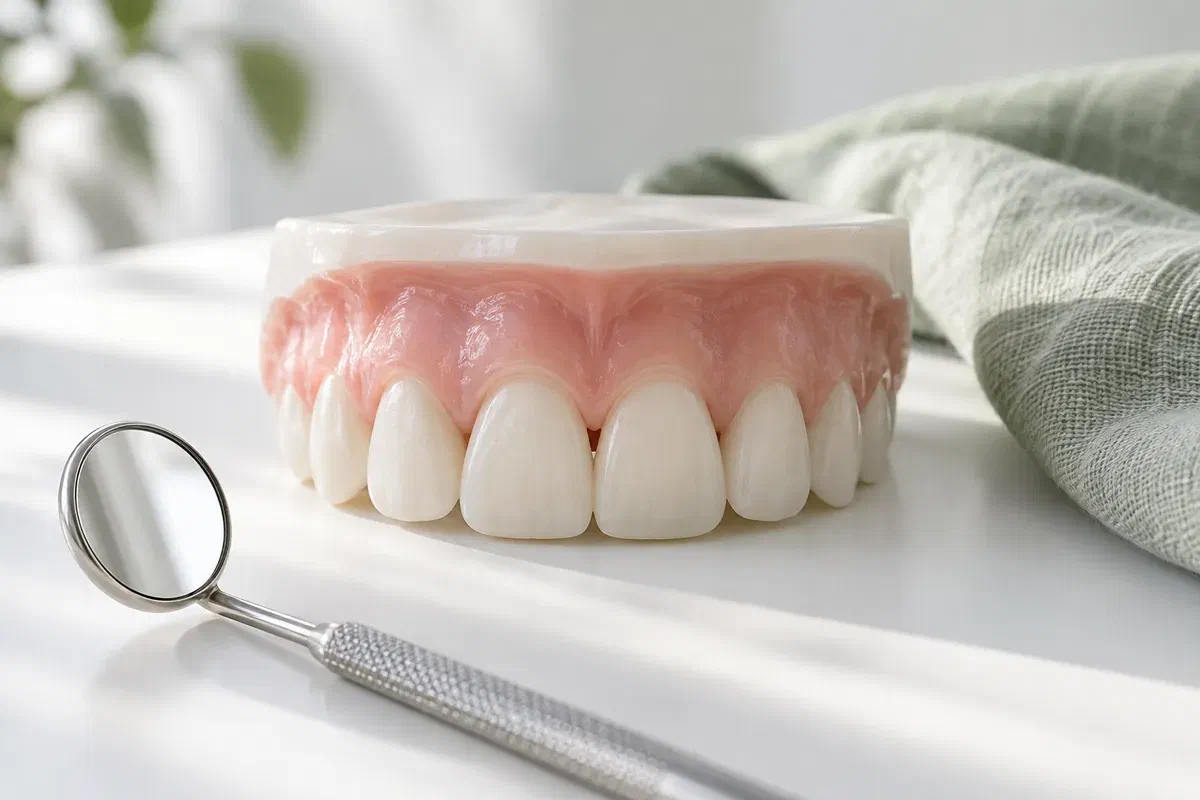
Illustrative dental model showing small triangular spaces near the gumline
Before anything is placed

Details that change the technique

A photograph is useful, but only an examination reveals the surfaces and tissues involved. Tell us when the space appeared, whether it has changed and anything you have felt there.

What you see, and what you would like

Explain which opening concerns you and what kind of change appeals to you. One small space and several across the smile need different approaches. Ask how much composite would be added and how that might alter tooth width.

How the area feels to clean

Mention food trapping, floss that shreds or tenderness. We look at the contact point, the surfaces on each side and any older restorations. Bonding should leave a smooth, reachable surface rather than a ridge that holds plaque.

What the gums are telling us

Bleeding, recession, soreness or a mobile tooth can change the order of treatment. If gum disease is present, it needs managing first. Composite placed over inflamed tissue is unlikely to serve you well.

A visible gap is not necessarily a disease, and a healthy one may not need any work. We will separate health findings from appearance choices so you can decide with full information.

Why the method matters

Conservative work, repairable later

In suitable cases, composite shaped onto the facing surfaces can reduce a gap while leaving most or all of the natural enamel in place. The amount of change depends on the tooth shapes and gums. Closing the space fully is not always achievable or attractive.

Ask about the planned outline, the upkeep and the limits before you agree. It is also worth finding out whether existing restorations should be updated and whether the bonding fits within wider gum, restorative or orthodontic care.

Patient information: Clinical trial — composite restoration of anterior black triangles · Research on tooth contact, bone level, and interdental gum tissue

A precise description of the work

Ask exactly which surfaces would receive composite and which would be left alone. That clarity helps you judge the plan. A partial reduction can be worthwhile even if full closure would make a tooth look oversized.

Minimal preparation where possible

Ask whether any enamel needs smoothing or removal, and why. Some cases need light preparation; others need almost none. Find out what repair or replacement would involve if the composite chips or wears in future.

Repairs planned from the start

Composite can usually be polished, added to or replaced. Ask how the contact, gums and material will be checked at later visits, and whom to call if a rough edge appears or cleaning gets harder.

Step by step

What happens in the chair

We want you to understand each step before it begins. Ask which X-rays or photos we will take, and whether input from another clinician would be useful.

  1. Examination and a look at past work

    Share your history of braces, gum care, fillings, crowns or veneers, and when the gap appeared. We check the teeth, the gums and any restorations beside the space. X-rays may show bone levels and contacts the eye cannot see.

  2. Choosing the approach

    Options may include monitoring, gum care, bonding, updating an older restoration or an orthodontic opinion. If bonding is chosen, ask which surfaces will change and how far the gap could narrow. Confirm the estimate and upkeep.

  3. Preparing and bonding

    The tooth surfaces are cleaned and treated so resin can adhere. Composite is then applied in thin layers, shaped by hand and hardened with a light. The work must respect the neighbouring tooth and gum edge. Ask for a break whenever you need one.

  4. Finishing touches and cleaning practice

    The surfaces are smoothed and polished, and the contact is tested with floss. We show you which aid to use and how. Review the result, any remaining space and the date of your next check.

Living with composite

Small precautions, steady routine

Bonded teeth still need daily cleaning between them. Use the technique you practised, and let us know if your aid no longer passes through smoothly.

Clean with the aid that fits

Ask which floss or interdental brush size suits the bonded area. Use it gently and consistently. If floss starts fraying in one place, it can signal a rough margin worth checking.

Protect edges from heavy force

Avoid biting hard objects, chewing ice or opening packaging with your front teeth. Mention any sharpness or small chip. Do not try to sand it smooth yourself; we can usually repair it in the chair.

Keep regular gum and recall visits

Continue the checkup and periodontal schedule recommended for you. Report bleeding, trapped food or a new gap. Composite does not remove the need to monitor gum and bone.

Patient information: Cleveland Clinic — gum recession and its assessment

Rockwood treatment options

Pick the method that matches the cause

Each option aims at something specific. A smaller gap, healthier gums and different tooth position are separate goals, and some may need to come first.

When the tooth outline can be built out

Additive composite bonding

Resin added to the sides of neighbouring teeth narrows the triangle. Ask about the resulting shape, how cleaning will work and the upkeep. Expect a plan that explains what bonding cannot do as well as what it can.

When tissue health is uncertain

Addressing the gums first

Inflammation, deep pockets or recession that has not been explained should be treated before cosmetic work. Ask whether a periodontist should see you and when the gap can be reassessed.

When position or preference leads

Monitoring, or an orthodontic view

A stable gap that you are comfortable with can be watched at regular visits. If tooth position contributes, an orthodontist can describe other routes. Take the time you need to compare them.

Technical questions

How bonding works on your teeth

Ask anything about the procedure, your smile or your routine. Answers should apply to your teeth, not a generic package.

(905) 876-4488
Is any drilling needed to bond a black triangle?
Often very little or none, since composite is mainly added. Some cases need light surface preparation or smoothing of an old restoration. Ask the dentist to explain exactly what would be done to each tooth.
My front tooth already has a crown. Can the gap beside it still be reduced?
Possibly, but composite bonds differently to crown materials than to enamel. Sometimes the crown itself would need replacing to change its shape. Ask how your existing work affects the options.
Is the bonding material the same as a white filling?
It is a similar tooth-coloured composite resin, chosen and shaded to suit front teeth. The difference lies in how it is shaped and where it is placed. Ask which material is planned for you.
Can I eat and drink normally after the appointment?
In most cases, yes, since the composite is hardened during the visit. Your dentist may suggest avoiding very hard or strongly staining foods at first. Ask what applies to your treatment.
Does adding composite to a tooth make it weaker?
When little or no enamel is removed, the natural tooth is generally left intact. The composite itself can chip under heavy force, which is why protecting the edges matters. Ask how your teeth would be prepared.
Will the space look the same from every angle after bonding?
Not always. Light, gum shape and viewing angle affect how a gap appears. The dentist reviews the result from several directions. Ask how the remaining space, if any, is likely to look in everyday situations.
Coming in from Rockwood

Ask us to walk you through each step

When you visit our Bronte Street practice, we will examine your gumline, ask about cleaning and earlier dental work, and explain the treatment options so you know exactly what is involved before deciding.

Whether bonding is suitable rests on how your teeth are shaped and aligned and on healthy gums. Gum disease still needs its own treatment.

Visit Milton Dental Clinic
Unit 1, 342 Bronte St. S, Milton, ON L9T 5B7
Get directions Clinic hours
Monday–Thursday
11am–7pm
Friday–Sunday
By appointment only

Areas we serve

  • Milton
  • Oakville
  • Mississauga
  • Georgetown
  • Halton Hills
  • Acton
  • Campbellville
  • Brampton
  • Burlington
  • Puslinch
  • Rockwood
  • Erin
  • Caledon
  • Etobicoke
  • Old Milton
  • Bronte Meadows
  • Timberlea
  • Dorset Park
  • Dempsey
  • Clarke
  • Beaty
  • Coates
  • Harrison
  • Scott
  • Willmott
  • Ford
  • Bowes
  • Cobden
  • Walker
  • Mountain View
  • Milton Heights
  • Hawthorne Village
  • Valley View
  • Fallingbrook
  • Nassagaweya
  • Trafalgar
  • Esquesing
  • Nelson
  • Brookville
  • Moffat
  • Glen Williams
  • Norval
  • Limehouse
  • Stewarttown
  • Ashgrove
  • Hornby
  • Silver Creek
  • Speyside
  • Scotch Block
  • North Oakville
  • River Oaks
  • Glen Abbey
  • West Oak Trails
  • Palermo
  • Bronte Creek
  • College Park
  • Joshua Creek
  • Uptown Core
  • Preserve
  • Iroquois Ridge
  • Lisgar
  • Meadowvale
  • Meadowvale Village
  • Churchill Meadows
  • Erin Mills
  • Central Erin Mills
  • Streetsville
  • East Credit
  • Creditview
  • Heartland
  • Sheridan
  • Mount Pleasant
  • Credit Valley
  • Huttonville
  • Churchville
  • Springbrook
  • Northwest Brampton
  • Bram West
  • Fletcher's Meadow
  • Fletcher's Creek South
  • Alton Village
  • Orchard
  • Millcroft
  • Headon Forest
  • Tansley
  • Brant Hills
  • Tyandaga
  • Kilbride
  • Lowville
  • Aberfoyle
  • Morriston
  • Arkell
  • Hillsburgh
  • Freelton
  • Carlisle
  • Waterdown
  • Flamborough
  • Mountsberg

How can we help?

Milton Dental Clinic

Have a question about your smile? Choose the option that works best for you.

For urgent dental concerns, please call.
Messages are reviewed during clinic hours.