

Illustrative patient and dental clinician discussing crown treatment with a tooth model
Cosmetic Dentistry

Cosmetic Crown Treatment in Acton

Getting a crown to look like a real tooth takes more than choosing a colour off a chart. For people coming from Acton, we look first at whether the tooth needs coverage, then work through shade, translucency, shape and fit with you so the result suits the smile around it.

Matching a crown for Acton smiles

Natural teeth are never just one colour.

Look closely at a front tooth and you will see a slightly deeper tone near the gum, a lighter, almost clear edge, and subtle texture across the surface. A crown that ignores those details can look flat or too bright. Good cosmetic planning tries to account for them, along with how the tooth sits in line with its neighbours.

Before any of that, though, there is a more basic question. A crown covers a reshaped tooth completely, and that reshaping is permanent. A tooth that is cracked, heavily filled or badly worn may need it. A sound tooth with a small flaw may not. Ask why full coverage has been suggested and what a smaller step could manage.

Our dentist starts by examining the tooth and understanding what you would like to change. Perhaps a crown you already have looks artificial, a front tooth was damaged, or someone has advised a crown and you want to know more. Once the tooth's needs are clear, we can turn to the finer points of appearance together.

Discuss how a crown would be matched
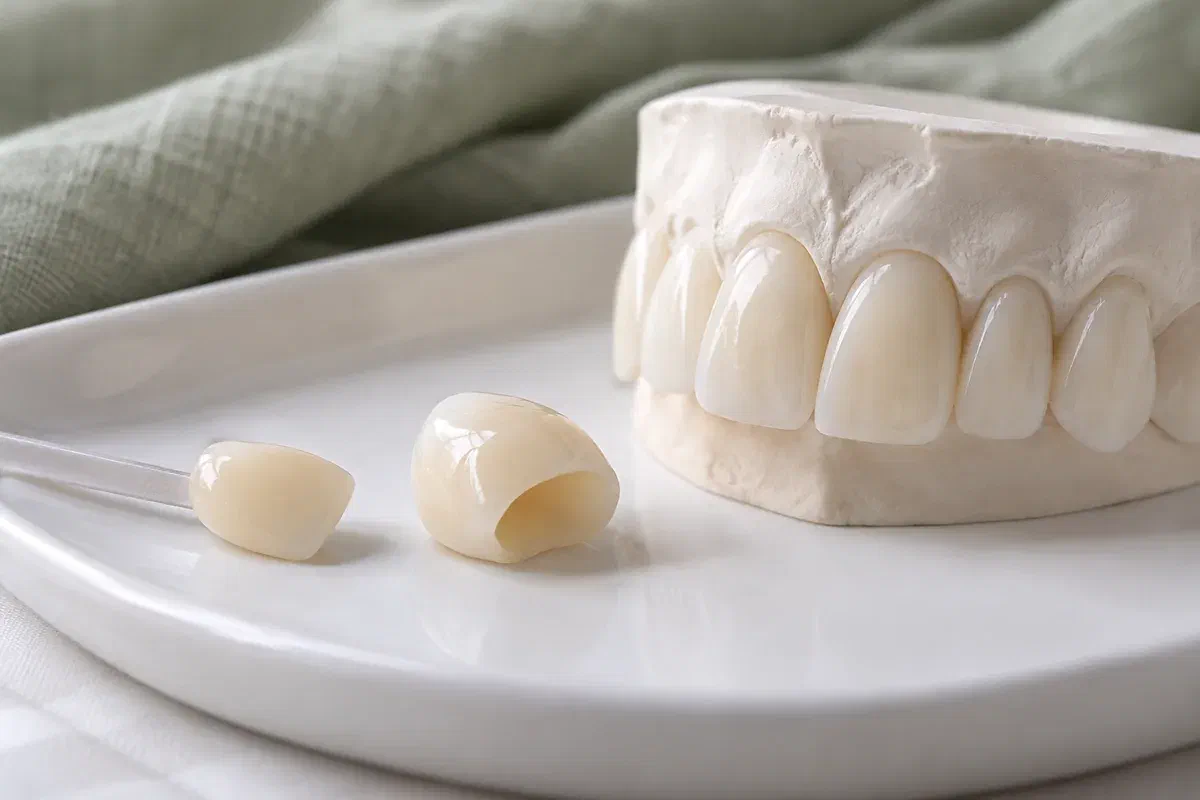
Illustrative tooth-coloured crown beside a front-tooth teaching model and shade sample
Reasons to take a closer look

Is the problem the colour, the tooth, or both?

Describe what you see in photos and in the mirror, and anything you feel when eating. Those details help separate cosmetic concerns from structural ones.

A crown that looks too bright, flat or opaque

Tell us exactly what makes it stand out: shade, shape, surface or a visible edge. We examine the crown, the tooth below and the gum around it. Ask whether replacement would fix everything that bothers you or only part of it.

A tooth with years of repairs behind it

Mention past fillings, fractures or root canal care. How much sound structure remains decides which restorations are possible. We can explain what support a crown would add and whether other treatment should come first.

A tooth that has darkened or lost its shape

Find out what caused the change before it is covered. Share any injury, discomfort and when you first noticed it. Testing may be needed, and once the tooth's health is understood we can discuss appearance options.

A good colour match is not a reason on its own to crown a healthy tooth. Ask whether whitening, bonding or a veneer could achieve your goal with less preparation.

What careful planning delivers

A crown that belongs in your smile.

When coverage is warranted, a crown can rebuild a strong surface and be crafted to echo the colour, shape and surface of the teeth beside it. The right material depends on where the tooth is, what remains of it, your bite and how much the tooth shows when you smile.

It is worth knowing the trade-offs. Crowns can chip, wear or eventually need replacing, and the tooth beneath still needs looking after. The plan should be open about risks, upkeep and anything uncertain about the tooth's future.

Patient information: Canadian Dental Association — crown treatment

A clear reason for full coverage

Ask what makes a crown the right choice for this tooth, and look at the evidence with us. The explanation should be about your tooth. You should also hear what a smaller repair could manage and where its limits lie.

A detailed appearance conversation

Talk about colour, brightness, translucency and shape, and whether the crown should match your teeth now or after whitening. Ask how the look will be checked, including photos or a try-in, before the crown is final.

A crown that fits the wider plan

Mention any retainers, guards, whitening or neighbouring repairs. These can change the sequence or the fit. Sorting them out early keeps the crown part of one considered plan rather than a separate cosmetic choice.

From shade to seating

Clinical checks first. Colour work throughout.

The order of steps depends on the tooth and the crown chosen. Ask how many visits to expect, whether a temporary will be used, and what would happen if more damage were found.

  1. Assess and discuss alternatives

    We review symptoms, previous dental work, gum health and X-rays. The dentist decides whether the tooth is a sound base for a crown. You will hear about any preliminary care, the risks and why a crown is preferred to other sensible choices.

  2. Select shade, material and shape

    Shade is often taken in natural light and may be recorded with photos for the lab. We discuss materials, how much reshaping is needed, the estimate and the sequence. Ask how comfort will be managed during preparation.

  3. Prepare the tooth and send records

    Once you decide to proceed, the tooth is shaped and a digital scan or impression goes to the lab along with the shade information. A temporary crown protects the tooth in the meantime. Ask what to do if it loosens.

  4. Try in and approve the look

    Fit, contacts, bite and appearance are reviewed before cementing. This is your chance to comment on colour or outline. After the crown is in, we cover cleaning, short-term instructions and when to come back.

Keeping it looking right

Good habits help the crown stay part of your smile.

Temporary and final crowns come with different advice. Call us if you are unsure which applies, since a quick phone conversation can sometimes save an unnecessary trip in from Acton.

Clean the crown's edge every day

Brush gently where the crown meets the gum and use the interdental cleaner we recommend. Plaque at the margin can inflame the gum and lead to decay in the natural tooth. Let us know about bleeding that keeps returning.

Watch for bite changes and sensitivity

If the tooth feels high, aches on chewing or stays sensitive, call us. New crowns should not be uncomfortable for long. The dentist can review the bite and the tissues around the tooth.

Look after the surface

Avoid biting hard objects, and ask about a night guard if you grind. Some crown materials can be scratched by abrasive products, so ask what toothpaste suits yours. Regular reviews let us monitor the crown and the tooth beneath.

Patient information: Cleveland Clinic — crowns, risks, and care

Other ways to improve a tooth's look

Choose the least treatment that meets the goal.

For each option, ask how much of the tooth it covers and why it is suggested. Appearance matters, alongside structure, function and future care.

When the tooth needs full coverage

A crown made to match your smile

A crown may be advised when the tooth's condition calls for it. Discuss material, margin placement and appearance, together with the reason the tooth needs protection. Understand preparation and upkeep before you commit.

When most of the tooth is healthy

A veneer or bonded repair

For some cosmetic concerns, a veneer or bonding may change the look while covering less. Find out what it would achieve and how it would hold up. It is not suitable for every tooth, but you should hear why.

When a crown is not the first move

Whitening, tests or monitoring

Some concerns need investigation or a different treatment before any restoration. A healthy tooth may not need elective coverage. Ask whether whitening or a period of watching would be a sensible first step.

Questions about matching

Getting the colour right, and other common questions.

Ask why a crown is proposed, how the appearance will be matched and what care will follow.

(905) 876-4488
How is the shade for a new crown chosen?
The dentist compares your teeth with shade samples, often in natural light, and may take photos for the lab. Several tones can be used in one crown to mimic a natural tooth.
Can a crown copy the clear edge my natural front teeth have?
Many crown materials can be layered to imitate translucency and colour variation. Ask what is realistic for your tooth and material.
What if I don't like the colour once the crown is tried in?
Say so before it is cemented. The dentist can discuss whether the crown can be adjusted or remade. Raising concerns at the try-in stage is much easier than after the crown is fixed.
Should I avoid coffee or tea before my shade appointment?
Ask us for any specific guidance. Clean teeth make shade selection more reliable, so a professional cleaning beforehand may be suggested if staining is significant.
Will my crown stain over time like natural teeth?
Many crown materials resist staining well, but surrounding teeth can still darken, creating contrast. Good cleaning and regular reviews help keep the match closer.
Do I need to whiten before having my crown matched?
If you want lighter teeth, whitening first is usually sensible, since crowns do not respond to bleaching. We can advise on timing.

Patient information: American Dental Association — whitening and existing restorations

Crown planning for Acton

Tell us what a natural result looks like to you.

Get in touch with our Bronte Street practice about a crown that looks artificial, a damaged tooth or a crown recommendation you want explained. We will assess the tooth, outline sensible alternatives and talk through appearance and care before treatment starts.

Whether a tooth suits a crown, and how much preparation it needs, depends on its condition. Appearance goals are balanced against structure, risks and maintenance.

Visit Milton Dental Clinic
Unit 1, 342 Bronte St. S, Milton, ON L9T 5B7
Get directions Clinic hours
Monday–Thursday
11am–7pm
Friday–Sunday
By appointment only

Areas we serve

  • Milton
  • Oakville
  • Mississauga
  • Georgetown
  • Halton Hills
  • Acton
  • Campbellville
  • Brampton
  • Burlington
  • Puslinch
  • Rockwood
  • Erin
  • Caledon
  • Etobicoke
  • Old Milton
  • Bronte Meadows
  • Timberlea
  • Dorset Park
  • Dempsey
  • Clarke
  • Beaty
  • Coates
  • Harrison
  • Scott
  • Willmott
  • Ford
  • Bowes
  • Cobden
  • Walker
  • Mountain View
  • Milton Heights
  • Hawthorne Village
  • Valley View
  • Fallingbrook
  • Nassagaweya
  • Trafalgar
  • Esquesing
  • Nelson
  • Brookville
  • Moffat
  • Glen Williams
  • Norval
  • Limehouse
  • Stewarttown
  • Ashgrove
  • Hornby
  • Silver Creek
  • Speyside
  • Scotch Block
  • North Oakville
  • River Oaks
  • Glen Abbey
  • West Oak Trails
  • Palermo
  • Bronte Creek
  • College Park
  • Joshua Creek
  • Uptown Core
  • Preserve
  • Iroquois Ridge
  • Lisgar
  • Meadowvale
  • Meadowvale Village
  • Churchill Meadows
  • Erin Mills
  • Central Erin Mills
  • Streetsville
  • East Credit
  • Creditview
  • Heartland
  • Sheridan
  • Mount Pleasant
  • Credit Valley
  • Huttonville
  • Churchville
  • Springbrook
  • Northwest Brampton
  • Bram West
  • Fletcher's Meadow
  • Fletcher's Creek South
  • Alton Village
  • Orchard
  • Millcroft
  • Headon Forest
  • Tansley
  • Brant Hills
  • Tyandaga
  • Kilbride
  • Lowville
  • Aberfoyle
  • Morriston
  • Arkell
  • Hillsburgh
  • Freelton
  • Carlisle
  • Waterdown
  • Flamborough
  • Mountsberg

How can we help?

Milton Dental Clinic

Have a question about your smile? Choose the option that works best for you.

For urgent dental concerns, please call.
Messages are reviewed during clinic hours.