

Illustrative patient and dental clinician discussing crown treatment with a tooth model
Cosmetic Dentistry

Cosmetic Crown Treatment in Brampton

A front tooth that breaks rarely picks a convenient week. If you are travelling from Brampton, we can assess the damage, explain whether a crown or a smaller repair suits what is left, and plan the temporary stage, the final shade and the fit around your schedule.

Repairing a visible tooth for Brampton households

A broken front tooth and a calendar that is already full.

A corner snaps off while you bite into something firm, or an old filling gives way on a tooth everyone can see. Two worries usually arrive at once: will the tooth be okay, and how will it look? A crown is one possible answer. It is a custom restoration that sits over a prepared tooth and can be shaped and shaded to match the teeth beside it.

Whether it is the right answer depends on how much healthy tooth remains. Smaller breaks on sturdy teeth can sometimes be bonded. Larger ones, or teeth already weakened by fillings, may need full coverage. Preparing a tooth for a crown is permanent, so it is worth asking why that level of treatment is being suggested.

Our team will look at the break, check for cracks or sensitivity, and talk about your priorities. Then we explain the options, including what a temporary crown would mean for the weeks ahead. If pain, swelling or a sharp edge is the immediate problem, call first so we can advise on what to do.

Ask about repairing a broken front tooth
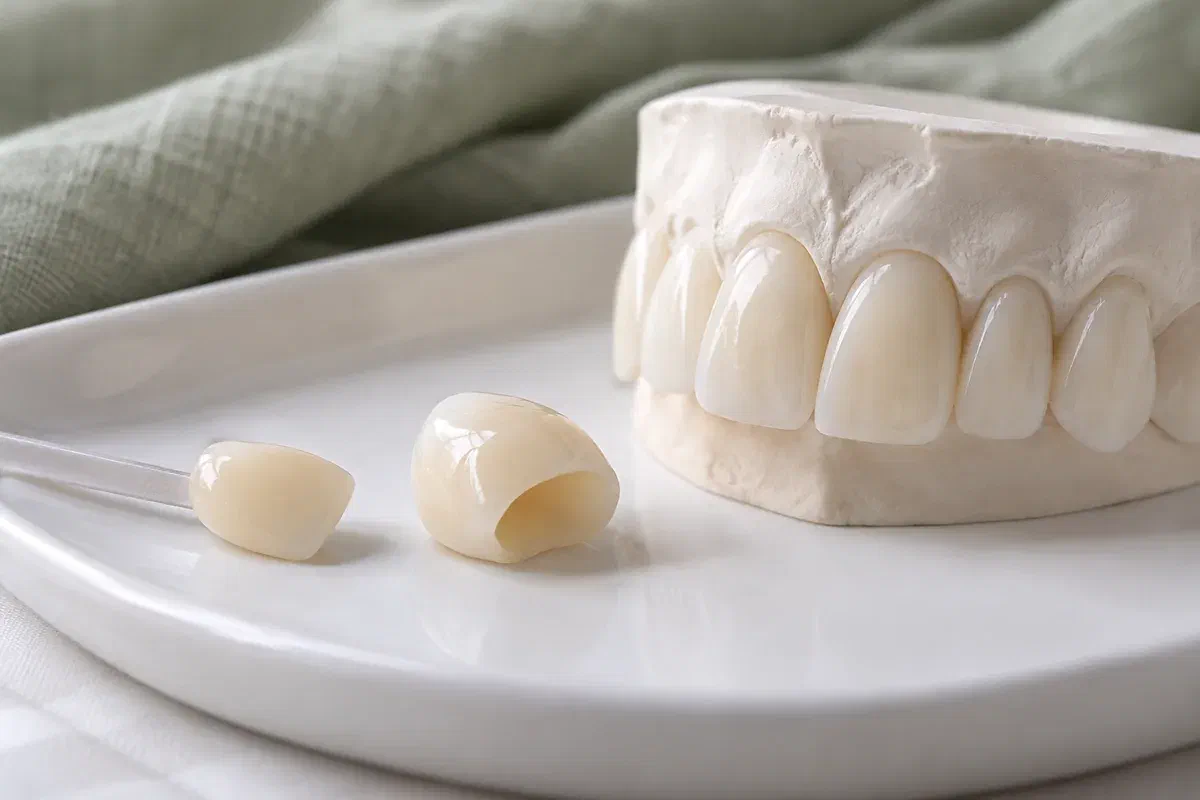
Illustrative tooth-coloured crown beside a front-tooth teaching model and shade sample
What you may be dealing with

Damage, an old crown, or a colour change.

Describe what happened and what you notice now, both in the mirror and when you chew. Those details show whether the problem is cosmetic, structural or a mix of the two.

An existing crown that chipped or stands out

Crowns can chip, and older ones may no longer match. Tell us what changed and when. We check the crown, the tooth under it and the gum before discussing replacement, so you can ask whether a new crown would fix everything or just the part you can see.

A tooth that cracked or broke

Let us know how it happened, whether the tooth had large fillings or a root canal, and if it hurts. The amount of sound structure left decides the options. We can explain what a crown would support and whether other treatment should come first.

A tooth that darkened after a knock

A tooth hit during play or a fall can change colour weeks or months later. Mention the injury and any discomfort. The tooth may need investigating before it is covered, and once we understand it we can talk about cosmetic options.

Even after damage, a crown is not automatic. Ask about less extensive repairs and what crown preparation would mean for the tooth's care in the future.

What a crown can restore

Something solid to bite on, and a tooth that looks like yours.

Where full coverage is suitable, a crown can rebuild the shape of a broken tooth and give it a reliable chewing surface. The material is chosen with the tooth's position, the remaining structure, the force of your bite and your appearance goals all in view.

It is equally important to understand what a crown cannot do. It may need adjusting, repairing or replacing later, and the tooth inside still needs care. Your plan should explain risks, upkeep and any uncertainty about how a damaged tooth will fare.

Patient information: Canadian Dental Association — crown treatment

A clear case for coverage

You should be able to see why the break calls for a crown, perhaps on an image or by looking at the tooth with us. The reasoning should be specific to your tooth. Ask too what bonding or a smaller filling could achieve, and why it might not be enough.

Input on how it will look

Share the shade and shape you would like, especially if the tooth is right at the front. Ask how the appearance will be reviewed before the crown is finalised. A close match to neighbouring teeth takes more than one colour sample.

A plan that accounts for the rest of your mouth

Mention retainers, mouthguards, whitening plans or other teeth needing work. Each can change the order or the fit. Covering them early keeps the crown part of a sensible plan and avoids surprises later.

What the visits look like

Stabilise, plan, prepare, then fit.

The sequence depends on the damage and the restoration chosen. Ask how many appointments are involved, how long the temporary stage may last, and what happens if the break turns out to go deeper.

  1. Assess the break and compare repairs

    We look at the damage, your symptoms, previous dental work and gum health, often with X-rays. The dentist decides whether enough tooth remains for a crown. You will hear about any preliminary care, the risks and the reasons for favouring one repair over another.

  2. Choose a material and a shape

    We talk about how you want the tooth to look, which materials would suit it and how much reshaping is needed. The estimate and visit plan are confirmed. Ask how comfort will be managed and what the temporary will look like.

  3. Prepare the tooth and fit a temporary

    If you proceed, the tooth is prepared and impressions or a scan are taken. A temporary crown usually protects it in the meantime and needs gentle use. Ask what to do if it loosens, and plan to keep the fitting appointment.

  4. Try in the final crown

    The dentist checks fit, contacts, bite and appearance before cementing. Tell us now if the shade or outline seems wrong. Afterward, we cover cleaning, short-term instructions and when to get in touch or return.

Back to everyday life

Busy weeks still need a few minutes for the crown.

You will receive instructions for the temporary and for the final crown, and they are not the same. If you lose track of which applies, call and ask.

Clean around it every day

Brush along the gum line and clean between teeth with the method we show you. The edge of the crown is where plaque builds up, and the tooth beneath can still decay. Let us know if the gum bleeds often or if cleaning is tricky.

Notice changes in your bite

Call if the crowned tooth hits first, aches when you bite or stays sensitive. There is no reason to accept discomfort because the crown is new. The dentist can check the bite, the tooth and the surrounding gum.

Guard against the next accident

Avoid using the crown to bite hard objects or open things. If anyone in the household plays contact sports, ask about a mouthguard, and have existing appliances checked. Regular reviews help us watch the crown and the tooth supporting it.

Patient information: Cleveland Clinic — crowns, risks, and care

Repair choices after a break

Match the repair to what the break left behind.

Ask how much of the tooth each option covers and what it is meant to protect. Appearance counts, together with saving natural structure, comfortable chewing and future care.

When the damage is extensive

A full crown for a weakened tooth

A crown may be recommended if the break or past repairs leave the tooth vulnerable. Discuss the material, the edge position and the expected look, along with why the tooth needs this protection. Be clear on preparation and maintenance before agreeing.

When the break is smaller

Bonding, a filling or a veneer

A modest chip on a sound tooth may be rebuilt with less coverage. Ask what that would achieve and how it would hold up. Less treatment is not right every time, but the comparison should be explained clearly.

When the tooth needs time or tests

Investigation or a short wait

A recently injured tooth may need monitoring or tests before a final decision. A tooth that is otherwise healthy may not need elective coverage at all. Ask whether a conservative step fits now, with a review later.

Questions after a broken tooth

What families often ask us.

Parents and adults from Brampton tend to ask the same core things: why a crown is being suggested, what the material can do and what the tooth will need over time.

(905) 876-4488
Can a broken front tooth be fixed without a crown?
Sometimes. If the break is small and the tooth is otherwise strong, bonding or a veneer may be options. A larger break or a weakened tooth may need more coverage. An exam shows what the tooth can support.
Will I have a gap while the permanent crown is being made?
In many cases a temporary crown is placed so the tooth is covered and protected in the meantime. Ask what the temporary will look like and how to look after it.
What should I do if the temporary crown falls off before my next visit?
Keep it, avoid chewing on that side and call us. Do not use household glue. We can advise whether to come in sooner and how to protect the tooth until then.
How soon after a tooth breaks should I be seen?
Call promptly, especially if there is pain, swelling, bleeding or a sharp edge. We can advise how urgent it is. If you cannot reach us and symptoms are severe, seek urgent care closer to home.
Can a crown chip like a natural tooth?
Crown materials can chip or wear, particularly under heavy force or grinding. Ask which material suits your bite and whether a night guard would help protect it.
Can my teenager get a crown on a damaged front tooth?
Treatment choices for younger patients depend on how far the tooth and gums have developed. The dentist can explain what is suitable now and what might be revisited later.

Patient information: American Dental Association — whitening and existing restorations

Crown visits from Brampton

Get the broken tooth looked at, then plan the rest.

Reach our Bronte Street practice about a damaged tooth, a chipped crown or a crown you have been advised to have. We will examine the tooth, explain realistic alternatives and talk through appearance and care before treatment starts.

Whether a crown suits a tooth, and how much it must be prepared, depends on that tooth. Appearance goals are weighed alongside structure, risks and maintenance.

Visit Milton Dental Clinic
Unit 1, 342 Bronte St. S, Milton, ON L9T 5B7
Get directions Clinic hours
Monday–Thursday
11am–7pm
Friday–Sunday
By appointment only

Areas we serve

  • Milton
  • Oakville
  • Mississauga
  • Georgetown
  • Halton Hills
  • Acton
  • Campbellville
  • Brampton
  • Burlington
  • Puslinch
  • Rockwood
  • Erin
  • Caledon
  • Etobicoke
  • Old Milton
  • Bronte Meadows
  • Timberlea
  • Dorset Park
  • Dempsey
  • Clarke
  • Beaty
  • Coates
  • Harrison
  • Scott
  • Willmott
  • Ford
  • Bowes
  • Cobden
  • Walker
  • Mountain View
  • Milton Heights
  • Hawthorne Village
  • Valley View
  • Fallingbrook
  • Nassagaweya
  • Trafalgar
  • Esquesing
  • Nelson
  • Brookville
  • Moffat
  • Glen Williams
  • Norval
  • Limehouse
  • Stewarttown
  • Ashgrove
  • Hornby
  • Silver Creek
  • Speyside
  • Scotch Block
  • North Oakville
  • River Oaks
  • Glen Abbey
  • West Oak Trails
  • Palermo
  • Bronte Creek
  • College Park
  • Joshua Creek
  • Uptown Core
  • Preserve
  • Iroquois Ridge
  • Lisgar
  • Meadowvale
  • Meadowvale Village
  • Churchill Meadows
  • Erin Mills
  • Central Erin Mills
  • Streetsville
  • East Credit
  • Creditview
  • Heartland
  • Sheridan
  • Mount Pleasant
  • Credit Valley
  • Huttonville
  • Churchville
  • Springbrook
  • Northwest Brampton
  • Bram West
  • Fletcher's Meadow
  • Fletcher's Creek South
  • Alton Village
  • Orchard
  • Millcroft
  • Headon Forest
  • Tansley
  • Brant Hills
  • Tyandaga
  • Kilbride
  • Lowville
  • Aberfoyle
  • Morriston
  • Arkell
  • Hillsburgh
  • Freelton
  • Carlisle
  • Waterdown
  • Flamborough
  • Mountsberg

How can we help?

Milton Dental Clinic

Have a question about your smile? Choose the option that works best for you.

For urgent dental concerns, please call.
Messages are reviewed during clinic hours.