

Illustrative patient and dental clinician comparing tooth shades during a consultation
Cosmetic Dentistry

Internal Tooth Bleaching in Burlington

Before you commit to a veneer or crown for one dark tooth, it may be worth asking whether the tooth could be lightened first. From Burlington, book a consultation to compare internal bleaching with covering options, based on what the examination shows.

Before you cover it

A veneer is not the only answer to a dark tooth.

People often arrive having already decided on a veneer or crown, because one discoloured tooth seems to need covering. For a tooth that has had root canal treatment, there may be a step to consider beforehand. Internal bleaching lightens the tooth from inside the crown under a dentist’s control, which is quite unlike whitening the outer surface.

Whether that step is available depends on the tooth. Your dentist looks at why it darkened, how sound the root canal treatment is, the health of the supporting tissue, and how much natural tooth is left to work with. A symptom or unresolved issue would normally come first, ahead of any decision about looks.

Coming from Burlington, it helps to bring your questions about each option as well as the tooth’s history: any injury, the root canal, and earlier whitening. Tell us whether the colour is steady or still changing, and how closely you want it to blend. We can then compare approaches side by side.

Compare options for a dark tooth
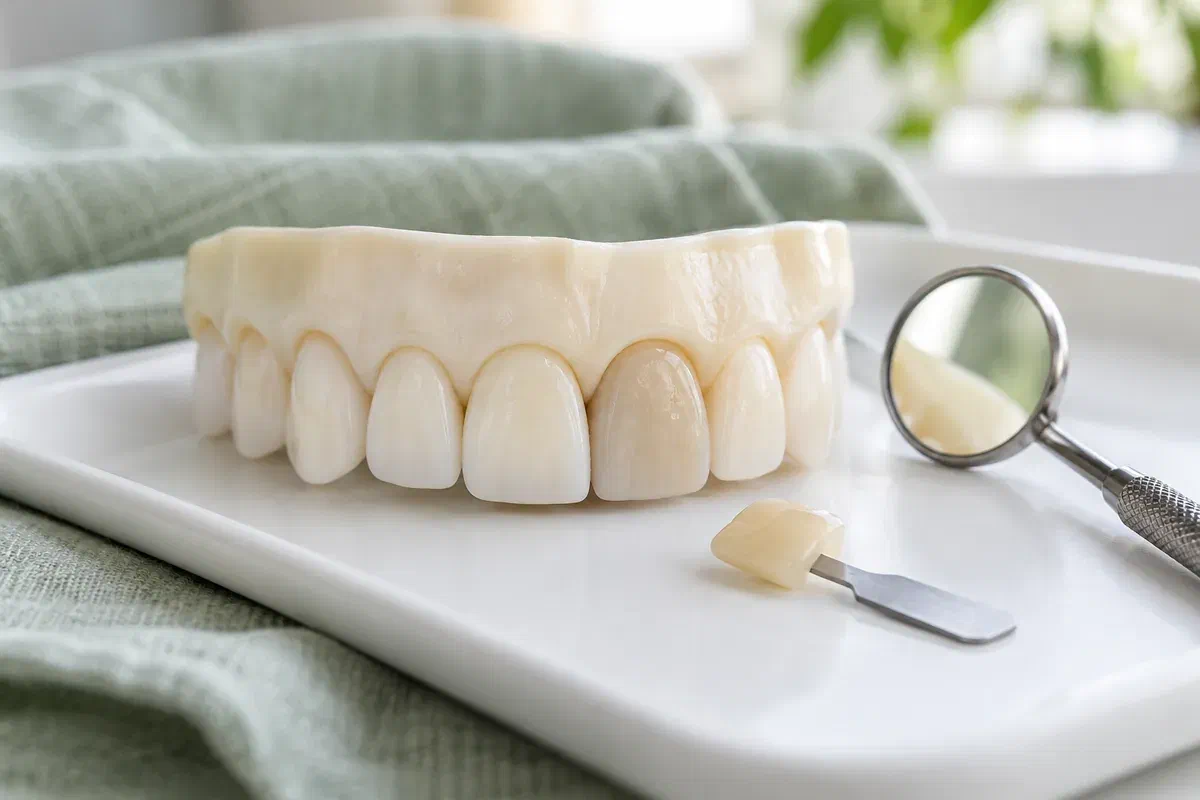
Illustrative front-teeth model with one subtly darker central tooth beside a shade sample
What the decision rests on

Three situations that steer the choice

Each points the conversation in a different direction. Describe yours openly, so the comparison between bleaching and covering starts from the tooth’s actual condition.

Colour change that followed trauma

If the tooth was struck at some point, share when and what was done about it. That background affects how the dentist weighs both bleaching and covering options. A shade change does not reveal on its own how the tissue inside or around the tooth is doing.

Discolouration around old dental work

Tell us about every filling or earlier whitening attempt on the tooth. Darkness from restorative material behaves differently from darkness in the tooth itself. Identifying the source helps decide whether bleaching, replacement of a filling, or a covering would make more sense.

A tooth that hurts or has a failing filling

Pain, swelling, or a breaking-down filling over the root canal opening needs looking at regardless of colour. Neither bleaching nor a veneer fixes infection or leakage. Your dentist will explain what root canal or restorative care should happen first.

A dark tooth is not a do-it-yourself project. Never open it, remove a filling, or place whitening products inside; internal bleaching requires a protective seal over the root filling and a plan set by your dentist.

The case for trying it first

Preserve more enamel, if the tooth allows.

For a suitable tooth, internal bleaching may lighten the colour while leaving the outer enamel untouched, whereas a veneer or crown involves reshaping. The result varies. It may narrow the gap with nearby teeth, but neither a precise nor a permanent match can be promised.

The trade-offs belong in the comparison too. Darkness can return, a visible filling may look off afterwards, and you might still need a covering later. Rarely, a serious complication called external cervical root resorption can occur, meaning tooth structure is lost near the root’s neck.

Patient information: Leeds Teaching Hospitals — whitening and non-vital bleaching · Research review — internal bleaching and external cervical resorption

Treatment for the colour’s real source

Make sure the plan is built around what is causing this particular tooth to look dark. Often the aim is for it to blend in, not to brighten everything. Ask how the shade target is set and when you will review it together.

Keeping covering options open

Discuss what each route would remove and whether bleaching would close any doors later. The tooth may still need a final restoration suited to its condition. Shade and long-term protection are related, but your dentist will treat them as separate questions.

Measured progress, not endless rounds

Ask how results will be assessed and at what point your dentist would stop or switch approach. You should know when reviews happen and what follows a limited response. A careful plan includes a finish line.

Planning the work

Exam, decision, bleaching, restoration

Your dentist chooses the technique once the tooth has been examined. Ask about the visits involved, the temporary filling, the safety measures, and the final seal.

  1. Look closely at the tooth and its colour

    The visit covers your history, symptoms, current filling, and the root canal work. Radiographs and shade photographs may be needed. Ask whether the tooth can proceed now or needs root canal review, repair, or another test first.

  2. Weigh bleaching against the alternatives

    Your dentist describes the technique and how the root filling and gums will be protected. Compare its limits, risks, and costs with a veneer, crown, or no treatment. Confirm what follow-up and final restoration the plan includes.

  3. Proceed with monitored bleaching

    A small opening is made in the crown, a barrier protects the root filling, and the bleaching agent is placed following a set protocol. Some methods use a temporary filling between visits. Follow your instructions and attend each review without changing the treatment yourself.

  4. Decide on the result and restore the tooth

    Your dentist reviews the change and chooses when to stop. The access is sealed with a suitable final filling or restoration at the agreed time. Ask whether existing visible fillings should be re-matched and what monitoring is recommended later on.

Keeping treatment on track

Care for the tooth until the final seal is in.

Aftercare depends on the technique and stage. Ask for written guidance and a contact route in case the temporary seal fails, the tooth feels different, or the gum around it changes.

Follow your dentist’s instructions exactly

Skip extra whitening products, do not stretch a stage, and leave the temporary filling alone. Questions are better asked than guessed at. Your dentist needs a full account of what was used and how the tooth responded.

Protect the temporary filling day to day

Keep to the eating and cleaning advice for that tooth. Get in touch if the temporary loosens, chips, or comes away. That kind of change should be reported promptly, not saved for the next scheduled visit.

Complete treatment and stay on review

Attend the appointment for the final restoration even if the shade already pleases you. Keep your usual dental check-ups and mention any later change. A root-treated tooth still needs monitoring after it lightens.

Patient information: American Association of Endodontists — root resorption

Side by side

How the three main options compare

For each one, find out what it alters and whether there is a health reason to treat the tooth anyway. The least extensive suitable choice differs from tooth to tooth.

If the exam supports lightening from within

Internal bleaching of a suitable tooth

Your dentist may suggest this for colour coming from inside, once the root-treated tooth has been reviewed. Ask about likely change, protective steps, and the final filling. It is a supervised clinical treatment, not a general whitening product.

Where health or structure is a concern

Treatment of the root canal or restoration first

A poor seal, a symptom, or another finding may need care before any cosmetic step. Ask why and how it might change what comes next. Bleaching is not a replacement for resolving an active problem.

For cases where another route fits better

A veneer, crown, other whitening, or leaving it

Depending on the cause, covering the tooth or another approach may suit it better. Compare preparation, upkeep, and matching limits. If the tooth is healthy, deciding to leave it untouched is a reasonable decision.

Burlington asks

Bleach first, or cover it?

Questions about how internal bleaching fits alongside veneers and crowns, and what to expect from the result.

(905) 876-4488
If bleaching does not work well enough, can I still get a veneer?
Often a covering restoration remains possible afterwards, but it depends on the tooth’s structure and condition. Your dentist can explain how bleaching might affect later options and whether a lighter base could help a future restoration.
Can a tooth that already has a crown be internally bleached?
A crown covers the visible tooth, so internal bleaching would not normally change how it looks. If the crown itself no longer matches, other approaches are usually discussed. Your dentist can review your particular situation.
How long will a lightened tooth stay that shade?
It varies. Some teeth keep their improved colour for a long time, while others darken again. Your dentist cannot promise a permanent result, but can explain what to watch for and when to have the tooth reassessed.
Does bleaching from the inside remove more tooth than a veneer?
The two work differently. Bleaching uses the existing access into a root-treated tooth, while a veneer involves preparing the outer surface. Your dentist can compare how each would affect the structure of your particular tooth.
What makes the resorption risk important to discuss?
External cervical resorption is uncommon, but it can be serious because it involves loss of tooth structure near the neck of the root. Ask how your history affects it, what protection will be used, and how the tooth will be followed.
Why can’t the access filling wait if I am happy with the colour?
The access still needs a proper permanent seal. Leaving the tooth in a temporary state is not part of a finished plan. Keep that appointment and ask your dentist about the expected timing.
From Burlington

Get the comparison before you choose.

Contact our Bronte Street practice to discuss a darker root-treated tooth and the options for it. We can review the relevant findings, explain where bleaching and covering each fit, and help you decide what to explore.

Suitability depends on the tooth and its root canal history. The shade change is never certain, and both the bleaching and the closing restoration are handled by your dentist.

Visit Milton Dental Clinic
Unit 1, 342 Bronte St. S, Milton, ON L9T 5B7
Get directions Clinic hours
Monday–Thursday
11am–7pm
Friday–Sunday
By appointment only

Areas we serve

  • Milton
  • Oakville
  • Mississauga
  • Georgetown
  • Halton Hills
  • Acton
  • Campbellville
  • Brampton
  • Burlington
  • Puslinch
  • Rockwood
  • Erin
  • Caledon
  • Etobicoke
  • Old Milton
  • Bronte Meadows
  • Timberlea
  • Dorset Park
  • Dempsey
  • Clarke
  • Beaty
  • Coates
  • Harrison
  • Scott
  • Willmott
  • Ford
  • Bowes
  • Cobden
  • Walker
  • Mountain View
  • Milton Heights
  • Hawthorne Village
  • Valley View
  • Fallingbrook
  • Nassagaweya
  • Trafalgar
  • Esquesing
  • Nelson
  • Brookville
  • Moffat
  • Glen Williams
  • Norval
  • Limehouse
  • Stewarttown
  • Ashgrove
  • Hornby
  • Silver Creek
  • Speyside
  • Scotch Block
  • North Oakville
  • River Oaks
  • Glen Abbey
  • West Oak Trails
  • Palermo
  • Bronte Creek
  • College Park
  • Joshua Creek
  • Uptown Core
  • Preserve
  • Iroquois Ridge
  • Lisgar
  • Meadowvale
  • Meadowvale Village
  • Churchill Meadows
  • Erin Mills
  • Central Erin Mills
  • Streetsville
  • East Credit
  • Creditview
  • Heartland
  • Sheridan
  • Mount Pleasant
  • Credit Valley
  • Huttonville
  • Churchville
  • Springbrook
  • Northwest Brampton
  • Bram West
  • Fletcher's Meadow
  • Fletcher's Creek South
  • Alton Village
  • Orchard
  • Millcroft
  • Headon Forest
  • Tansley
  • Brant Hills
  • Tyandaga
  • Kilbride
  • Lowville
  • Aberfoyle
  • Morriston
  • Arkell
  • Hillsburgh
  • Freelton
  • Carlisle
  • Waterdown
  • Flamborough
  • Mountsberg

How can we help?

Milton Dental Clinic

Have a question about your smile? Choose the option that works best for you.

For urgent dental concerns, please call.
Messages are reviewed during clinic hours.