

Illustrative patient and dental clinician comparing tooth shades during a consultation
Cosmetic Dentistry

Internal Tooth Bleaching in Oakville

Strips brightened the rest of your smile, yet one root-treated tooth stayed just as dark. Coming from Oakville, you can book an assessment to learn why surface whitening missed it and whether supervised bleaching from inside the tooth might help.

When strips do not reach

Surface whitening and a darkened tooth are two separate problems.

A common story goes like this: a box of whitening strips lifts the coffee stains from most teeth, but one front tooth barely changes, so the gap looks wider than before. If that tooth has had a root canal, its darkness may sit inside rather than on the enamel. Internal bleaching targets that inner colour, and only a dentist carries it out.

It still is not a default fix. Your dentist first works out where the colour comes from, how the root canal treatment is holding up, what the gums and bone show, and how much sound tooth remains. Tenderness, swelling, or a leaking filling would generally be addressed before anyone talks about shade.

When you come in from Oakville, tell us which products you have used and for how long. Mention any old injury, the root canal history, and whether the tooth seems darker this year than last. Knowing the result you hope for, a close blend or simply less contrast, helps us explain which assessment and option make sense.

Ask why one tooth stayed dark
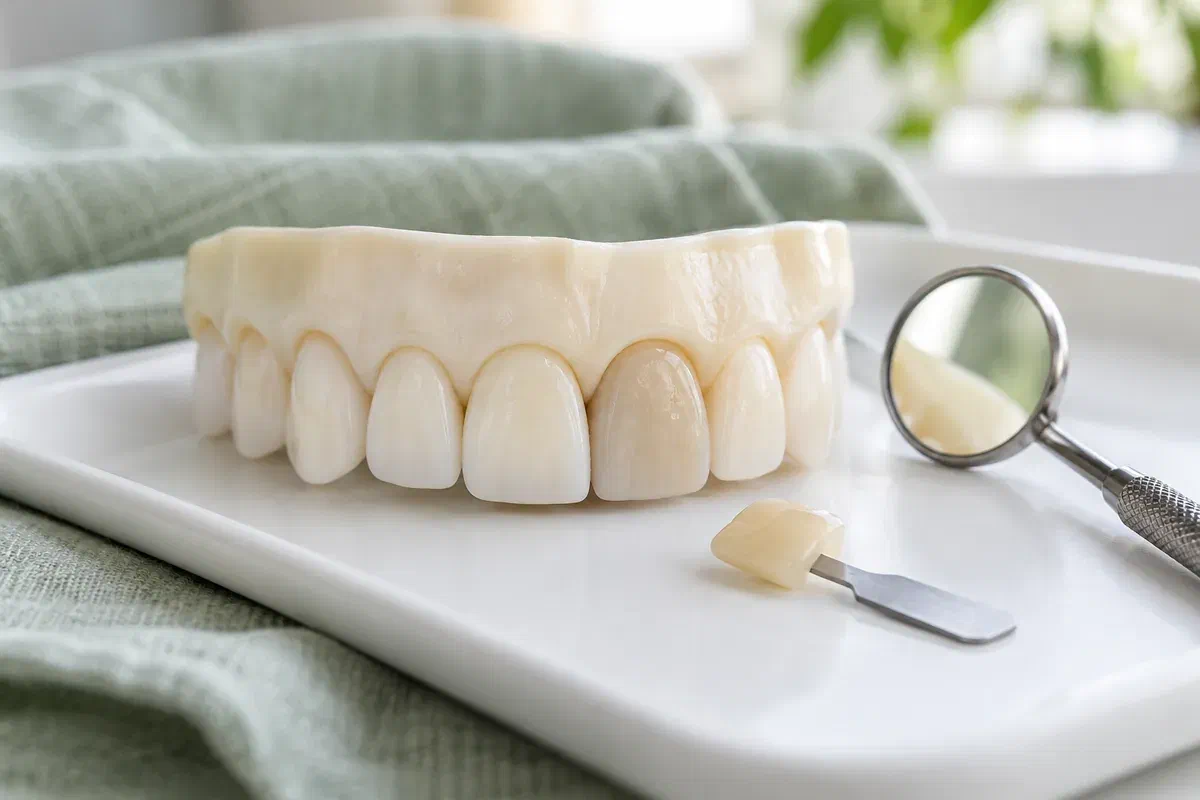
Illustrative front-teeth model with one subtly darker central tooth beside a shade sample
Sorting out the source

Is it stain, filling, or the tooth itself?

The answer shapes everything after it. Describe what changed and when, and let the examination settle the health questions before the cosmetic ones.

A tooth that dulled after an old blow to the face

Trauma can affect a tooth long before the colour shifts. Share the date of the injury, roughly, and any care you received. Your dentist cannot judge the tooth’s current health from its shade, so the history fills in important gaps.

A treated tooth that whitening products ignored

Let us know what you used and which part of the tooth still looks off. Old fillings, the material inside the tooth, or changes in the dentin can each cause darkness. Pinning down which one is involved tells us what internal bleaching could alter.

Ache, a gum bump, or a cracked filling

These deserve attention on their own. Bleaching does nothing for infection or a broken seal over the root canal opening. Your dentist may suggest a root canal or restorative check before any whitening plan is made.

Over-the-counter whitening is designed for the outside of teeth. Never put gel into a tooth, remove a filling, or try to reach the inside yourself; internal bleaching needs a protective barrier over the root filling and a dentist’s plan.

What it might change

A chance to soften the contrast while keeping natural enamel

When a tooth is a good candidate, internal bleaching may reduce darkness without the preparation a veneer or crown involves. The degree of change differs from tooth to tooth. It may bring the shade closer to its neighbours, though a perfect or permanent match is never assured.

Any honest comparison includes the risks. The darker tone may return, a visible filling may no longer blend, and further treatment could be needed. External cervical root resorption, an uncommon but potentially serious loss of tooth structure near the root’s neck, is part of that discussion.

Patient information: Leeds Teaching Hospitals — whitening and non-vital bleaching · Research review — internal bleaching and external cervical resorption

One tooth in focus

Confirm the plan targets what is actually darkening this tooth. For many people the goal is less contrast with the surrounding teeth, not a brighter smile overall. Ask how shade will be recorded and when you will compare it.

Less tooth removed, if it works

Weigh bleaching against covering the tooth, including how much preparation each would need. A long-term filling suited to the tooth’s condition may still be required. Lightening it and protecting it are connected goals, yet each needs its own answer.

A stopping point agreed in advance

Ask how your dentist will judge progress and what would prompt a change of approach. Understand the review timing and the fallback if the shade only shifts a little. Bleaching should have a planned end, not continue indefinitely.

The treatment path

How a root-treated tooth is lightened, step by step

Technique is decided after the examination. Ask about visit spacing, the temporary filling, safety measures for the root, and the final seal.

  1. Start with an exam and a baseline shade

    History, symptoms, the current filling, and the root canal are all reviewed. Your dentist may take radiographs and shade photos. Ask whether the tooth is ready, or whether root canal review, a repair, or more investigation should come first.

  2. Agree on the method and understand the risks

    You will learn how the bleaching is done and how the root filling and gum tissue are shielded. Talk about likely limits, complications, cost, and the option of leaving things as they are. Confirm which follow-up and final restoration are included.

  3. Work through supervised bleaching visits

    Your dentist opens a small access in the crown, seals off the root filling with a barrier, and places bleaching material according to the protocol. Between visits a temporary filling may hold it in. Keep your reviews and avoid changing anything yourself.

  4. Check the shade and close the tooth

    At review, your dentist decides whether to continue or stop. The access is then closed with a suitable permanent filling or restoration on schedule. Ask whether a visible filling needs replacing to match, and how the tooth will be followed afterwards.

Between bleaching visits

Hands off the strips while the inside is being treated.

Instructions differ by technique and stage. Get yours in writing and keep a way to reach the clinic if anything shifts with the temporary filling, the tooth itself, or the surrounding gum changes.

Pause your own whitening products

Unless your dentist says otherwise, set aside strips, pens, and trays, and do not alter the temporary filling or extend a stage. When unsure, call. Your dentist needs to know everything applied and how the tooth has reacted.

Chew and clean with the temporary in mind

Follow the advice about eating and brushing near the tooth. Report a temporary filling that loosens, cracks, or falls out the same day. A missing seal is not something to save for the next appointment.

Return for the permanent filling and reviews

Keep the visit that seals the access, even if you already like the colour. Stay on schedule with regular dental care and point out any later change. A brighter tooth that had a root canal still needs watching.

Patient information: American Association of Endodontists — root resorption

Other ways forward

Match the option to the cause, not the other way round.

For each choice, ask what it changes and whether the tooth needs care for health reasons too. The most conservative suitable option varies between teeth.

When the exam supports a supervised shade change

Bleaching inside a suitable root-treated tooth

This may be offered for internal discolouration once the tooth’s condition has been reviewed. Discuss how much lightening is realistic, the protective steps, and the final filling. It is a clinical procedure, not a stronger version of store-bought strips.

If something needs fixing before appearance

Treating a health or structural issue first

If the seal over the root canal has broken down or the tooth is sore, that gets investigated or treated ahead of any cosmetic step. Ask why it comes first and whether it changes your later options. Bleaching cannot take the place of solving an active problem.

When another route suits the tooth or you

A veneer or crown, different whitening, or no change

Some causes respond better to a different approach. Compare preparation, maintenance, and how closely each can match. You may also decide a healthy tooth can stay as it is once the findings are clear.

Oakville questions

Strips, gels, and the stubborn dark tooth

Answers to common questions about why surface whitening misses some teeth and what internal bleaching involves.

(905) 876-4488
Why didn’t whitening strips lighten my root-treated tooth?
Strips act on the outer surface. When discolouration comes from inside a root-treated tooth, surface products may have little effect. Your dentist can check the likely source of the colour and whether internal bleaching is worth discussing.
Is it safe to keep using strips on my other teeth during treatment?
Ask your dentist before continuing. Changing the shade of nearby teeth shifts the target for the darker one, and timing matters. Your dentist can tell you whether to pause and when surface whitening could fit into the plan.
How will the dentist decide what shade to aim for?
Shade guides, photos, and comparison with neighbouring teeth are common ways to record colour. Your dentist will usually note a starting shade and review the change at each visit. Discuss what kind of match you are hoping for.
Can a dentist bleach a tooth that has had no root canal from the inside?
Internal bleaching is generally reserved for selected root-treated teeth. A dark tooth that has not had root canal treatment needs a diagnosis of why it changed. Root canal treatment should not be done only to make bleaching possible.
What happens to a tooth-coloured filling when the tooth lightens?
Filling materials keep their colour while the tooth around them may change. A visible filling could stand out afterward and may need to be replaced. Ask about this, including any added cost, before treatment starts.
How should I plan bleaching visits if I am coming from Oakville?
Ask for the expected number and spacing of appointments at the consultation so you can book around work or school. Keep a contact number handy between visits in case the temporary filling comes loose.
Visiting from Oakville

Tell us what you have tried, and we will look at why.

Get in touch with our Bronte Street practice to discuss a root-treated tooth that has not responded to whitening. We can review the findings, explain suitable options, and help you decide whether internal bleaching is worth pursuing.

Whether internal bleaching suits a tooth depends on its condition and root canal history. Results vary, and treatment needs professional supervision and a suitable final restoration.

Visit Milton Dental Clinic
Unit 1, 342 Bronte St. S, Milton, ON L9T 5B7
Get directions Clinic hours
Monday–Thursday
11am–7pm
Friday–Sunday
By appointment only

Areas we serve

  • Milton
  • Oakville
  • Mississauga
  • Georgetown
  • Halton Hills
  • Acton
  • Campbellville
  • Brampton
  • Burlington
  • Puslinch
  • Rockwood
  • Erin
  • Caledon
  • Etobicoke
  • Old Milton
  • Bronte Meadows
  • Timberlea
  • Dorset Park
  • Dempsey
  • Clarke
  • Beaty
  • Coates
  • Harrison
  • Scott
  • Willmott
  • Ford
  • Bowes
  • Cobden
  • Walker
  • Mountain View
  • Milton Heights
  • Hawthorne Village
  • Valley View
  • Fallingbrook
  • Nassagaweya
  • Trafalgar
  • Esquesing
  • Nelson
  • Brookville
  • Moffat
  • Glen Williams
  • Norval
  • Limehouse
  • Stewarttown
  • Ashgrove
  • Hornby
  • Silver Creek
  • Speyside
  • Scotch Block
  • North Oakville
  • River Oaks
  • Glen Abbey
  • West Oak Trails
  • Palermo
  • Bronte Creek
  • College Park
  • Joshua Creek
  • Uptown Core
  • Preserve
  • Iroquois Ridge
  • Lisgar
  • Meadowvale
  • Meadowvale Village
  • Churchill Meadows
  • Erin Mills
  • Central Erin Mills
  • Streetsville
  • East Credit
  • Creditview
  • Heartland
  • Sheridan
  • Mount Pleasant
  • Credit Valley
  • Huttonville
  • Churchville
  • Springbrook
  • Northwest Brampton
  • Bram West
  • Fletcher's Meadow
  • Fletcher's Creek South
  • Alton Village
  • Orchard
  • Millcroft
  • Headon Forest
  • Tansley
  • Brant Hills
  • Tyandaga
  • Kilbride
  • Lowville
  • Aberfoyle
  • Morriston
  • Arkell
  • Hillsburgh
  • Freelton
  • Carlisle
  • Waterdown
  • Flamborough
  • Mountsberg

How can we help?

Milton Dental Clinic

Have a question about your smile? Choose the option that works best for you.

For urgent dental concerns, please call.
Messages are reviewed during clinic hours.