

Illustrative patient and dental clinician reviewing an aligner beside its protective case
Cosmetic Dentistry

Invisalign Attachment Repair in Georgetown

Same tooth, same bump, gone for the second or third time. If you are travelling from Georgetown, we look for the reason behind repeated attachment loss before simply bonding another one, and confirm how your aligner fits.

When it keeps happening

Gone again

A single lost attachment is a nuisance. Losing the same one twice starts to feel personal, and many people quietly assume they are doing something wrong. Usually there is a more practical explanation, and the goal is to find it rather than keep replacing the bump on a loop.

Attachments are small composite shapes bonded to specific teeth so your aligners can grip and guide them. Their design follows your treatment plan. When one fails repeatedly, the clinician looks at the tooth surface, any older restoration, the fit of the tray, and how it is being removed.

If our team supervises your aligners, call and tell us how many times this has happened and when. If another office leads your treatment, contact them first so any repair we provide is coordinated. In either case, avoid improvised fixes; they make the next bond harder.

Talk about a recurring attachment
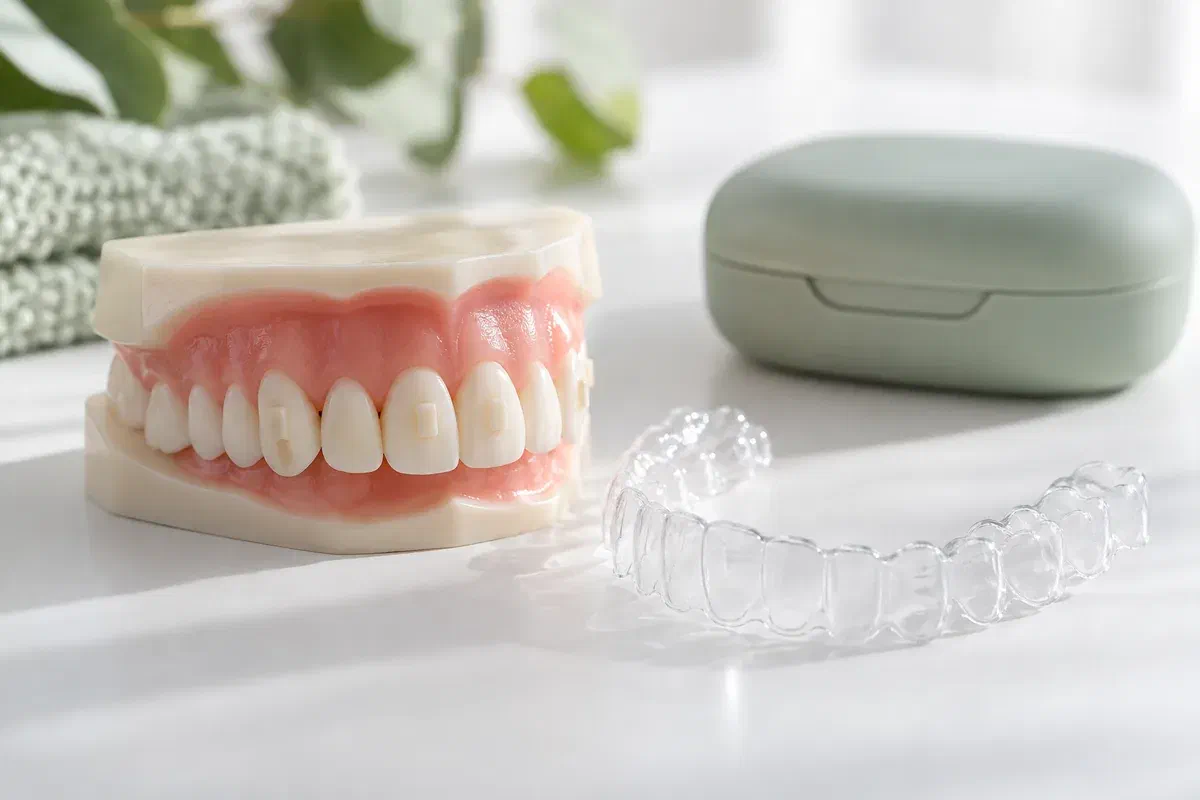
Illustrative tooth model with small tooth-coloured attachments beside an aligner and case
Clues worth recording

Patterns tell the clinician more than a single event

You do not need to figure out why it keeps failing. Noting a few details each time it happens gives the clinician something to work with.

Which tooth, and how often

List the side and tooth, and the approximate dates of each loss. Note whether it happened during meals, while removing the tray, or overnight. If you are not certain which tooth had an attachment, we can confirm from the plan.

Any change in tray fit

Look for a gap at a tooth edge, a looser feel, a distorted area, or difficulty seating the tray. Include the tray number. A tray that never quite seated may be part of the story, so avoid forcing it or moving ahead.

Discomfort and your removal habit

Mention soreness or a rough spot, and describe how you usually take the tray out, including which side you start from. This is not about blame. Removal technique is one of several practical things the clinician may want to adjust.

Bring your current aligners and, if you have them, earlier trays from around the time of each loss. Ask which tray to wear until you are seen and whether to delay the next change.

Why look deeper

Solve the pattern, not just the gap

Each attachment has a prescribed role, so a replacement should match the planned shape and position. With repeated loss, the review widens: the clinician may consider the bonding surface, nearby fillings, the tray’s engagement, and handling, so the next attachment has a better chance of staying.

Getting in touch each time keeps you from guessing about wear and tray changes. You will learn whether to be seen before switching and how to manage in the meantime. Because causes differ, there is no single rule for how long a missing attachment can wait.

Patient information: Invisalign — the purpose and placement of attachments

A view of the bigger picture

Ask whether the attachment is active in your current stage and what repeated loss means for your plan. The clinician can explain options that go beyond rebonding. Generic advice cannot account for your history.

Attention to the tray

Point out cracks, sharp spots, or fit changes in the aligner. A tray that rubs or lifts in one area may be contributing. Addressing the appliance as well as the attachment helps break the cycle.

A practical plan to prevent another loss

Before leaving, confirm your current tray, next change, and next review, plus any change to how you remove the tray. If instructions differ from the original schedule, ask for them again. You should leave knowing what to do differently, if anything.

Georgetown visits, step by step

Investigate first, then rebuild

A clean loss, a partial chip, and a loss alongside a sore tooth are handled a little differently. Tell us about any filling, crown, or recent work on the tooth.

  1. Go over the history

    We talk through your current tray, wear time, each occasion the attachment came off, and any symptoms. The clinician reviews the plan for that tooth. If another office supervises, their records may be needed, especially for repeat repairs.

  2. Examine surface, restoration, and fit

    The clinician looks at the tooth surface, any leftover composite, and nearby dental work, and tries the aligner in as needed. Ask what they think may be causing the repeat. You should hear the findings before a replacement is placed.

  3. Rebond with attention to the cause

    If the attachment is to be replaced, the surface is carefully prepared and composite is shaped to the planned form, often with a template. Light curing hardens it, and the clinician removes any flash. Preparation may differ when the tooth has a restoration.

  4. Practise removal and confirm the plan

    The tray is tried over the result, and you may be asked to show how you remove it. Small changes in technique can help. Leave with your stage, next change date, and what to record if it happens again.

Giving the new bond its best chance

Small changes, steady results

Your treating clinician’s wear and change instructions still apply. A replacement does not mean you should go back a tray, skip ahead, or add days unless they say so.

Remove trays gently, starting where advised

Use the technique the clinician showed you, often working from the back teeth forward. Avoid unnecessary removal and do not peel the tray off over the attachment. If it still catches, call rather than modifying the plastic.

Keep the bonded area clean

Brush carefully around the composite and continue your interdental routine. Ask how to reach an awkward spot. Good cleaning keeps the surrounding gum healthy and lets you notice changes early.

Track it without testing it

Avoid pressing on the attachment with your tongue or biting hard objects. If it chips or comes off again, add the date to your notes and call. Repeated loss calls for a fresh look, not more force or home adhesive.

Options for a recurring loss

What can change this time?

The plan, tray fit, and tooth condition guide what is recommended. Ask why a particular approach makes sense and what to wear in the meantime.

When the attachment is still needed

Rebond with a refined approach

A new attachment goes on to the prescribed design, with extra attention to surface preparation and tray fit. Ask whether the timing affects your next change. The repair fits your aligner sequence, not a separate filling visit.

When fit or surface may be the cause

Address the tray or tooth first

A tray that does not seat fully, an older restoration, or unexpected discomfort may need attention before another bond. Mention everything you have noticed. The clinician may recommend another step or a plan adjustment.

When the plan itself may need a look

Review with the supervising provider

Repeated loss can be a reason for the supervising clinician to review the design or timing. If another office runs treatment, they should be involved. An attachment cannot be reliably recreated without the treatment information.

Georgetown questions about repeat loss

Why it happens and what helps

When you call, give the tooth, tray number, and how many times it has come off. That history helps us plan the right visit.

(905) 876-4488
Is it common for the same attachment to come off more than once?
It does happen. The reason may relate to the tooth surface, an existing restoration, tray fit, or removal technique. The clinician will look at each of these rather than assume one cause.
Could the way I remove my aligner be the problem?
Possibly. Peeling the tray off over an attachment can put stress on it. Ask the clinician to watch you remove it and suggest any changes. It is a common, easily discussed adjustment.
Does an attachment on a filled tooth come off more easily?
Bonding to a restoration can be less predictable than bonding to natural enamel. The clinician may use a different preparation. Let them know about any work on that tooth.
Should I keep a record of each time it happens?
Yes, a short note with the date, tray number, and what you were doing is helpful. It lets the clinician look for a pattern rather than relying on memory.
Can I use a dental product from the pharmacy to hold it on?
No. Over-the-counter adhesives are not designed for this and can make proper rebonding harder. Contact the team instead.
Does repeated loss mean my treatment will not work?
Not necessarily. It is a signal to reassess, not a verdict. The clinician reviews your stage and fit, explains any effect on the plan, and suggests a way forward.
Repeat attachment concerns

Tell us the whole story

If you are in aligner treatment with us and an attachment keeps coming off, call our Bronte Street practice. Share the dates, your current tray, and the affected tooth, so we can look at the cause as well as the repair.

Treated by a different office? Ask them how they want repeat losses handled. Anything urgent should go to us by phone, not through the booking form.

Visit Milton Dental Clinic
Unit 1, 342 Bronte St. S, Milton, ON L9T 5B7
Get directions Clinic hours
Monday–Thursday
11am–7pm
Friday–Sunday
By appointment only

Areas we serve

  • Milton
  • Oakville
  • Mississauga
  • Georgetown
  • Halton Hills
  • Acton
  • Campbellville
  • Brampton
  • Burlington
  • Puslinch
  • Rockwood
  • Erin
  • Caledon
  • Etobicoke
  • Old Milton
  • Bronte Meadows
  • Timberlea
  • Dorset Park
  • Dempsey
  • Clarke
  • Beaty
  • Coates
  • Harrison
  • Scott
  • Willmott
  • Ford
  • Bowes
  • Cobden
  • Walker
  • Mountain View
  • Milton Heights
  • Hawthorne Village
  • Valley View
  • Fallingbrook
  • Nassagaweya
  • Trafalgar
  • Esquesing
  • Nelson
  • Brookville
  • Moffat
  • Glen Williams
  • Norval
  • Limehouse
  • Stewarttown
  • Ashgrove
  • Hornby
  • Silver Creek
  • Speyside
  • Scotch Block
  • North Oakville
  • River Oaks
  • Glen Abbey
  • West Oak Trails
  • Palermo
  • Bronte Creek
  • College Park
  • Joshua Creek
  • Uptown Core
  • Preserve
  • Iroquois Ridge
  • Lisgar
  • Meadowvale
  • Meadowvale Village
  • Churchill Meadows
  • Erin Mills
  • Central Erin Mills
  • Streetsville
  • East Credit
  • Creditview
  • Heartland
  • Sheridan
  • Mount Pleasant
  • Credit Valley
  • Huttonville
  • Churchville
  • Springbrook
  • Northwest Brampton
  • Bram West
  • Fletcher's Meadow
  • Fletcher's Creek South
  • Alton Village
  • Orchard
  • Millcroft
  • Headon Forest
  • Tansley
  • Brant Hills
  • Tyandaga
  • Kilbride
  • Lowville
  • Aberfoyle
  • Morriston
  • Arkell
  • Hillsburgh
  • Freelton
  • Carlisle
  • Waterdown
  • Flamborough
  • Mountsberg

How can we help?

Milton Dental Clinic

Have a question about your smile? Choose the option that works best for you.

For urgent dental concerns, please call.
Messages are reviewed during clinic hours.