

Illustrative adult patient discussing aligner treatment with a dental clinician
Cosmetic Dentistry

Invisalign Consultations in Erin

Dentist or orthodontist? Aligners or something else? Adults coming from Erin and Hillsburgh often arrive with that question first. An Invisalign consultation assesses your teeth and bite, explains who would be responsible for your care, and tells you plainly when a specialist referral makes more sense.

Invisalign consultations for Erin

Who should be looking after your teeth while they move?

Clear aligners are offered in many settings, which can make it hard to know where to start. A useful first step is an assessment that tells you what kind of movement your teeth need and how complex it is. That, more than the appliance itself, shapes who should be treating you.

Invisalign works with a prescribed series of removable trays that shift teeth gradually. Some concerns are well suited to treatment in a general dental setting. Others, particularly those involving the jaw relationship or significant bite changes, may be better handled by an orthodontist, or with a different appliance.

The consultation gives you room to ask about records, supervision, referral and the day-to-day routine. Coming in creates no obligation. If the honest answer is that a specialist should see you, you leave with that clarity and an idea of what to ask next.

Ask who should treat your concern
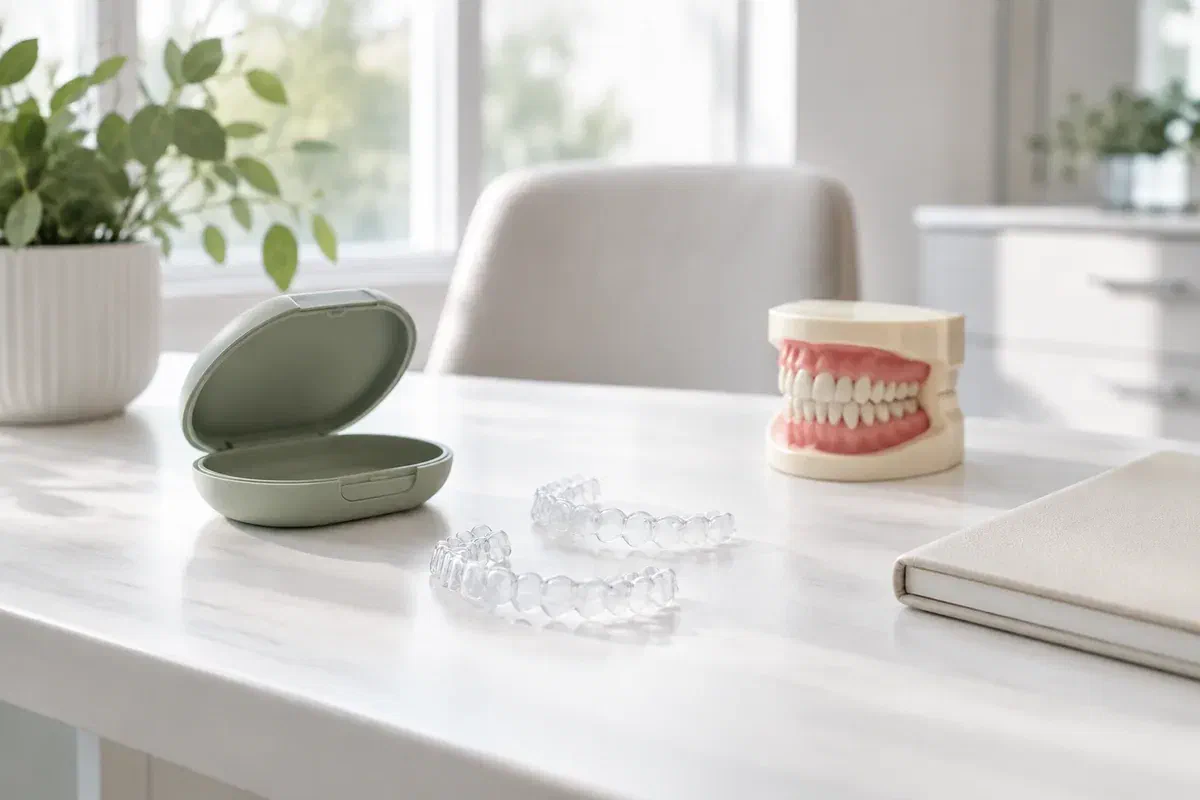
Illustrative aligners, protective case, tooth model, and notebook on a consultation desk
Useful to share at the start

Your concern, your history, your expectations of care

What you hope for and what has happened before both affect who should plan treatment. Raise questions about comfort, time, fees and long-term follow-up as well.

What you want to change

Describe the crowding, spacing, rotation or bite issue that concerns you. Ask whether it is mainly cosmetic or affects how your jaws meet. A responsible plan says what it aims to do and what it will not, instead of promising a perfect result.

Previous orthodontics and restorations

Mention braces, retainers, crowns, bridges, implants, injuries and gum care, as well as any specialist you have seen before. Bring records or letters if you have them. These help decide the right setting for care.

The routine trays would require

Think about work, meals, travel and how easily you keep a routine. Aligners need consistent wear and careful cleaning. Ask how that would fit your life rather than choosing them only because they are hard to spot.

A first conversation may point to a full exam, more records, other dental care or a specialist opinion before any recommendation. Ask what this visit includes and what would be arranged separately.

What you should know afterwards

Clear roles, a clear goal, a clear plan

You should leave understanding whether removable aligners suit the movements involved and who would be responsible for planning and monitoring them, whether that is our team or a specialist. A brand name alone does not tell you whether the approach is right.

The commitment continues after active treatment. Retainers maintain the result and follow-up checks confirm stability. Ask who would provide and review retention, what it costs, and how additional trays or a revised plan would be handled.

Patient information: Invisalign Canada — treatment stages and retention · British Orthodontic Society — questions before orthodontic treatment

A goal and the reason for it

Ask which teeth would move, which bite relationships would change and what would remain. Being able to explain the aim yourself helps you compare a limited plan, a comprehensive one and a specialist’s view.

A frank account of daily treatment

Ask about removal for meals, cleaning, storage and review frequency, and whether attachments would be used. Clear trays still involve some visible features and an adjustment period with each new set.

Fees with clear limits

Ask what the estimate includes and what may be separate, such as records, replacement trays, retainers or further stages. If a referral is suggested, ask whether specialist fees would be separate.

How the consultation runs

Understand the problem, then decide who solves it.

The visit’s scope depends on how it was booked and what records exist. Ask beforehand whether it is an initial discussion or includes records for a detailed proposal.

  1. Explain your goals and history

    Describe the change you hope for and any earlier orthodontic care or specialist visits. The clinician reviews health information, medications, symptoms and dental work. Mention any plans to move or travel for long periods.

  2. Assess how complex the movement is

    Teeth, gums and bite are examined, along with how the jaws relate. Photos, radiographs or a scan may be recommended for a specific purpose. Ask whether anything should be treated first.

  3. Discuss aligners, alternatives and referral

    Suitability, likely stages, risks and your role in wear and reviews are explained. If a specialist would be more appropriate, the reasons are discussed. Any simulation is a planning tool rather than a guaranteed outcome.

  4. Agree the next step

    That might be more records, a referral or time to consider an estimate. Confirm what was agreed, any fees and what information would be sent to a specialist if one is involved.

In the days that follow

Think about who you want beside you for the whole course.

Most people use this time to review the proposal or referral and complete any recommended care. Keep your usual brushing, flossing and checkups going while you decide.

Check the wear schedule against home life

Invisalign guidance often describes 20 to 22 hours a day of wear, with your clinician setting your instructions. Think about meals, cleaning and time away. Raise any concern now rather than relying on part-time wear.

Confirm supervision and contact

Ask who monitors progress, how often, and whom to call about a loose or lost tray. If care is shared with a specialist, ask who handles which part. Clear responsibility matters throughout treatment.

Coordinate any other dental care

If another office is planning a filling, crown or other repair, let both teams know. A change to a tooth’s shape after scanning can stop trays seating properly. Keep to whatever order was agreed, and ask whether a fresh check is wise before the first set of trays arrives.

Patient information: Invisalign Canada — patient questions and wear guidance

Where the assessment points

Here, with a specialist, or not yet

Ask why a route suits you. Interest in Invisalign does not commit you, and a referral is a sign of careful planning rather than a setback.

When the movement suits aligners in our setting

Invisalign planning with our team

If trays fit the goals, records and a detailed proposal may be next. Confirm scope, limits and responsibilities before ordering. Monitoring and retention should be part of the plan.

When complexity or the bite calls for specialist care

Referral to an orthodontist or another appliance

Some concerns are better managed by an orthodontist or with a different appliance. Ask what the referral should answer and what records will be shared. You can still discuss your interest in removable trays with the specialist.

When oral health or timing suggests a pause

Other care first, or wait

Decay, gum concerns or a busy period may make another step the priority. You may decide not to go ahead with an elective change. Ask what needs care and how monitoring would work.

Erin questions about who treats what

Dentist, orthodontist or both?

Ask about your own teeth, who would be supervising and what treatment would involve. Advertising cannot decide the right setting for your care.

(905) 876-4488
What is the difference between a dentist and an orthodontist offering aligners?
An orthodontist has completed additional specialty training in tooth and jaw alignment. Many general dentists also provide aligner treatment for suitable cases. Ask about the clinician’s approach and when they refer.
When would you refer me to an orthodontist?
Referral may be suggested for more complex bite or jaw problems, or when another appliance seems more appropriate. The clinician should explain the reasoning and what the specialist will assess.
Can I ask for a referral even if aligners seem suitable?
Yes. A second opinion is a reasonable request for any elective treatment, and nobody should take offence at it. Ask which records can be shared with the specialist so you are not repeating X-rays or scans unnecessarily, and whether there is anything you should bring along.
Who would provide my retainers if a specialist treated me?
Usually the clinician who carries out the movement arranges retention and the checks that follow. Arrangements differ, though, so ask before treatment starts. It helps to know who makes the retainer, who replaces it if it is lost and who you would contact if it stops fitting.
Do I have to decide at my first consultation?
No. The first appointment is there to explain what was found and what the choices are. Ask what the next step would be and whether it carries a fee. Whether you are holding a proposal or a referral letter, you are free to take your time with it.
Will having had braces before change who should treat me?
It may, depending on what has shifted and how the bite looks now. Bring information about earlier treatment so the clinician can advise on the best setting.

Patient information: Align Technology — patient instructions and treatment considerations

From Erin and Hillsburgh

Start with an assessment. The right setting follows.

Come and see us on Bronte Street to find out whether Invisalign with our team, a referral to a specialist or a different approach would suit your teeth best. We will talk you through what we find and what each route would ask of you, then leave the choice with you.

Nobody can say whether aligners fit, or whether you should see an orthodontist, until your teeth have been examined. When you call, the team can tell you what the consultation costs and which records it covers.

Visit Milton Dental Clinic
Unit 1, 342 Bronte St. S, Milton, ON L9T 5B7
Get directions Clinic hours
Monday–Thursday
11am–7pm
Friday–Sunday
By appointment only

Areas we serve

  • Milton
  • Oakville
  • Mississauga
  • Georgetown
  • Halton Hills
  • Acton
  • Campbellville
  • Brampton
  • Burlington
  • Puslinch
  • Rockwood
  • Erin
  • Caledon
  • Etobicoke
  • Old Milton
  • Bronte Meadows
  • Timberlea
  • Dorset Park
  • Dempsey
  • Clarke
  • Beaty
  • Coates
  • Harrison
  • Scott
  • Willmott
  • Ford
  • Bowes
  • Cobden
  • Walker
  • Mountain View
  • Milton Heights
  • Hawthorne Village
  • Valley View
  • Fallingbrook
  • Nassagaweya
  • Trafalgar
  • Esquesing
  • Nelson
  • Brookville
  • Moffat
  • Glen Williams
  • Norval
  • Limehouse
  • Stewarttown
  • Ashgrove
  • Hornby
  • Silver Creek
  • Speyside
  • Scotch Block
  • North Oakville
  • River Oaks
  • Glen Abbey
  • West Oak Trails
  • Palermo
  • Bronte Creek
  • College Park
  • Joshua Creek
  • Uptown Core
  • Preserve
  • Iroquois Ridge
  • Lisgar
  • Meadowvale
  • Meadowvale Village
  • Churchill Meadows
  • Erin Mills
  • Central Erin Mills
  • Streetsville
  • East Credit
  • Creditview
  • Heartland
  • Sheridan
  • Mount Pleasant
  • Credit Valley
  • Huttonville
  • Churchville
  • Springbrook
  • Northwest Brampton
  • Bram West
  • Fletcher's Meadow
  • Fletcher's Creek South
  • Alton Village
  • Orchard
  • Millcroft
  • Headon Forest
  • Tansley
  • Brant Hills
  • Tyandaga
  • Kilbride
  • Lowville
  • Aberfoyle
  • Morriston
  • Arkell
  • Hillsburgh
  • Freelton
  • Carlisle
  • Waterdown
  • Flamborough
  • Mountsberg

How can we help?

Milton Dental Clinic

Have a question about your smile? Choose the option that works best for you.

For urgent dental concerns, please call.
Messages are reviewed during clinic hours.