

Illustrative patient and dental clinician reviewing an aligner and tooth model
Cosmetic Dentistry

Invisalign Refinements in Puslinch

A refinement stage usually starts with new records: fresh scans or photos, and sometimes new attachments. For people coming from Puslinch, knowing what will be measured and why makes the review easier to plan, and helps you judge whether a further series is the right way to finish.

Refinement records for Puslinch patients

New scan, new plan, same goals

The first series of aligners was designed from records taken before any tooth moved. By the end, those records describe a mouth that no longer exists. If something still needs adjusting, a new plan generally has to begin from where your teeth sit today, which is why a refinement review often involves fresh measurements.

Refinements are the additional aligners that come out of that process. They continue active treatment toward goals that were not fully reached. They are not the same as retainers, which are used once the clinician is satisfied that active movement is over and the priority becomes stability.

When our clinic supervises your aligners, raise your concerns at the progress review and ask what records will be needed. If another practice runs your treatment, begin there; we can give a separate opinion if it would genuinely help. You should understand what is being measured and what the new trays would be for.

Ask what your review will include
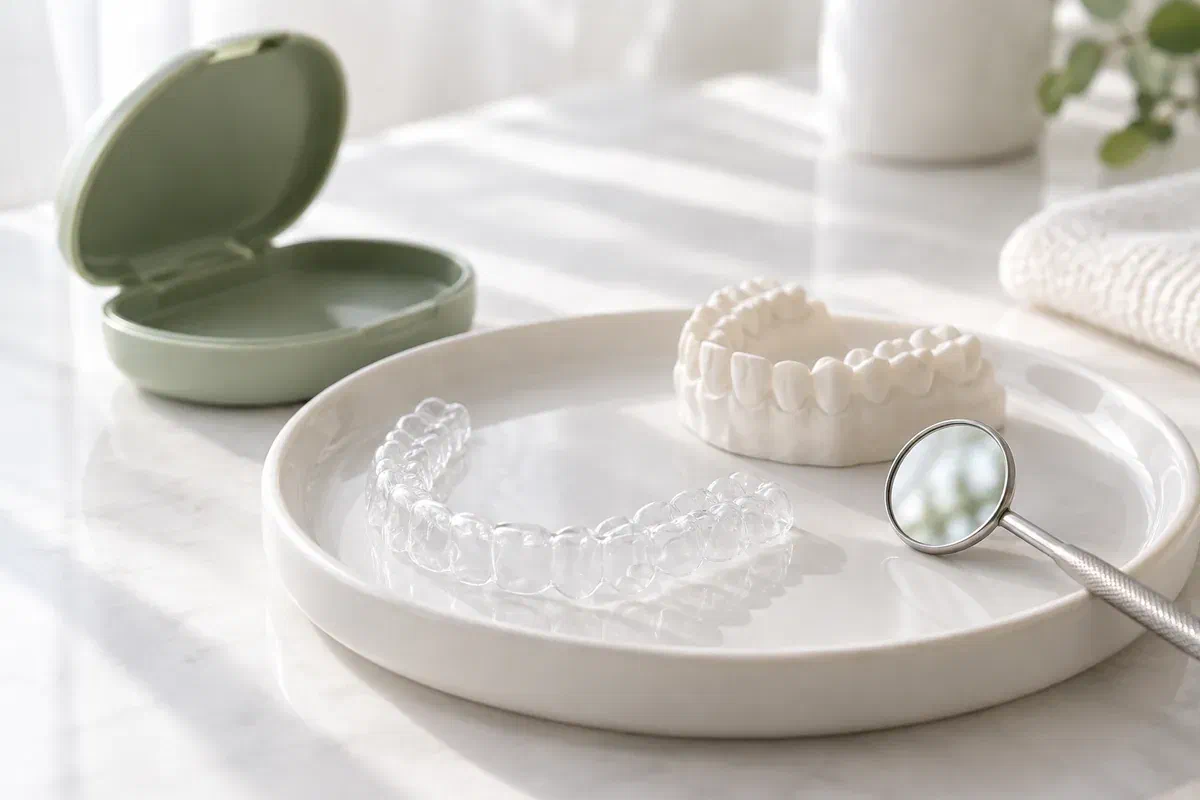
Illustrative clear aligner, tooth model, dental mirror, and protective case
What to flag before records are taken

Mention it now, so it can be planned for.

Concerns raised before scanning can be built into planning. Say what you see and what you feel, so the clinician can distinguish unfinished movement from a fit problem or tooth-shape question.

A position that still falls short

Show the tooth, space, or overlap that you still notice. Ask whether it differs from your agreed outcome and whether more movement is advisable. Photos can help you explain, but the clinician needs to look at your teeth and bite directly.

Attachments, fit, or bite changes

Report any attachment that has chipped or fallen off, a tray that no longer grips, or a change in how your teeth meet. Mention the stage and timing. A cause should be identified before anyone concludes that more aligners are needed.

How much more you want to take on

New records and a new series add appointments, fees, and wear. Share your concerns openly. Ask what the next stage is intended to achieve and what other paths are possible before you agree to scanning or ordering.

A refinement recommendation does not by itself mean an error occurred or that you were not wearing your trays. Ask what the examination revealed in your case.

Why fresh records matter

Planning from the present, not the past

The point of reassessment is to tie current findings to a defined next step. Ask which remaining concern affects your bite or oral health, which is cosmetic, and which may come from a tooth’s natural shape rather than its position.

It is also where limits become clear. Another series cannot promise a flawless result, and some changes may not be advisable. A careful discussion covers expected benefit, risks, uncertainty, and whether you want to keep going before records are taken.

A reason behind each record

Ask why a scan, photos, or impressions are recommended and what they will show. Ask, too, what the new series would change. Understanding the purpose of each step is more reassuring than being told refinements are just routine.

Attachments planned for the next moves

Attachments may be kept, added, replaced, or removed for a refinement series. Ask what is planned for yours and why. Any new dental concern, such as a chipped filling, should be considered before the plan is finalized.

An endpoint you can picture

Ask what the clinician will look for at the next review to decide the goals are met, and how retainers would be introduced. Confirm practical and cost limits. Seeing the finish line helps, even though timing is never guaranteed.

From records to new aligners

What a refinement review typically covers

The details depend on your history and the concern being reviewed. Ask for instructions covering the review, the records appointment if separate, and the wait for new trays.

  1. Restate the original targets

    Bring your current aligners and explain what you have noticed. Mention missed wear, lost attachments, and any soreness honestly. The clinician will compare your observations with your treatment records and the goals you set together.

  2. Examine and take new records if needed

    Your tooth positions, bite, and oral health are assessed. A scan, photos, or impressions may be taken for a stated reason. Ask what each will capture and whether anything needs treatment before more movement is planned.

  3. Review the new plan and its options

    Discuss what the refinement aligners would aim to achieve, their limits, and changes to attachments or other components. Confirm fees and what is included. If another approach is suggested, ask why it might suit the findings better.

  4. Confirm the interim and the restart

    Before leaving, write down the appliance you are meant to keep in, the daily wear time, and the number to ring if it is damaged. When the refinement trays arrive, follow the updated instructions instead of the earlier change schedule.

While the refinement plan is prepared

The wait is part of treatment, too.

Planning and manufacturing can take a few weeks after records are taken. Ask your questions at the review so the gap does not undo your progress.

Follow the holding instruction exactly

Your clinician may ask you to keep wearing a specific tray or another appliance until new aligners arrive. Wear it for the full hours given. Finishing the series is not a cue to stop. A split edge or a tray that refuses to seat is worth a phone call the same week.

Get to know the new attachments and trays

Check the tray order, change interval, and any new attachments or elastics. Ask how to care for new attachments. If your routine around Puslinch has shifted since you started, mention it so the plan suits your days.

Close out questions before retention

Raise any remaining concern about appearance or bite at the scheduled review, and ask whether aligners can address it. Make sure active movement is formally ended and that the retainer plan is clear before you consider treatment finished.

Where the records may point

Three directions a new plan can take

The recommendation should come from the exam, the records, and your goals. For each direction, ask what problem it solves, what it leaves unsolved, and how it shapes the appointments ahead.

When specific movement is still sensible

A refinement series built from new records

A new set of aligners may be designed to adjust particular teeth or contacts. Ask what will change and how progress will be checked. Confirm visits and any additional fees before the series is ordered.

When the records suggest another route

Specialist input or a different technique

Findings may point to a referral, a different method, or a tooth-shape or restorative discussion. Ask whether repeating aligner movement is likely to resolve it, and who will coordinate the next step.

When the goals are confirmed

Concluding treatment with retainers

If your clinician considers active treatment finished, make sure any small compromise is written into your notes and that the retention plan is spelled out. Ask about the type of retainer, wear instructions, check-ups, and what to do if it stops fitting.

Patient information: British Orthodontic Society — aligner treatment and retention

Records and attachment questions

What gets measured, and why

These answers are general. Your own will depend on your records and exam, not on how many refinement trays someone else received.

(905) 876-4488
Why do I need a new scan for refinements?
Because your teeth have moved since the original records were taken. A new scan or photos let the clinician plan any further aligners from your current positions. Ask what is being recorded and how it will be used in planning.
Will my attachments be removed before the new scan?
It depends on the plan. Sometimes attachments stay, sometimes they are removed, replaced, or new ones are added. Ask your clinician what will happen to yours and when, so you know what to expect at the appointment.
How should I care for new attachments?
Brush carefully around them and keep up with flossing, since plaque can build up at their edges. Avoid biting hard objects. If an attachment chips or comes off, tell the team rather than waiting for the next review.
Can I be scanned and fitted for refinements in one trip?
Usually not, because new aligners need to be planned and made after records are taken. Ask the team how many visits are likely and whether any steps can be combined to reduce travel from Puslinch.
Do refinements mean my first plan was inaccurate?
Not on their own. Teeth respond individually, and some movements are more difficult than others. Ask which goals were achieved and which remain, and how the findings support the recommendation for more trays.
After refinements, how is a retainer different from my last aligner?
A retainer is designed to hold teeth in place rather than move them, and it comes with its own wear routine. Ask which retainer is planned and how the change from active treatment will be confirmed.
Planning your Puslinch review

Come with your trays and anything that has chipped or come loose.

Arrange a progress review at our Bronte Street practice, where we can explain which records are needed and what any further aligners would be for. If another provider manages your care, let us know when booking.

Refinement suitability, fees, timing, and any change of provider need to be assessed. Additional aligners do not guarantee any particular outcome.

Visit Milton Dental Clinic
Unit 1, 342 Bronte St. S, Milton, ON L9T 5B7
Get directions Clinic hours
Monday–Thursday
11am–7pm
Friday–Sunday
By appointment only

Areas we serve

  • Milton
  • Oakville
  • Mississauga
  • Georgetown
  • Halton Hills
  • Acton
  • Campbellville
  • Brampton
  • Burlington
  • Puslinch
  • Rockwood
  • Erin
  • Caledon
  • Etobicoke
  • Old Milton
  • Bronte Meadows
  • Timberlea
  • Dorset Park
  • Dempsey
  • Clarke
  • Beaty
  • Coates
  • Harrison
  • Scott
  • Willmott
  • Ford
  • Bowes
  • Cobden
  • Walker
  • Mountain View
  • Milton Heights
  • Hawthorne Village
  • Valley View
  • Fallingbrook
  • Nassagaweya
  • Trafalgar
  • Esquesing
  • Nelson
  • Brookville
  • Moffat
  • Glen Williams
  • Norval
  • Limehouse
  • Stewarttown
  • Ashgrove
  • Hornby
  • Silver Creek
  • Speyside
  • Scotch Block
  • North Oakville
  • River Oaks
  • Glen Abbey
  • West Oak Trails
  • Palermo
  • Bronte Creek
  • College Park
  • Joshua Creek
  • Uptown Core
  • Preserve
  • Iroquois Ridge
  • Lisgar
  • Meadowvale
  • Meadowvale Village
  • Churchill Meadows
  • Erin Mills
  • Central Erin Mills
  • Streetsville
  • East Credit
  • Creditview
  • Heartland
  • Sheridan
  • Mount Pleasant
  • Credit Valley
  • Huttonville
  • Churchville
  • Springbrook
  • Northwest Brampton
  • Bram West
  • Fletcher's Meadow
  • Fletcher's Creek South
  • Alton Village
  • Orchard
  • Millcroft
  • Headon Forest
  • Tansley
  • Brant Hills
  • Tyandaga
  • Kilbride
  • Lowville
  • Aberfoyle
  • Morriston
  • Arkell
  • Hillsburgh
  • Freelton
  • Carlisle
  • Waterdown
  • Flamborough
  • Mountsberg

How can we help?

Milton Dental Clinic

Have a question about your smile? Choose the option that works best for you.

For urgent dental concerns, please call.
Messages are reviewed during clinic hours.