

Illustrative patient and clinician discussing a tooth model before restorative planning
Cosmetic Dentistry

Pre-Restorative Tooth Alignment in Campbellville

When teeth meet unevenly, a new crown, bridge or bonded repair has to work within that bite. From Campbellville, you can discuss with us whether shifting a few teeth first would give the restoration a steadier setting, or whether it can be designed well around the bite you have.

How the teeth come together

Your bite is part of every restoration.

Maybe one side seems to touch first when you close, or a worn tooth takes most of the pressure when you chew. A crown or bridge in that spot has to fit the way your teeth actually meet. Pre-restorative alignment considers whether moving some teeth would change that relationship enough to make the restoration easier to design and maintain.

In many mouths, restorations are built successfully around an imperfect bite. Movement is one possibility, not a rule. If it is suggested, you should hear the specific reason it would help this restoration, together with a clear account of how the work would be done without it.

Rural households around Campbellville often prefer to group appointments. Mention that early, and bring any previous proposals or imaging. Our team can explain what assessment remains, whether an orthodontic or other specialist opinion would help, and how the planned restoration informs every recommendation.

Ask how your bite affects a restoration
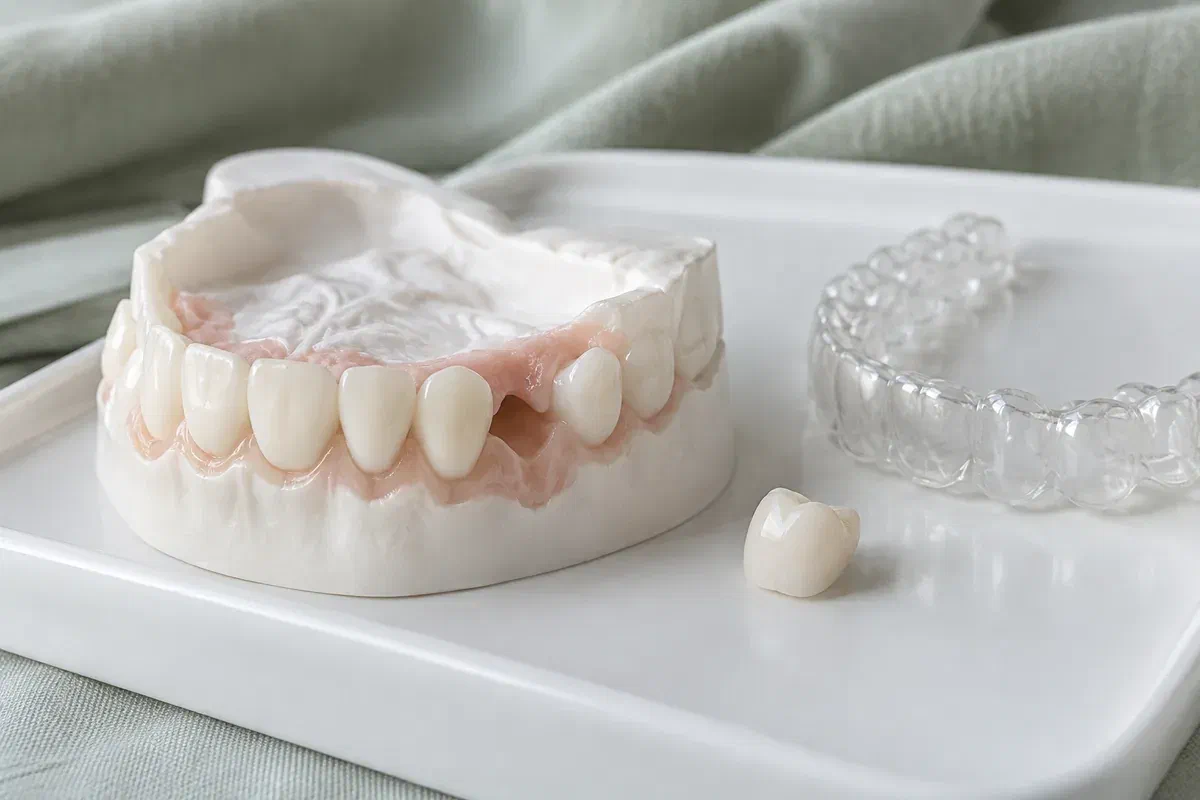
Illustrative tooth model, ceramic crown sample, and clear aligner on a consultation tray
Signs the position may matter

Do the bite, the space or the order need attention?

What counts is whether a different position would change the care you need. An examination, bite records and imaging help clinicians answer that.

An opening for a replacement that has changed

Teeth near a gap can tip, and an opposing tooth may drift toward it. The space then suits a bridge or implant crown less well. Neighbouring teeth, roots and the opposing tooth all need checking, since the gap seen from the front is only part of it.

A worn or misplaced tooth needing a crown or bonding

Heavy wear or a tooth that sits too high, low or crooked can make a crown harder to shape for a comfortable bite. Moving and reshaping teeth do different things. Your dentist should explain whether doing both would offer a sound benefit.

A plan without a clear order

Bite adjustments, gum care, orthodontics and restorations may all be on the table. Find out how they fit together and who is coordinating them. An appointment booked without the wider plan in mind can create extra work later.

Dental implants are joined to bone and do not shift under orthodontic pressure. Tell the team about every implant and planned restoration before any movement is proposed.

What a combined plan can offer

A restoration designed for the bite it will live in

Alignment is worth doing only if it improves the restorative outcome. The explanation should tell you whether moving teeth would change how they meet, the space for a replacement or the shape the restoration can take. If the benefit is unclear, ask for a more specific description.

Weigh the commitment honestly. Orthodontics comes with its own visits, appliance care, possible risks, fees and retention afterwards. Compare those with a suitable plan that leaves teeth in place, and choose the approach that fits your priorities and the time you can give it.

Patient information: British Dental Journal — principles of interdisciplinary orthodontic and restorative treatment

Agreed positions before treatment starts

The clinicians should settle on the tooth positions and bite the restoration needs before any movement. That target is about function and design, not simply a straighter look. Ask what will be confirmed before restorative work is scheduled.

A clear view of the alternatives

Learn how the tooth would be restored with the bite as it is, and what that means for comfort, appearance and upkeep. A combined approach should be justified by your findings, not offered as the better option by default.

Straightforward roles and contacts

Find out who carries out each stage, who checks progress and whom to call between appointments. Where an orthodontist and a restorative dentist are at different practices, ask how bite records and updates will be shared.

Planning in four parts

Begin with how the teeth meet, end with a restoration that fits.

Combined care may bring in more than one clinician and several reviews. Know which information is still missing, and which decisions might change as treatment progresses.

  1. Describe the tooth, the bite and your goals

    Tell us what you notice when you chew or close, which tooth or space concerns you, any earlier advice and what you want from the result. Bring records or estimates. If you would like visits grouped, say so at the start.

  2. Record the bite and examine supporting tissues

    The clinicians assess teeth, gums and how your jaws close together. Bite records, scans or models may be taken alongside X-rays to study space and roots. Decay or gum disease usually needs attention before teeth are moved.

  3. Agree target positions and the treatment order

    Discuss which teeth might move, appliance options, alternatives, limitations and risks. Understand how the restoration will fit the new bite. If a specialist is involved, find out what they are assessing and who will put their advice into the overall plan.

  4. Recheck the bite before restoring

    When movement is complete, tooth positions and contacts are compared with the agreed target. Ask what will hold them steady while the restoration is made. Updated bite records may be needed before any tooth is irreversibly prepared.

Keeping the bite steady

Small shifts now can change the fit later.

Between alignment and restoration, the teeth need careful holding. Know your retainer instructions, your next review date and who to call if the timeline has to change.

Follow retention instructions closely

Wear the retainer or appliance as directed and report breakage or a change in fit quickly. A bite that feels settled can still shift if wear stops. Ask how positions will be protected while you wait for the restoration or another clinician’s review.

Mention any other dental visits

A filling, extraction, crown or bite adjustment elsewhere can affect the sequence or an appliance. Make sure each clinician is aware of the others. If you rebook one appointment, check whether the timing of another stage changes too.

Get a maintenance plan that covers both

Once the restoration is fitted, your retainer may need adjusting to its shape, so learn who will check it. Review how to clean the restoration and aligned teeth and when the bite will next be assessed.

Deciding on an approach

Adjust position, restore as is, or gather more detail

Findings may point toward combined care, a restoration alone or further assessment. Consider what each option would do for the tooth, your bite and your oral health in the long run.

When the bite limits the restoration

Reposition, then restore

Moving teeth first may be suggested where it gives the restoration a clearly better bite to work within. Confirm the endpoint, how it will be measured and how retention will hold the result until the restoration is placed.

When the existing bite is workable

Restore within the current bite

Many restorations are designed successfully around the teeth as they are. Learn what preparation, appearance, function and maintenance would be involved, and compare it on equal terms with the combined option.

When findings point to added complexity

Further review before committing

A specialist opinion or other treatment may be needed before the sequence is chosen. Clarify what remains uncertain and what can wait safely. You can take time to think over an elective combined plan before you agree.

Questions from Campbellville

Bite, position and restoration: common questions

These answers can help clarify how your bite and tooth positions connect to the restoration planned.

(905) 876-4488
Can an uneven bite be improved with a crown instead of orthodontics?
Sometimes the shape of a restoration can help a bite contact, and sometimes tooth position is the limiting factor. Ask what each approach could realistically change, and what the limits of a restoration-only plan would be.
Will my bite feel different after teeth are moved?
It may, since the purpose is often to change how teeth meet. Ask what changes to expect, how they will be checked and what to report if chewing feels uncomfortable during or after movement.
Can appointments be grouped for a household travelling in from a rural area?
Let us know your preferences early. Where it is clinically appropriate, records and reviews may sometimes be combined or booked in sequence. Ask which visits must be separate because one result informs the next.
Does an existing implant limit which teeth can be moved?
It can, because an implant stays fixed while teeth around it move. Its position has to be built into the plan. Make sure every clinician knows where your implants are before an orthodontic proposal is prepared.
Who sets the final bite before the restorative stage?
The clinicians responsible for movement and restoration should agree on the target together. Ask who leads that decision and how they will confirm the bite is ready before the restoration is made.
Could my restoration be delayed after alignment, and what then?
Delays can happen. Tell the clinicians and ask how positions should be held in the meantime, which appliance to wear and whether a review is needed. Do not switch to an old retainer without advice.
Planning from Campbellville

Close your teeth together, and tell us what you notice.

Arrange a discussion at our Bronte Street practice about whether moving teeth would help your planned restoration. We can explain how your bite will be assessed, how stages would be coordinated and when specialist input may help.

Whether teeth should move, and in what order treatment proceeds, depends on individual assessment. No particular appliance, specialist service or result is assumed.

Visit Milton Dental Clinic
Unit 1, 342 Bronte St. S, Milton, ON L9T 5B7
Get directions Clinic hours
Monday–Thursday
11am–7pm
Friday–Sunday
By appointment only

Areas we serve

  • Milton
  • Oakville
  • Mississauga
  • Georgetown
  • Halton Hills
  • Acton
  • Campbellville
  • Brampton
  • Burlington
  • Puslinch
  • Rockwood
  • Erin
  • Caledon
  • Etobicoke
  • Old Milton
  • Bronte Meadows
  • Timberlea
  • Dorset Park
  • Dempsey
  • Clarke
  • Beaty
  • Coates
  • Harrison
  • Scott
  • Willmott
  • Ford
  • Bowes
  • Cobden
  • Walker
  • Mountain View
  • Milton Heights
  • Hawthorne Village
  • Valley View
  • Fallingbrook
  • Nassagaweya
  • Trafalgar
  • Esquesing
  • Nelson
  • Brookville
  • Moffat
  • Glen Williams
  • Norval
  • Limehouse
  • Stewarttown
  • Ashgrove
  • Hornby
  • Silver Creek
  • Speyside
  • Scotch Block
  • North Oakville
  • River Oaks
  • Glen Abbey
  • West Oak Trails
  • Palermo
  • Bronte Creek
  • College Park
  • Joshua Creek
  • Uptown Core
  • Preserve
  • Iroquois Ridge
  • Lisgar
  • Meadowvale
  • Meadowvale Village
  • Churchill Meadows
  • Erin Mills
  • Central Erin Mills
  • Streetsville
  • East Credit
  • Creditview
  • Heartland
  • Sheridan
  • Mount Pleasant
  • Credit Valley
  • Huttonville
  • Churchville
  • Springbrook
  • Northwest Brampton
  • Bram West
  • Fletcher's Meadow
  • Fletcher's Creek South
  • Alton Village
  • Orchard
  • Millcroft
  • Headon Forest
  • Tansley
  • Brant Hills
  • Tyandaga
  • Kilbride
  • Lowville
  • Aberfoyle
  • Morriston
  • Arkell
  • Hillsburgh
  • Freelton
  • Carlisle
  • Waterdown
  • Flamborough
  • Mountsberg

How can we help?

Milton Dental Clinic

Have a question about your smile? Choose the option that works best for you.

For urgent dental concerns, please call.
Messages are reviewed during clinic hours.