

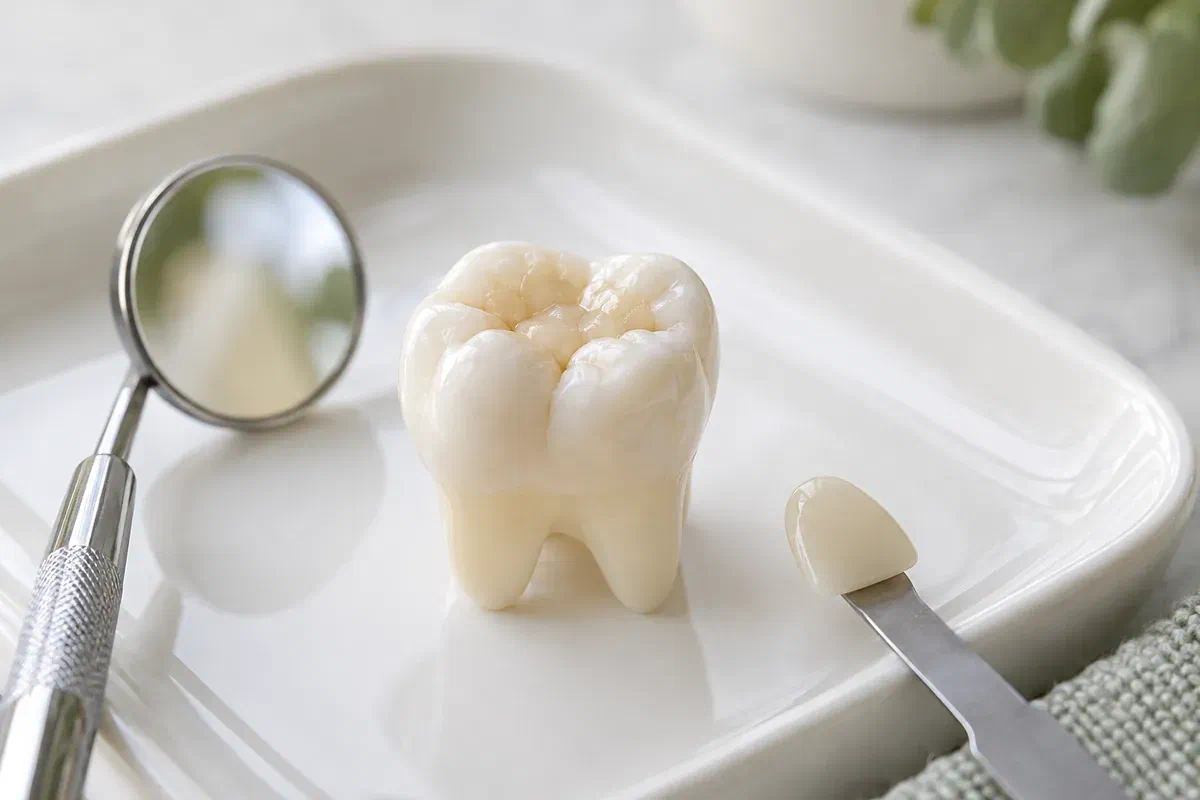
Illustrative patient and clinician reviewing a tooth model and shade samples
Cosmetic Dentistry

Replacement of Discoloured Fillings in Acton

Sometimes your tongue finds the problem before the mirror does: a filling that feels rough, dull, or slightly worn, and now looks darker too. From Acton, you can have the surface and edges examined and learn whether polishing, repair, monitoring, or replacement suits it.

Rough, dull, and darker

When texture and colour change together

A tooth-coloured filling starts out smooth and glossy. With years of chewing and brushing, its surface can lose that polish, and a rougher surface tends to hold stain more easily. That is one reason a filling may look darker and feel different at the same time. A rough edge can also mean a chip, a small gap, or decay, so it deserves a closer look.

Replacement is not the only answer to a worn surface. Removing a filling takes out the old material and may cost some sound tooth as well. Refinishing and polishing, a small repair, or keeping watch can be sensible choices when the examination supports them and the result meets your goals.

Acton is a smaller community northwest of Milton, and a single well-planned visit often covers the first step. Point out the area your tongue keeps finding, mention when its colour changed, and tell us about any sensitivity. We will explain what we see and why any treatment is suggested.

Have a worn filling assessed
Illustrative molar teaching model with a slightly contrasting composite filling
Notes worth bringing

What have you felt, and what have you seen?

These details help separate cosmetic wear from a restoration or tooth needing other care. Please mention any discomfort, however minor, even if appearance brought you in.

A filling that has lost its shine and colour

Tell us when it started looking dull or darker and whether you have whitened since it was placed. Smile so we can see which surfaces show. The answers help us judge whether the change is surface wear, stain, the material itself, or the enamel around it.

A rough spot, a ledge, or trapped food

Describe where your tongue catches or where food lodges after meals. These signs are read alongside the filling’s fit and the tooth’s health. Roughness can be simple wear, but it can also accompany a defect, and a comfortable tooth is not always sound.

Sensitivity or a piece that broke away

Explain what triggers sensitivity and how long it lasts. Mention a chip, a crack, or a deep filling from years ago. These findings can move the plan away from cosmetic refinishing and need checking first.

Older metal fillings can look dark and slightly tarnished. That appearance on its own is not evidence of failure or harm, so discuss their condition and what removal would involve before deciding.

Why an exam beats guessing

A smoother surface may be closer than you think.

We aim for the least invasive treatment that properly addresses the finding. If replacement is recommended, ask what it achieves beyond refinishing or a repair. If the filling can remain, we explain how it looks and how it will be followed at future visits.

Colour planning should consider your natural teeth and any later cosmetic work. A filling cannot be promised to look invisible under every light or keep its shade indefinitely. Material, remaining tooth, and daily care all affect how it ages.

Patient information: FDI World Dental Federation — assessing repair and replacement of restorations

A clear explanation of the cause

You will hear whether the concern is surface wear and stain, a localized defect, a broader restoration problem, or decay, and how that leads to our suggestion. A filling’s age is not a full explanation on its own.

The option to refinish or repair

Polishing a worn composite, or repairing one rough area, can sometimes avoid removing the whole filling. Neither is right for every case, and we will tell you when they are not. If chosen, we explain the limits and future checks.

A plan that looks beyond today

Mention any interest in whitening, bonding, or other visible work. It can affect timing and material. We also talk about how surfaces wear, what upkeep helps, and when future polishing might be useful.

During your visit

From a rough spot to a smooth finish

Refinishing, repair, and replacement each involve different steps. Ask what is planned and how it might change if more is found once work begins.

  1. Feel, look, and test

    The dentist runs an instrument gently over the surface and margins, looks at the tooth and gums around them, and checks how you bite. If decay under the edge is a possibility, an X-ray may help settle it. Mention past sensitivity, fractures, whitening, and the filling’s age if known.

  2. Explain what will help

    We set out whether monitoring, refinishing, repair, or replacement is suitable. Ask about materials, realistic shade, risks, and fees. If much of the tooth is already restored, another kind of restoration may be worth discussing.

  3. Carry out the chosen work

    The surface or filling is prepared for the agreed approach, with freezing used where needed. Tell the team if you need a moment. If anything unexpected turns up, it is explained along with its impact on the plan.

  4. Smooth, polish, and check the bite

    The treated surface is finished to a smooth polish and checked for fit, contacts, and chewing comfort. Run your tongue over it and tell us how it feels. Before leaving, confirm what should settle and whether a recheck is planned.

Afterward at home

Notice how it feels as well as how it looks.

Aftercare depends on the procedure and material. Follow your visit instructions rather than assuming all fillings have the same restrictions.

Wait for normal feeling before chewing

If freezing was used, take care until it wears off and follow the eating advice given. Check with us about when firmer foods are fine again. If the bite feels high or uneven, contact us rather than testing it on hard food.

Keep the surface and edges clean

Keep brushing twice a day and cleaning between teeth the way you were shown. Tell us if any spot is difficult to reach or still traps food. Restored teeth can develop new decay, so daily care continues to matter.

Report roughness, sensitivity, or colour concerns

If the area feels rough again, if sensitivity lingers or worsens, or if the colour still bothers you, book a review. Avoid filing, scraping, or bleaching the filling yourself, which can damage its surface.

Options for a worn filling

Refinish what you can, replace only what you must.

Each approach has benefits and tradeoffs. Consider the health of the tooth, the material in place, and the importance of appearance to you.

Surface wear or stain on a sound filling

Refinishing, polishing, or monitoring

Refinishing can restore smoothness and may improve surface stain without removal. Monitoring is reasonable when the filling is sound and its appearance acceptable. We will tell you what to watch for and when to return sooner.

A chip or rough area that can be fixed on its own

A small repair

A repair can rebuild a limited area while keeping suitable existing material. Its suitability depends on the defect and the type of filling. We discuss the likely appearance, its limits, and the follow-up involved.

Wear or damage too extensive to fix locally

Replacement or another restoration

When the problem is too wide for a local fix, replacing the filling or choosing a different restoration may be advised. You can ask what drilling would take from the tooth, how it may feel afterward, and which other paths exist. Age alone does not justify removal.

Patient information: FDA — considerations before removing an existing amalgam filling

Questions we hear from Acton

Common questions about rough and dull fillings

These answers help you weigh a cosmetic refresh against changing the filling entirely.

(905) 876-4488
Why does my filling feel rough when it used to be smooth?
Chewing and brushing gradually wear the surface, and small chips can form at the edges. Roughness can also accompany a defect or decay. An examination shows which applies and what, if anything, needs doing.
Can a rough tooth-coloured filling be smoothed without replacing it?
Often, if the filling is sound, refinishing and polishing can restore a smoother surface and may improve stain. Deeper problems may need another approach. Ask what improvement is realistic for your filling.
Does a worn surface make a filling stain faster?
A rougher surface can hold pigment more readily than a smooth, polished one. Keeping the surface smooth and maintaining regular cleanings may help. Ask how your material tends to wear and stain.
Is grinding my teeth affecting how my fillings look?
Clenching or grinding can contribute to wear and chipping on teeth and fillings. Mention it at your visit so we can look for signs and discuss what may help protect your restorations.
Should I worry about a dark old silver filling that feels fine?
Not because of colour alone. A comfortable, sound metal filling may be perfectly reasonable to keep. Ask about its condition and what replacing it would mean for the tooth before deciding.
Can I file down a rough spot on my filling myself?
Please do not. Home tools can damage the filling and the tooth around it. If a spot feels sharp or rough, book a visit so it can be checked and smoothed safely if appropriate.
Filling reviews for Acton

Bring the spot your tongue keeps finding.

Schedule time at our Bronte Street practice to have a worn, rough, or discoloured filling examined. We will explain what we find and which approach fits the tooth best.

Several outcomes are possible for a filling like this. Which one suits you, and the colour we can realistically reach, depends on what we find, the existing filling, and how much tooth remains.

Visit Milton Dental Clinic
Unit 1, 342 Bronte St. S, Milton, ON L9T 5B7
Get directions Clinic hours
Monday–Thursday
11am–7pm
Friday–Sunday
By appointment only

Areas we serve

  • Milton
  • Oakville
  • Mississauga
  • Georgetown
  • Halton Hills
  • Acton
  • Campbellville
  • Brampton
  • Burlington
  • Puslinch
  • Rockwood
  • Erin
  • Caledon
  • Etobicoke
  • Old Milton
  • Bronte Meadows
  • Timberlea
  • Dorset Park
  • Dempsey
  • Clarke
  • Beaty
  • Coates
  • Harrison
  • Scott
  • Willmott
  • Ford
  • Bowes
  • Cobden
  • Walker
  • Mountain View
  • Milton Heights
  • Hawthorne Village
  • Valley View
  • Fallingbrook
  • Nassagaweya
  • Trafalgar
  • Esquesing
  • Nelson
  • Brookville
  • Moffat
  • Glen Williams
  • Norval
  • Limehouse
  • Stewarttown
  • Ashgrove
  • Hornby
  • Silver Creek
  • Speyside
  • Scotch Block
  • North Oakville
  • River Oaks
  • Glen Abbey
  • West Oak Trails
  • Palermo
  • Bronte Creek
  • College Park
  • Joshua Creek
  • Uptown Core
  • Preserve
  • Iroquois Ridge
  • Lisgar
  • Meadowvale
  • Meadowvale Village
  • Churchill Meadows
  • Erin Mills
  • Central Erin Mills
  • Streetsville
  • East Credit
  • Creditview
  • Heartland
  • Sheridan
  • Mount Pleasant
  • Credit Valley
  • Huttonville
  • Churchville
  • Springbrook
  • Northwest Brampton
  • Bram West
  • Fletcher's Meadow
  • Fletcher's Creek South
  • Alton Village
  • Orchard
  • Millcroft
  • Headon Forest
  • Tansley
  • Brant Hills
  • Tyandaga
  • Kilbride
  • Lowville
  • Aberfoyle
  • Morriston
  • Arkell
  • Hillsburgh
  • Freelton
  • Carlisle
  • Waterdown
  • Flamborough
  • Mountsberg

How can we help?

Milton Dental Clinic

Have a question about your smile? Choose the option that works best for you.

For urgent dental concerns, please call.
Messages are reviewed during clinic hours.