

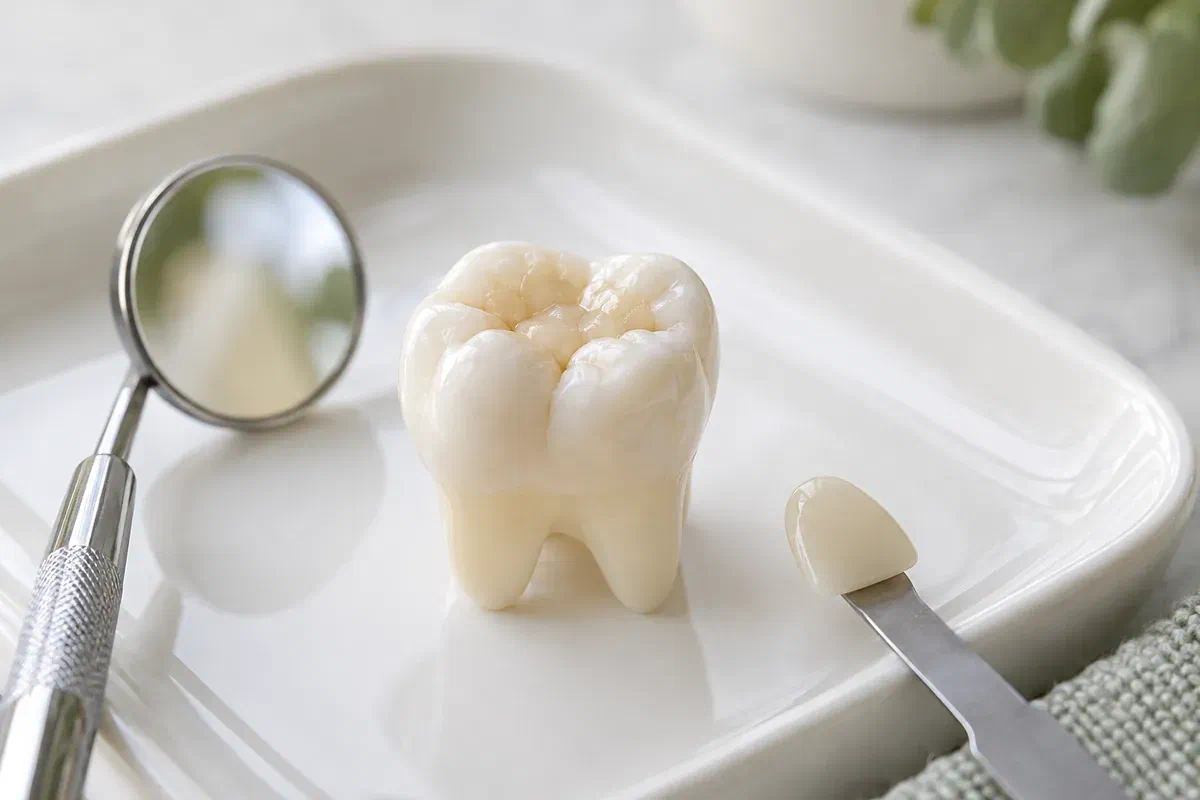
Illustrative patient and clinician reviewing a tooth model and shade samples
Cosmetic Dentistry

Replacement of Discoloured Fillings in Brampton

Years of tea, coffee, or red wine can slowly tint a tooth-coloured front filling until it looks yellow or brown. From Brampton, book an assessment to learn whether the change is surface stain that may polish away or a filling that needs repair, monitoring, or replacing.

Front-tooth fillings that have yellowed

Stain on top, or a change within?

Composite on a front tooth sits right where everyone looks. Over the years, strongly coloured drinks and foods can leave pigment on its surface, and the resin itself can gradually take on a warmer tone. Meanwhile the enamel beside it may lighten or darken on its own schedule. Now and then, a brownish rim turns out to be a leaking edge or early decay.

Surface stain and deeper change call for different responses. A professional polish sometimes refreshes the outer layer well. A chipped or rough corner might be repaired. If the filling is sound and you can live with its look, monitoring is fine. Full replacement drills out the old composite and can take tooth with it, so it should have a clear reason.

When you come in from Brampton, tell us about your daily habits honestly; nobody is judging the coffee. Point to the tooth, describe when its colour changed, and mention any sensitivity. We will explain what we find and why we suggest any treatment, and the choice stays with you.

Ask about a stained front filling
Illustrative molar teaching model with a slightly contrasting composite filling
Details that guide us

A few questions before the exam

These help us separate a cosmetic stain from a filling or tooth that needs care for other reasons. Please mention discomfort, even when appearance is the main concern.

A filling that has gone yellow, brown, or grey

Tell us whether the change was gradual or sudden and whether you have whitened since the filling was done. Smile naturally so we can see what others see. This tells us whether the colour sits on top, within the resin, or in the enamel around it.

A rim that looks stained or feels uneven

Mention a spot your tongue keeps finding or a place where food lodges. The rim is interpreted alongside the filling’s fit and the tooth’s health. Brown lines are often stain, but not always, and a filling without pain may still have a gap.

Sensitivity or a chipped corner

Front fillings can chip when biting into something firm. Describe what triggers any sensitivity and whether it lingers. Mention earlier deep fillings or trauma to the tooth. These findings take priority over shade.

If a back tooth has a dark silver filling, that colour alone is not a sign of failure or harm. Talk about its condition and what removing it would involve before deciding to replace it.

What a stain assessment offers

Sometimes a polish is enough. Sometimes it is not.

We aim for the least invasive response that genuinely fits. If a new filling is recommended, ask what it gains over polishing or a repair. If the current one can stay, we talk about its appearance and how we will keep track of it at regular visits.

Matching a front filling to natural teeth is skilled work, but it has limits. No restoration is promised to vanish in all lighting or keep its exact shade forever. Diet, the material, the remaining tooth, and your cleaning routine all shape how it looks over time.

Patient information: FDI World Dental Federation — assessing repair and replacement of restorations

An honest read on the cause

We will tell you whether the concern is surface stain, a small local defect, a broader problem with the filling, or a problem in the tooth. That finding should lead clearly to any plan. A filling being several years old is not enough of a reason by itself.

A chance to refresh instead of remove

Polishing or refurbishing a composite can sometimes restore much of its look without removal. Repair can also work for a chipped edge. Neither suits every filling, and we will explain the limits and how the tooth will be followed.

A shade plan that fits your habits

Tell us about future whitening, bonding, or other visible work. These affect timing and the material chosen. We also talk about how diet and upkeep influence staining, and the likelihood of future polishing or touch-ups.

Your appointment

From first look to a finished smile line

Polishing, a repair, and a full replacement each involve different steps. Ask which applies and what could change if something unexpected appears.

  1. Study the stain and the tooth

    The dentist examines the filling surface and edges, the surrounding enamel and gums, and the bite where relevant. An X-ray may be suggested if decay is a question. Share your history of sensitivity, chips, whitening, and roughly when the filling was placed.

  2. Decide on the right level of treatment

    We explain whether monitoring, polishing, repair, or replacement suits the tooth. Ask about material choices, realistic shade expectations, risks, and fees. A front tooth with a large, weakened area may need a different restoration discussed.

  3. Treat with care for comfort

    The surface or filling is prepared according to the plan and material. Freezing is used if needed. Let us know whenever you want a break. If more appears once work starts, we pause to explain it and how it changes things.

  4. Shape, polish, and compare the shade

    The finished filling is contoured and polished, then checked against neighbouring teeth and your bite. Ask how it should look in different light and how to care for it. Before leaving, confirm what should settle and whether a review visit is planned.

Keeping it bright

Small habits help a front filling hold its look.

Your instructions depend on what was done and the material placed. Follow the specific advice from your visit, since fillings do not all share the same restrictions.

Wait for the numbness to fade

If freezing was used, avoid biting or hot drinks until feeling returns, and follow the eating advice given. Ask when normal use is fine. A bite that feels off should be adjusted at the clinic, not tested on hard foods.

Rinse after dark drinks and keep cleaning well

A quick rinse with water after tea or coffee can help, along with regular brushing and cleaning between teeth. Ask for tips if the area traps food. A new filling still needs daily care, since the tooth around it can decay.

Raise any colour or comfort concern

Tell the clinic about sensitivity that lingers, worsens, or affects eating. If the shade bothers you after it settles, book a review. Avoid whitening toothpaste scrubbing, abrasive tools, or bleaching gel aimed at the filling.

Approaches for a stained filling

Refresh, mend, or remake

Each approach has benefits and tradeoffs. Weigh the tooth’s health, the existing filling material, and how much the look matters to you.

Best suited to surface stain or an acceptable filling

Polishing, cleaning, or monitoring

A professional polish can lift some surface stain and leave the composite in place. If the filling is sound and you are comfortable with it, monitoring is reasonable too. We will tell you what we check at each visit and which changes warrant coming in sooner.

Suited to one limited problem area

Repairing a chip or a stained corner

A small repair can rebuild one area while keeping the rest of the filling. Whether it works depends on the defect and the material. We describe the expected blend, its limits, and how it will be followed, without calling it either permanent or merely temporary.

Suited to more extensive findings

A new filling or a different restoration

Replacement, or another type of restoration, may be advised when the problem cannot be managed locally. Ask how much tooth would remain, whether sensitivity is possible, and what alternatives exist. A good reason should go beyond the filling’s age.

Patient information: FDA — considerations before removing an existing amalgam filling

Stained filling questions

Answers about yellowed and brown fillings

These help you compare a cosmetic refresh with the realities of changing a filling.

(905) 876-4488
Why has my front filling turned yellow while my teeth have not?
Composite surfaces can absorb pigment and change tone at a different rate from enamel. Your teeth may also have lightened or darkened over time. An examination shows where the colour sits and whether any treatment is needed.
Will a professional polish make a stained composite look new again?
It may improve surface stain noticeably, but deeper discolouration or a defect may not respond. Ask whether your stain is on the surface and what result is realistic before choosing replacement.
Can whitening toothpaste remove stain from a filling?
It is not designed for that, and abrasive scrubbing can roughen a filling’s surface. Ask us before trying products on a restoration. A professional assessment is a better first step.
How do I keep a new front filling from staining?
Rinsing after dark drinks, brushing well, and keeping regular cleanings all help. Some staining over time is still possible. Ask how your material ages and when polishing might be useful in future.
Is a brown line next to my front filling a cavity?
It might be stain, a small gap, or decay. Only an assessment can tell, sometimes with an X-ray. Ask what we found at the edge and why a particular response is suggested.
I am planning whitening. Should I fix the filling first?
Usually it is worth discussing the order first, since fillings do not lighten with bleaching. Ask how to sequence the steps and when your natural shade should be checked. Avoid extra whitening on your own to make a filling match.
Brampton stain assessments

Find out what that stain really is.

Visit our Bronte Street practice to have a yellowed or brown filling assessed. We will explain whether polishing, repair, monitoring, or a new filling makes sense for that tooth, and why.

We do not assume a stained filling needs replacing. The right step and how closely we can match your shade come down to the exam findings, the filling material, and how much tooth remains.

Visit Milton Dental Clinic
Unit 1, 342 Bronte St. S, Milton, ON L9T 5B7
Get directions Clinic hours
Monday–Thursday
11am–7pm
Friday–Sunday
By appointment only

Areas we serve

  • Milton
  • Oakville
  • Mississauga
  • Georgetown
  • Halton Hills
  • Acton
  • Campbellville
  • Brampton
  • Burlington
  • Puslinch
  • Rockwood
  • Erin
  • Caledon
  • Etobicoke
  • Old Milton
  • Bronte Meadows
  • Timberlea
  • Dorset Park
  • Dempsey
  • Clarke
  • Beaty
  • Coates
  • Harrison
  • Scott
  • Willmott
  • Ford
  • Bowes
  • Cobden
  • Walker
  • Mountain View
  • Milton Heights
  • Hawthorne Village
  • Valley View
  • Fallingbrook
  • Nassagaweya
  • Trafalgar
  • Esquesing
  • Nelson
  • Brookville
  • Moffat
  • Glen Williams
  • Norval
  • Limehouse
  • Stewarttown
  • Ashgrove
  • Hornby
  • Silver Creek
  • Speyside
  • Scotch Block
  • North Oakville
  • River Oaks
  • Glen Abbey
  • West Oak Trails
  • Palermo
  • Bronte Creek
  • College Park
  • Joshua Creek
  • Uptown Core
  • Preserve
  • Iroquois Ridge
  • Lisgar
  • Meadowvale
  • Meadowvale Village
  • Churchill Meadows
  • Erin Mills
  • Central Erin Mills
  • Streetsville
  • East Credit
  • Creditview
  • Heartland
  • Sheridan
  • Mount Pleasant
  • Credit Valley
  • Huttonville
  • Churchville
  • Springbrook
  • Northwest Brampton
  • Bram West
  • Fletcher's Meadow
  • Fletcher's Creek South
  • Alton Village
  • Orchard
  • Millcroft
  • Headon Forest
  • Tansley
  • Brant Hills
  • Tyandaga
  • Kilbride
  • Lowville
  • Aberfoyle
  • Morriston
  • Arkell
  • Hillsburgh
  • Freelton
  • Carlisle
  • Waterdown
  • Flamborough
  • Mountsberg

How can we help?

Milton Dental Clinic

Have a question about your smile? Choose the option that works best for you.

For urgent dental concerns, please call.
Messages are reviewed during clinic hours.