

Illustrative patient and clinician discussing smile preferences with a mirror and shade guide
Cosmetic Dentistry

Smile Design in Oakville

Holding a cosmetic proposal you're not sure about? Smile design for people coming from Oakville is a chance to slow down, look at your shade, tooth shape, alignment and oral health, and understand what each suggested step is really for.

Before you say yes

Is the plan in front of you the right size for what you asked?

Sometimes the question isn't what to change, but whether a proposal you've already received makes sense. You may have asked about one chipped tooth and come away with a quote for several. Smile design is the process of working out what you want, what your mouth needs and how the two fit.

It brings several things into one view: the colour and outline of each tooth, where teeth sit, any existing restorations, gum health, and the way you bite and speak. None of that adds up to a single standard procedure. Two people with similar concerns can sensibly end up with very different plans.

From Oakville or anywhere else, you're welcome to come in with notes, an earlier proposal or simply a feeling that something isn't right. We'll help separate your goal from the methods on offer. Taking a smaller step, staging care, seeking another view or choosing no change are all legitimate outcomes.

Arrange a planning consultation
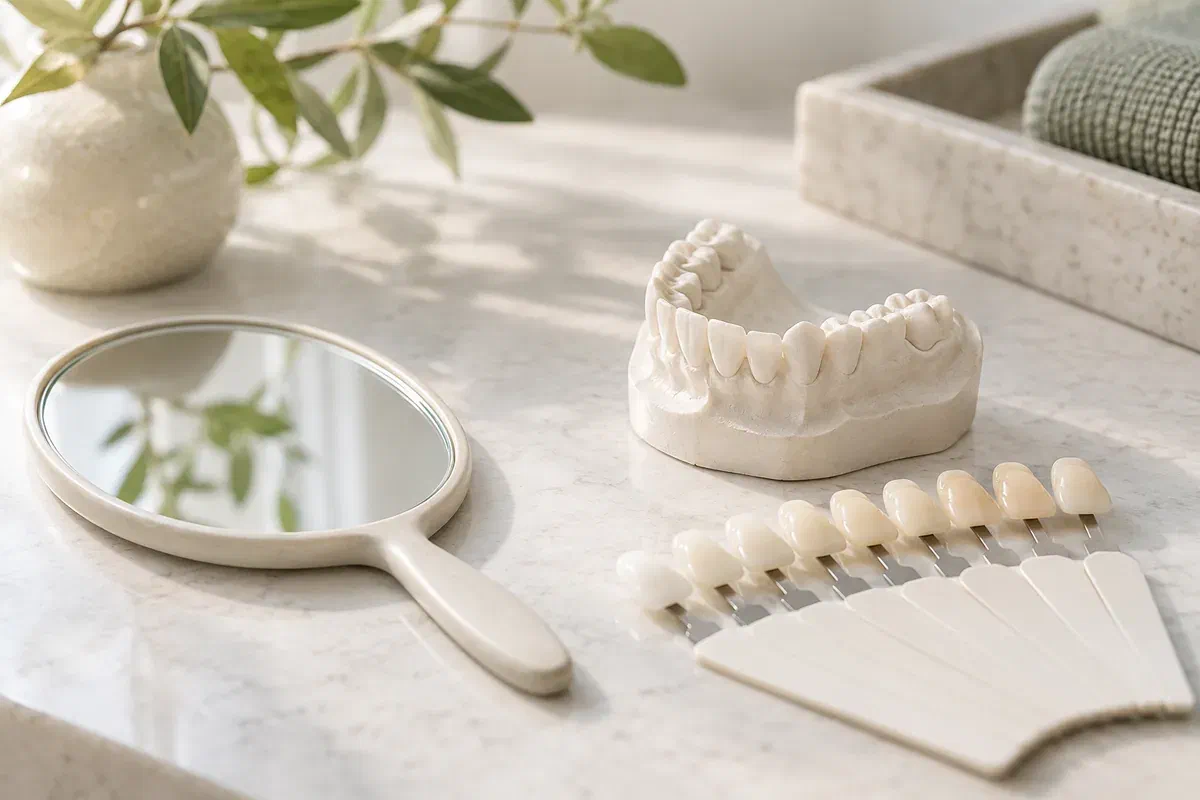
Illustrative consultation mirror, dental study cast, and natural tooth shade samples
Sorting out the concern

Start with what you'd point to in the mirror.

It helps to explain the concern as it shows up day to day, rather than only in a zoomed-in photo. Mention whether appearance, comfort, maintenance or a particular occasion has you thinking about it now.

A small detail with a big proposal attached

If you noticed one edge, shade difference or gap, say so plainly. Ask whether a focused option could deal with it alone. A modest concern doesn't automatically call for reshaping healthy neighbouring teeth or taking on a full cosmetic programme.

Function that's part of the picture

Worn edges, chewing that feels lopsided, sensitivity or a tooth that has started to feel odd are all relevant. Ask how they influence the change you'd like. Planning must account for how your teeth work together, not just a flattering front view.

Worry about looking overdone

Tell us what you'd hate to lose as well as what you'd change. Reference photos can show a style you like, yet another person's proportions and shade might not suit you. Ask how a proposal would keep your smile looking like your own.

Discussing a smile plan does not mean consenting to veneers, whitening, aligners or any procedure. Consent comes later, once that specific treatment, its risks, alternatives and fees have been explained clearly.

Clarity before commitment

Each step should earn its place.

A plan worth following connects every proposed treatment to something specific, either a concern you raised or a finding from the exam. You should be able to say, in your own words, why a step is there. When a plan seems larger than your request, it's fair to ask what justifies the extra work.

Planning makes the long-term side visible too. Number of visits, tooth preparation, cleaning routines, repairs and eventual replacement differ between options. Weighing them early lets you compare the change you'd see against the time, effort and ongoing care involved.

A shared list of priorities

Agree which features matter most and where your limits are. Maybe you want a subtle shade change, to keep a gap that feels like you, or to leave sound teeth unprepared. Clear priorities make it easier to judge whether a proposal matches you.

Reasons behind the order

In a plan with several parts, ask why one stage leads and how the rest depend on it. Some choices are better made after earlier results. You can then review as you go instead of assuming the later stages are already settled.

Honest comparisons

Request the alternatives with their practical differences, including no elective treatment. Look at upkeep and how much natural tooth would be altered, not just the finished look. A clear plan states its limits and uncertainties openly.

What the planning involves

Four stages, at the pace you choose

Records and visit numbers depend on your concerns and the options being considered. Ask what the consultation includes, and whether further assessment or specialist input could be useful.

  1. Explain your goal and any earlier advice

    Describe what you'd like to change, past treatment and any proposal you've already received. Share your timing and the kinds of care you're comfortable with. Photos may help show a preference, but your own teeth remain the reference point.

  2. A full look at health and the bite

    Before recommending anything, the dentist examines your teeth, gums, restorations and bite. Other records may be added where they help. Ask which findings call for care on health grounds and which suggestions are elective, so the two stay distinct.

  3. Compare approaches side by side

    Go through suitable options, the preparation each needs, its limits and its maintenance. If a mock-up, model or photographs are offered, ask what they show and what they can't predict. No particular scanner or preview software is assumed for everyone.

  4. Agree on stages and check-ins

    Settle the treatment, consent, fees and schedule before starting. Where other clinicians are involved, confirm who handles what. Ask when appearance and function will be reviewed and how a new preference or unexpected finding would be managed.

The long view

What will this plan ask of you in ten years?

Smile design is planning; the upkeep belongs to whatever treatments you go on to choose. Ask for maintenance details for each element rather than assuming all cosmetic work needs the same care.

Routines tied to each option

Ask about cleaning, review appointments, and any appliance or product instructions for the treatment proposed. If a routine sounds hard to manage, mention it before you commit. A great preview image is only part of whether a plan suits your daily life.

Monitoring and future repairs

Find out how results are checked and what may need attention later. Where restorations are part of the plan, talk about repair and replacement. Lifespan and fee figures are estimates and responsibilities, not a promise that nothing will change.

Raising problems early

After treatment, let the team know about a rough edge, a bite that feels changed or an area that's tricky to clean. Bring appearance concerns to your review. Please don't file, polish or adjust dental work on your own.

Patient information: British Orthodontic Society — long-term implications of restorative and alignment choices

Matching scope to the concern

A focused fix, a joined-up plan, or no treatment

Recommendations can be one targeted step, a coordinated sequence or nothing elective at all. For each, ask how it responds to the concern you started with.

When the concern is contained

A local change to one feature

Cleaning, whitening, edge repair or another focused option may be considered if suitable. Ask which treatment changes what you actually notice and what it leaves as is. A small plan is a valid choice when it fits both the findings and your expectations.

When several factors combine

Alignment and restorative care considered together

Tooth position, spacing, shade and existing work sometimes need joint planning. Ask whether orthodontic or specialist input would help, and how stages would be coordinated. Each intervention should have a clear purpose rather than arrive as part of a bundle.

When the commitment isn't worth it to you

Watching and keeping what works

Once the options are clear, you may decide a healthy feature can stay as it is. Ask what routine care or monitoring is appropriate. A consultation that ends without cosmetic treatment can still give you useful answers about your oral health.

Oakville smile-design questions

Getting a second view on a cosmetic plan

Ask about the reasoning behind any appearance change, how much treatment it really involves and what you'd be responsible for afterward.

(905) 876-4488
Can you look at a treatment plan I received somewhere else?
Yes. Bring the proposal and any records you have. The dentist will still need to examine you, but can then explain where they agree or see other options. You’re never obliged to choose one plan over another.
Why would two dentists suggest such different numbers of teeth?
Different priorities, assumptions about your goal and readings of the findings can lead to different scopes. Ask each clinician to tie every tooth in the plan to a reason. That makes the comparison about substance, not just totals.
How do I compare two smile-design proposals fairly?
Line up the preparation involved, the alternatives offered, the risks, maintenance and fees, as well as the expected look. Where scope differs, ask why. Taking extra time or another opinion is reasonable if the choice still feels unclear.
Is it possible to change only the teeth that show when I smile?
Sometimes. The dentist will consider which teeth are visible and how a change to them affects the bite and the teeth beside them. Ask what limiting the plan would mean for the look and for function.
Can I keep the slight overlap in my front teeth?
Yes, if that’s your preference. Say which features feel like part of you. The dentist can explain how keeping them relates to health and cleaning. No plan should assume every natural variation needs removing.
What should I ask about veneers before agreeing to them?
Ask how much tooth would be prepared, what the alternatives are, how long they’re expected to last and what maintenance involves. A planning visit doesn’t commit you to veneers; that decision needs its own explanation and consent.
Smile design for Oakville

Bring the proposal, and your doubts.

Book a conversation at our Bronte Street practice about the shade, outline, position or overall look of your teeth. We'll explain the assessment involved and help you understand the reasoning behind a plan that fits you.

Treatment scope, records, previews, timing and fees are decided after assessment. No specific technology, procedure or cosmetic outcome is promised.

Visit Milton Dental Clinic
Unit 1, 342 Bronte St. S, Milton, ON L9T 5B7
Get directions Clinic hours
Monday–Thursday
11am–7pm
Friday–Sunday
By appointment only

Areas we serve

  • Milton
  • Oakville
  • Mississauga
  • Georgetown
  • Halton Hills
  • Acton
  • Campbellville
  • Brampton
  • Burlington
  • Puslinch
  • Rockwood
  • Erin
  • Caledon
  • Etobicoke
  • Old Milton
  • Bronte Meadows
  • Timberlea
  • Dorset Park
  • Dempsey
  • Clarke
  • Beaty
  • Coates
  • Harrison
  • Scott
  • Willmott
  • Ford
  • Bowes
  • Cobden
  • Walker
  • Mountain View
  • Milton Heights
  • Hawthorne Village
  • Valley View
  • Fallingbrook
  • Nassagaweya
  • Trafalgar
  • Esquesing
  • Nelson
  • Brookville
  • Moffat
  • Glen Williams
  • Norval
  • Limehouse
  • Stewarttown
  • Ashgrove
  • Hornby
  • Silver Creek
  • Speyside
  • Scotch Block
  • North Oakville
  • River Oaks
  • Glen Abbey
  • West Oak Trails
  • Palermo
  • Bronte Creek
  • College Park
  • Joshua Creek
  • Uptown Core
  • Preserve
  • Iroquois Ridge
  • Lisgar
  • Meadowvale
  • Meadowvale Village
  • Churchill Meadows
  • Erin Mills
  • Central Erin Mills
  • Streetsville
  • East Credit
  • Creditview
  • Heartland
  • Sheridan
  • Mount Pleasant
  • Credit Valley
  • Huttonville
  • Churchville
  • Springbrook
  • Northwest Brampton
  • Bram West
  • Fletcher's Meadow
  • Fletcher's Creek South
  • Alton Village
  • Orchard
  • Millcroft
  • Headon Forest
  • Tansley
  • Brant Hills
  • Tyandaga
  • Kilbride
  • Lowville
  • Aberfoyle
  • Morriston
  • Arkell
  • Hillsburgh
  • Freelton
  • Carlisle
  • Waterdown
  • Flamborough
  • Mountsberg

How can we help?

Milton Dental Clinic

Have a question about your smile? Choose the option that works best for you.

For urgent dental concerns, please call.
Messages are reviewed during clinic hours.