

Illustrative patient and clinician discussing smile alignment at a consultation desk
Cosmetic Dentistry

Treatment for Crooked Teeth in Mississauga

When meetings, clients or a camera are part of your workday, the question of what you’d wear on your teeth comes up fast. Treatment for crooked teeth in Mississauga starts earlier than that: which positions to change, the state of your gums and bite, and what plan fits your smile overall.

Mississauga · fitting care into a busy week

Start with the teeth, not the appliance.

Many adults arrive with an appliance already in mind, often clear aligners, because of how treatment would look at work. That’s a fair concern, and we’ll get to it. First, though, it helps to name what you’re actually seeing: a rotated incisor, a tooth tucked behind its neighbour, a lower front tooth pushed forward, or an uneven line across the smile.

The appliance question only makes sense once the movement is understood. A single tooth that looks out of place may need space made for it, a change in how it touches adjacent teeth, and a check of the teeth that close against it. A clear plan explains the movement first and the tools second.

From Mississauga, including western neighbourhoods such as Meadowvale and Churchill Meadows, you can share both your concern and your constraints at the first visit. We’ll go through the examination, any records that would help and whether an orthodontic referral is worth having. You’re free to arrive undecided about aligners, braces or cosmetic restorations.

Talk through your concern and your schedule
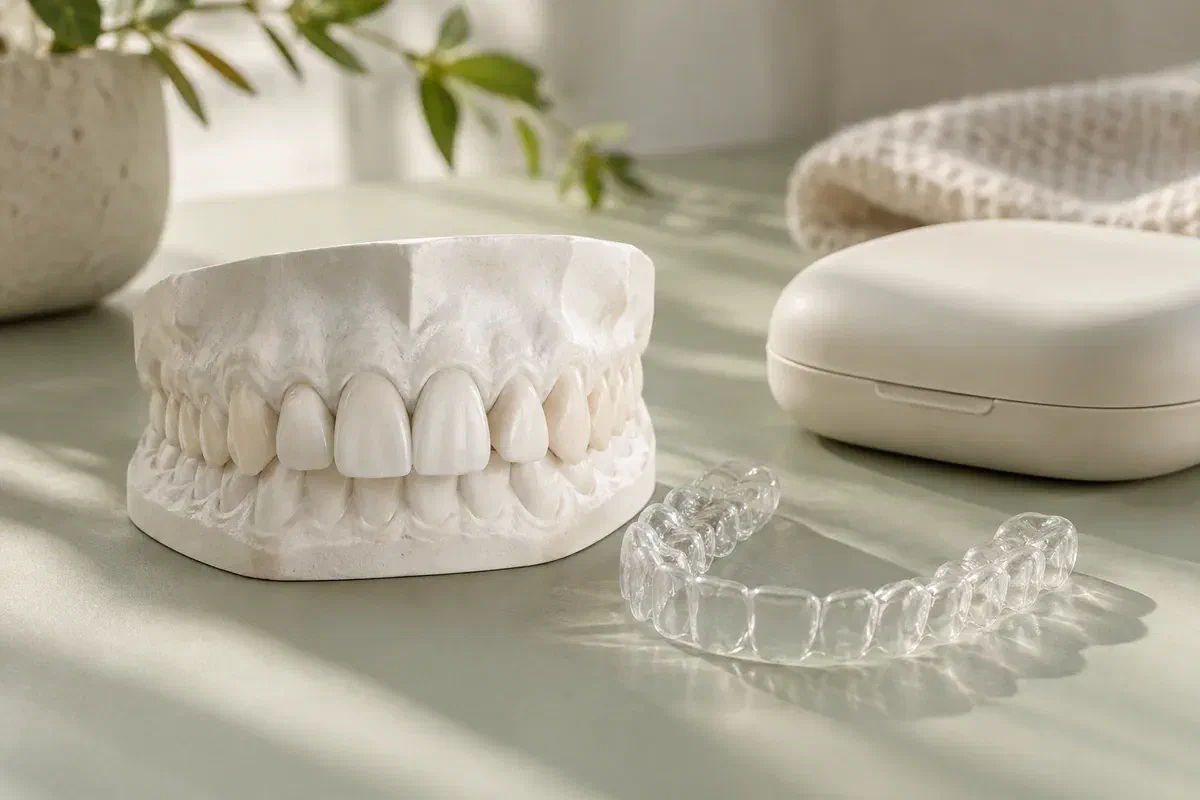
Illustrative dental study cast with a subtly rotated front tooth beside a clear appliance and case
Naming what you see

Not every crooked look comes from position

Show us the feature in a mirror and tell us roughly when it appeared. It may be about alignment, about another dental problem, or about a natural variation that you decide to keep.

A turned or tipped front tooth

Explain which edge or angle you’d alter. Ask whether the appearance mostly reflects where the tooth sits or the shape of the tooth itself. Knowing that helps you compare treatment that moves teeth with treatment that only changes their visible surface, before you weigh up any appliance.

Changes after past braces or aligners

Tell us when your earlier orthodontic care ended, what retention you were given and what you’ve noticed since. Bring old retainers or aligners if you have them. The clinician can talk about whether reassessment is worthwhile and what ongoing retention might involve this time.

A new lean with other signs

Mention looseness, bleeding gums, aching, or a tooth that has begun tipping only recently. Ask whether oral-health issues should be addressed before any movement. A tooth that has started to look crooked lately is not automatically a cosmetic question and deserves a proper check.

The front surface can look tidy while the roots, gum, bone or bite tell a different story. An in-person examination and suitable records come before choosing how to move teeth.

What you gain from a proper plan

An honest match between goal, method and routine

A good plan tells you, in plain language, what treatment is supposed to accomplish. You can ask which teeth would move, whether bite improvements are included and what limits might remain. That way the expected result can be compared with the concern you walked in with, not with a general promise.

It should be just as clear about what the treatment needs from you. Wear time, appointment frequency and maintenance vary between approaches, and some suit a packed calendar better than others. A sensible plan takes that into account and gives you space to decide whether the gain is worth the commitment.

Patient information: British Orthodontic Society — defining limited treatment goals and responsibilities

A narrow plan or a broader one

Ask whether the proposal is confined to the visible teeth or reaches into the overall bite. Discuss what a smaller plan may give up and why a larger one could be advised. Settle the scope before comparing duration or fees, so the comparison is fair.

An appliance that fits your days

Describe what matters most: being discreet, being able to remove it for presentations or meals, the effort involved, and your social routine. Ask how those preferences line up with the movements required. The right appliance suits the plan and asks for habits you can keep.

Alignment alongside cosmetic work

If bonding, crowns, implants or new restorations are on your list, raise them before alignment is decided. Ask whether moving teeth would change the order or design of that work. A combined sequence shows which choices should wait for the teeth to be assessed or moved.

Four stages

From “I’d like to fix this” to a plan you understand

The outcome of an assessment can be treatment, more information, a referral or monitoring. Ask what happens at the first visit and which choices will need a second conversation.

  1. Your concern and timeline

    Say which positions bother you and whether the change is recent or longstanding. Cover previous orthodontics, injuries, restorations and how you’ve used retainers. If a deadline matters, mention it, but focus on what improvement would be worthwhile rather than on a promised completion date.

  2. Examination and records

    The clinician examines your teeth, gums and bite and considers which records would clarify the alignment. Ask about anything that affects whether movement is advisable. If gum treatment or other care comes first, ask how that fits in and when you’ll be reassessed.

  3. Options, risks and what stays the same

    Go through the planned movements, appliance choices, your responsibilities, risks and alternatives. Ask which features the plan won’t change and whether a referral would help. A preview can support planning, but it is not a guarantee of exact positions or timing.

  4. Reviews, then retention

    Progress is checked against the agreed aims, and the plan may be adjusted. Let the team know about wear issues, discomfort or a damaged appliance. At the end, confirm your retainer routine and how any later shifting will be reviewed.

Keeping treatment on course

Routines that survive a busy calendar

Your instructions will depend on the appliance and the stage of treatment. When something becomes hard to manage, ask for help rather than reworking the plan yourself.

Wear time and appointments

Confirm how removable aligners, elastics or other prescribed parts should be used. If travel or long days make the schedule unrealistic, tell the clinician before moving on to the next stage. Lost aligners or missed wear call for specific guidance, not a homemade catch-up plan.

Routine care still counts

Ask how to keep the appliance and the spaces between teeth clean as positions shift. Stay on top of recommended checkups and preventive appointments. Progress reviews focus on alignment and may not cover everything else, so confirm who checks what.

Retainers for the long run

Follow your personal retainer instructions, and arrange a check whenever the fit starts to change. A case in your bag keeps retainers safe during lunch or travel; take them to appointments when requested. If a tooth starts to rotate back, ask for advice rather than squeezing into an old appliance.

Patient information: British Orthodontic Society — ongoing retention responsibilities

Possible routes

Three paths, each with different trade-offs

Ask how each option deals with the underlying position and the appearance you’re aiming for. Compare preparation, time, maintenance and limits before deciding.

When changing positions is the answer

Orthodontic tooth movement

Aligners, fixed braces or other orthodontic options may be discussed after assessment. Ask which movements are included and how your bite is considered. Sometimes the plan reaches well beyond the tooth that caught your attention, and you should understand that scope before starting.

When shape contributes to the look

A cosmetic surface change

In suitable cases, bonding or contouring can improve how a tooth appears without moving it. Ask what the approach can and can’t achieve and whether it affects healthy enamel. A disguised tooth keeps its original alignment and bite.

When more information is the next step

Referral, monitoring or no change

A specialist opinion can help with a complex case, or you might decide the current look is acceptable. Ask what to keep an eye on and how to maintain oral health. Choosing to keep a natural variation can be a well-informed decision.

Practical questions

Straightening around work, meals and meetings

The visible size of a concern doesn’t determine the size of the treatment. These questions connect what you notice to what an assessment examines.

(905) 876-4488
Can I take aligners out for an important meeting or meal?
Removable aligners are designed to come out for eating and cleaning, but they only work when worn as prescribed. Ask how many hours a day your plan requires and what to do on days when that’s difficult. Regularly cutting wear short can slow or alter progress.
Are fixed braces ever a better choice than aligners for adults?
For some movements, yes. The right appliance depends on what needs to move and how. Ask why one option is recommended over another, and how each would affect your appearance, your routine and the number of appointments.
How often will I need appointments during treatment?
That varies with the appliance and the plan. Ask for a likely pattern of visits once you’ve been assessed. Weekday appointments run until 7pm Monday through Thursday, and weekend times can be arranged on request, which may help if your office hours are long.
Is treating a single crooked tooth always a small job?
Not always. A tooth’s position is tied to its neighbours, the available space and the bite. Ask which teeth would be involved and why. Even a focused concern may call for a wider plan, or at least a clear account of what a smaller approach leaves as it is.
Will alignment fix the uneven edges of my front teeth?
Moving teeth changes their position, not the outline of worn or chipped edges. Ask how the edges may look after alignment and whether any reshaping would be a separate choice later. You may find they need nothing further, but that’s a decision to make once the teeth have moved.
Does a consultation commit me to treatment?
No. The assessment is there to help you understand the findings and options. Ask questions, take time to think, and decide whether any plan is right for you before agreeing to start.
Planning from Mississauga

Get the findings first, then choose the appliance.

Choose a time at our Bronte Street practice and bring the tooth, or teeth, that keep catching your eye. We’ll work out what information is needed to weigh up suitable care, give you a realistic sense of scope, and say so when an orthodontist’s view would add something.

Your suitability, the appliance that fits, and how long and how much it would be are confirmed only after examination. A limited-looking concern may still call for a wider plan.

Visit Milton Dental Clinic
Unit 1, 342 Bronte St. S, Milton, ON L9T 5B7
Get directions Clinic hours
Monday–Thursday
11am–7pm
Friday–Sunday
By appointment only

Areas we serve

  • Milton
  • Oakville
  • Mississauga
  • Georgetown
  • Halton Hills
  • Acton
  • Campbellville
  • Brampton
  • Burlington
  • Puslinch
  • Rockwood
  • Erin
  • Caledon
  • Etobicoke
  • Old Milton
  • Bronte Meadows
  • Timberlea
  • Dorset Park
  • Dempsey
  • Clarke
  • Beaty
  • Coates
  • Harrison
  • Scott
  • Willmott
  • Ford
  • Bowes
  • Cobden
  • Walker
  • Mountain View
  • Milton Heights
  • Hawthorne Village
  • Valley View
  • Fallingbrook
  • Nassagaweya
  • Trafalgar
  • Esquesing
  • Nelson
  • Brookville
  • Moffat
  • Glen Williams
  • Norval
  • Limehouse
  • Stewarttown
  • Ashgrove
  • Hornby
  • Silver Creek
  • Speyside
  • Scotch Block
  • North Oakville
  • River Oaks
  • Glen Abbey
  • West Oak Trails
  • Palermo
  • Bronte Creek
  • College Park
  • Joshua Creek
  • Uptown Core
  • Preserve
  • Iroquois Ridge
  • Lisgar
  • Meadowvale
  • Meadowvale Village
  • Churchill Meadows
  • Erin Mills
  • Central Erin Mills
  • Streetsville
  • East Credit
  • Creditview
  • Heartland
  • Sheridan
  • Mount Pleasant
  • Credit Valley
  • Huttonville
  • Churchville
  • Springbrook
  • Northwest Brampton
  • Bram West
  • Fletcher's Meadow
  • Fletcher's Creek South
  • Alton Village
  • Orchard
  • Millcroft
  • Headon Forest
  • Tansley
  • Brant Hills
  • Tyandaga
  • Kilbride
  • Lowville
  • Aberfoyle
  • Morriston
  • Arkell
  • Hillsburgh
  • Freelton
  • Carlisle
  • Waterdown
  • Flamborough
  • Mountsberg

How can we help?

Milton Dental Clinic

Have a question about your smile? Choose the option that works best for you.

For urgent dental concerns, please call.
Messages are reviewed during clinic hours.