

Illustrative patient discussing tooth crowding with a clinician and dental study model
Cosmetic Dentistry

Treatment for Crowded Teeth in Oakville

Seen an aligner advert and wondered if it would sort out your overlapping teeth? From Oakville, you can book an assessment that starts with space, bite and gum health, so the choice of appliance comes after the facts rather than before them.

Planning crowding care from Oakville

The appliance is the last decision, not the first.

It is natural to start by asking about clear aligners or braces. A better first question is how much space your teeth are short of. Crowding means the arch cannot hold every tooth in a tidy line, so some rotate, overlap or sit in front of or behind the row. How the upper teeth meet the lower ones adds another layer.

Once that is understood, the rest of the plan has something to rest on. You can ask where room would be gained, which teeth would travel and how far, and whether the gums and bone around them are healthy enough. Settling on a product before answering those points tends to blur what the treatment will actually do.

Tell us which part concerns you most: the look, cleaning access, a bite that seems to be changing, or overlap that returned after orthodontics. We can describe the assessment, say when an orthodontist’s input is wise, and set out the scope clearly so you can decide before any active care begins.

Book a space-first assessment
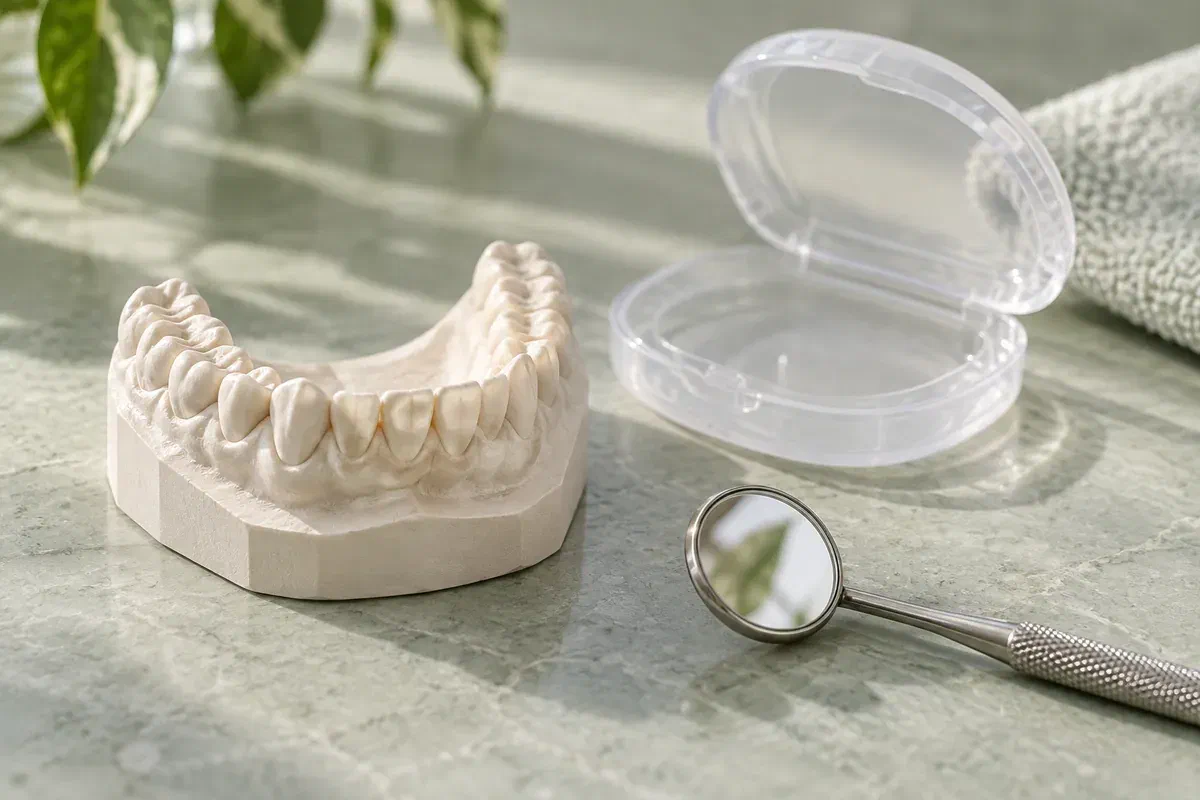
Illustrative lower dental study cast with mild front-tooth overlap beside a case and mirror
Everyday clues

Crowding tends to announce itself in small ways.

Share what you have spotted and what you would like treatment to change. A similar-looking overlap can belong to quite different space and bite situations.

Floss that frays or food that lodges

Show us the contacts that give you trouble. You can leave with cleaning tips that help straight away, whatever you decide about alignment. Gum inflammation and other active problems need attention before any appliance is considered.

A tooth that breaks the line of the smile

Tell us whether it has always been out of line or has moved lately. We look at how it sits beside its neighbours and against the opposite arch. Planning has to account for the room it needs, not just the way it looks in a photo.

Relapse after childhood or teen orthodontics

Bring old retainers if you have them and describe how you used them. We can talk about what has shifted and whether you would like to hold the current position or correct it. Making a new retainer and moving teeth again are separate goals.

If the overlap is changing fast, or you notice a loose tooth, bleeding, pain or a gap opening elsewhere, say so when you book. Those findings should be checked rather than assumed to be ordinary crowding.

What you gain from asking first

Clarity about space makes every option easier to compare.

When the space picture is clear, the conversation about treatment becomes much simpler. You learn roughly how far teeth would move, which ones are involved and what the change should improve. The recommended method is then tied to your examination, rather than to the hope that one system fits every crowded mouth.

You can also test the commitment against your week. Appliance wear, cleaning, visits and retention each take time. For households coming from Oakville, it helps to know how many reviews to expect. A workable plan is honest about the effort involved and about anything it will not change.

A space strategy you can repeat back

Ask how room will be made or used, and why that approach suits your teeth and bite. If enamel reduction, extraction, expansion or another measure comes up, request its purpose and alternatives in plain terms. It should never sit in the plan unexplained.

A goal that includes contacts and cleaning

Talk about how the finished positions would affect the way teeth touch, how easy they are to clean and the rest of the arch. Ask whether the plan is limited or comprehensive. Knowing what will not change helps you judge if the result answers your real concern.

Retention agreed in advance

Ask about retainers before you start: wear, cleaning, reviews and who replaces a lost one. Holding the new positions is part of the result, not an add-on at the end. Include that long-term step when you compare one approach with another.

What happens, step by step

Four stages, starting with a look at the whole arch.

Records, visit numbers and suitable options depend on how much crowding there is and what we find. Ask who plans, provides and checks each stage of care.

  1. Your concern and dental background

    Describe the overlap, how it has changed and what you hope for. Mention previous orthodontics, missing teeth, restorations and planned dental work. If we ask, bring existing retainers or records, which help us understand your starting point.

  2. A full examination of both arches

    We review upper and lower teeth together with the gums and bone that hold them. Suitable records may be suggested to show positions and space. Ask what each record tells us and whether gum or restorative care should be completed before teeth are moved.

  3. Options for movement and for space

    Go through the proposed appliance, the way space would be handled, risks, alternatives and your role. Ask how the plan changes if you turn down one part. If a specialist referral is suggested, find out how it works and who coordinates any related dental treatment.

  4. Reviews, then retention

    Keep the planned review appointments and report appliance or cleaning problems. Ask how progress is checked and what could change the schedule. Before finishing, confirm the retention plan and what to do if a retainer goes missing or no longer fits.

While teeth are moving

Most of the progress happens at home.

Stick to the instructions for the appliance and plan prescribed for you. Another person’s schedule, or an old appliance used to catch up after missed wear, can set treatment back.

Ask for help with awkward areas

Request a demonstration of cleaning around overlapping teeth and any attachments. Keep up routine dental visits as well as orthodontic reviews. If bleeding, deposits or discomfort make cleaning hard, raise it early so the advice can be adjusted.

Report a problem instead of improvising

Tell the treating clinician about a broken attachment, an aligner that does not seat or a wear routine you are struggling with. Ask what to do next rather than switching stages on your own. Accurate updates help each review match what really happened.

Treat the retainer as part of the result

After active movement, wear and care for retainers as instructed and attend recommended checks. Get in touch with the responsible provider if one is lost, damaged or uncomfortable. New overlap means it is time to ask, not to force an older appliance back in.

Patient information: British Orthodontic Society — retainers and maintaining tooth positions

Approaches worth comparing

What fits depends on how much room is needed and where it comes from.

Ask why a recommendation suits your crowding and what it gives up. Compare whole plans, not just which appliance is least visible.

When teeth genuinely need to move

Aligners or fixed appliances, if suitable

The appliance considered depends on the movements required and clinical suitability. Ask about daily responsibilities, monitoring and realistic limits. A wish for removable or discreet treatment is worth sharing, though it does not settle suitability by itself.

When alignment depends on finding room

A defined step to create or manage space

Some plans include carefully selected measures to make space. Ask what is proposed, whether it is reversible and how an alternative would differ. Enamel reduction or extraction should be explained and consented to within the whole plan, never booked as a quick shortcut.

When timing, complexity or preference shapes what is next

Keep watching, or seek a specialist view

You might want more information first, or choose to keep your teeth as they are. For children, growth and erupting teeth also affect timing. Ask what to monitor and when a reassessment would be sensible if you decide to wait.

Patient information: British Orthodontic Society — planned interproximal reduction

Before you choose an appliance

Questions worth asking about crowded teeth.

Answers depend on the examination, space, bite and oral health. Overlap you can see does not, on its own, show what treatment is needed.

(905) 876-4488
Should I order aligners online for crowded teeth?
Treatment without an in-person examination can miss gum problems, decay or bite issues that affect suitability. Ask for an assessment of your teeth and supporting tissues first, and make sure someone is responsible for monitoring the movement.
What records might be taken at a crowding assessment?
Photographs, scans, impressions or X-rays may be recommended depending on what the clinician needs to see. Ask what each record is for and how it will inform the plan. Not everyone needs the same set.
How many visits should I expect from Oakville?
That depends on the plan, the appliance and how often progress needs checking. Ask for an outline of review appointments at the start so you can plan around work and school, and ask which problems can be discussed by phone first.
Is crowding only a cosmetic concern?
For some people it is mainly about appearance; for others, cleaning access or the bite matters more. An examination helps sort out which applies to you. Ask what the findings mean for your oral health as well as your smile.
Does fixing upper crowding mean treating the lower teeth too?
Often both arches need to be considered because they work together as a bite. Ask which changes are proposed in each and whether treating only one arch would leave compromises you should understand first.
Why do retainers matter so much after alignment?
Teeth may move after active treatment ends, so retention belongs in the plan from day one. Ask about the retainer type, wear schedule and reviews recommended for you. Straight teeth at the final adjustment still need that ongoing support.
Coming in from Oakville

Ask the space questions first. We will help you answer them.

Book an assessment at our Bronte Street practice to discuss crowding, cleaning trouble and the change you are hoping for. We will explain what information is needed to compare suitable options and whether an orthodontic referral makes sense.

Appliance suitability, space management, treatment scope, timing and fees depend on individual assessment. We cannot guarantee a particular system or an extraction-free result.

Visit Milton Dental Clinic
Unit 1, 342 Bronte St. S, Milton, ON L9T 5B7
Get directions Clinic hours
Monday–Thursday
11am–7pm
Friday–Sunday
By appointment only

Areas we serve

  • Milton
  • Oakville
  • Mississauga
  • Georgetown
  • Halton Hills
  • Acton
  • Campbellville
  • Brampton
  • Burlington
  • Puslinch
  • Rockwood
  • Erin
  • Caledon
  • Etobicoke
  • Old Milton
  • Bronte Meadows
  • Timberlea
  • Dorset Park
  • Dempsey
  • Clarke
  • Beaty
  • Coates
  • Harrison
  • Scott
  • Willmott
  • Ford
  • Bowes
  • Cobden
  • Walker
  • Mountain View
  • Milton Heights
  • Hawthorne Village
  • Valley View
  • Fallingbrook
  • Nassagaweya
  • Trafalgar
  • Esquesing
  • Nelson
  • Brookville
  • Moffat
  • Glen Williams
  • Norval
  • Limehouse
  • Stewarttown
  • Ashgrove
  • Hornby
  • Silver Creek
  • Speyside
  • Scotch Block
  • North Oakville
  • River Oaks
  • Glen Abbey
  • West Oak Trails
  • Palermo
  • Bronte Creek
  • College Park
  • Joshua Creek
  • Uptown Core
  • Preserve
  • Iroquois Ridge
  • Lisgar
  • Meadowvale
  • Meadowvale Village
  • Churchill Meadows
  • Erin Mills
  • Central Erin Mills
  • Streetsville
  • East Credit
  • Creditview
  • Heartland
  • Sheridan
  • Mount Pleasant
  • Credit Valley
  • Huttonville
  • Churchville
  • Springbrook
  • Northwest Brampton
  • Bram West
  • Fletcher's Meadow
  • Fletcher's Creek South
  • Alton Village
  • Orchard
  • Millcroft
  • Headon Forest
  • Tansley
  • Brant Hills
  • Tyandaga
  • Kilbride
  • Lowville
  • Aberfoyle
  • Morriston
  • Arkell
  • Hillsburgh
  • Freelton
  • Carlisle
  • Waterdown
  • Flamborough
  • Mountsberg

How can we help?

Milton Dental Clinic

Have a question about your smile? Choose the option that works best for you.

For urgent dental concerns, please call.
Messages are reviewed during clinic hours.