

Illustrative patient and clinician reviewing natural tooth shades for an existing veneer concern
Cosmetic Dentistry

Veneer Replacement in Caledon

A worn veneer is rarely the only thing going on in a mouth that has had years of dental work. For adults in Bolton and across Caledon, we look at the veneer, the tooth under it, and the crowns, fillings, or other plans nearby, so any repair or replacement fits the bigger picture.

One restoration among many

Plan the veneer with the rest of your mouth in mind

By midlife and beyond, many smiles carry a mix of work: a crown here, a large filling there, perhaps a bridge or an implant, and a veneer or two on the front teeth. When one veneer starts to chip or discolour, it makes sense to consider how it fits with everything around it, and with any treatment you already have planned.

That broader view can change the answer. Sometimes a modest polish or repair is enough for now, especially if other work nearby is coming up. A sound veneer that has lifted might be rebonded. In other cases, replacing it alongside a neighbouring crown helps match shade and shape, or a different restoration suits the tooth better.

Living in Caledon, you may prefer fewer, well-planned appointments. Bring a list of recent or planned dental work, any records you can find, and what you know about when the veneer was placed. If it comes off, store it carefully in a small container and phone before your visit so you can be advised on protecting the tooth.

Review a veneer within your wider plan
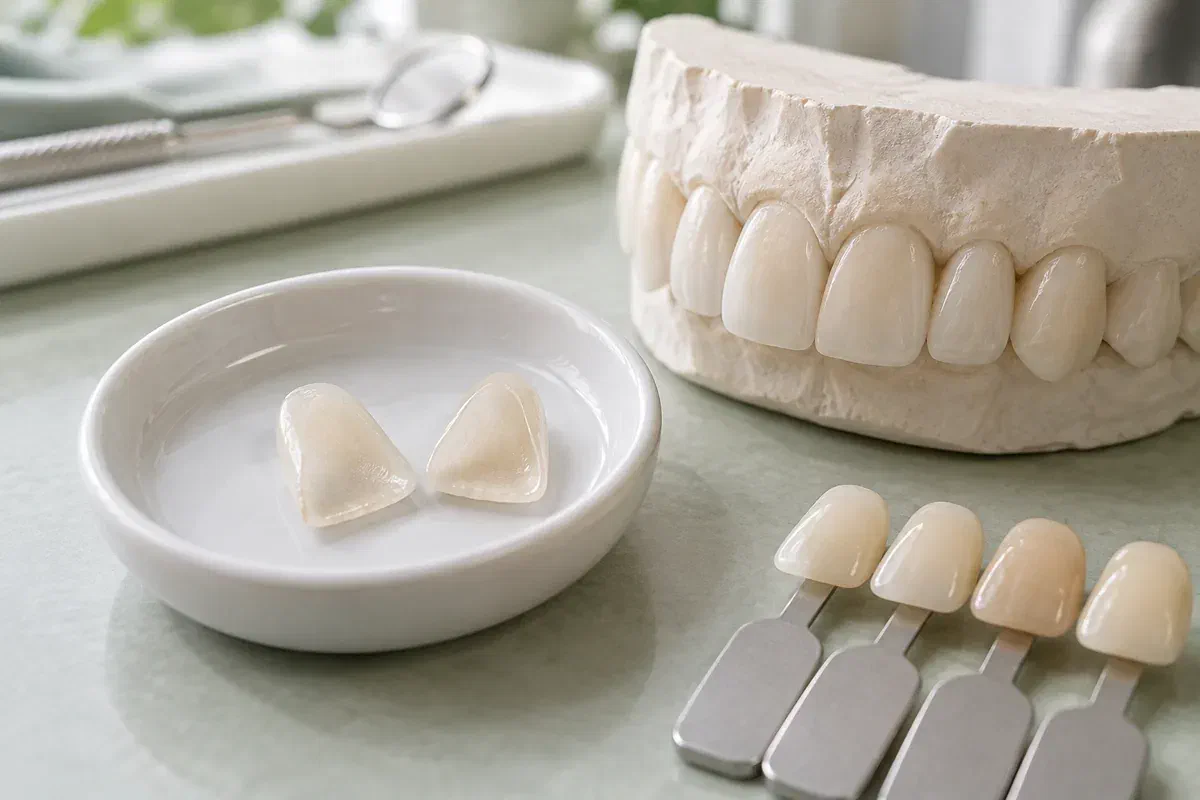
Illustrative thin ceramic veneer samples in a dish beside a dental cast and shade guide
Changes you may have spotted

Damage, shade drift, and comfort, each in context

The veneer's age is one detail among several. Let us know when the change began, whether an injury or hard bite preceded it, what other dental work is nearby, and how you'd like your smile to look.

A cracked, chipped, or loosened veneer

Ring the clinic and describe the break, any sharpness, and your comfort level. Save a detached piece in a protective container. Ask how to manage until your visit, and keep household glue and nail files well away.

Colour that no longer suits nearby crowns or teeth

Point out whether the difference is with natural teeth, a nearby crown, or both, and whether it developed slowly. The source might be the veneer, its margin, or the surrounding restorations. A visible mismatch is worth discussing, but it doesn't settle whether replacement is right.

Sensitivity, gum changes, or an altered bite

Mention cold sensitivity, chewing discomfort, receding or sore gums, or a bite that feels different since other work was done. These need examination. The tooth, gums, or bite may need attention before any new veneer is planned.

A veneer depends on the natural tooth beneath it, which can still develop decay, cracks, or gum recession over the years. Replacement planning considers that tooth's health and structure along with the work around it.

The advantage of a joined-up plan

Sequence the work so each step supports the next.

An assessment explains what's happening with the veneer and whether a conservative approach could manage it for now. It also shows how the decision relates to other planned treatment. You can ask whether a repair would be sensible while other work is completed, and what replacing the veneer would mean for the tooth.

If a new veneer is the right step, planning considers its look alongside neighbouring crowns and natural teeth, as well as the bite and cleaning access. Coordinating shade and shape across several restorations can be easier when they're planned together rather than one at a time over years.

Patient information: FDI World Dental Federation — evaluating repair before total replacement

Clear reasons for the timing

Ask why the veneer should be treated now, later, or alongside other work. If a smaller step is advised as a stopgap, ask how long it's expected to serve. Understanding the tradeoffs helps you plan treatment and budget.

A consistent shade across your restorations

Tell the dentist whether you'd like to keep your current shade or change it. Ask how the veneer will be matched to nearby crowns and teeth, and whether whitening would be discussed first. Including other teeth is a separate choice.

Attention to bite and wear

Ask whether changes in your bite, wear, clenching, or recent dental work have affected the veneer. Find out how the overall plan responds. Replacing the veneer without considering these may not hold up as well.

Fitting it into a treatment plan

How the steps are usually arranged

The appointment count depends on the veneer material, what's found, the restoration chosen, and how it fits with other work. Ask what the assessment covers, whether temporaries or lab time are likely, and how fees for each part are set.

  1. Take stock of the veneer and nearby work

    Share the veneer's history and any other treatment done or planned. Records help. The dentist examines the veneer, its margins, neighbouring restorations, your bite, and the gums, and may recommend additional investigation.

  2. Decide on order and approach

    Discuss whether monitoring, polishing, repair, or rebonding suits the veneer for now, or whether replacement should be coordinated with other work. Ask about preparation, possible findings underneath, and alternative restorations.

  3. Prepare and match the restoration

    When the time comes, the old veneer is managed as planned and the tooth rechecked. Shade, shape, and records are discussed with neighbouring crowns and teeth in view. Ask about any temporary and the appointment sequence.

  4. Fit, check, and review the overall plan

    At the appropriate stage before final bonding, you'll see the fit and appearance. Afterward, the bite and finish are checked and care explained. Ask when to return and how the next stages of your wider plan will follow.

Looking after a mouth with several restorations

Routine care that protects every piece of work

Advice may differ for a temporary, a repaired veneer, a new veneer, and nearby crowns or bridges. Check which instructions apply and whom to call if something changes.

Protect temporaries while work continues

Ask about foods to avoid, how to clean around any temporary, and what to do if it loosens. Keep the clinic's number handy and call before your next appointment if something comes up. Don't try to recement anything at home.

Clean around every margin

Follow the brushing and interdental routine recommended for you, including around crowns, bridges, and veneers. If floss catches, food traps, or a gum is sore, mention it. Routine exams and cleanings help catch changes early.

Reduce strain and stay alert to changes

Avoid biting very hard foods or using teeth as tools. If clenching, grinding, or wear is a concern, ask about protection. Report a bite change, looseness, or ongoing sensitivity rather than waiting for the next stage of treatment.

Options in a wider context

Hold, replace, or rethink the tooth

Compare the veneer material, the defect, the tooth's condition, nearby restorations, and your goals. Ask how each option preserves natural tooth and fits with the rest of your plan.

When keeping the veneer suits the overall plan

Polish, repair, or rebond for now

A limited concern may be managed without replacement, depending on findings and other planned work. Ask what this achieves, how long it's expected to serve, and when it should be reviewed. It still needs assessment and isn't permanent.

When replacement fits the tooth and the timeline

A new veneer coordinated with nearby work

Discuss material, preparation, shade, contour, and maintenance, and how the veneer will match neighbouring crowns or teeth. Ask whether it's a single replacement or part of a staged plan. Each restoration should be assessed individually.

When the tooth needs more than a veneer

A crown, other restoration, or referral

If the tooth has extensive damage or another clinical issue, a different restoration or specialist care may be better. Ask what's suggested, why, and what it involves. The type of veneer you had before doesn't limit the options.

Caledon veneer questions

Veneers, crowns, and planning ahead

Bring what you know about your veneer and other dental work, plus your goals. The assessment clarifies whether replacement is appropriate and how it might fit your wider plan.

(905) 876-4488
Should my veneer be replaced at the same time as a nearby crown?
Sometimes planning them together helps match shade and shape. In other cases, it’s reasonable to treat them separately. Ask the dentist what makes sense for your teeth and timeline.
Can a veneer be matched to an existing crown?
The aim is a close match, but different materials and ages can make it challenging. Ask how shade will be checked, and what options exist if a match isn’t close enough.
My gums have receded around a veneer. Does it need replacing?
Not necessarily. Recession can expose the margin or root surface, and treatment depends on the cause and your concerns. Ask whether gum care, monitoring, or a restoration change is suggested.
Is it worth doing a temporary repair if more work is planned?
It can be, if a repair or polish manages the concern until a coordinated plan is ready. Ask what it would achieve and how it affects later options.
Will whitening affect how my veneer and crowns match?
Whitening products lighten natural teeth but not veneers or crowns. If you’re considering whitening, it’s usually discussed before shades of new restorations are chosen.
From Caledon, can a staged plan be organised to reduce visits?
Ask when planning. Some steps can be grouped, though timing depends on the findings, lab work, and how each stage needs to heal or settle.

Patient information: Canadian Dental Association — bleaching and existing restorative materials

Booking from Caledon

One veneer, considered as part of the whole.

Speak with our Bronte Street team if a veneer has chipped, loosened, or stopped matching the work around it. We'll examine it with the tooth beneath and nearby restorations, then explain repair, replacement, or other care in the context of your overall plan.

Options, preparation, temporaries, sequencing, and fees are confirmed after examination. A new veneer or exact match to crowns or natural teeth can't be guaranteed in advance.

Visit Milton Dental Clinic
Unit 1, 342 Bronte St. S, Milton, ON L9T 5B7
Get directions Clinic hours
Monday–Thursday
11am–7pm
Friday–Sunday
By appointment only

Areas we serve

  • Milton
  • Oakville
  • Mississauga
  • Georgetown
  • Halton Hills
  • Acton
  • Campbellville
  • Brampton
  • Burlington
  • Puslinch
  • Rockwood
  • Erin
  • Caledon
  • Etobicoke
  • Old Milton
  • Bronte Meadows
  • Timberlea
  • Dorset Park
  • Dempsey
  • Clarke
  • Beaty
  • Coates
  • Harrison
  • Scott
  • Willmott
  • Ford
  • Bowes
  • Cobden
  • Walker
  • Mountain View
  • Milton Heights
  • Hawthorne Village
  • Valley View
  • Fallingbrook
  • Nassagaweya
  • Trafalgar
  • Esquesing
  • Nelson
  • Brookville
  • Moffat
  • Glen Williams
  • Norval
  • Limehouse
  • Stewarttown
  • Ashgrove
  • Hornby
  • Silver Creek
  • Speyside
  • Scotch Block
  • North Oakville
  • River Oaks
  • Glen Abbey
  • West Oak Trails
  • Palermo
  • Bronte Creek
  • College Park
  • Joshua Creek
  • Uptown Core
  • Preserve
  • Iroquois Ridge
  • Lisgar
  • Meadowvale
  • Meadowvale Village
  • Churchill Meadows
  • Erin Mills
  • Central Erin Mills
  • Streetsville
  • East Credit
  • Creditview
  • Heartland
  • Sheridan
  • Mount Pleasant
  • Credit Valley
  • Huttonville
  • Churchville
  • Springbrook
  • Northwest Brampton
  • Bram West
  • Fletcher's Meadow
  • Fletcher's Creek South
  • Alton Village
  • Orchard
  • Millcroft
  • Headon Forest
  • Tansley
  • Brant Hills
  • Tyandaga
  • Kilbride
  • Lowville
  • Aberfoyle
  • Morriston
  • Arkell
  • Hillsburgh
  • Freelton
  • Carlisle
  • Waterdown
  • Flamborough
  • Mountsberg

How can we help?

Milton Dental Clinic

Have a question about your smile? Choose the option that works best for you.

For urgent dental concerns, please call.
Messages are reviewed during clinic hours.