

Illustrative patient and clinician reviewing natural tooth shades for an existing veneer concern
Cosmetic Dentistry

Veneer Replacement in Erin

Floss that snags on one veneer, a gum that bleeds in the same spot, or a faint rough edge you notice while brushing can be the first sign that an older restoration needs a look. From Erin or Hillsburgh, an examination of the veneer and tooth helps decide between care at home, repair, or a new veneer.

Clues from your daily routine

Your toothbrush and floss often notice first.

Most changes around a veneer are subtle. You might find floss shredding at one particular gap, a ridge where the veneer meets the tooth, or a patch of gum that's always a bit pink after brushing. These small signs are worth mentioning, because they can relate to the veneer's edge, plaque build-up, the gum, or the tooth under it.

That doesn't mean the veneer has to go. A margin that catches floss might be smoothed or polished, a small defect repaired, and gum irritation can sometimes improve with a change in cleaning technique. When the veneer or tooth has a larger problem, rebonding, a new veneer, or a different restoration might come into the discussion.

If you're coming from Erin, it's helpful to note how long the sign has been there and what you've already tried at home. Mention when the veneer was placed, if you know, and any repairs. Should it loosen or come off, keep it in a small container and call so the team can advise before any further preparation.

Ask about changes around a veneer
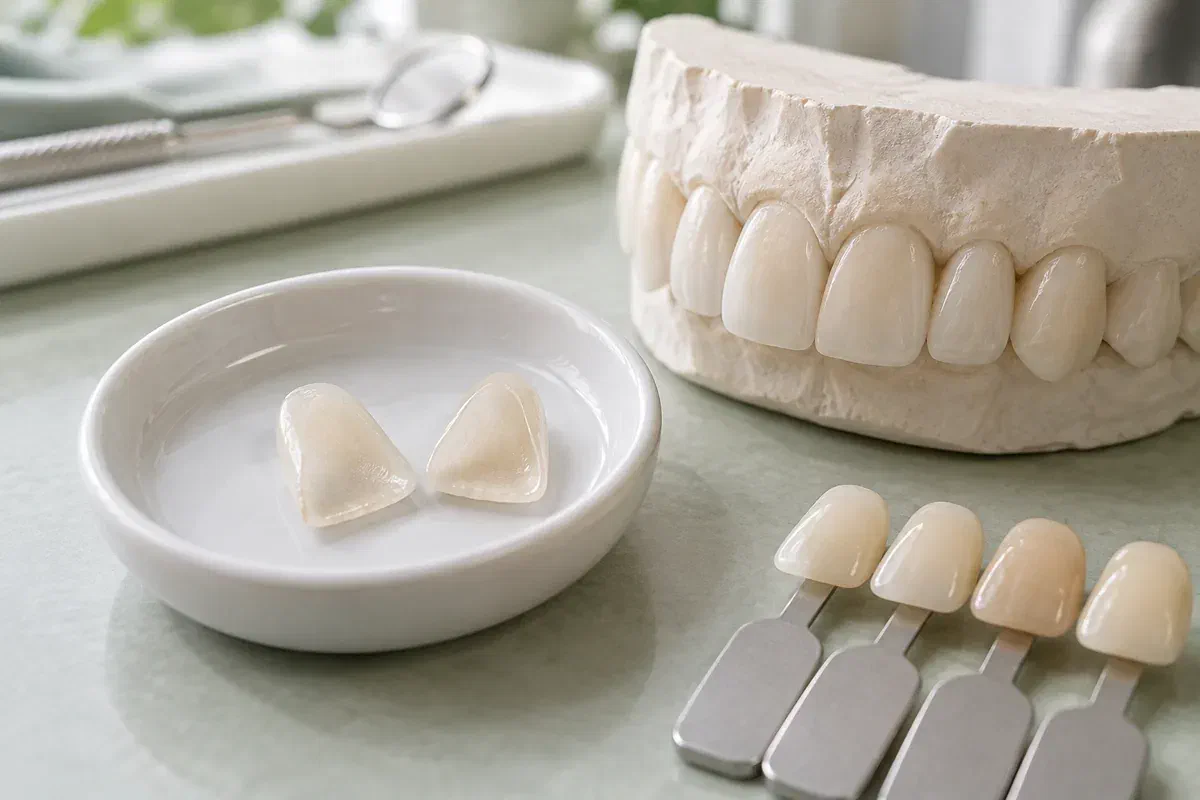
Illustrative thin ceramic veneer samples in a dish beside a dental cast and shade guide
Things you might notice at home

From a snagging floss to a sudden chip

A veneer's age won't decide what happens next. Describe what you notice during brushing and flossing, when it started, whether there was any injury, and what you'd like to achieve.

A chip, crack, or loose veneer

Call to describe any break, sharpness, movement, or pain. Keep a detached piece in a safe container. Ask for advice until you're seen, and leave glues and emery boards out of it, as they can damage the tooth and restoration.

A rough margin, stain, or colour change

Show where floss catches or where you've seen a line or stain, and whether the change has been gradual. It may come from the veneer surface, the edge, the gum, or nearby teeth. Finding a rough spot is a reason to check, not proof that the veneer has failed.

Bleeding gums, sensitivity, or soreness

Mention gum bleeding or swelling beside the veneer, cold sensitivity, discomfort on biting, or a contact that's changed. These need examination. Gum or tooth care may be needed before any thought of a new veneer.

A veneer is bonded to a natural tooth, and both the tooth and gum around it can develop problems. A replacement discussion should look at their health and the tooth's remaining structure, not colour alone.

What you learn from a check

Know whether it's a cleaning issue or a veneer issue.

An assessment sorts out whether the change you've noticed comes from the veneer, the gum, or your routine, and whether something modest could manage it. Ask what polishing, repair, or a different cleaning approach would accomplish, and what full replacement would mean for the tooth. Advice should reflect findings, not a veneer's age.

If a new veneer turns out to be right, planning covers its appearance along with how easy it will be to keep clean. The shape of the margin, how it meets the teeth beside it, and long-term maintenance are part of the design. A restoration that's simple to care for helps protect the gum and tooth around it.

Patient information: FDI World Dental Federation — evaluating repair before total replacement

The reasoning behind any treatment

Ask what about the veneer, tooth, or gum supports the recommended step. If a smaller fix won't help, ask why. That lets you weigh the expected benefit against the preparation a replacement would involve.

Looks and cleanability together

Say whether you'd like to match your current smile or make a broader change. Ask how a single new veneer will relate to nearby teeth and how you'll clean around it. Changes to additional teeth should be discussed separately.

Finding the root of the problem

Ask whether plaque build-up, gum changes, your bite, clenching, or decay is involved. Find out how the plan addresses it. A new veneer won't resolve a problem that comes from somewhere else.

Working it out together

Check, clean, compare, and then restore if needed

One visit or several? That comes down to the veneer's material, the exam, and any restoration chosen. Ask what the first visit includes, if a temporary might be needed, how lab time fits in, and what each step costs.

  1. Look closely at the veneer and gum

    Describe what you've noticed during brushing and flossing, plus the veneer's age and any repairs. The dentist examines the margins, surface, bite, and gum tissue, and may suggest further investigation if something isn't clear.

  2. Try the simplest effective step

    Talk about whether polishing, smoothing, repair, or improved cleaning could solve the problem. If replacement is recommended, ask about preparation, what might be found underneath, and alternatives. The plan can change after old material is removed.

  3. Prepare and design the replacement

    If you go ahead, the existing veneer is managed as agreed and the tooth rechecked. Shade, shape, the margin design, and any temporary covering are discussed. Ask about the sequence of appointments without assuming a same-day option.

  4. Fit, finish, and learn the routine

    At the right stage, you'll review fit and appearance before bonding. Afterward, the bite and margins are checked and you'll be shown how to clean around the new veneer. Ask when to come back and what signs to report.

Your home routine

Daily habits that keep veneer edges healthy

A temporary covering, a polished or repaired veneer, and a newly bonded one each have their own advice. Check which applies to your stage and how to reach us if something changes.

Clean gently around a temporary

Ask how to brush and floss near it, which foods to avoid, and what to do if it lifts. Keep the clinic's number close and call early if a problem arises. Don't try to stick it back yourself.

Make flossing part of every day

Use the floss, interdental brush, or technique recommended for you, paying attention to where the veneer meets the gum. If floss still catches or the gum keeps bleeding, let us know. Regular cleanings and exams stay important.

Avoid damage and notice changes

Don't use your teeth to open things or bite down on very hard items. If you grind, clench, or play sports, ask about protection. Report a rough edge, looseness, a bite change, or lingering sensitivity early.

What might be recommended

From a polish to a new restoration

Options depend on the material, the specific defect, the tooth and gum health, and your goals. Ask how each one preserves natural tooth and how easy the result will be to keep clean.

When the existing veneer can stay with some help

Smooth, polish, repair, or rebond

An uneven edge or small defect may be addressed without replacing the veneer, depending on findings. Ask what to expect and how often it should be reviewed. Conservative care still needs assessment and isn't permanent.

When a new veneer fits the tooth and problem

A replacement designed for easy care

Discuss material, preparation, shade, contour, and how the margin will be shaped for cleaning. Ask whether this is for one tooth or part of a broader plan. Other veneers are assessed individually rather than swapped together.

When the tooth or gum needs a different approach

Gum care, another restoration, or referral

If the gum or tooth has a problem beyond the veneer, treatment may focus there first, sometimes with a specialist. Ask what's suggested, why, and what it involves. Your current veneer doesn't set the next step.

Erin veneer questions

Everyday care and when a veneer needs more

Bring what you've noticed at home and what you know about the veneer. The examination will show whether replacement is right or whether something simpler would help.

(905) 876-4488
Why does floss keep catching on one of my veneers?
It may be a rough or uneven margin, a small chip, tartar, or a tight contact. The dentist can check which applies and whether smoothing, polishing, or another step would help.
My gum bleeds next to a veneer. Should I stop flossing there?
Usually not, but use a gentle technique and mention the bleeding at your visit. Bleeding can relate to plaque, gum inflammation, or the veneer’s edge, and the cause guides what’s recommended.
Which cleaning tools are safe to use around veneers?
A soft toothbrush and floss or interdental brushes are commonly recommended. Ask which tools suit the spacing of your teeth and whether any products should be avoided.
Can a rough edge on my veneer be smoothed instead of replaced?
Sometimes. Depending on the material and location, a rough area may be polished or repaired. Ask what would be achieved and why replacement would or wouldn’t be advised.
Do I need all my veneers replaced if one has a problem?
Not necessarily. Each veneer is assessed on its own condition. Any plan involving several should explain the reasons for each and the alternatives.
Can I combine a veneer check with my hygiene visit when coming from Erin?
Ask when booking. Often a concern can be looked at during a routine visit, though further appointments may be needed depending on what’s found.

Patient information: Canadian Dental Association — bleaching and existing restorative materials

Plan a visit from Erin

Tell us what your floss has been telling you.

Contact our Bronte Street practice about a veneer that catches floss, has a rough edge, looks stained, or has chipped or loosened. We'll check the restoration, the gum, and the tooth beneath, and explain the most sensible next step.

Suitable options, preparation, temporaries, scheduling, and fees are confirmed after examination. A replacement veneer or perfect shade match can't be promised ahead of time.

Visit Milton Dental Clinic
Unit 1, 342 Bronte St. S, Milton, ON L9T 5B7
Get directions Clinic hours
Monday–Thursday
11am–7pm
Friday–Sunday
By appointment only

Areas we serve

  • Milton
  • Oakville
  • Mississauga
  • Georgetown
  • Halton Hills
  • Acton
  • Campbellville
  • Brampton
  • Burlington
  • Puslinch
  • Rockwood
  • Erin
  • Caledon
  • Etobicoke
  • Old Milton
  • Bronte Meadows
  • Timberlea
  • Dorset Park
  • Dempsey
  • Clarke
  • Beaty
  • Coates
  • Harrison
  • Scott
  • Willmott
  • Ford
  • Bowes
  • Cobden
  • Walker
  • Mountain View
  • Milton Heights
  • Hawthorne Village
  • Valley View
  • Fallingbrook
  • Nassagaweya
  • Trafalgar
  • Esquesing
  • Nelson
  • Brookville
  • Moffat
  • Glen Williams
  • Norval
  • Limehouse
  • Stewarttown
  • Ashgrove
  • Hornby
  • Silver Creek
  • Speyside
  • Scotch Block
  • North Oakville
  • River Oaks
  • Glen Abbey
  • West Oak Trails
  • Palermo
  • Bronte Creek
  • College Park
  • Joshua Creek
  • Uptown Core
  • Preserve
  • Iroquois Ridge
  • Lisgar
  • Meadowvale
  • Meadowvale Village
  • Churchill Meadows
  • Erin Mills
  • Central Erin Mills
  • Streetsville
  • East Credit
  • Creditview
  • Heartland
  • Sheridan
  • Mount Pleasant
  • Credit Valley
  • Huttonville
  • Churchville
  • Springbrook
  • Northwest Brampton
  • Bram West
  • Fletcher's Meadow
  • Fletcher's Creek South
  • Alton Village
  • Orchard
  • Millcroft
  • Headon Forest
  • Tansley
  • Brant Hills
  • Tyandaga
  • Kilbride
  • Lowville
  • Aberfoyle
  • Morriston
  • Arkell
  • Hillsburgh
  • Freelton
  • Carlisle
  • Waterdown
  • Flamborough
  • Mountsberg

How can we help?

Milton Dental Clinic

Have a question about your smile? Choose the option that works best for you.

For urgent dental concerns, please call.
Messages are reviewed during clinic hours.