

Illustrative patient and clinician reviewing natural tooth shades for an existing veneer concern
Cosmetic Dentistry

Veneer Replacement in Milton

An older veneer that has chipped, darkened at the edge, or started to feel loose is worth a proper look before anyone talks about a new one. In Milton, we review the restoration and the natural tooth under it, then explain whether polishing, repair, rebonding, or replacement makes sense.

When a veneer you've had for years changes

Is it time for a new veneer, or just a closer look?

Most people notice a veneer problem in an ordinary moment: a rough edge under the tongue, a thin grey line in a photo, or a tooth that suddenly feels different when biting into toast. Each of those can have a different cause, and the cause shapes what should happen next. The covering and the natural tooth behind it are assessed together.

A new veneer is one possibility, not the default. Depending on what the examination shows, the conversation may cover polishing a surface, repairing a small defect, rebonding a sound veneer, keeping an eye on a minor change, or choosing a different restoration altogether. Knowing why the current one has run into trouble helps the next plan hold up better.

Because you're close by in Milton, it is easy to come in early, before a small change becomes a bigger decision. Bring whatever you know about when the veneer was placed and any repairs since. If it has come away, keep it in a safe container and call us for advice before any further preparation of the tooth is discussed.

Ask about your existing veneer
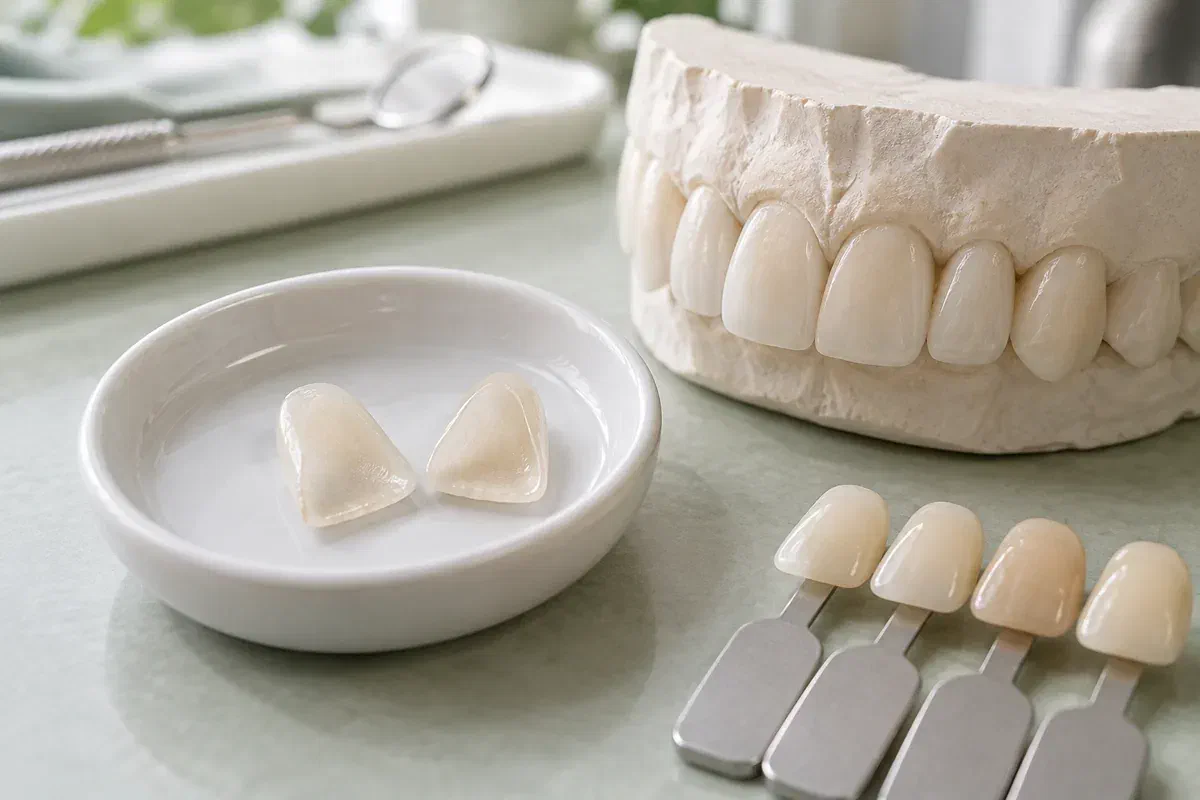
Illustrative thin ceramic veneer samples in a dish beside a dental cast and shade guide
Signs worth mentioning

Tell us what you see and what you feel.

The age of the restoration is only part of the picture. Let us know when you first noticed the change, whether something hard or an injury was involved, and what you would like the tooth to look like.

Chipped, cracked, or fallen off

Call and describe what broke, whether an edge feels sharp, and any discomfort. If the veneer or a piece of it came off, put it in a small container. Ask what to do in the meantime, and avoid household glue or filing the tooth yourself.

A dark margin, stain, or colour mismatch

Show us where the change is and say whether it crept in slowly or appeared all at once. The cause might be the veneer surface, its edge, the neighbouring teeth, or something else. A visible line on its own does not prove the whole restoration has to go.

Sensitivity, tenderness, or a bite that feels off

Mention sensitivity to cold, pain when chewing, sore gum tissue, or a contact that has changed. These need an examination, not just a cosmetic fix. The tooth and gums may need attention first, before a new covering is planned.

A veneer is bonded to a living tooth, and that tooth can still develop decay or other problems. Any replacement conversation should include its health and how much natural structure remains, not only the shade.

What you gain from an assessment first

A clear reason behind whichever option you choose

A good review tells you what has actually gone wrong and whether a conservative step could manage it. You can ask what a repair or refurbishment would keep and what full replacement would involve for the tooth. The recommendation should rest on what is found, not on a guess about how long veneers usually last.

When a new veneer does make sense, planning is where you talk about the shape and shade you want, along with the practical demands on the tooth. Contacts with neighbouring teeth, how easily you can clean around it, and future upkeep all matter. A fresh look works best when it fits the conditions the restoration has to handle.

Patient information: FDI World Dental Federation — evaluating repair before total replacement

An explanation for repair or replacement

Ask which feature of the veneer or the tooth points toward the suggested approach. If a smaller step won't work, ask why not. Seeing the tradeoff lets you weigh the likely benefit against removing more existing material from the tooth.

Shade and shape planned together

Say whether you want to blend with your current smile or are thinking about a wider colour change. Ask how a single new veneer will sit beside neighbouring teeth and restorations. Any suggestion to redo other veneers should be presented as its own decision.

A look at why the veneer failed

Talk about whether your bite, clenching, a past knock, decay, or another finding needs managing alongside the veneer. Ask how the new plan accounts for it. Simply repeating the old restoration without understanding the problem can leave part of the decision unclear.

How replacement visits usually unfold

From the first look to the final check

The number of visits depends on the existing material, what the examination finds, and the restoration being planned. Ask about the assessment, any temporary stage, lab work, and what the fee covers.

  1. Go over the veneer's history

    Tell us when it was placed, what has changed, and about any earlier repairs or sensitivity. Bring records or material details if you have them. The dentist examines the restoration, its edges, your bite, and the surrounding gums, and decides whether further investigation is needed.

  2. Weigh smaller options against a new restoration

    Talk through whether monitoring, polishing, repair, or rebonding is realistic before agreeing to remove anything. If replacement is advised, ask about preparation, what could be found underneath, and other restoration types. The plan may need adjusting once the old material is off.

  3. Prepare the tooth and arrange the replacement

    The existing veneer is handled as agreed and the tooth is checked again. You'll discuss shade, shape, records, and any temporary covering needed. Confirm how many appointments to expect without assuming a particular scanner, lab, or same-day option.

  4. Check the fit and plan ongoing care

    Before the final placement, you'll review the look and fit at the right stage. Afterward, contacts and finish are checked and care instructions explained. Ask when to come back for a review and how to tell us about a bite, cleaning, or appearance concern.

Looking after the tooth and the veneer

Care for the restoration and the tooth it covers

Advice is different for a temporary, a repaired veneer, and a newly bonded one. Check which instructions fit your stage and who to call if anything changes.

Treat a temporary gently

Ask what to eat, how to clean, and what to do if the temporary loosens. Keep our number handy and call before your next visit if there's a problem. A temporary stage is never a reason to try cementing or adjusting anything at home.

Keep the edges and contacts clean

Stick with the brushing and in-between cleaning routine recommended for you. Let us know if floss snags, food packs in, or the gum next to the veneer feels sore. A smooth surface still needs regular checkups and professional cleaning.

Protect it and report new symptoms

Don't use your teeth to open packages or bite down on hard objects. If clenching, grinding, or sports protection applies to you, ask for advice that suits your situation. Tell us about a changed bite, looseness, or lingering sensitivity instead of waiting it out.

Your options for an existing veneer

Different problems call for different responses.

Look at the material, the defect, the condition of the tooth, and the result you want. Ask how each option balances keeping natural structure with a result that lasts and is easy to maintain.

When the current veneer can reasonably stay

Polish, repair, or rebond

A limited problem may be manageable without a full replacement, depending on the findings. Ask what this approach can achieve, how it will look, and what follow-up it needs. A conservative step still needs proper assessment and is not a permanent guarantee.

When replacement suits the tooth and the problem

A carefully designed new veneer

Review the proposed material, preparation, shade, contour, and upkeep. Ask whether the new veneer is meant to match one tooth or belongs to a broader plan. Neighbouring veneers should be judged on their own condition, not replaced as a set by default.

When the tooth underneath needs something else

A different restoration or further assessment

A tooth with extensive damage or another clinical issue may need more than a veneer. Ask why another restoration or a specialist opinion is suggested and what it would involve. The type of veneer you had before doesn't decide every future choice.

Common questions

What people in Milton ask about replacing a veneer

Bring what you know about your current restoration and the result you hope for. The examination shows whether replacement is right and which alternatives are worth weighing.

(905) 876-4488
My veneer has a rough spot I can feel with my tongue. Should I book soon?
It’s worth booking an assessment rather than waiting for it to get worse. A rough area can come from a chip, wear, or a change at the edge. Avoid filing or picking at it, and let us know if it is catching your tongue or lip.
How do I know if the problem is the veneer or the tooth underneath?
That’s what the examination is for. The dentist looks at the margins, your bite, and the gums, and may suggest further investigation. Sensitivity or pain points more toward the tooth or supporting tissues, while a shade issue may come from the veneer itself.
Will a single new veneer match the teeth beside it?
A close match is the aim, but it cannot be promised in advance. Shade, translucency, and shape all play a part, and neighbouring teeth or restorations affect the result. Ask how matching will be checked before the final placement.
Is removing an old veneer hard on the tooth?
Removal can involve taking away bonded material, and the dentist plans this carefully to protect the remaining tooth. Ask what preparation is expected and whether it might change once the old veneer is off. What is found underneath can affect the options.
Can polishing fix a dull or stained veneer surface?
Sometimes surface staining responds to cleaning or polishing, depending on the material. Veneers do not whiten the way natural teeth do. Ask what polishing can realistically improve before deciding to replace a veneer for appearance alone.
What should I do if my veneer pops off on a weekend?
Keep the veneer in a safe container and call the clinic to explain what happened. Fridays through Sundays are by appointment only, so leave a message or check our urgent care page. Seek prompt care for significant pain, swelling, or injury.

Patient information: Canadian Dental Association — bleaching and existing restorative materials

Book in Milton

Have the veneer and the tooth checked together.

Chipped, loose, or simply not looking right anymore? Drop by or phone our Bronte Street practice. We'll look at the existing restoration, talk about what might be kept, and explain whether repair, replacement, or other care suits you.

Material, repair options, preparation, temporaries, timing, and fees all depend on the assessment. We cannot guarantee a new veneer or a perfect shade match beforehand.

Visit Milton Dental Clinic
Unit 1, 342 Bronte St. S, Milton, ON L9T 5B7
Get directions Clinic hours
Monday–Thursday
11am–7pm
Friday–Sunday
By appointment only

Areas we serve

  • Milton
  • Oakville
  • Mississauga
  • Georgetown
  • Halton Hills
  • Acton
  • Campbellville
  • Brampton
  • Burlington
  • Puslinch
  • Rockwood
  • Erin
  • Caledon
  • Etobicoke
  • Old Milton
  • Bronte Meadows
  • Timberlea
  • Dorset Park
  • Dempsey
  • Clarke
  • Beaty
  • Coates
  • Harrison
  • Scott
  • Willmott
  • Ford
  • Bowes
  • Cobden
  • Walker
  • Mountain View
  • Milton Heights
  • Hawthorne Village
  • Valley View
  • Fallingbrook
  • Nassagaweya
  • Trafalgar
  • Esquesing
  • Nelson
  • Brookville
  • Moffat
  • Glen Williams
  • Norval
  • Limehouse
  • Stewarttown
  • Ashgrove
  • Hornby
  • Silver Creek
  • Speyside
  • Scotch Block
  • North Oakville
  • River Oaks
  • Glen Abbey
  • West Oak Trails
  • Palermo
  • Bronte Creek
  • College Park
  • Joshua Creek
  • Uptown Core
  • Preserve
  • Iroquois Ridge
  • Lisgar
  • Meadowvale
  • Meadowvale Village
  • Churchill Meadows
  • Erin Mills
  • Central Erin Mills
  • Streetsville
  • East Credit
  • Creditview
  • Heartland
  • Sheridan
  • Mount Pleasant
  • Credit Valley
  • Huttonville
  • Churchville
  • Springbrook
  • Northwest Brampton
  • Bram West
  • Fletcher's Meadow
  • Fletcher's Creek South
  • Alton Village
  • Orchard
  • Millcroft
  • Headon Forest
  • Tansley
  • Brant Hills
  • Tyandaga
  • Kilbride
  • Lowville
  • Aberfoyle
  • Morriston
  • Arkell
  • Hillsburgh
  • Freelton
  • Carlisle
  • Waterdown
  • Flamborough
  • Mountsberg

How can we help?

Milton Dental Clinic

Have a question about your smile? Choose the option that works best for you.

For urgent dental concerns, please call.
Messages are reviewed during clinic hours.