

Illustrative clinician and patient discussing a tooth model during an enamel assessment
Cosmetic Dentistry

White Spot Treatment in Caledon

When faint white streaks or flecks show up on several teeth rather than one, the pattern itself is a clue. From Bolton or elsewhere in Caledon, you can have the whole picture examined and hear which marks need protecting and which are simply part of your enamel.

More than one tooth

A pattern of marks tells its own story.

One white fleck is easy to shrug off. A scattering of them across your front teeth, or matching streaks on teeth on both sides of the mouth, tends to raise a different question: is something affecting all of them at once? It is a fair thing to wonder, and the answer is usually less worrying than people expect, but it does deserve a proper look rather than a guess.

Often the answer lies in the past. Marks that appear in a symmetrical pattern frequently formed while the teeth were developing, for reasons such as fluorosis or other changes during childhood. Patches clustered along the gumline or in the shape of old brackets point instead to areas where plaque caused minerals to leave the enamel. Each pattern leads to a different plan.

For households in Caledon, we examine all the affected teeth, map out where the marks sit, and explain what the pattern suggests. That way, any protective care goes where it is needed, and any cosmetic discussion covers the teeth you actually care about.

Have a pattern of white marks assessed
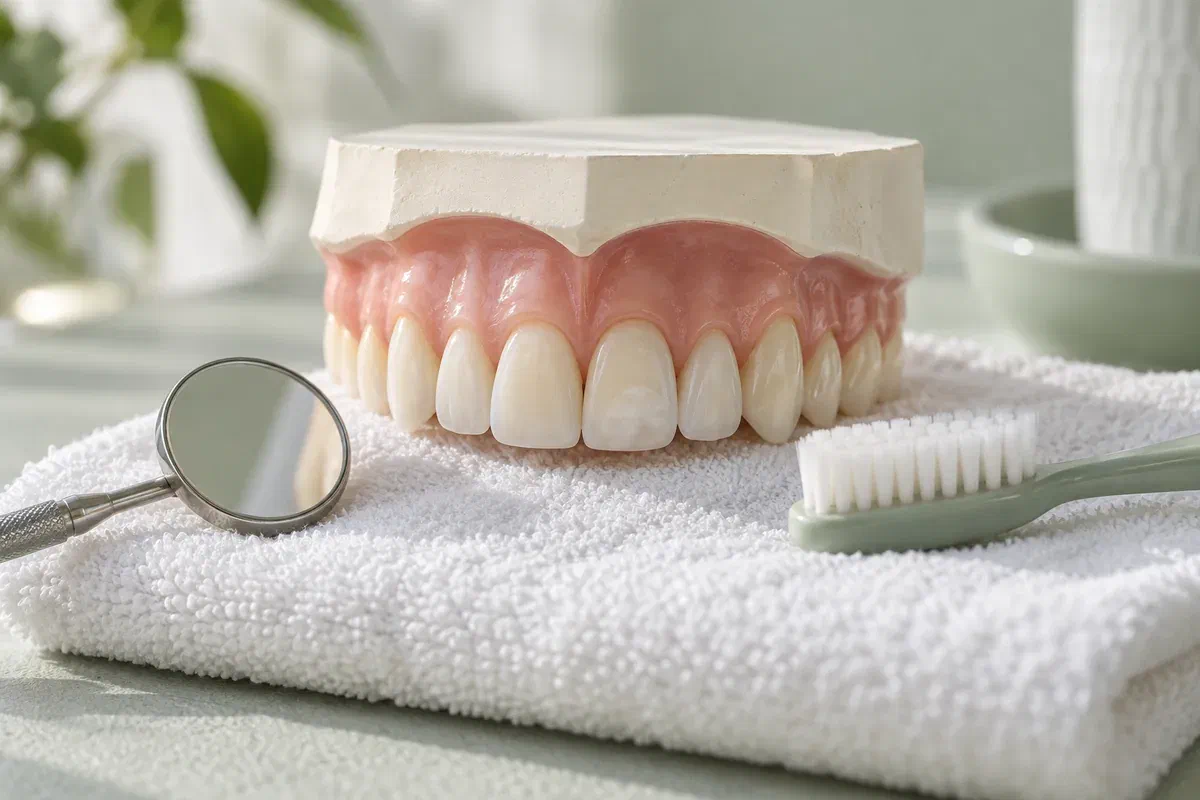
Illustrative dental teaching model with a subtle white enamel patch beside a mirror and toothbrush
Reading the pattern

Where the marks cluster can point to their cause.

We look at every affected tooth along with the gums and your daily routine. You do not need exact dates, but knowing whether the marks appeared together or one by one is useful.

Patches grouped near the gums or bracket sites

Several chalky areas sitting where plaque collects, or tracing the outline of former brackets, suggest mineral loss in those places. The priority is a routine that protects each one. We will look at what has been feeding the risk and how to reduce it across the mouth.

Symmetrical flecks present since childhood

Matching marks on teeth that came in around the same age often reflect how enamel formed, as with fluorosis. These are generally stable. Mention anything you know about early fluoride exposure or childhood illness, since it helps confirm the explanation.

One mark that behaves differently

If a single patch among several feels rough, looks stained at the edge, catches food or is sensitive, it may need separate attention. Please point it out. Avoid scratching at any of the marks, and do not expect one cosmetic product to address every tooth equally.

A group of white marks can share one cause or have several. Areas in the first stages of mineral loss can frequently be held steady with good care, so they never progress to cavities. Developmental patterns usually stay as they are, and a damaged surface on any one tooth calls for its own care.

What a full assessment gives you

A map of which teeth need what

With several marks, it helps to sort them. Some may need protective care because minerals are being lost. Others may only need watching. A few might be ones you would like to look less obvious. The plan should say which goal applies to which tooth, and how each will be judged, because a patch that stays visible can still sit on perfectly healthy enamel.

If appearance matters to you, think about scope. Treating every marked tooth is a bigger undertaking than softening the two you notice most. Ask how each option affects the tooth, what upkeep it brings, and how results may differ from one mark to the next. Concentrating on a few teeth, or leaving stable marks untouched, are both reasonable choices.

An explanation for the whole pattern

The dentist should be able to tell you what supports the likely cause, whether it applies to every mark, and whether photographs would help track them. If the cause differs between teeth, ask how that changes the plan for each.

Prevention that covers every at-risk area

Talk through cleaning along the gums and between teeth, snack and drink habits, and any fluoride product being recommended. One clear routine for the whole mouth is easier than several, especially in a busy household where everyone shares a bathroom schedule. Agree on when the marks will be reviewed.

Realistic expectations across several teeth

Ask whether an approach would blend, soften or mask the marks, and whether results are likely to be even from tooth to tooth. Find out what may still show. No one can promise every patch will disappear.

Working through several marks

Sort, protect, prioritise, review

Some people need only prevention and monitoring. Others decide to treat the most noticeable marks once the enamel is stable, and leave the rest.

  1. Examine every affected tooth

    Tell us when you noticed the marks, whether they appeared together, any orthodontic history and any sensitivity. The dentist examines each patch and the surrounding teeth, explains whether the surfaces are intact, and notes the overall pattern.

  2. Protect the areas that need it

    Where some marks reflect active mineral loss, we agree on a single practical routine and a review date. Each product is explained. We will say which teeth need watching most closely before any appearance discussion.

  3. Choose which teeth, if any, to treat

    For marks you want to change, we compare monitoring, a limited enamel technique such as resin infiltration, and bonding, tooth by tooth. Preparation, isolation, materials and the limits of blending are covered so you can set your priorities.

  4. Review before widening the plan

    After any treatment, the results and surfaces are checked. If some marks remain noticeable, you can decide whether to address them. Extending treatment to more teeth is always a separate choice, never an automatic next step.

Keeping things steady

One routine, applied evenly

Aftercare depends on whether you are following prevention, had enamel treatment on some teeth, or received bonding. We will explain what applies to each treated area and when you are due back.

Give every at-risk area attention

Brush along the gums, clean between the teeth and use fluoride as advised, paying particular attention to the areas we pointed out. If some spots are harder to reach, ask us to demonstrate.

Compare marks at the review

With several patches, it is especially easy to second-guess changes in the mirror, and one tooth can seem worse simply because of where the light falls. Clinical photos taken under the same conditions make comparisons fairer. Keep the follow-up and mention any tooth that starts to feel rough or sensitive.

Keep remedies and kits on the shelf

Avoid scraping or acidic home treatments on any of the marks. Ask before whitening, since it can change contrast unevenly across several teeth and affect how bonding matches.

Approaches for multiple marks

Mix and match, tooth by tooth

Different marks in the same mouth may suit different options. We explain how each relates to the cause, surface and your priorities, and the gentlest approach that would meet your goal is considered first.

For at-risk areas and stable patterns

Prevention and monitoring

A single tailored routine with periodic reviews can protect every marked tooth. The patches may still show. A mouth with a few visible flecks can be entirely healthy, and leaving them is a reasonable decision.

For the most noticeable intact patches

Selective enamel treatment

Resin infiltration or a similar technique may be considered for suitable unbroken marks. Results can vary between teeth, so we discuss which patches are good candidates and what blending is realistic.

For damaged surfaces or stubborn marks

Bonding on selected teeth

Tooth-coloured bonding can repair or mask particular patches. It adds material that needs maintenance. Veneers across several teeth would be a much larger change and are not the default for scattered white marks.

Patient information: DMG — indications and limitations for smooth-surface resin infiltration

Caledon questions

When the marks are on several teeth

General answers about patterns of white enamel marks. Your exam will show which apply to you.

(905) 876-4488
Why do I have matching white marks on teeth on both sides?
Symmetrical marks often formed while those teeth were developing, at around the same time. Fluorosis is one common example. The dentist can examine the pattern and explain the most likely cause.
Is fluorosis harmful to my teeth?
Mild fluorosis is mainly a cosmetic difference in the enamel and does not usually affect the health of the tooth. If the appearance bothers you, the dentist can discuss options.
Do I need to treat every tooth that has a mark?
No. Many people choose to address only the most visible marks, or none at all. The dentist will point out any that need protective care for health reasons, and the rest is up to you. You can also start with one or two teeth and decide about the others later.
Can different white marks in my mouth have different causes?
Yes. A developmental pattern and newer patches from mineral loss can exist side by side. That is why each mark is examined rather than treated as one group.
My siblings have similar marks. Is that common?
Family members sometimes share marks, especially if they grew up with similar fluoride sources or habits. Each person still needs their own exam, because causes and suitable options can differ.
Would whitening make several white flecks less noticeable at once?
It may soften contrast on some teeth and not others, and can make flecks stand out for a while. Discuss whitening with the dentist before starting, especially if bonding is planned.

Patient information: American Dental Association — whitening responses and intrinsic enamel marks

Booking from Caledon

Show us the pattern, not just one spot.

Get in touch with our Bronte Street practice to have white flecks, streaks or chalky patches on several teeth examined. We will explain the likely cause and the prevention, monitoring and cosmetic choices for each area.

The cause of each mark, the condition of the surfaces, suitable options, likely blending, number of visits and fees can only be confirmed after an exam. Complete disappearance of the marks cannot be promised.

Visit Milton Dental Clinic
Unit 1, 342 Bronte St. S, Milton, ON L9T 5B7
Get directions Clinic hours
Monday–Thursday
11am–7pm
Friday–Sunday
By appointment only

Areas we serve

  • Milton
  • Oakville
  • Mississauga
  • Georgetown
  • Halton Hills
  • Acton
  • Campbellville
  • Brampton
  • Burlington
  • Puslinch
  • Rockwood
  • Erin
  • Caledon
  • Etobicoke
  • Old Milton
  • Bronte Meadows
  • Timberlea
  • Dorset Park
  • Dempsey
  • Clarke
  • Beaty
  • Coates
  • Harrison
  • Scott
  • Willmott
  • Ford
  • Bowes
  • Cobden
  • Walker
  • Mountain View
  • Milton Heights
  • Hawthorne Village
  • Valley View
  • Fallingbrook
  • Nassagaweya
  • Trafalgar
  • Esquesing
  • Nelson
  • Brookville
  • Moffat
  • Glen Williams
  • Norval
  • Limehouse
  • Stewarttown
  • Ashgrove
  • Hornby
  • Silver Creek
  • Speyside
  • Scotch Block
  • North Oakville
  • River Oaks
  • Glen Abbey
  • West Oak Trails
  • Palermo
  • Bronte Creek
  • College Park
  • Joshua Creek
  • Uptown Core
  • Preserve
  • Iroquois Ridge
  • Lisgar
  • Meadowvale
  • Meadowvale Village
  • Churchill Meadows
  • Erin Mills
  • Central Erin Mills
  • Streetsville
  • East Credit
  • Creditview
  • Heartland
  • Sheridan
  • Mount Pleasant
  • Credit Valley
  • Huttonville
  • Churchville
  • Springbrook
  • Northwest Brampton
  • Bram West
  • Fletcher's Meadow
  • Fletcher's Creek South
  • Alton Village
  • Orchard
  • Millcroft
  • Headon Forest
  • Tansley
  • Brant Hills
  • Tyandaga
  • Kilbride
  • Lowville
  • Aberfoyle
  • Morriston
  • Arkell
  • Hillsburgh
  • Freelton
  • Carlisle
  • Waterdown
  • Flamborough
  • Mountsberg

How can we help?

Milton Dental Clinic

Have a question about your smile? Choose the option that works best for you.

For urgent dental concerns, please call.
Messages are reviewed during clinic hours.