

Illustrative private dental conversation about an oral health concern
General & Family Dentistry

Bad Breath Assessment and Treatment in Milton

Sometimes a partner, a child or a close friend is the one who mentions it. If breath odour keeps coming back, book a calm, private assessment in Milton to look for oral causes and plan care that does more than hide the smell.

Breath concerns, close to home in Milton

When someone close to you notices first

A comment at the kitchen table, a child leaning back during a bedtime story, a colleague who keeps a little more distance. Moments like these can leave you wondering about your breath for weeks. Halitosis, the clinical word for persistent bad breath, is an ordinary reason to see a dentist, and you are welcome to book even when nothing hurts.

Odour rarely has just one source. Plaque along the gumline, a coated tongue, low saliva, a food trap beside an old filling, or a denture that needs better cleaning can each play a part. Onions at lunch are not the same as a smell that lingers day after day despite brushing. Good care follows what the examination shows, not a promise that one product works for everyone.

Your visit begins with a quiet talk about what you or others have noticed, when it tends to happen, and what you have already tried. We then check the mouth for oral contributors and explain what we see in plain language. Where the history points beyond the mouth, we can talk about a medical opinion, without assuming the stomach is to blame.

Book a private breath assessment
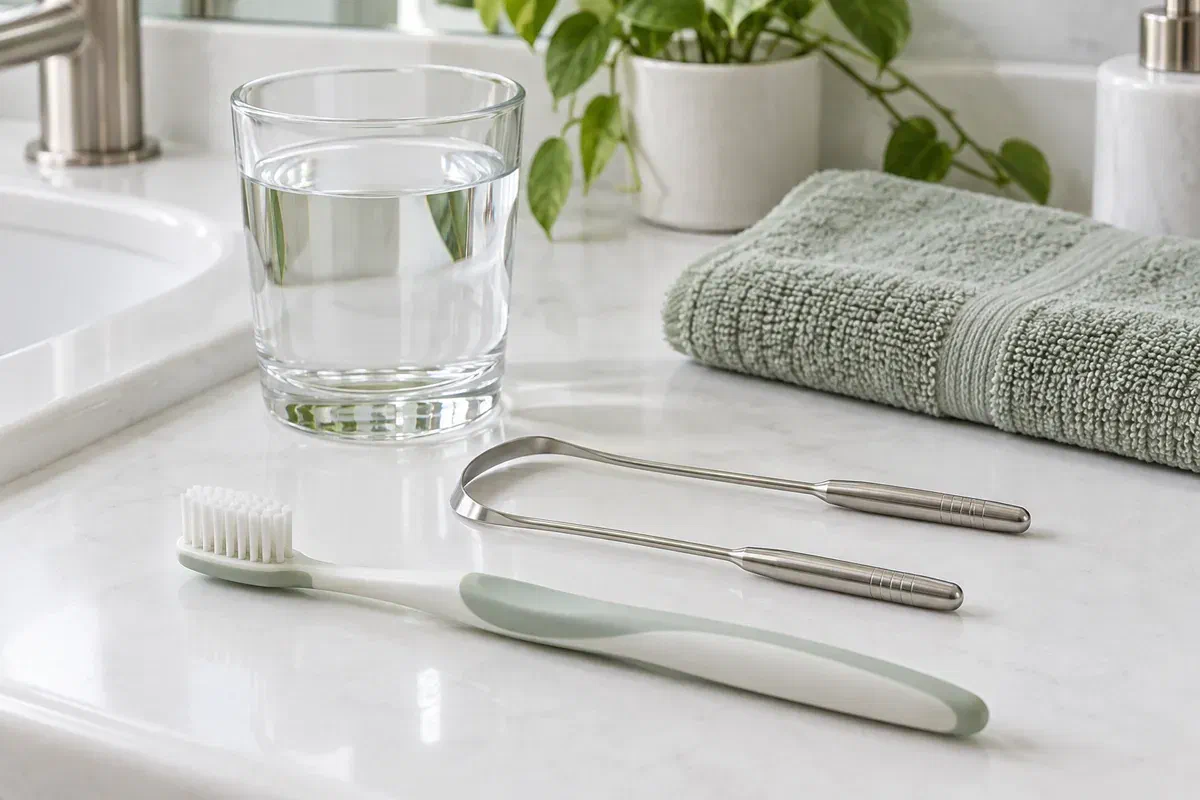
Toothbrush, tongue cleaner, and glass of water illustrating everyday oral care
Clues worth mentioning

The smell is only part of the story

Let us know whether the odour is strongest first thing in the morning, after eating, or all day long. Changes elsewhere in the mouth help narrow things down, though no one sign proves where it is coming from.

Gums that bleed, or food that sticks

Inflamed gums, built-up plaque and spots that keep catching food can all feed a lingering odour. Point out the places that are hard to clean or where floss shreds. We look at the gums, teeth and older fillings or crowns instead of simply suggesting a mintier toothpaste.

Dryness through the day or night

Less saliva can change both breath and comfort. Tell us about frequent thirst, a tacky feeling, sleeping with your mouth open, or a recent change in medicines. Dryness can have several causes, so any product we suggest should fit your overall history.

A denture or appliance in the picture

Removable appliances need cleaning of their own, and one that collects debris or has begun to fit poorly should be looked at. Bring it along and tell us your usual routine. We check the gums and tissues underneath, not just the appliance.

A foul taste together with swelling, strong tooth pain or discharge can signal something that needs attention soon. Phone us instead of reaching for mints while you wait for a routine appointment.

Why an assessment helps

From trial and error to a clear reason

Most people have tried a cabinet full of rinses and sprays before they ask. An assessment links the advice you get to something we can actually see, such as a stubborn cleaning spot, inflamed gums, an appliance problem or ongoing dryness. Knowing the reason makes it easier to follow the plan and to judge later whether it worked.

You can also tell us how the worry is affecting you. If you avoid close conversations or check your breath again and again, that matters and is worth saying aloud. Your concern deserves respect, including when the mouth looks healthy or when another kind of assessment makes sense.

A careful look at the mouth

Checking teeth, gums and soft tissues can reveal problems that no mint will reach. We explain findings before suggesting any treatment, so a breath question does not turn into a large treatment plan by default.

Technique you can try at home

If your brushing or flossing needs a tweak, ask us to show you with tools you can realistically use. Learning to reach one awkward corner is often worth more than a list of new products.

A date to check progress

Together we set a time to review how things are going and agree what would lead to a different kind of assessment. A persistent concern deserves a defined next step, not months of guessing.

What happens at the appointment

Your observations come first, then the examination

Please bring a list of your medicines and the mouth care products in your bathroom. If you have spotted a pattern in timing, share it. When you book, ask whether anything special is needed beforehand.

  1. A private conversation

    We ask when you first noticed the odour, whether it comes and goes, and what seems to help or worsen it. Smoking, dryness, denture wear and relevant health symptoms may come up. Let us know what you have tried and whether anything irritated your mouth.

  2. Checking the mouth

    We assess the teeth, gums, tongue and other tissues, looking for plaque, inflammation, decay, trapped food and appliance issues. Extra tests are suggested only when they would answer a real clinical question; nobody needs a special device by default.

  3. Setting priorities together

    We go through what we found and any treatment needed for gum disease, a broken tooth or another problem. Home care tips and dry-mouth support are matched to you. Feel free to ask about fees, and whether a suggested treatment relates to the breath concern or to something separate.

  4. Following up

    At review we look at what has improved and what still bothers you. If dental care does not explain the odour, or other health symptoms are present, we may suggest seeing your physician. We will be honest about uncertainty instead of promising an outcome.

Between appointments

A routine you can keep beats a stronger mint

Stick with the plan we agree on after your visit. If something stings, leaves your mouth drier or is simply awkward to use, let us know and we can look at other choices.

Reach every surface that matters

Brush twice a day with fluoride toothpaste and clean between your teeth daily with tools that suit you. We may talk about gentle tongue cleaning. Scrubbing until the gums or tongue bleed does not help; good technique matters more than force.

Care for appliances separately

Clean a denture or removable appliance the way its material requires, and wear it on the schedule you were given. Ask how to store and soak it if you are unsure. Household cleaners are too harsh to use on it.

Keep us posted on dryness and health

Tell us if dry mouth continues, and raise medicine questions with the doctor who prescribed them. Please do not stop a prescription on your own. Sipping water and saliva support can ease comfort, but lasting dryness needs its cause and effect on the teeth looked at.

Patient information: NHS — caring for the mouth when breath is a concern · NIDCR — dry mouth

Treatment follows the findings

Different causes call for different care

Wherever we can, we aim at a contributor the examination has identified. Ask how each recommendation connects to what we found, and what the plan is if the odour persists.

If plaque or gum disease is involved

Cleaning help and gum treatment

You may be given a personalised cleaning routine along with suitable professional gum care. How much is needed depends on the state of your gums. A regular cleaning and treatment for advanced periodontal disease are often quite different visits.

If a tooth or appliance is the issue

Repairing a specific problem

Decay, a filling that traps food or an appliance problem may call for targeted care. Ask about the diagnosis, the alternatives and what improvement to expect. Fixing one finding is not a guarantee that every possible source of odour is gone.

If the cause looks broader or unclear

Support or a wider assessment

Dry-mouth care, a product picked for one clear purpose, or a medical assessment may fit. A cosmetic rinse can freshen breath for a while without treating disease. Ask whether a product is meant for comfort, prevention or a diagnosed condition.

Patient information: American Dental Association — mouthrinse and its limitations

Breath questions from Milton

Ask what you have been wondering

Put your worry into your own words; there is no right way to describe it. We can start with your history and an examination even if you have no idea whether teeth, gums or something else are involved.

(905) 876-4488
My partner says my breath is bad but I can’t smell it myself. Is that normal?
Yes, it is common. People tend to get used to their own odour, so self-checks are unreliable. A comment from someone you trust is a reasonable prompt to book. We examine the mouth and talk through what was noticed, without judgement.
Does tooth pain have to be present before I can book for breath?
No. You do not need any pain for us to assess your mouth. Some oral problems cause odour without hurting, and some breath concerns turn out not to be dental at all. Tell us how long it has lasted and what else you have noticed.
Could my child’s breath point to a dental problem?
It can, for example when plaque builds up, a tooth has decay or food gets packed around teeth. It can also follow a cold or mouth breathing. Bring your child in and describe when you notice it, and we will check their teeth and gums gently.
Is a white coating on my tongue part of the problem?
A coated tongue can hold bacteria and contribute to odour for some people. We look at it during the examination and can show you a gentle way to clean it if that is appropriate. Scraping hard or until it bleeds is not recommended.
What if my mouth looks healthy and I’m still worried?
Tell us the concern is ongoing and how it is affecting you. We can go over what was checked and whether a physician’s opinion might help. Repeated harsh rinsing or constant checking will not settle the worry the way a clear plan can.
Can one appointment fit around a busy family week in Milton?
An initial assessment is one visit, and you can ask for a time that suits school runs and work. Our weekday hours run into the early evening, and Friday to Sunday visits are by appointment. If treatment is needed, we will explain how many visits it may take.
Bad breath care in Milton

A hard subject, handled kindly

Book a time at our Bronte Street practice to talk about a lingering breath concern and have your mouth checked. Bring your questions, plus a list of the products and medicines you use. We will explain what we find and agree on a sensible next step together.

For strong pain, swelling or a sudden worrying change, please phone us. Online requests are for routine appointments only.

Visit Milton Dental Clinic
Unit 1, 342 Bronte St. S, Milton, ON L9T 5B7
Get directions Clinic hours
Monday–Thursday
11am–7pm
Friday–Sunday
By appointment only

Areas we serve

  • Milton
  • Oakville
  • Mississauga
  • Georgetown
  • Halton Hills
  • Acton
  • Campbellville
  • Brampton
  • Burlington
  • Puslinch
  • Rockwood
  • Erin
  • Caledon
  • Etobicoke
  • Old Milton
  • Bronte Meadows
  • Timberlea
  • Dorset Park
  • Dempsey
  • Clarke
  • Beaty
  • Coates
  • Harrison
  • Scott
  • Willmott
  • Ford
  • Bowes
  • Cobden
  • Walker
  • Mountain View
  • Milton Heights
  • Hawthorne Village
  • Valley View
  • Fallingbrook
  • Nassagaweya
  • Trafalgar
  • Esquesing
  • Nelson
  • Brookville
  • Moffat
  • Glen Williams
  • Norval
  • Limehouse
  • Stewarttown
  • Ashgrove
  • Hornby
  • Silver Creek
  • Speyside
  • Scotch Block
  • North Oakville
  • River Oaks
  • Glen Abbey
  • West Oak Trails
  • Palermo
  • Bronte Creek
  • College Park
  • Joshua Creek
  • Uptown Core
  • Preserve
  • Iroquois Ridge
  • Lisgar
  • Meadowvale
  • Meadowvale Village
  • Churchill Meadows
  • Erin Mills
  • Central Erin Mills
  • Streetsville
  • East Credit
  • Creditview
  • Heartland
  • Sheridan
  • Mount Pleasant
  • Credit Valley
  • Huttonville
  • Churchville
  • Springbrook
  • Northwest Brampton
  • Bram West
  • Fletcher's Meadow
  • Fletcher's Creek South
  • Alton Village
  • Orchard
  • Millcroft
  • Headon Forest
  • Tansley
  • Brant Hills
  • Tyandaga
  • Kilbride
  • Lowville
  • Aberfoyle
  • Morriston
  • Arkell
  • Hillsburgh
  • Freelton
  • Carlisle
  • Waterdown
  • Flamborough
  • Mountsberg

How can we help?

Milton Dental Clinic

Have a question about your smile? Choose the option that works best for you.

For urgent dental concerns, please call.
Messages are reviewed during clinic hours.