

Illustrative dental consultation with an older patient and her chosen support person
General & Family Dentistry

Caregiver-Assisted Dental Visits in Caledon

Memory changes can make dental advice slip away by the time you are home. Plan a visit from Caledon with a partner or relative who keeps notes, while the patient still leads the conversation.

Memory and continuity

Notes on the fridge, questions in the chair

Someone living with memory loss may follow the dentist perfectly in the room and recall none of it by supper. A spouse or adult child who comes along can keep track of the details and keep the household routine steady. Whether home is in Bolton or one of the smaller villages around Caledon, that shared memory often matters as much as the appointment itself.

Support can also mean help with the car, the walker, the pill organizer or the toothbrush. Let us know which of these apply, how the patient communicates now, and any swallowing, positioning or medical concerns. Our team can then describe what we are able to arrange, and whether another setting or provider might be a better match.

Memory changes do not remove a person from their own care. We speak with the patient, give them time, and respect the decisions they can make. A companion’s observations about daily life are valuable, yet the plan should follow the individual rather than assumptions tied to age or a diagnosis of dementia.

Arrange a visit with a note-taker
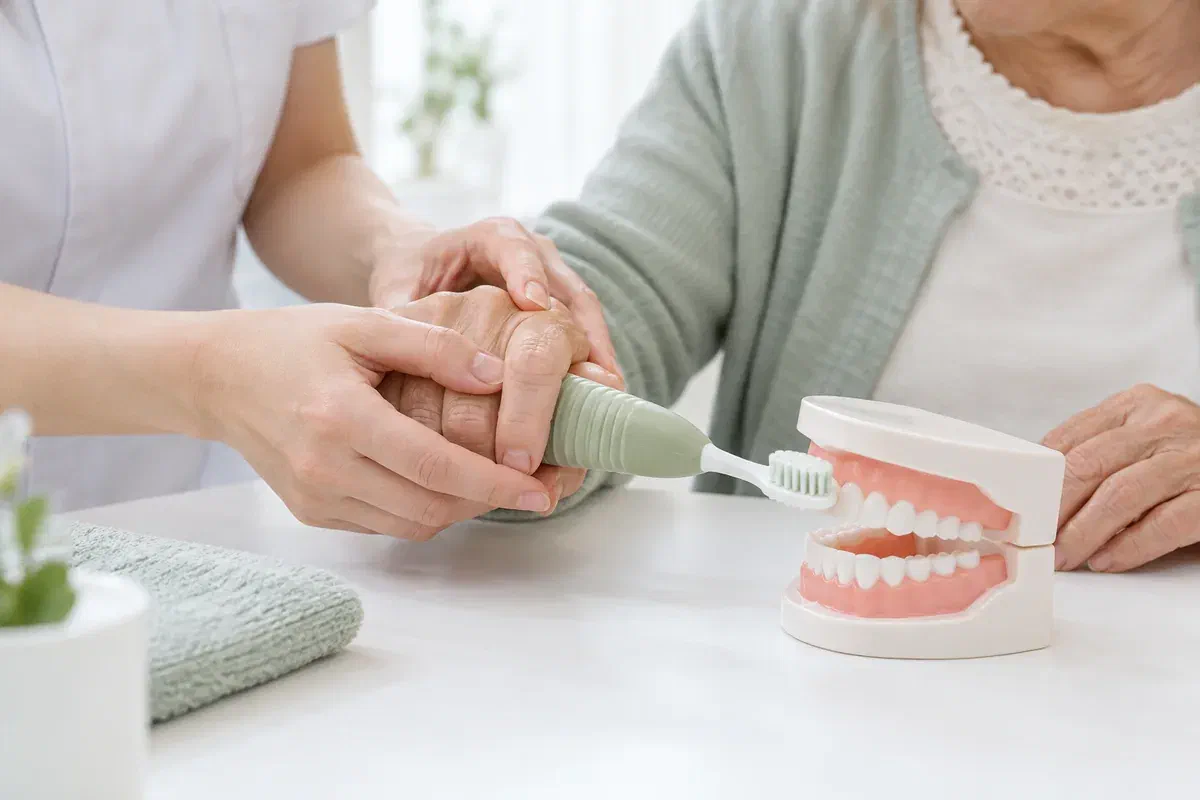
Illustrative practice with a larger toothbrush handle and a dental model
Before the appointment

Good days, hard days, and what helps

Memory loss looks different from person to person and even from morning to evening. Tell us what has made past visits easier and what has caused confusion or distress.

Conversation and recall

Mention hearing aids, glasses, a preferred language and whether the patient manages best with short explanations or a familiar phrase. Some need gentle reminders of why they are here. Say how you usually help, and we will keep inviting the patient’s own answers.

Moving, sitting and stamina

Describe mobility aids, unsteadiness, difficulty reclining or a tendency to tire late in the day. Confirm arrangements with us rather than expecting transfer help or particular equipment. These factors may shorten the visit or suggest a different setting.

Changes noticed at home

Watch for refusing to brush, pocketing food, bleeding gums, losing a denture or wincing while eating. Record what happened and when. A dental problem can show up as a change in mood, so these signs deserve an examination rather than being blamed on the dementia.

Phone promptly if there is strong pain, facial swelling, a refusal of meals and drinks, or a sudden worrying change. A gentle, get-to-know-us approach must not delay an urgent examination.

The companion as a memory

Continuity between the clinic and the kitchen

A partner who helps every day knows things the patient may not remember to mention: that the denture has gone missing twice, that brushing is easier after breakfast, that the bottom right side seems sore. With those details, the dental team can suggest a routine that fits the household and the patient’s current abilities.

Agree beforehand how the companion will take part. Some patients want them close by the entire time for reassurance; others want to speak for themselves first and bring the companion in for the summary. Note the preference when booking, and revisit it as needs change over months.

Patient information: NIDCR — oral health support and individualized care

A reliable history

Bring a current medication list, relevant care instructions and dated observations. Accuracy matters more than volume. Flag anything that should be confirmed with the patient’s family doctor, geriatric team or pharmacist.

Routines built on habit

Ask how brushing can be simplified and tied to an existing habit, and whether an adapted handle or powered brush would help. Some patients brush with prompting; others need the caregiver to brush. The plan should match the real task.

Written instructions for later

With the patient’s agreement, decide who receives information and how it is shared among family members. Before leaving, note the follow-up date, the symptoms that need a call and the daily steps.

What happens, in order

Calm, familiar steps from booking to follow-up

If the visit depends on particular support, please contact us before scheduling. We can discuss the reason for the appointment, what to bring and anything requiring additional planning.

  1. Describe the patient today

    Tell us about the dental concern, how memory changes affect conversation, and the support you will offer. Let us know who is coming and their role. Mention mobility or medical needs early, so the appointment setting is considered beforehand.

  2. Settle consent carefully

    The dentist talks with the patient about proposed care and determines which consent process applies. Capacity can vary by decision, and a spouse or child does not automatically have authority. If a substitute decision-maker is needed, the team must identify them and any documents.

  3. Move slowly, explain often

    Each step is introduced before it begins and repeated as needed. Agree a signal to pause, raise positioning concerns and watch for signs of confusion. A first visit might focus on assessment and planning, with treatment booked separately.

  4. Write the plan down

    Results, options, fees and follow-up are discussed with the patient and the authorized support person where appropriate. Ask for key points in writing. Agree who books the next visit and how to report new symptoms or brushing difficulties.

Everyday mouth care

Routines that rely on habit, not memory

Support may be a visual cue at the sink, a hand-over-hand guide or full brushing. Ask for an approach that suits what the patient can still do, and how they sit and swallow, instead of a technique meant for another person.

Prompt, then wait

Offer one short instruction at a time, then give the patient a moment to respond. Let them do the parts they still manage. If brushing becomes painful or agitating, stop and contact us, since discomfort may be the reason for resistance.

Keep tools simple and visible

Leave the same brush in the same spot, and ask about adapted handles or powered brushes. Choose with grip and safety in mind. Never put fingers between the teeth or force the mouth open.

Log what you see

Note bleeding, swelling, refused foods, a missing or loose denture, or new resistance to care, with dates. Precise records help the team more than describing the patient as uncooperative.

Ways to arrange care

Support shaped to the stage of memory loss

As memory changes progress, the right format may change too. Ask what our office can offer safely at this stage, and when a referral to another provider would be wiser.

Reassurance and recall

A visit with a familiar companion

A companion can share history and keep track of advice while the patient takes part in decisions. Agree when they should step in, and whether the patient wants any part of the conversation in private.

When a calmer pace helps

Short or staged appointments

Where clinically appropriate, shorter visits or care in stages may be discussed. Everyone should understand each visit’s purpose and limits. Urgent problems still need timely assessment.

When needs go beyond this office

Care with other resources

Advanced medical, behavioural or mobility needs sometimes call for a team with different facilities. We can discuss referral and keeping care connected. A companion’s presence does not widen what every office can do.

Memory-care questions

What families ask as needs change

Patients, spouses, adult children and support workers all ask about preparation. Arrangements should follow the patient’s wishes and the clinical purpose of the visit.

(905) 876-4488
My husband has early dementia. Should I tell the team before we arrive?
Yes, if he agrees. Knowing ahead helps us plan a calm pace and clear explanations. Share what helps him on a good day and what tends to cause confusion, so the visit can be organized around that.
Is a morning appointment better for someone who gets confused later in the day?
It may be. Think about when he is usually most settled, then ask what times are available. Our weekday hours run late morning to evening, with weekend visits by appointment.
Can my mother still make her own dental decisions after a dementia diagnosis?
A diagnosis alone does not settle that. Capacity can depend on the specific decision. The dentist assesses this as part of the consent process and involves a substitute decision-maker only where required.
She keeps losing her denture. What should we do?
Mention it at the visit. The team can discuss labelling, storage routines and what to do if a replacement is needed. Also watch for soreness or difficulty eating, which may mean the denture needs checking.
What if he becomes agitated and wants to leave mid-appointment?
Let the team know. We can pause, reassure, and talk about the safest next step, which might be a brief look, another appointment or a referral. We will not force care. Urgent symptoms still need a timely plan.
We live in the north of Caledon. How can we make each trip worthwhile?
Call ahead to confirm support and access needs and to share recent changes. Bring the medication list and any notes. Planning the time of day around the patient’s best hours can make a longer drive easier.
For Caledon families

Keep the plan steady, even when memory isn’t.

Phone our Bronte Street practice to describe the dental concern, the memory changes involved and who will attend. Telling us about access or communication needs early helps us prepare and explain what to bring.

Call to discuss particular access or support needs. Online requests do not confirm equipment, transfer help or appointment availability.

Visit Milton Dental Clinic
Unit 1, 342 Bronte St. S, Milton, ON L9T 5B7
Get directions Clinic hours
Monday–Thursday
11am–7pm
Friday–Sunday
By appointment only

Areas we serve

  • Milton
  • Oakville
  • Mississauga
  • Georgetown
  • Halton Hills
  • Acton
  • Campbellville
  • Brampton
  • Burlington
  • Puslinch
  • Rockwood
  • Erin
  • Caledon
  • Etobicoke
  • Old Milton
  • Bronte Meadows
  • Timberlea
  • Dorset Park
  • Dempsey
  • Clarke
  • Beaty
  • Coates
  • Harrison
  • Scott
  • Willmott
  • Ford
  • Bowes
  • Cobden
  • Walker
  • Mountain View
  • Milton Heights
  • Hawthorne Village
  • Valley View
  • Fallingbrook
  • Nassagaweya
  • Trafalgar
  • Esquesing
  • Nelson
  • Brookville
  • Moffat
  • Glen Williams
  • Norval
  • Limehouse
  • Stewarttown
  • Ashgrove
  • Hornby
  • Silver Creek
  • Speyside
  • Scotch Block
  • North Oakville
  • River Oaks
  • Glen Abbey
  • West Oak Trails
  • Palermo
  • Bronte Creek
  • College Park
  • Joshua Creek
  • Uptown Core
  • Preserve
  • Iroquois Ridge
  • Lisgar
  • Meadowvale
  • Meadowvale Village
  • Churchill Meadows
  • Erin Mills
  • Central Erin Mills
  • Streetsville
  • East Credit
  • Creditview
  • Heartland
  • Sheridan
  • Mount Pleasant
  • Credit Valley
  • Huttonville
  • Churchville
  • Springbrook
  • Northwest Brampton
  • Bram West
  • Fletcher's Meadow
  • Fletcher's Creek South
  • Alton Village
  • Orchard
  • Millcroft
  • Headon Forest
  • Tansley
  • Brant Hills
  • Tyandaga
  • Kilbride
  • Lowville
  • Aberfoyle
  • Morriston
  • Arkell
  • Hillsburgh
  • Freelton
  • Carlisle
  • Waterdown
  • Flamborough
  • Mountsberg

How can we help?

Milton Dental Clinic

Have a question about your smile? Choose the option that works best for you.

For urgent dental concerns, please call.
Messages are reviewed during clinic hours.