

Illustrative dental consultation with an older patient and her chosen support person
General & Family Dentistry

Caregiver-Assisted Dental Visits in Etobicoke

When a caregiver books time off to bring someone from Etobicoke, each appointment should count. Plan the support, paperwork and follow-up in advance, and know where to turn for urgent care closer to home.

Fewer trips, better planned

Make one well-prepared visit do the work of two.

A caregiver who travels from Etobicoke, in Toronto’s west end, usually juggles work hours, transport and the patient’s energy for the day. That makes preparation more valuable than usual. When we already know the concern, the support involved and the paperwork that matters, the appointment can focus on the person in the chair instead of on sorting out details.

The help a companion gives varies widely. It might be steadying someone on the walk in, filling gaps in a medical history, repeating instructions later, or doing all of the brushing at home. Tell us which roles apply, along with any swallowing, positioning or health issues, and our team can say what is practical here or whether another setting would suit better.

Through all of that, the patient stays the decision-maker wherever they are able. Their comfort, questions and preferences guide the visit. A caregiver can add important context about everyday life, but advice is shaped around the individual, not around a general assumption tied to age or a condition.

Plan an organised supported visit
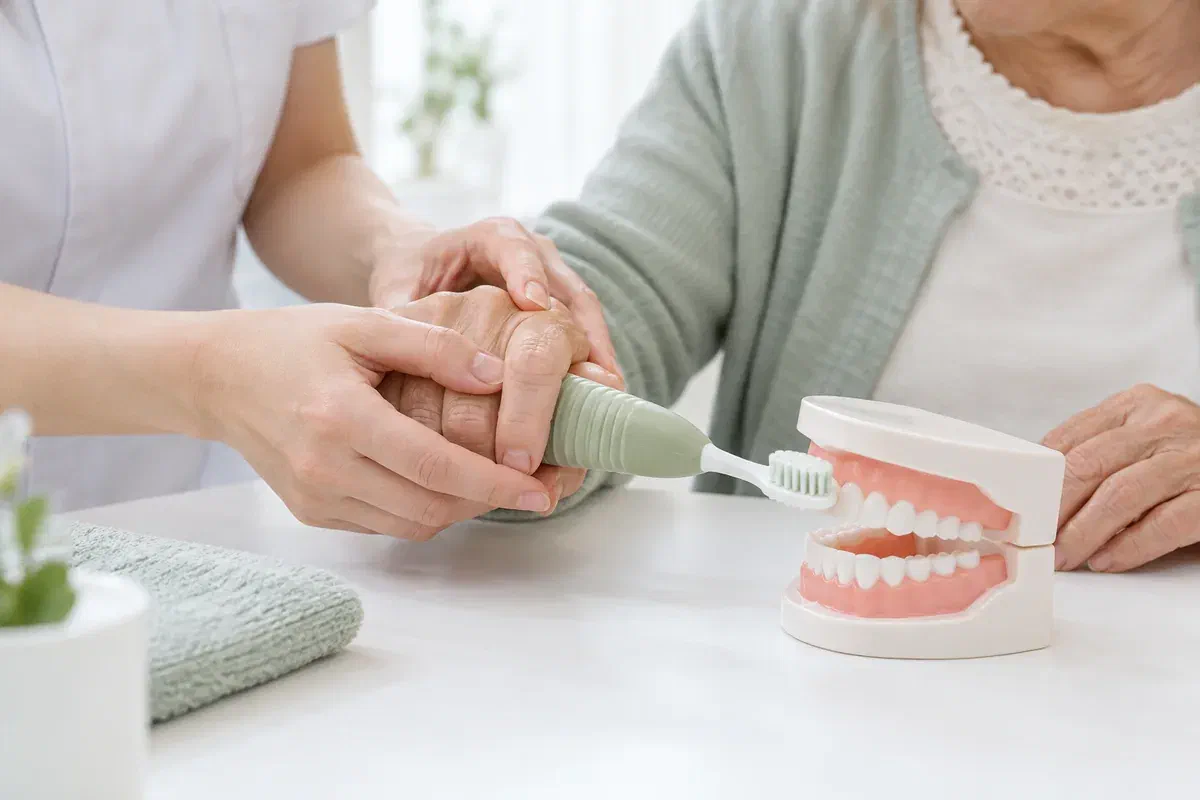
Illustrative practice with a larger toothbrush handle and a dental model
Send this before the trip

The details that save a second journey

A diagnosis rarely tells the full story. What made earlier appointments go well, or go badly, is often the most useful thing a caregiver can share ahead of time.

How the patient communicates

Describe hearing or vision needs, a preferred language, a communication aid, or a need for slower conversation. Some people manage best with single steps. Tell us how you usually assist so the patient still has the chance to answer in their own way.

Mobility, posture and fatigue

Explain mobility devices, transfer help, trouble reclining and how long the patient can stay seated after a long ride. Confirm arrangements with us rather than assuming lifting assistance or certain equipment is available. Travel fatigue may influence how much is planned for one visit.

Recent changes at home

Point out bleeding gums, a denture causing sores, foods being avoided or new resistance to brushing, with approximate dates. Changes like these warrant an examination and should not be put down to temperament or an existing diagnosis.

For strong pain, swelling, an inability to eat or drink, or a sudden alarming change, call right away. Given the distance, ask whether care nearer home or a hospital would be the quicker route.

Why the caregiver’s input matters

Clear advice to carry home

On a long trip back, instructions have a way of blurring. A caregiver who knows the home routine can make sure advice is grounded in reality from the start: which hand motions are painful, whether dentures stay in at night, which side of the mouth gets avoided. Recommendations built on that are easier to follow for weeks afterward.

Agree before the visit how the companion will take part. Some patients want support for the whole appointment; others would rather speak alone and invite their helper back for the summary. Note it when booking. If needs change between visits, the arrangement can change too.

Patient information: NIDCR — oral health support and individualized care

Paperwork ready on day one

A current medication list, relevant care notes and dated observations help the team understand the situation without a second trip. Flag anything you are unsure of, so it can be confirmed with the patient’s doctor or pharmacist.

Practical brushing coaching

Ask for brushing and between-teeth cleaning methods adapted to the patient’s reach and grip. An enlarged handle might let one person carry on independently, while another needs full help. A short demonstration avoids guesswork later.

Follow-up without phone tag

Decide, with the patient’s consent, who receives updates and how. Before leaving, confirm the next appointment, warning signs and daily care, so the household does not need extra calls to rebuild the plan.

Organising the appointment

Most of the planning happens by phone.

Call us before booking if the appointment needs specific support. We can cover the reason for the visit, what to bring and whether anything calls for further arrangement, so the drive is worthwhile.

  1. Give us the full picture

    Share the dental concern, the patient’s communication preferences and the help you will provide. Let us know who will attend and their role. Describe access and medical needs so the setting can be confirmed in advance.

  2. Settle consent before the day

    Care options are discussed with the patient, and the dentist confirms the right consent pathway. A caregiver making the journey does not, through that alone, gain authority over treatment. If another person must decide, identifying them and their documentation early prevents a wasted visit.

  3. Assess without hurrying

    Every step is explained in terms the patient can follow. Agree a pause signal, mention positioning concerns and watch for signs of fatigue. Where appropriate, assessment and planning may be grouped efficiently, with treatment scheduled for a later visit.

  4. Leave with every answer

    Findings, options, fees and next steps are reviewed with the patient and any authorized representative. Ask until the home routine is clear. Settle who will book the next appointment and how to reach us about new symptoms.

Between visits

Home care that holds up until the next appointment

Assistance can mean a prompt, a guiding hand or complete brushing. Ask for guidance tailored to the patient’s abilities and any swallowing or positioning precautions, instead of reusing a technique designed for another person.

Keep the patient involved

Describe each step before starting, and let them contribute what they can. They may brush the lower teeth well but need help above. If care becomes sore or upsetting, stop and call us to talk through what might be causing it.

Use the right equipment

Ask whether a broad-handled or powered brush, or another aid, suits the patient’s grip and coordination. Safety matters as much as effectiveness. Never slip fingers between the teeth or force the mouth open.

Keep a short log

Jot down bleeding, swelling, refused foods, denture trouble or a drop in comfort during care, with dates. A clear log helps us judge whether something needs attention sooner than the next planned visit.

Formats to consider

Which kind of visit makes the trip worthwhile?

The right approach depends on the dental concern and the help needed. Ask what can be provided safely here, and when a referral nearer home or elsewhere would make more sense.

Shared history and reminders

An assessment with the caregiver

Your companion can supply background or note instructions while the patient takes part in each decision. Agree in advance when they should speak, and whether a private conversation is wanted for any part.

When pacing matters

A staged plan

If clinically suitable, a shorter introduction or care split into stages may be discussed, timed to keep trips manageable. Each visit’s aim and limits should be clear. Urgent disease still needs prompt assessment.

When needs are greater

A different provider

Some medical, mobility or procedural needs are better served in a setting with other facilities, possibly closer to where the patient lives. We can discuss referral and keeping records connected. Support at the chairside does not expand what any office can safely do.

Planning from a distance

Questions caregivers ask before the drive

Patients, relatives and paid support workers ask us how best to prepare. The answers below assume one principle: the patient’s wishes and dental needs come before convenience.

(905) 876-4488
Can several dental concerns be looked at in one supported visit?
Mention everything when booking so the team can plan the time. Whether multiple concerns can be addressed together depends on the patient’s comfort, stamina and what is clinically appropriate. Sometimes assessment happens first and treatment is scheduled afterward.
Where should we go if dental pain flares up between appointments?
Call us first to describe the problem. Given the travel involved, we may suggest seeking care closer to home. Swelling that affects breathing or swallowing, or a high fever with facial swelling, calls for emergency medical attention right away.
My brother handles Dad’s finances. Can he consent to his dental work?
Managing finances does not automatically include authority over health decisions. The dentist must use the correct consent process, involving a substitute decision-maker only where required. Tell us about any arrangements and ask what documents to bring.
Should I bring snacks or water for the patient?
Bring what the patient normally needs for a longer outing, especially for medical reasons such as diabetes. Ask the team whether eating or drinking should be avoided before or after any procedure planned for that day.
What happens if Mum is too worn out to finish once we arrive?
Tell us. We can stop and discuss what makes most sense, such as a brief look, a return visit, different preparation or a referral. We will not push on. Pain or worrying symptoms still need a plan, which may include care nearer home.
Can follow-up questions be handled by phone after we get back to Etobicoke?
Many questions about home care or next steps can be raised by phone. Agree beforehand who is allowed to receive information. New symptoms may still need an in-person look, here or closer to home, depending on urgency.
Supported visits from Etobicoke

Plan ahead and the visit can stay unhurried.

Phone our Bronte Street practice to outline the dental concern, the support involved and any access needs. The more we know beforehand, the better we can organise the day and tell you exactly what to bring.

Call to confirm access or support arrangements before travelling. Website requests are not confirmation of equipment, transfer help or an appointment.

Visit Milton Dental Clinic
Unit 1, 342 Bronte St. S, Milton, ON L9T 5B7
Get directions Clinic hours
Monday–Thursday
11am–7pm
Friday–Sunday
By appointment only

Areas we serve

  • Milton
  • Oakville
  • Mississauga
  • Georgetown
  • Halton Hills
  • Acton
  • Campbellville
  • Brampton
  • Burlington
  • Puslinch
  • Rockwood
  • Erin
  • Caledon
  • Etobicoke
  • Old Milton
  • Bronte Meadows
  • Timberlea
  • Dorset Park
  • Dempsey
  • Clarke
  • Beaty
  • Coates
  • Harrison
  • Scott
  • Willmott
  • Ford
  • Bowes
  • Cobden
  • Walker
  • Mountain View
  • Milton Heights
  • Hawthorne Village
  • Valley View
  • Fallingbrook
  • Nassagaweya
  • Trafalgar
  • Esquesing
  • Nelson
  • Brookville
  • Moffat
  • Glen Williams
  • Norval
  • Limehouse
  • Stewarttown
  • Ashgrove
  • Hornby
  • Silver Creek
  • Speyside
  • Scotch Block
  • North Oakville
  • River Oaks
  • Glen Abbey
  • West Oak Trails
  • Palermo
  • Bronte Creek
  • College Park
  • Joshua Creek
  • Uptown Core
  • Preserve
  • Iroquois Ridge
  • Lisgar
  • Meadowvale
  • Meadowvale Village
  • Churchill Meadows
  • Erin Mills
  • Central Erin Mills
  • Streetsville
  • East Credit
  • Creditview
  • Heartland
  • Sheridan
  • Mount Pleasant
  • Credit Valley
  • Huttonville
  • Churchville
  • Springbrook
  • Northwest Brampton
  • Bram West
  • Fletcher's Meadow
  • Fletcher's Creek South
  • Alton Village
  • Orchard
  • Millcroft
  • Headon Forest
  • Tansley
  • Brant Hills
  • Tyandaga
  • Kilbride
  • Lowville
  • Aberfoyle
  • Morriston
  • Arkell
  • Hillsburgh
  • Freelton
  • Carlisle
  • Waterdown
  • Flamborough
  • Mountsberg

How can we help?

Milton Dental Clinic

Have a question about your smile? Choose the option that works best for you.

For urgent dental concerns, please call.
Messages are reviewed during clinic hours.