

Illustrative dental consultation with an older patient and her chosen support person
General & Family Dentistry

Caregiver-Assisted Dental Visits in Halton Hills

After a hospital stay or a new diagnosis, someone in the family often takes over mouth care overnight. If that is you, in Halton Hills, a supported dental visit can help you learn what to do.

New to caregiving

Suddenly responsible for someone else’s mouth care?

Nobody hands you a manual when a parent comes home from hospital unable to brush on their own. Across Georgetown, Acton, Glen Williams and the hamlets in between, families take on tasks like this with little warning. Mouth care is easy to overlook in the rush, yet it affects comfort, eating and overall well-being, which is why a supported dental visit can be such a useful early step.

The appointment gives you both a chance to explain what has changed. Describe how the patient communicates now, what feels comfortable, and any mobility, swallowing, positioning or medication issues that affect care. Our team can then talk about what we can arrange, and whether a different provider or setting would better meet those needs.

Your relative is still the one we are treating and talking with. You may describe things they find hard to explain, especially changes since the illness, and that information is valuable. Still, the plan must reflect what they want and can manage, rather than a guess based on age or their medical history.

Book a visit to learn alongside them
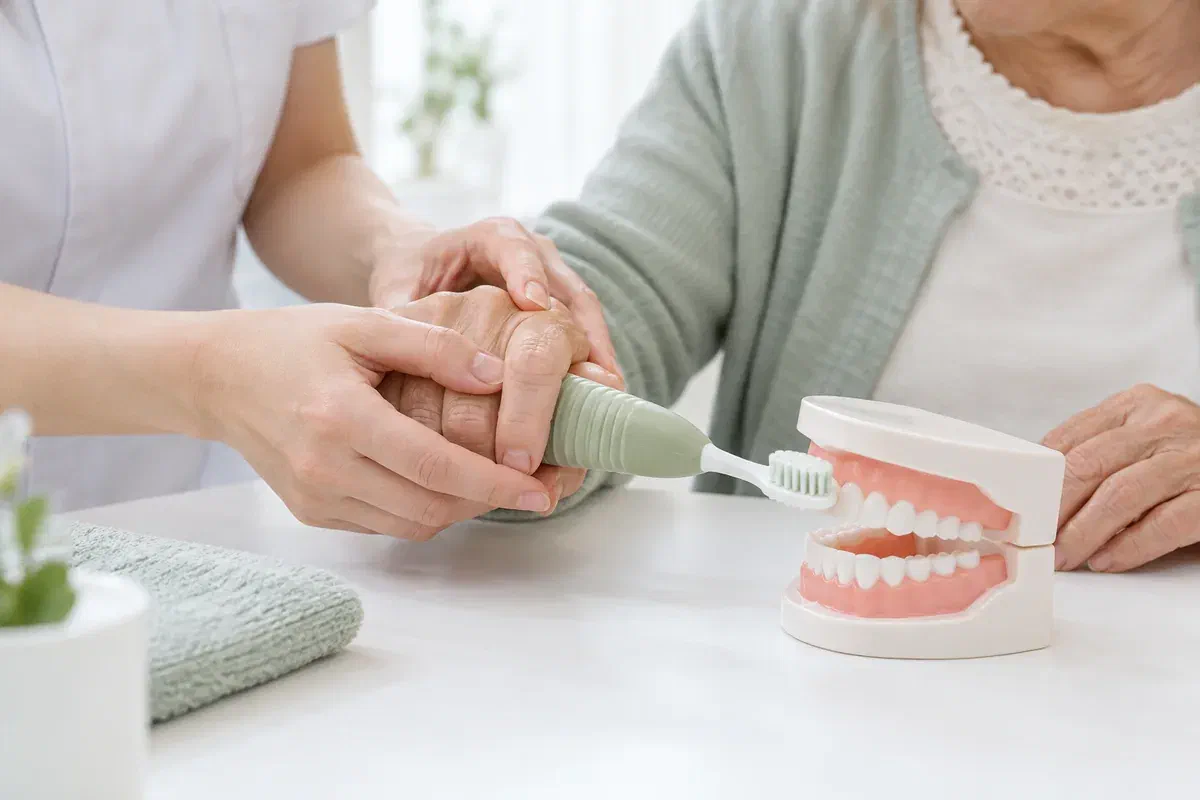
Illustrative practice with a larger toothbrush handle and a dental model
What has changed lately

Start with the new routine, not just the diagnosis.

The same condition can affect two people very differently. Tell us what the patient managed before, what they struggle with now, and what has made recent appointments of any kind easier.

Speech, hearing and attention

A recent illness may affect speech, hearing, memory or concentration. Tell us about aids used, the patient’s preferred language, and whether short instructions help. Explain how you support communication, and we will keep checking in with the patient directly.

Strength, balance and positioning

Describe walkers or wheelchairs, weakness on one side, difficulty reclining and how quickly the patient tires. Ask us what can be arranged instead of assuming transfer help or particular equipment. These details may affect appointment length or point to another setting.

What you are noticing during care

New caregivers often see bleeding when brushing, food pocketing on one side, a denture that no longer fits, or flinching during cleaning. Note when it started and what happened. These signs need a look and should not be assumed to be part of recovery.

Severe pain, a swollen face or jaw, being unable to manage meals or fluids, or an abrupt change in your relative deserves a prompt call. A teaching appointment should never hold up urgent care.

Learning together

Confidence for the person holding the toothbrush

Many new caregivers worry about doing harm: brushing too hard, missing the back teeth, or handling a denture wrongly. Describing exactly what you do now, and where you hesitate, lets the dental team offer advice suited to your home and your relative’s abilities rather than general guidance that leaves you guessing.

Discuss early how the patient wants you involved during the visit. Some want a family member at their side from start to finish. Others prefer to speak with the dentist on their own and bring you in for the practical lesson. Both are fine, and the arrangement can shift as recovery continues.

Patient information: NIDCR — oral health support and individualized care

Discharge notes and medication lists

Bring the current medication list and any discharge papers or care instructions that touch on eating, swallowing or oral care. Mark anything uncertain; the hospital team or family doctor may need to confirm it.

A hands-on demonstration

Ask to see how brushing and cleaning between teeth can be done for someone with limited grip or one-sided weakness. Sometimes an adapted handle restores independence; sometimes a caregiver needs to take over. Guidance should match the real task.

Knowing who to call

Agree, with your relative’s permission, who receives instructions and how they are shared. Confirm the next visit, warning signs and the daily routine before leaving, so you are not left unsure once you are back home.

How it works

A plan in four parts

When the visit hinges on particular support, a call before booking helps. Together we can cover why the patient needs to be seen, which papers to bring and anything needing extra preparation.

  1. Describe the recent changes

    Tell us the dental concern, how the patient communicates now and the help you provide. Let us know who will attend and their role. Mention new mobility or medical needs so the setting can be considered ahead of time.

  2. Confirm decision-making

    The patient is offered information about any proposed care and the dentist follows the appropriate consent process. A family member’s new caregiving role does not by itself bring authority over treatment. Where someone else legally decides for the patient, the team needs to know who that is and see the relevant documents.

  3. Go step by step

    We talk through the examination in plain language as it happens. Agree a way to signal for a pause, mention positioning concerns, and keep us informed about how the patient feels. An early appointment may focus on assessment and teaching, with treatment arranged later.

  4. Agree on the plan

    Results, options, costs and the timing of the next visit are reviewed with your relative and any authorized helper. Keep asking about home care until you feel ready. Settle who books the follow-up and whom to call if something new appears.

Mouth care at home

Gentle, consistent, and shared where possible

Help may range from a reminder at the sink to brushing every tooth yourself. Request advice that fits your relative’s abilities and any swallowing or positioning precautions instead of following a method meant for someone else.

Work with them, not around them

Explain what you are going to do and let them do any part they can, even holding the brush with you. If care becomes painful or distressing, stop and ask us what might be making it harder.

Choose safe, simple tools

Ask whether a wider grip, a powered toothbrush or a specific cleaning aid would help. Choices should reflect grip, coordination and safety. Keep your fingers out from between the teeth, and never pry the jaw open to get the job done.

Watch and record

Note bleeding, swelling, foods refused, denture problems or growing discomfort during care, along with dates and details. Specific observations help the team far more than a sense that care is simply getting harder.

Choosing a starting point

Three possible routes

Where to go from here turns on the dental problem and the amount of assistance your relative requires. Ask what our office can do safely, and when a referral would be the better choice.

Communication and reminders

A visit with family present

A relative can share history and keep track of instructions while the patient remains part of every decision. Agree when you should speak, and whether the patient would like a private conversation for any part of it.

When building comfort helps

An introduction or staged care

Where clinically suitable, a short first visit or care in stages may be considered, especially during recovery. The purpose and limits should be clear to everyone. Urgent issues still need prompt assessment.

When more support is needed

Another care setting

During recovery, some health, mobility or treatment needs are best handled where different facilities are available. We can discuss referral and coordinated care. Having family along will not make every treatment possible in a general office.

For new caregivers

Questions families ask in the first months

Patients, relatives and support workers across Halton Hills all ask how to get started. Whatever you arrange, base it on what your relative wants and on why they need dental care right now.

(905) 876-4488
Mum just came home from hospital. How soon should she see a dentist?
If there is pain, swelling, a broken tooth or trouble eating, call promptly. Otherwise, ask when a routine visit makes sense given her recovery, and check whether her medical team has any guidance about timing or precautions.
How do I brush someone else’s teeth without hurting them?
Ask for a demonstration during the visit. Positioning, a soft brush and gentle, unhurried movements generally help. The team can adjust the technique for how your relative sits, swallows and responds to touch.
I am now my father’s main caregiver. Does that mean I can consent for him?
Not automatically. Becoming his caregiver does not by itself grant decision-making authority. Consent comes from him wherever he is capable, and from a recognized substitute decision-maker only when the law calls for one. Tell us about any arrangements and ask what documents to bring.
Should dentures stay in overnight after a stroke?
Ask the dental team, and share any guidance from the patient’s other clinicians. Recommendations depend on the denture, the mouth and swallowing safety. A demonstration of cleaning and storage can be part of the visit.
What if my relative cannot sit through the whole examination?
Tell us during the visit. We can pause and consider the safest option, which may be a shorter assessment, another appointment, adjusted preparation or a referral. Nothing should be forced, and urgent symptoms still need timely attention.
We live in a rural part of Halton Hills. How can we cut down on trips?
Call before booking so support and access needs are settled. Bring the medication list and discharge notes, and share the main concern ahead of time. That helps the appointment focus on what matters and may reduce the need for extra visits.
Halton Hills caregivers

You do not have to work it out alone.

Phoning our Bronte Street practice is the easiest first step. Explain what is happening in your relative’s mouth and the help they now need, including communication, access and swallowing issues, and we will plan from there.

Phone to discuss specific access or support needs. Submitting a request online is not confirmation of equipment, transfer assistance or a booking.

Visit Milton Dental Clinic
Unit 1, 342 Bronte St. S, Milton, ON L9T 5B7
Get directions Clinic hours
Monday–Thursday
11am–7pm
Friday–Sunday
By appointment only

Areas we serve

  • Milton
  • Oakville
  • Mississauga
  • Georgetown
  • Halton Hills
  • Acton
  • Campbellville
  • Brampton
  • Burlington
  • Puslinch
  • Rockwood
  • Erin
  • Caledon
  • Etobicoke
  • Old Milton
  • Bronte Meadows
  • Timberlea
  • Dorset Park
  • Dempsey
  • Clarke
  • Beaty
  • Coates
  • Harrison
  • Scott
  • Willmott
  • Ford
  • Bowes
  • Cobden
  • Walker
  • Mountain View
  • Milton Heights
  • Hawthorne Village
  • Valley View
  • Fallingbrook
  • Nassagaweya
  • Trafalgar
  • Esquesing
  • Nelson
  • Brookville
  • Moffat
  • Glen Williams
  • Norval
  • Limehouse
  • Stewarttown
  • Ashgrove
  • Hornby
  • Silver Creek
  • Speyside
  • Scotch Block
  • North Oakville
  • River Oaks
  • Glen Abbey
  • West Oak Trails
  • Palermo
  • Bronte Creek
  • College Park
  • Joshua Creek
  • Uptown Core
  • Preserve
  • Iroquois Ridge
  • Lisgar
  • Meadowvale
  • Meadowvale Village
  • Churchill Meadows
  • Erin Mills
  • Central Erin Mills
  • Streetsville
  • East Credit
  • Creditview
  • Heartland
  • Sheridan
  • Mount Pleasant
  • Credit Valley
  • Huttonville
  • Churchville
  • Springbrook
  • Northwest Brampton
  • Bram West
  • Fletcher's Meadow
  • Fletcher's Creek South
  • Alton Village
  • Orchard
  • Millcroft
  • Headon Forest
  • Tansley
  • Brant Hills
  • Tyandaga
  • Kilbride
  • Lowville
  • Aberfoyle
  • Morriston
  • Arkell
  • Hillsburgh
  • Freelton
  • Carlisle
  • Waterdown
  • Flamborough
  • Mountsberg

How can we help?

Milton Dental Clinic

Have a question about your smile? Choose the option that works best for you.

For urgent dental concerns, please call.
Messages are reviewed during clinic hours.