

Illustrative dental consultation with an older patient and her chosen support person
General & Family Dentistry

Caregiver-Assisted Dental Visits in Milton

Bringing a parent, partner or client to the dentist raises a simple question: who does what in the room? We help you plan that in Milton, keeping the patient’s own voice at the centre.

Two people, one appointment

Who speaks first when you both walk in?

Many adult children in Milton find themselves driving a mother or father to appointments they once handled alone. The car ride is easy. The harder part starts in the treatment room, when it is unclear whether you should answer the questions, fill in gaps, or simply sit nearby. A caregiver-assisted visit is a way of deciding that ahead of time instead of improvising.

Support takes many shapes. One person needs help recalling which medications changed last month. Another hears well but struggles with a long list of instructions, or needs an arm when moving to the chair. Someone else manages perfectly in conversation but cannot keep up with brushing at home. Telling us which of these apply lets our team prepare for the person who is actually coming.

Throughout, the patient stays the one being cared for and consulted. Your observations about eating, comfort and daily routines are useful, and sometimes they fill in details the patient cannot easily describe. Even so, the plan should follow what that person wants and can manage, rather than an assumption based on age or a medical label.

Start planning a supported visit
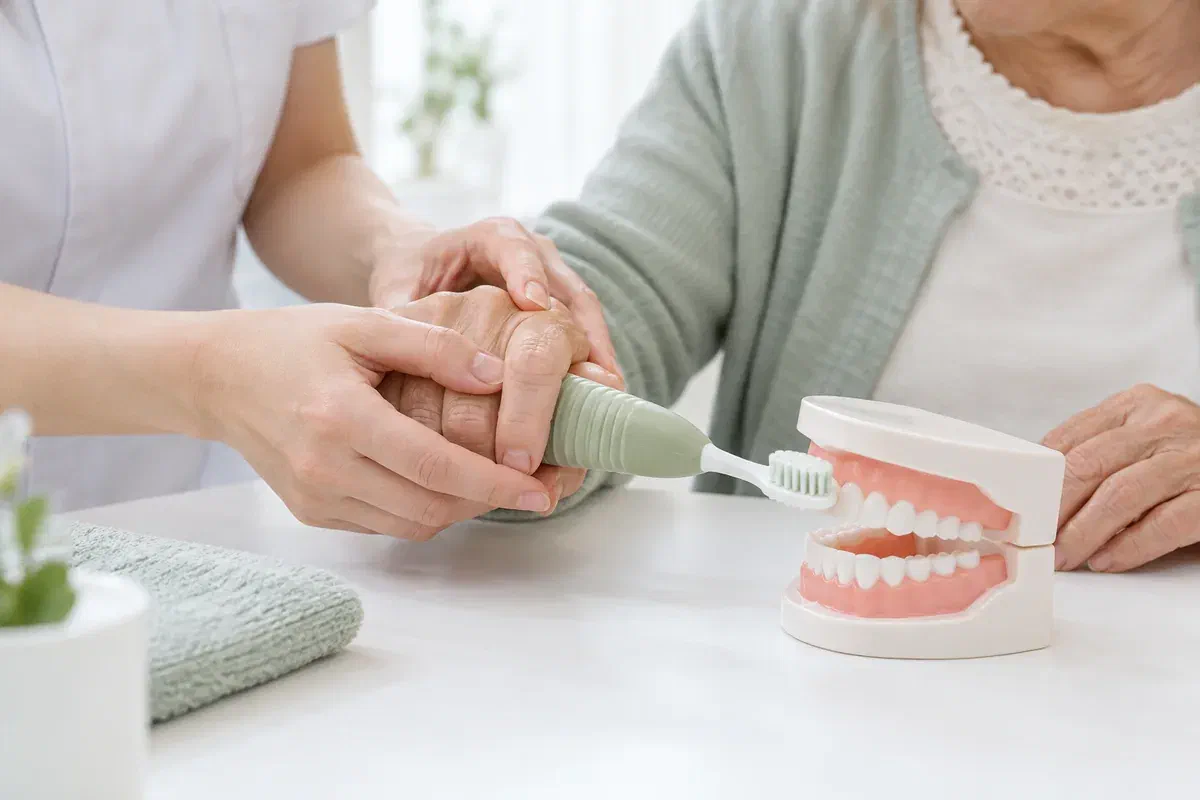
Illustrative practice with a larger toothbrush handle and a dental model
Before you book

Tell us what a good visit would look like for them.

A diagnosis on its own says little about what someone needs in a dental chair. Past appointments are often the best guide, including the moments that went smoothly and the ones that did not.

How they take in information

Mention hearing aids, glasses, a preferred language, or a habit of needing a pause before answering. Some people follow better with one step at a time. Say how you usually help, so the conversation still leaves space for the patient’s own replies.

Getting into and staying in the chair

Describe walkers, wheelchairs, difficulty lying back, or how long they can sit before tiring. Ask us to confirm what can be arranged rather than assuming a lift or transfer help will be on hand. These details can change the visit’s length or suggest a different setting.

What you have seen at home

Perhaps they now chew on one side, their gums bleed when brushed, a denture no longer stays put, or they resist mouth care. Note what you saw and when. A change like this needs a look, not a shrug that it is just part of their condition.

Call us promptly about strong pain, facial swelling, trouble eating or drinking, or any sudden change that worries you. A gentle get-to-know-us visit is not a reason to wait on something urgent.

Why a second person can help

Advice that survives the trip home

Recommendations only matter if they can be carried out on an ordinary Tuesday evening in a Milton kitchen. A companion can describe the real routine: who holds the brush, whether a partial denture comes out at night, which area seems sore. Suggestions can then match the household instead of an ideal that never happens.

It also helps to settle early how involved you will be. Some people want their companion beside them from start to finish. Others would rather handle the conversation themselves and call you in for the instructions at the end. Either is reasonable, and the arrangement can shift later if health or preferences change.

Patient information: NIDCR — oral health support and individualized care

A fuller health picture

Bring an up-to-date medication list and any care notes that matter for dental treatment. Stick to information you know is accurate, and flag anything you are unsure about so it can be checked with the patient’s physician or another clinician.

Home-care tips that match their hands

Ask to see how brushing and flossing can be adjusted for reach, grip and coordination. A thicker handle might let one person keep brushing on their own, while another needs someone to do it for them. The advice should fit the person in front of us.

Instructions that do not get lost

Decide together who receives follow-up information and how it will be passed on, with the patient’s consent. Before leaving, confirm the next appointment, what to watch for, and what daily care looks like so nobody is guessing at the kitchen table later.

How we set it up

Four conversations, mostly before the visit

If the appointment depends on particular support, please reach out before choosing a time. We can talk about the purpose of the visit, the details to bring along, and anything that needs extra arrangement.

  1. Start with what matters to the patient

    Describe the dental problem, how the patient likes to communicate, and the help you expect to give. Tell us who is coming and in what role, plus any access or health needs, so nothing is left to sort out at the front desk.

  2. Settle questions about consent

    The dentist explains proposed care to the patient and follows the correct consent process. Coming along with someone does not, by itself, give a companion the right to make treatment decisions. If a substitute decision-maker is required, the team needs to identify that person and any supporting documents.

  3. Examine without rushing

    Each part of the examination is explained in a way that suits the patient. Agree on a signal for a break, raise any positioning concerns, and let us know how they seem to be coping. Sometimes the first visit is mainly an assessment, with treatment booked for another day.

  4. Leave with one shared plan

    We go over findings, options, costs and follow-up with the patient and, where appropriate, the authorized support person. Ask about any unclear home-care advice. Decide who books the next visit and how to report new symptoms or struggles at home.

Back at home

Help that leaves room for them to do what they can

Caregiving might mean a reminder by the sink or brushing someone else’s teeth entirely. Request guidance that fits the patient’s abilities and any limits on swallowing or positioning, rather than borrowing a method meant for another person.

Talk them through it

Say what you are about to do, and let them take part wherever they can. Someone might manage the front teeth and need help at the back. If the routine starts to hurt or upset them, stop and ask us what may be making it hard.

Choose tools with care

Ask whether a wider grip, an electric brush or a specific cleaning aid would make a difference. The right product depends on grip strength, coordination and whether it can be used safely. Never put your fingers between their teeth or pry the mouth open to finish.

Keep simple notes

Write down bleeding, puffiness, foods being refused, denture trouble, or a shift in how comfortable care feels. Include the date it started and what you noticed. Concrete details let us assess the problem far better than a general sense that they are being difficult.

Picking a format

Not every supported visit looks the same.

What comes next depends on the dental concern and how much help is needed. We can talk through what is safe and comfortable here, and when a referral makes more sense.

Help with history and reminders

A visit with a companion present

Your companion can fill in background details or keep track of instructions while you stay part of every decision. Agree in advance when they should step in, and say if you would like some of the conversation to happen without them.

When getting familiar comes first

A gradual, step-by-step start

Where it is clinically suitable, a brief introductory appointment or care spread across several stages may be offered. Everyone should understand what each visit is for and what it cannot do. An urgent problem still needs prompt attention, even when routine care is usually built up slowly.

When more resources are needed

Care arranged elsewhere

Certain medical, mobility or treatment needs are better met by a provider with different facilities. We can discuss a referral and how care stays connected. Having a caregiver along does not mean every procedure can be done in any office.

What companions ask us

Practical answers for the person beside the patient

These questions come from patients, relatives and paid support workers around Milton. In every case, arrangements should follow the patient’s wishes and the clinical reason for the visit.

(905) 876-4488
My father prefers to answer for himself. Should I still come into the treatment room?
That is his call. You can come in for the start and step out, wait outside until instructions are given, or stay the whole time. Let us know his preference when booking. He can also change his mind on the day, and we will follow his lead.
Does being someone’s power of attorney let me agree to dental work on their behalf?
It depends on the type of document and whether the patient is able to make the decision themselves. The dentist must follow the proper consent process. Please tell us about any arrangement in place and ask what paperwork to bring so it can be reviewed before treatment is discussed.
How much health information should I bring for a parent?
A current medication list, recent changes in health, the reason for the visit, and contact details for their doctor are a good start. Add what you have noticed about daily mouth care. If you are unsure of something, say so rather than guessing, and we can confirm it with the right person.
Is it better to book a morning or late-day appointment for someone who tires easily?
Think about when the patient is usually most alert and comfortable, then ask what times are available. Our weekday hours run from late morning into the evening, with weekend visits by appointment. Mention fatigue when you book so the length and pacing of the visit can be considered.
What happens if my mother becomes too uncomfortable to finish the exam?
Tell the team straight away. The examination can pause, and we can talk through the safest next step, which might be a shorter assessment, a return visit, a different approach to preparation, or a referral. We will not push through. Pain or urgent symptoms still need a timely plan.
Can you show me how to clean a partial denture for someone else?
Yes, you can ask for that during the visit. A demonstration can cover handling, cleaning and when to remove the denture, adjusted to the patient’s comfort and any swallowing or positioning concerns. Ask what changes in fit or soreness should prompt a call back.
Supported visits in Milton

Tell us about the support, and we will plan around it.

Call our Bronte Street practice to describe the dental concern and the kind of help the patient would like on the day. Raise communication or access needs as early as you can, and we will talk through the arrangements and what to bring.

Please phone to discuss particular access or support needs. An online request does not confirm equipment, transfer help or an appointment time.

Visit Milton Dental Clinic
Unit 1, 342 Bronte St. S, Milton, ON L9T 5B7
Get directions Clinic hours
Monday–Thursday
11am–7pm
Friday–Sunday
By appointment only

Areas we serve

  • Milton
  • Oakville
  • Mississauga
  • Georgetown
  • Halton Hills
  • Acton
  • Campbellville
  • Brampton
  • Burlington
  • Puslinch
  • Rockwood
  • Erin
  • Caledon
  • Etobicoke
  • Old Milton
  • Bronte Meadows
  • Timberlea
  • Dorset Park
  • Dempsey
  • Clarke
  • Beaty
  • Coates
  • Harrison
  • Scott
  • Willmott
  • Ford
  • Bowes
  • Cobden
  • Walker
  • Mountain View
  • Milton Heights
  • Hawthorne Village
  • Valley View
  • Fallingbrook
  • Nassagaweya
  • Trafalgar
  • Esquesing
  • Nelson
  • Brookville
  • Moffat
  • Glen Williams
  • Norval
  • Limehouse
  • Stewarttown
  • Ashgrove
  • Hornby
  • Silver Creek
  • Speyside
  • Scotch Block
  • North Oakville
  • River Oaks
  • Glen Abbey
  • West Oak Trails
  • Palermo
  • Bronte Creek
  • College Park
  • Joshua Creek
  • Uptown Core
  • Preserve
  • Iroquois Ridge
  • Lisgar
  • Meadowvale
  • Meadowvale Village
  • Churchill Meadows
  • Erin Mills
  • Central Erin Mills
  • Streetsville
  • East Credit
  • Creditview
  • Heartland
  • Sheridan
  • Mount Pleasant
  • Credit Valley
  • Huttonville
  • Churchville
  • Springbrook
  • Northwest Brampton
  • Bram West
  • Fletcher's Meadow
  • Fletcher's Creek South
  • Alton Village
  • Orchard
  • Millcroft
  • Headon Forest
  • Tansley
  • Brant Hills
  • Tyandaga
  • Kilbride
  • Lowville
  • Aberfoyle
  • Morriston
  • Arkell
  • Hillsburgh
  • Freelton
  • Carlisle
  • Waterdown
  • Flamborough
  • Mountsberg

How can we help?

Milton Dental Clinic

Have a question about your smile? Choose the option that works best for you.

For urgent dental concerns, please call.
Messages are reviewed during clinic hours.