

Illustrative dental consultation with an older patient and her chosen support person
General & Family Dentistry

Caregiver-Assisted Dental Visits in Mississauga

When a relative helps translate or explain, a dental visit works best if everyone knows that role in advance. Plan a supported appointment from Mississauga that keeps the patient in the conversation.

Language, hearing and understanding

A conversation that includes everyone

A grandmother who is most comfortable in Punjabi, Tagalog or Polish may bring a grandson to her check-up. A man recovering from a stroke may need his daughter to help him find words. In both cases the companion is there to bridge a gap, and the dental visit goes better when that role has been talked about before anyone sits down.

Caregiver-assisted appointments cover communication help and much more: transport, reminders, mobility and brushing at home. Let us know which pieces apply. Describe what puts the patient at ease, how they prefer to express themselves, and any medical, swallowing or positioning concerns. Our team can then explain what can be arranged and whether another setting might serve them better.

Even with help, the patient stays at the heart of the discussion. We speak to them directly, give them time, and check that their own wishes are being heard rather than summarized. A relative’s observations add valuable context; the plan, though, should fit the person instead of their age or a diagnosis.

Talk to us about communication support
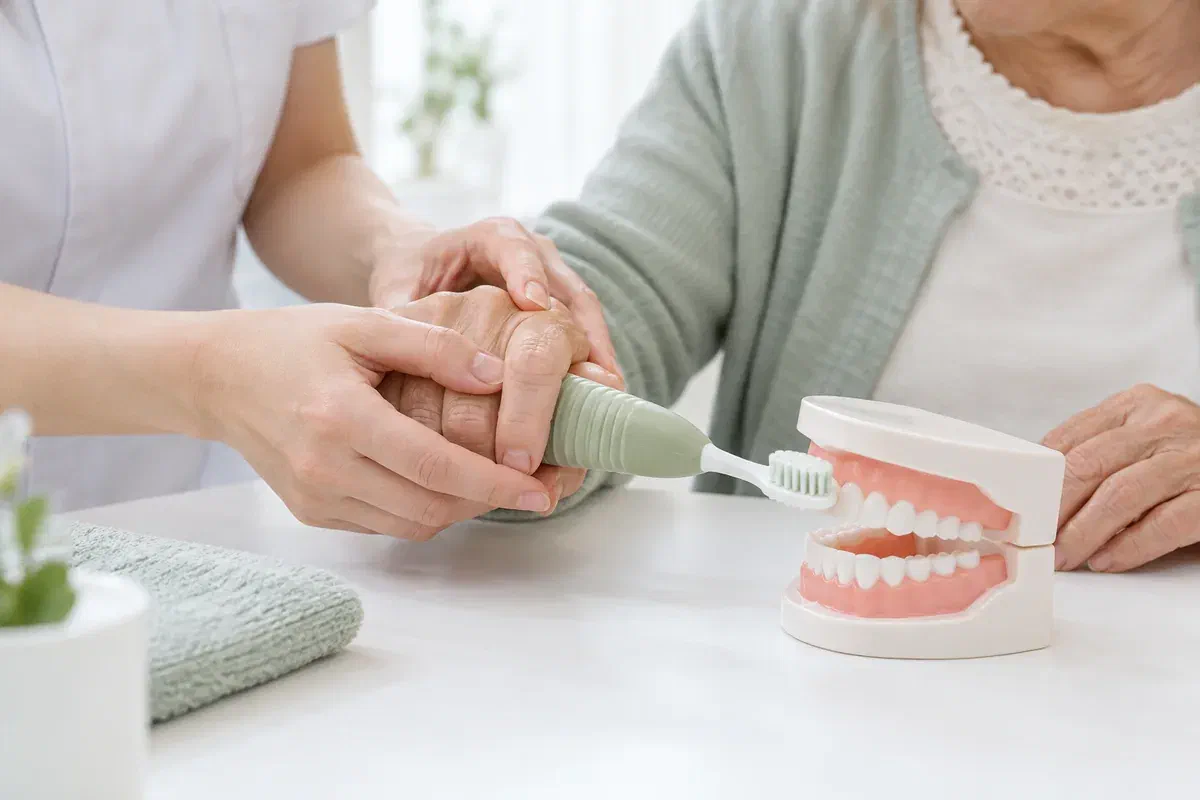
Illustrative practice with a larger toothbrush handle and a dental model
Helpful to share in advance

How does the patient prefer to be spoken to?

The same diagnosis can come with very different needs. It helps to hear what made previous medical or dental appointments easier for this person, and what made them confusing.

Language and communication style

Tell us the patient’s preferred language, any hearing or vision differences, and whether they use a device or gestures. Some need slower speech or short steps. Explain how the companion usually helps, and we will keep turning back to the patient for answers.

Moving, reclining and endurance

Describe walkers or wheelchairs, any difficulty tipping back, and how long sitting stays comfortable. Ask us to confirm what is possible rather than counting on lifting help or particular equipment. These factors can shape appointment length or the best place for care.

Changes the family has noticed

Relatives often see small shifts first: avoiding meat, bleeding when brushing, a denture left in a cup, or pulling away from the toothbrush. Share what happened and when. Such changes need assessment and should not be blamed on mood or an existing illness.

Please call about serious pain, swelling, inability to eat or drink normally, or any sudden concerning change. A familiarization visit is never a reason to put off urgent assessment.

Why the companion’s view helps

Turning instructions into something that happens at home

Advice only works if it reaches the person who brushes the teeth. A relative who helps each evening can describe which motions are hard, whether a denture is worn to bed, and when pain seems worst. That context lets our recommendations match the real household and the language in which they will be explained later.

Agree from the outset how support will be shared during the appointment. Some patients want their companion translating every sentence; others follow most of the conversation and only want help with medical terms. Mention the preference early, and know it can change from one visit to the next.

Patient information: NIDCR — oral health support and individualized care

Background in one place

A current medication list, any care instructions that bear on dental treatment and clear observations all help. Keep to accurate information and mark anything that should be confirmed with a family doctor, pharmacist or specialist.

Hands-on brushing guidance

Ask how brushing and cleaning between teeth can be adjusted for the patient’s grip and reach. An adapted handle might keep them independent; another person may need a relative to brush for them. A demonstration helps the family repeat it.

A plan everyone can explain

Decide, with the patient’s consent, who receives information and how it will be passed along. Confirm warning signs, home care and the next booking before leaving, so the instructions survive translation and memory.

What to expect

Four steps, with the patient’s voice in each

If the visit relies on communication or other support, reach out before booking. We can cover the reason for the appointment, what to bring and any needs that call for further planning.

  1. Describe the concern and the help

    Tell us what is bothering the patient’s mouth, the language and communication approach that work, and the support requested. Mention who will attend and how they will help. Share access or medical details so the setting can be thought through beforehand.

  2. Make consent clear

    Treatment options are put to the patient in terms they can follow, and the dentist uses the right consent process. Interpreting for someone does not give a relative authority to approve treatment. If a substitute decision-maker is required, that person and any paperwork must be confirmed.

  3. Check understanding as we go

    Explanations are given in plain terms, with pauses for interpretation and questions. Agree on a stop signal, raise any positioning concerns, and tell us how the patient is coping. Some first visits concentrate on assessment, with treatment scheduled later.

  4. Review the plan together

    Findings, options, fees and follow-up are discussed with the patient and any authorized support person. Ask for home-care steps to be repeated until they make sense. Agree who will book next time and how new symptoms or routine problems should be reported.

Home routines

Support that keeps independence intact

Help might be a reminder in the patient’s own language or complete brushing by a relative. Ask for advice that fits their abilities and any swallowing or positioning limits rather than a routine meant for someone else.

Explain each step

Tell them what you are about to do in words they know, and let them handle any part they can. A patient may clean the front teeth and need help further back. If care becomes painful or upsetting, stop and ask us what may be causing it.

Pick tools that fit

Ask whether a bigger grip, an electric brush or a specific aid would help. Product choice should reflect grip, coordination and safety. Avoid placing a finger where it could be bitten, and stop rather than force their mouth open.

Report specific changes

Write down bleeding, swelling, foods being refused, denture trouble or a shift in comfort during care, along with the date. Precise descriptions give the team more to work with than a general sense that the patient is resisting.

Possible arrangements

One visit, several possible shapes

What happens next depends on the dental issue and the level of help needed. Ask what can be done here safely and comfortably, and when referral to another provider would make sense.

Language and memory support

A check-up with a relative present

A relative can interpret, add history or help remember advice while the patient makes their own choices. Agree when they should speak, and whether the patient would like part of the conversation held privately.

When getting used to things helps

A gentle, staged start

Where clinically appropriate, a short introductory visit or care in stages may be discussed. Each step’s purpose and limits should be understood. Urgent problems still need prompt attention, whatever the usual pace.

When needs go beyond this office

Care with another provider

Some medical, mobility or treatment needs call for a setting with different resources. We can talk through referral and continuity of care. Family support is valuable, yet it does not change what an office is equipped to provide.

Questions families ask

Language, roles and decisions

Patients, relatives and support workers from Mississauga all ask us about preparing. What the patient wants, and the dental reason for coming, should decide how support is arranged.

(905) 876-4488
Can my son interpret for me during my dental appointment?
You can ask for a family member to help with language. Tell us when booking, and let us know if you would prefer a professional interpreter for detailed discussions. The dentist will still speak to you directly and check that your questions are answered.
Will the dentist speak to me, or only to my daughter?
To you. Your companion can help, but the conversation is about your care and your choices. If you want your daughter to take a bigger role, tell us. If you want some of the discussion to happen without her, you can ask for that too.
Can my grandchild who helps with translation make decisions about my treatment?
Not simply because they are helping you communicate. The dentist follows the proper consent process, and a substitute decision-maker is involved only where required. Let us know about any legal arrangements and ask which documents to bring.
Is written information available to take home for the family?
Ask the team at the end of the visit for the key points, including warning signs and home care. With your permission, these can be shared with the relatives who help you. Ask questions until the plan is clear to everyone involved.
What if my father stops cooperating halfway through the exam?
Let us know as soon as it happens. We will pause and talk about the safest next step, which could be a shorter assessment, another visit, different preparation or a referral. Nothing should be forced, and painful or urgent symptoms still need timely attention.
We are coming from Mississauga. How can we keep the visit efficient?
Call ahead so support and access needs are settled before the day. Bring a medication list and any recent health notes, and give us the main concern in advance. That way the appointment can focus on the patient rather than on paperwork.
From Mississauga, with support

Tell us who is coming and how they will help.

A phone call to our Bronte Street practice is the best start: tell us what is troubling the patient, which language or communication support is involved, and any access needs. Sharing this early lets us discuss the arrangements and what to bring.

Particular access or support needs should be discussed by phone. Requests made through the website are not a confirmation of equipment, transfer assistance or a time slot.

Visit Milton Dental Clinic
Unit 1, 342 Bronte St. S, Milton, ON L9T 5B7
Get directions Clinic hours
Monday–Thursday
11am–7pm
Friday–Sunday
By appointment only

Areas we serve

  • Milton
  • Oakville
  • Mississauga
  • Georgetown
  • Halton Hills
  • Acton
  • Campbellville
  • Brampton
  • Burlington
  • Puslinch
  • Rockwood
  • Erin
  • Caledon
  • Etobicoke
  • Old Milton
  • Bronte Meadows
  • Timberlea
  • Dorset Park
  • Dempsey
  • Clarke
  • Beaty
  • Coates
  • Harrison
  • Scott
  • Willmott
  • Ford
  • Bowes
  • Cobden
  • Walker
  • Mountain View
  • Milton Heights
  • Hawthorne Village
  • Valley View
  • Fallingbrook
  • Nassagaweya
  • Trafalgar
  • Esquesing
  • Nelson
  • Brookville
  • Moffat
  • Glen Williams
  • Norval
  • Limehouse
  • Stewarttown
  • Ashgrove
  • Hornby
  • Silver Creek
  • Speyside
  • Scotch Block
  • North Oakville
  • River Oaks
  • Glen Abbey
  • West Oak Trails
  • Palermo
  • Bronte Creek
  • College Park
  • Joshua Creek
  • Uptown Core
  • Preserve
  • Iroquois Ridge
  • Lisgar
  • Meadowvale
  • Meadowvale Village
  • Churchill Meadows
  • Erin Mills
  • Central Erin Mills
  • Streetsville
  • East Credit
  • Creditview
  • Heartland
  • Sheridan
  • Mount Pleasant
  • Credit Valley
  • Huttonville
  • Churchville
  • Springbrook
  • Northwest Brampton
  • Bram West
  • Fletcher's Meadow
  • Fletcher's Creek South
  • Alton Village
  • Orchard
  • Millcroft
  • Headon Forest
  • Tansley
  • Brant Hills
  • Tyandaga
  • Kilbride
  • Lowville
  • Aberfoyle
  • Morriston
  • Arkell
  • Hillsburgh
  • Freelton
  • Carlisle
  • Waterdown
  • Flamborough
  • Mountsberg

How can we help?

Milton Dental Clinic

Have a question about your smile? Choose the option that works best for you.

For urgent dental concerns, please call.
Messages are reviewed during clinic hours.